56 F
Davis

Davis, California

Friday, December 26, 2025
Home Blog Page 524

The waters beneath our feet

MICHELLE GORE / AGGIE

Studying groundwater to protect health, water needs of the future

Water has been a precious resource in California’s modern history. Many conflicts have been waged over surface water usage from lakes and dam construction on rivers, but the future of California’s water availability may be in the vast groundwater reserves found in the rocks below us.

At a recent installment of Sacramento Science Distilled, Sacramento State scientists Amelia Vankeuren and Justin Miller-Schulze spoke about their work investigating groundwater systems. Using key tracers in water, both researchers are able to understand characteristics of where the water originated from and what type of sources it has touched on its journeys.

Water from rainfall, running rivers, crop irrigation and human waste seeps through the topsoil into pores in the rocks below, where millions of gallons of water collect in aquifers.

“Our aquifers are made up of what look like essentially sand grains, all stacked on top of each other,” said Vankeuren, an assistant professor in the Department of Geology at Sacramento State. “In the Central Valley, the water is all stuck in little pores between sediments.”

Miller-Schulze tends to focus more on the human contributions to water sources, like caffeine, sucralose and antibiotics, which informs researchers that the water has been in contact with human wastewater. In 2017, Miller-Schulze and other researchers discovered elevated levels of lead in water fountains and sinks at Sac State.

“We found fairly high concentrations of lead in a lot of the drinking water on campus,” said Miller-Schulze, an assistant professor in the Department of Chemistry. “That, obviously, made people uncomfortable. The treatment, or what to do there — that’s hard to answer.”

Lead is usually not found naturally in groundwater systems. The heavy metal is introduced to water supplies by human construction projects, chiefly lead pipes and soldering. Lead causes developmental problems and neurological damage when it builds up in human bodies. Replacing lead pipes is one option to prevent exposure to leaded water at Sac State’s campus, but Miller-Schulze thinks filtering at the point of contact might be more practical.

“What we found — and I think what other people found — is that you’re not going to replace all the piping in somebody’s house, and that’s where a lot of this [lead] comes from,” Miller-Schulze said. “I think filtering at the point of use is the only option that guarantees that you’re going to clean the water as best you can.”

Vankeuren uses environmental tracers, like heavy water and tritium radiation, to determine the origins of water flowing to groundwater sources. The 2014 Sustainable Groundwater Management Act requires vulnerable basins to be brought into balance by 2040, but Californians don’t know what serves as a “normal” level of groundwater.

“We’re using environmental tracers to track the flow path and the water velocity, so we can figure out how much water is getting put into the system from the [American River],” Vankeuren said. “That may help with Sacramento County’s Groundwater Sustainability Plan, because one question is: how much recharge do we have?”

UC Davis graduate students Amy Yoder and Stephen Maples work on measuring and modeling groundwater systems in Sacramento County. By measuring how much groundwater is beneath our feet, sustainability agencies can begin to better manage the vast water reserves.

“Due to the 2014 act, Groundwater Sustainability Agencies were formed in California,” said Yoder, a masters student in the Department of Land, Air and Water Resources. “They have to design Groundwater Sustainability Plans by 2020, but in many cases, they don’t have enough groundwater data. We’re trying to increase data availability so that the public and these agencies can see what’s happening in the subsurface.”

Yoder’s work involves dropping measuring equipment into wells to measure the water levels in real-time, sending measuring data out every 15 minutes. During rainfall, levels can fluctuate dramatically, and the changes help scientists better understand the geology and hydrology of the area. Such quality data can help inform both sustainable groundwater agencies as well as researchers like Maples who create models to understand groundwater levels.

One ongoing project between Vankeuren and UC Davis professor Laura Foglia includes flooding a vineyard during the off-season when the grapevines are dormant. The water slowly flows down into the groundwater, helping to recharge the strained system. Vankeuren is sampling the water after it has reached the aquifer to determine if these recharge efforts are contaminating the groundwater with farm runoff.

“A lot of these farmers have been farming this land for many decades,” said Maples, a Ph.D. candidate in the Department of Land, Air Water Resources. “They’re applying fertilizers and pesticides, which can accumulate in the soil zone. A big question is, are you flushing these nutrients and pesticides down into the aquifer system when we do on-farm recharge?”

Groundwater research will become more important in the coming decades as scientists better understand how to measure and manage the precious Californian reserves. The goal will be to keep the water balance equal between the water flowing underground and the vast amounts being pumped to the surface for human usage.


Written by: George Ugartemendia — science@theaggie.org
Senior year bucket list

VENOOS MOSHAYEDI / AGGIE

Don’t regret missing out

Senior year… what an emotional rollercoaster of a year. Now that it’s Spring Quarter, the highs and lows of graduating are constantly on the mind. To make sure you check off everything you want to do before you leave Davis, here is a list of things to do before you graduate.

Go see a show at the Mondavi Center

The Mondavi offers a variety of shows that range from orchestral music to comedians doing stand-up.


The Davis Trinity

The Trinity consists of three drinks that should be consumed in under 90 minutes. The first drink is the Wicky Wacky Woo from Bar Bernardo; the second, the Devastator at Bistro 33 and, lastly, the FML from Red 88 Noodle bar.


Visit the animals of Davis

Go see the cows by Tercero and take a walk through the Arboretum to arrive at the Equestrian Center. Davis is known for its animals, so you should try to meet them all before you leave.


Have a picnic at the arboretum

The Arboretum is one of the campus’ defining features. The animal life, plush green fields, or picturesque nap locations are all part of the magic our school offers.


Go to Sacramento

Sacramento is only 20 minutes away and full of adventures. There are plenty of live concerts to see and easily accessible venues (like Ace of Spades and the Golden1 Center). Sacramento also offers great stores, both retail and thrift.


Bike the green belt

The green belt, located in North Davis, is basically a giant beautiful park. There are paths that run all the way through it that are great for biking, running or taking a nice stroll.


Bowling at the MU

With manageable prices, the MU has its very own bowling alley and game center that will make for a fun evening with friends.


Relax in a hammock on the quad

The hammocks are the most sought-after commodity on campus during the springtime, so it would make sense to see what all the fuss is about.


Go to the Manetti Shrem

Now that we have our own state-of-the-art museum, there’s no reason not to take advantage of it. Free for students, this is a experience worth having.


Berryessa Brewing Company

Located in Winters, this brewery boasts live music, food trucks, lots of beer and a guaranteed good time.


Napa wine tasting

Located only 40 minutes from Davis, Napa can be a much-needed escape. With wineries offering $25 tastings, Napa makes for a great day trip with a bunch of friends. Napa also offers a quaint downtown filled with shops and ice cream on every block.


Written by: CaraJoy Kleinrock — arts@theaggie.org

The most picturesque campus locations for graduation photos

SHANE COONEY / AGGIE

Capturing the end of an era

Ah Spring Quarter, it took you long enough to arrive! The Winter Quarter blues were rough, but we’ve all made it through to the end of the tunnel. The sun is shining again, the birds are chirping their melodious harmonies signaling the arrival of spring, and graduating seniors are taking their much-anticipated graduation photos. UC Davis’s beautiful campus makes it rather difficult for seniors to narrow down the top spots for graduation photos. The California Aggie has compiled a list of some of the prime campus locations that’ll guarantee that your graduation photos turn out picture-perfect.


The Arboretum and Public Garden

The Arboretum is truly a Davis classic. If you’re a UC Davis student, odds are you’ve visited the Arboretum at least once. The sunlight seeping through the trees, the glistening arboretum waters, the abundance of green fields everywhere you look — the Arboretum encompasses the beauty that is Davis. And if you’re lucky enough, you’ll be visited by some of the the famous Arboretum otters!


The Bookhead Egghead

Let’s admit it — we’ve all spent one too many late nights at Shields Library cramming for a midterm or final that we should’ve studied for weeks in advance. What better way to pay homage to those sleepless nights than to take your graduation photo with the infamous bookhead? The bookhead is one of the most popular eggheads for a reason — it is the visual representation of your years as a ‘tired college student.’


West Quad

Nothing captures the essence of the quaint city of Davis quite like bicycles do. Biking is every Davisite’s preferred mode of transportation, and at some point in your time here, you surely must have biked down that familiar path overlooking the CoHo and Wellman Hall. Did you fall victim to the infamous ‘freshman stripe’ during Davis’s intense winter rainfall? Sure. Did you get into a couple of bike accidents here and there? Guilty. Looking back on those graduation photos you took along West Quad will allow you to reminisce back on your glory days of bike fenders and bike circles.


The Jan Shrem and Maria Manetti Shrem Museum of Art

One of of the newer buildings on campus, the Manetti Shrem’s architectural excellence makes it a beautiful site for photoshoots of any kind. The museum’s exhibits, which include artwork crafted by renowned contemporary artists, portray everything that is unique about Davis. The building itself is a marvel to look at and serves as an alluring backdrop for students’ graduation photos.


The Brick UC Davis Sign

The brick sign is a go-to spot for all graduation photoshoots. It’s become somewhat of a tradition for freshman students to take end-of-the-year photos in front of the brick sign as a signification of finishing their first year at UC Davis. It is no wonder the brick sign has become such a popular destination for graduation photos — it’s a tribute to the years of opportunities, friendships and personal growth that students have experienced during their time at UC Davis, between their very first brick-sign photo to their last.


Written by: Emily Nguyen — features@theaggie.org

Administrators overrule student advisory council’s 2017 vote to reject increase in student fees

MACLEAN HARTFORD / AGGIE

Questions raised over council’s purpose, administration’s commitment to students

The Council on Student Affairs and Fees’ May 19, 2017 vote on an increase in student fees to support intercollegiate athletics ended in a tie, which, for the council, is an effective no. Then-Interim Chancellor and current Provost Ralph Hexter decided a month after the decision to provide the increase in student fees for athletics despite the council’s advice not to, raising questions on the purpose of the council and the administration’s obligation to students.

COSAF is one of 11 administrative advisory committees. Its purpose, according to its website, is to “provide a more comprehensive oversight of student fees” and “assure the highest degree of transparency and accountability regarding the use of student fees.” The council, which comprises 10 undergraduates, four graduate students, one faculty member and two staff members, passes nearly every proposal put in front of it.

Daniel Nagey, a third-year economics and psychology double major who at the time was acting as ASUCD’s appointee to COSAF and voted against the athletics measure, believes that students usually pass every proposal because the issues are complex and the students involved do not typically understand the dynamics of university politics. It is difficult, he said, for students to fully understand university budget politics in single-year terms, so many students seem to simply go along with what is said in an effort to pad their resumes and “play nice” with the administration.

Despite this, “it’s not in the chancellor’s best interest to not take [COSAF’s] recommendation,” Nagey said.

COSAF provides a student voice in the fee process, and Nagey believes that ignoring the advice of the council continuously could lead to a decrease in morale and questions of the council’s legitimacy.

Nevertheless, Hexter dismissed COSAF’s advice, announcing over a month later in an email to COSAF co-chairs Madelina Garcia and Brionda Tanner that he would be approving the fee increase for athletics, which amounts to about an $8 increase per student, or approximately $200,000 total, because of his concern “about a continued degradation of spending power” for student-athlete scholarships. These scholarships “allow teams to recruit the best student-athletes” and pay for their tuition, fees, housing and books, Hexter clarified in an email to The California Aggie. The fee increase was deemed necessary because of increases in tuition and fees.

The decision to dismiss COSAF’s advice came at a time when the council was in transition; the 2016-2017 school year was coming to a close, council members were terming out, and the university was transitioning to Gary May’s chancellorship, relieving Hexter of his powers as acting chancellor. Hexter said he made the decision based on a recommendation from the UC Office of the President and that “there was no intent to rush to make this decision before my term as interim chancellor conclude and I returned to my position as provost and executive vice chancellor.”

“I would say it was a snaky move to try to pull something like that when it’s the end of the year and you know that COSAF is transitioning,” Nagey said. “It’s a time where, if people were to find out, not a lot could happen.”

“As a student who spends hours going to these meetings, I felt unnecessary, powerless,” Nagey said. “What does this say about admin listening to students and not believing the students who pay the tuition? [The administration] is clearly not listening to the demands of students.”

Hexter, however, maintained that student input is taken seriously.

“I want to assure students that the administration does listen to the voices of students,” Hexter said in an email to The California Aggie. “Students are, however, bound to be frustrated if they expect recommendations to be taken as directives. I receive recommendations from many bodies across the university; I often agree, since those who offer advice think carefully about the matters before them, but sometimes I don’t agree and in those cases don’t follow the recommendation in every detail. In other words, one can listen and nonetheless respectfully disagree. It does not mean one has not listened, and listened carefully.”

In part, the decision to not approve the fee for athletics was due to Athletic Director Kevin Blue’s presentation, sources say. In the transcript, two voting students said the presentation was “poor,” with another expressing concern for the lack of transparency on what the money would be spent on. During the presentation, Blue also made a comment about the athletic department having to get over a financial wall akin to President Trump’s border wall, which some council members thought was made in bad taste.

“The brief comment was misunderstood by some,” Blue said in an email to The California Aggie. “It was not a joke […] nor was there any intent to be insensitive. I apologized for any misunderstanding and we moved forward fifteen months ago.”

Voting members also mentioned a “separation and a disconnect between Student Athletics and the student body.” A suggestion was made to “make athletics more palatable to the general student body.” Some of the affirmative votes on the proposal seemed reluctant but still voted yes because of the obligation that the students have to pay for intercollegiate athletics that originally stems from UC Davis’s transition from Division II to Division I.

When the university transitioned to Division I, it was agreed that the athletics department would not give preferential treatment to the more visible sports like men’s basketball and football. It also promised to not cut sports, and students at the time made an agreement with the UC Regents that the core funding for athletics would come from student fees rather than outside sources. This led to UC Davis becoming one of the largest spenders of student fees for athletics in the UC system. Students paid $562.11 in fees for the 2017-2018 school year to support scholarships for student-athletes that include out-of-state tuition and housing costs.

With nearly 28,000 undergraduates this year, the athletics department received around $15.5 million just from student fees. The athletics department’s request for more money last May raised questions of bloat in the department that follows a nationwide trend of athletics departments overspending.

Chancellor May addressed accusations of financial bloat in an email to The California Aggie. He said the athletics department pays “below the campus average” for staff positions and coaching salaries are “very modest.” The department also provides recent graduates with positions “to reduce costs and provide entry-level employment.” Daily spending and lodging are “significantly less than the allowable amounts” for the university, and the operating budget for administrative support for the department was reduced by five percent in 2018 and will further be reduced in 2019.

“I do not believe ICA [intercollegiate athletics] should be considered bloated in anyway,” May said. “I believe that ICA is stewarding its funding very conscientiously.”


Written by: Taylor LaPoint — campus@theaggie.org


53,000 UC employees to strike May 7-9

KARY HERNANDEZ / COURTESY

AFSCME 3299 authorizes strike; nurses, healthcare workers to strike in solidarity

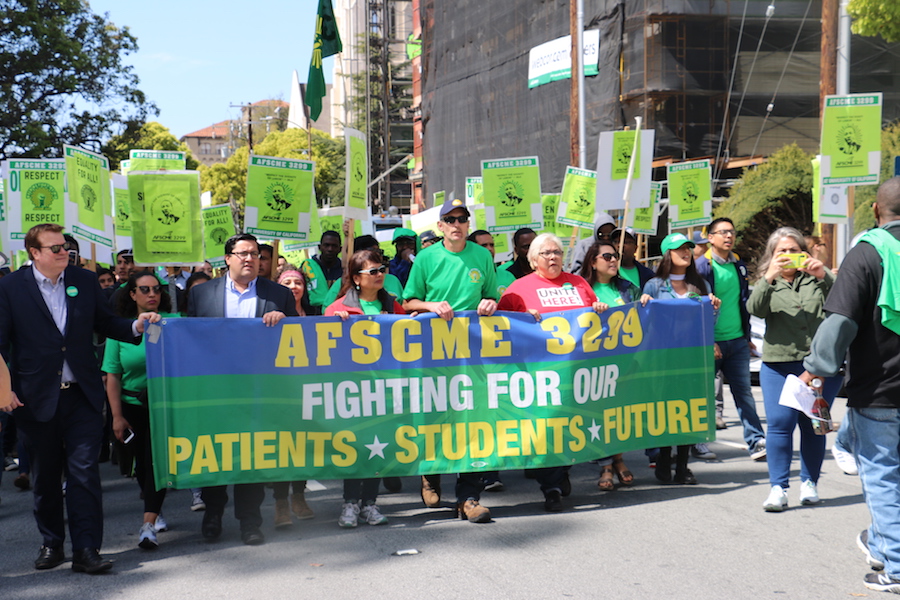
The American Federation of State, County & Municipal Employees 3299, the UC’s largest employee union, voted to enact a system-wide strike after workers rejected UC’s failure to meet demands and acceptable patient care for employees. After a year of negotiations, AFSCME members voted to authorize a strike with 97 percent support.

AFSCME represents over 25,000 employees working at all UC campuses, medical centers, clinics, research laboratories and the UC Hastings Colleges of Law. A three-day strike is planned to start on May 7.

“The May 7th-9th strike involves over 9,000 AFSCME Local 3299 represented UC Service workers, with over 15,000 AFSCME Local 3299 represented Patient Care Technical workers authorizing a sympathy strike in solidarity,” a press release from AFSCME sent to The California Aggie stated.

Recently, UC registered nurses approved a sympathy strike with a 98 percent majority. In addition to the AFSCME employees and the 14,000 nurses in the California Nurses Association, 15,000 employees from the University Professional and Technical Employees-CWA union.

“For the UC RNs this will be a sympathy strike, called in solidarity with members of AFSCME Local 3299 who are striking over their collective bargaining contract dispute with the UC administration,” a press release from the California Nurses Association sent to The Aggie stated. “A third union, University Professional & Technical Employees/CWA members at UC facilities also plan to sympathy strike.”

The Sacramento Bee estimates that over 10,000 of the 53,000 estimated employees planning to strike are employed at UC Davis.

AFSCME members were discouraged by UC’s contract offer, which would raise healthcare premiums, increase the age of retirement and flatten wages.

AFSCME Local 3299 President Kathryn Lybarger released a response to the UC’s contract offer.

“This is a full-frontal assault — not just on the collective bargaining process and the frontline workers that make the UC system run every day, but on the values that this institution is supposed to represent,” Lybarger’s statement read.

According to AFSCME, at the same time that UC fails to meet union workers’ contract needs, the UC has awarded raises to high-earning executives and increased student tuition and fees.

Recently, AFSCME commissioned a study that showed growing wage discrepancies between female and minority union workers and white men. According to the study, Black women are being paid a starting wage that is 23 percent lower than white, male coworkers. This can result in an annual income difference of up to $16,000. The article inspired AFSCME members to protest and block traffic in Westwood.

The union is calling on speakers such as Senator Kamala Harris and Congressman John Lewis — scheduled to speak at UC Berkeley and UC San Diego, respectively — to “boycott university functions.”

UC spokesperson Stephanie Beechem outlined the UC’s offer rejected by AFSCME. Along with a wage increase of 3 percent, Beechem said employees were also offered a one-time payment of $750. The statement revealed a potential increase in health care premiums, justified by UC’s proposed limit on any potential increases that may occur. In response to the strike, UC has altered their offer.

“The university is not implementing the annual 3 percent raise, the limit on health insurance premiums or the lump-sum payment from its final offer,” Beecham said via email. “Those aspects of the UC’s final settlement offer were in exchange for a multi-year contract, and we are disappointed AFSCME leaders chose to reject our settlement proposal. We strongly disagree with AFSCME’s decision to strike, which will negatively impact patients, students and the UC community.”

Oscar Rubio, the vice president of AFSCME Local 3299’s service unit, commented on UC’s response to AFSCME striking in an online statement.  

“Instead of working with us to address issues of widening inequality and outsourcing, UC’s administrators are pushing proposals that will only make things worse,” Rubio said.

A recent release from UC Davis Vice Chancellor of Finance, Operations and Administration Kelly Ratliff was sent to The California Aggie.

“I want to assure you that we have contingency plans in place and campus operations will continue during this time,” Ratliff’s statement said. “On the Davis campus, you may experience some alterations to traditional schedules, however Student Health Services will remain open as will the Veterinary Hospital, dining halls will continue operating, and custodial and maintenance services will be available. UC Davis Health will remain open, though it is possible that some scheduled appointments may be delayed if your medical team determines it is safe to do so.”


Written by: Ally Russell — campus@theaggie.org

Expanding worldviews, one summer at a time

UC DAVIS STUDY ABROAD / COURTESY

A look at new study abroad programs, process of starting them

Bhutan is said to be the happiest country in the world. Beginning this summer, students at UC Davis will have the opportunity to experience this place for themselves through a four-week study abroad program entitled Bhutan: Introduction to Geographic Information Systems.

“There’s a concept called Gross National Happiness […which] instead of measuring success on gross national product by how much economically you’re producing, Gross National Happiness is looking at a whole series of pillars on happiness including environmental well-being, psychological well-being, all those kinds of things including economic, education, all these different things,” said Karen Beardsley, the instructor of the Bhutan program and director of professional programs for Global Affairs. “It’s called GNH and you hear it everywhere and it’s taken very seriously. The Bhutanese are very proud of GNH.”

The program, Bhutan: Introduction to Geographic Information Systems, is an abroad substitute for Landscape Architecture 150: Introduction to Geographic Information Systems, a four-unit course coupled with a 198 course for four units of pass/no pass credit.

“[Bhutan] is a very special place,” Beardsley said. “There’s so much to see and do there and experience, so we’re going to break it down into a couple of long days in the computer lab, including lectures and labs, and then we’ll take a few days of field trips, visiting cultural sites and environmentally significant sites, even using geospatial technology to collect data in the field.”

In addition to the class and field trip components, Beardsley will ask her students to keep track of their time in Bhutan through individual and group journaling and story-mapping.

“Because it’s a mapping class, I’m hoping to also have the students do some keeping track of their time in Bhutan through journaling but also story-mapping, which is a way of using maps to follow along,” Beardsley said. “You can have information about where you went, collect data about different places, and have some text and photos and such associated with that. Then some of that we hope to bring back and share here in the International Center.”

The college that UC Davis students will be located abroad at, Royal Thimphu College, is located about seven miles from the center of Bhutan’s capital city of Thimphu. Beardsley noted that the country is not very populated; Thimphu itself only has a population of about 150,000, which is roughly twice the size of Davis.

“There are no stop lights in the entire country,” Beardsley said. “There is one intersection where they have what’s called ‘the dancing policeman’ at a little roundabout who directs traffic. At one point in time they put in a traffic light and everyone complained and didn’t want it so they took it back out again. [Also] the people are about almost 100% Buddhist, so there’s Buddhist temples. Basically everyone during the day wears traditional Bhutanese dress.”

Tourism is very highly regulated in the country and can be expensive, so being a study abroad student there is a unique opportunity. Students even have the chance to be part of a mentor program.

“For every three or four UC Davis students, there will be a Bhutanese student who will be there to really be their liaison, to show them around, to take them to town, to be their person who can help, and also teach them a little bit of [the native language] Dzongkha,” Beardsley said.

The idea for this program came about after Beardsley experienced Bhutan as a Fulbright professor. Between the summers of 2015 and 2016, Beardsley lived and taught in Bhutan on this teaching fellowship and helped set up the GIS lab at the Royal Thimphu College.

“While I was there and I noticed all these other exchange programs that they had,” Beardsley said. “I thought, ‘what a wonderful experience for a student to come to Bhutan and have this international experience.’ It’s just such an interesting culture, a safe place, there’s just so much about it that made me think ‘oh if I were a student I would really want to come here.’”

However, it wasn’t a quick process for Beardsley to get this program up and running. Although she originally wanted to run it in the summer of 2017, all the loose ends were not tied up until this year because UC Davis Study Abroad requires a specific application process of faculty and program-leaders.

“The concept is that a faculty member takes a program that they teach on campus, or a class that they teach on campus and just teach it abroad with amazing field trips,” said Jennifer Moylan, a program coordinator and advisor for UC Davis Study Abroad. “All summer abroad programs are built around eight units of one core course like the LDA 150 and then a 198, which is four units of pass/no pass. So because we’re drawing from our faculty, different people come with all kinds of different knowledge.”

Study Abroad offers the opportunity to develop new programs every year when they release a call for proposals in the winter. Sometimes the solicitation may be looking for a few specific traits in a program, but it is always open to fun and unique ideas. This year, UC Davis Study Abroad held two information sessions for faculty to come and ask questions that would help them create a stronger and more thorough proposal.

In the early stages of this process, when the initial proposals are submitted, the program committee looks them over and provides feedback. When this is done, Aliki Dragona, who is the faculty director of faculty-led programs, writes up an executive summary and gives it to Joanna Regulska, the vice provost and associate chancellor of Global Affairs, to get her feedback as well.

“We say on the proposal call that we will respond to our faculty proposals by a certain date (in 2018, it is May first) and then if a proposal is accepted for development, we work with that faculty to build their program,” Dragona said in an email. ”Sometimes faculty have figured out everything in their proposal: their partner, the dorms, whatnot. But sometimes faculty might need a little help, in which case we say ‘if you need a little bit of help with France, let us connect you with Jennie, who is our France specialist’ and that’s how we help our faculty move forward from the proposal phase to actual program development.”

“Each faculty member [whose proposal is greenlighted] gets paired with a program coordinator,” Moylan said. “I coordinate right now about ten programs, so I’m working with a faculty member to deeply understand how their course is going to work abroad, what they need for success, what the place they’re going to has for resources and how we need to shore it up.”

For Melissa Bender, a continuing lecturer in the University Writing Program and the assistant director for writing across the curriculum, the process from beginning to end for her new study abroad program took nearly three years.

Beyond getting everything figured out for the program, there’s the added work of having to advertise for the new program so students know about it and will enroll. Bender’s program, Iconic American Landmarks in NYC and Washington, D.C., has about 10 people currently signed up for this summer’s first trip.

“After it gets approved you start promoting the class the fall before it’s going to run,” Bender said. “Especially for a new course, you have to do a lot of going around and talking to students about what the course is. I did a lot of class visits.”

The program will take its students to Washington, D.C. where the group will tour famous landmarks and monuments like those at the Washington Mall, as well as New York City, where students will visit places like the Statue of Liberty and the 9/11 Memorial.

“This class will be studying the buildings, structures, public spaces that we associate with those two cities, through a rhetorical framework,” Bender said. “The question that will be driving the class is ‘how do these landmarks of these two cities have an impact in how we understand what the United States is as a nation?’”

Although she couldn’t foresee what would take place at the initial conception of this program a couple years ago, Bender believes that now is a great time to run a program like this due to the events in Charlottesville last summer around the removal of Confederate monuments.

“I’m really excited about the class and think that the timing turned out to be really good in terms of that,” Bender said. “I think it’s a really important time in our nation to be thinking about what these monuments mean to us and why perhaps some people have such strong reactions, as we’ve seen in places like Charlottesville and New Orleans.”

Bender’s program is a study abroad opportunity that is actually not abroad. Having done some programs in Europe, Bender knew that she enjoyed this kind of work. So when Study Abroad was thinking about running some domestic programs, she thought it would be a great opportunity for international students at UC Davis.

“While [international students are] here they may want to see other parts of the United States, and New York and Washington DC are pretty high on foreigners’ lists when they come to the U.S. for travel,” Bender said. “It seemed like a really good opportunity, and I knew it’s pretty easy to get between the two cities, so I got into conversation with a few of the folks over at study abroad and ran the idea past them and they gave me the thumbs up, so then I wrote the proposal.”

Study Abroad offers many opportunities for its students to have life-changing experiences and is always open to introducing new and exciting programs and concepts. Whether it’s visiting the mountains and forests of Bhutan or experiencing the cosmopolitan east coast of the United States, there are plenty of ways students can get out and see the world while studying at UC Davis.

“There was recently some research out that talked about that people who have gone abroad have a really strong sense of self,” Moylan said. “I think that’s because when we’re in our own society, part of what we do is because of our own selves, and part of it is because of everyone’s expectations on us, and then when you go abroad there are new expectations on you which you can feel, but you can also feel the expectations of your home place fall away.”


Written by: Marlys Jeane — features@theaggie.org

PLASMA at UC Davis celebrates first year with Demo Day

UC PLASMA TEAM / COURTESY

Entrepreneurship program culminated 12-week program with event for companies, investors

Curing breast cancer, keeping Unitrans buses clean and coaching athletes online — all of these services have a few things in common. Namely, they are startups created by UC Davis alumni and are supported by PLASMA.

PLASMA at UC Davis is a new accelerated program for entrepreneurs. Accelerator programs are used by startups to get ahead in the world of business and receive advice from mentors.

As an undergraduate at UC Davis, Mathew Magno and a team of students created a business called Japa in order to manage parking lots better. For certain parking lots, such as some here at UC Davis, the accompanying Japa app shows drivers where open spots are.

“There was an old accelerator program here called the ASUCD Entrepreneurship,” said Magno, a PLASMA founder. “Right after Japa got started, we were like ok, let’s join this accelerator program because it’s supposed to accelerate you and, you know, [be] business ready. And we tried it and it was horrible.”

Since Magno didn’t like the accelerator program at UC Davis, his company applied and went through an online one called Y Combinator. Magno said that the program was an amazing experience and he was inspired to start one at UC Davis that would be better.

“PLASMA stands for prototyping labs and startup mentorship accelerator,” Magno said. “So what we do is we take people with companies or ideas or startups and we mentor them for 12 weeks. Every week we bring in a mentor from the industry, whether it’s a CEO that’s launched a couple companies, or a venture capitalist or you know, we have lawyers and patent attorneys come in. And we guide them every week to keep them progressing with their company.”

To apply to PLASMA, companies have to go through a rigorous process. Judges review all applications and send a selected 15 applications to board members. These are limited down to only 10 companies. Any idea in any stage of development is welcome to apply. The accepted companies are given seed money in addition to access to mentors from the field.

“It’s a balance,” said Angelika Joseph, a PLASMA board member. “It’s a big problem for venture portfolios because there’s a lot where you understand that most of the startups you invest in probably won’t make it to the Facebook level where they’re more than a billion dollars, very few do.”

Magno, Ravi Chopra and Liz Tang are the founders of PLASMA. Chopra credited the success of the program to Tang, a faculty member of UC Davis. Tang teaches classes on the topic of entrepreneurship and Chopra believes she is the reason the PLASMA will continue to be successful in the future.

“I see big things for PLASMA,” Magno said. “I see it becoming so big that it’s going to bring a community of entrepreneurs to Davis and build and grow that community…I feel like PLASMA is going to help that and motivate people to actually start their ideas and build a company and build great products that, you know, will help innovate and change the world.”

PLASMA accepts applications from any company, no matter what their focus may be. The mentoring lasts for 12 weeks and at the end of that, there is an event called Demo Day. This year, Demo Day was on April 28 and the companies that went through the PLASMA program gave three-minute pitches to investors and judges. Judges awarded the startups a number of monetary prizes.

This year, Demo Day saw more than $10,000 awarded to companies started by UC Davis alumni. $5,000 was given to JB Solutions for ideas on collecting data on groundwater systems. An app for Chinese international students, called Xiaocun, received $3,000. The innovation that helps keep Unitrans clean was created by Whitecell Technologies. It won $2,000 for an antimicrobial handle, which prevents germs from spreading on public transportation.

The other companies that were a part of PLASMA can keep their seed money and still gained the experience of talking to professionals in business. Others who did not get into PLASMA or other accelerated programs should not view their rejection as a total failure, according to Joseph.

“Ask why [you did not get in],” Joseph said. “And then listen to the answer…And it’s because they’re [the company] not quite there for whatever reason but that doesn’t mean they aren’t getting it there […] No shouldn’t be no. It should be an encouraging thing.”

Magno suggested that students interested in creating their own startups visit the Student Startup Center in Bainer Hall. Other events, such as Create-a-Thon, Shopbot classes and 3D printing classes can help support alumni looking for ways to create their own business.

“We are the future,” Magno said. “Why not start now and guide people to do the right thing?”


Written by: Rachel Paul — science@theaggie.org

UC Davis Health Campus announced as site for Aggie Square

CHRISTIE NEO / AGGIE

Released assessment of other sites in consideration discuss demographic disparities university, city project aims to address

Chancellor Gary May and Sacramento Mayor Darrell Steinberg held a news conference in Sacramento on April 12 to announce the UC Davis Health Center as the site for the project Aggie Square.

Aggie Square is a prospective extension of UC Davis as a campus for graduate, undergraduate students and faculty to live in, pursue research or secure internships. Partnerships with private or public companies are meant to introduce restaurants or retail into the square to create a learning-centered community.

The UC Davis Health Center, located in Sacramento, was one of four sites considered by a working group of representatives from UC Davis and the city.

Representing UC Davis were Vice Chancellor of Finance, Operations and Administration Kelly Ratliff; Associate Vice Chancellor of Campus Planning and Environmental Stewardship Robert Segar; Interim Vice Chancellor of the Office of Research Cameron Carter; Academic Senate Chair Rachael Goodhue; Academic Senate Vice Chair Kristin Lagattuta and Associative Chancellor and Chief of Staff to the Chancellor Karl Engelbach.

Other potential sites were the Railyards, recycled land projects in Sacramento, the Sacramento Center for Innovation and North Natomas.

The finalization of the site falls under the first phase of the planning of Aggie Square. The first phase also involves looking for relationships between UC Davis and entities in Sacramento that can provide future funding.

“There is much planning to be done,” said UC Davis spokesperson Kimberly Hale. “The university and city will be looking at public-private partnerships, consultations with community, business and other leaders on the composition of Aggie Square.”

The next phase in planning is deciding what kind of academic programs will be available for students at the Square. These programs, according to Chief Marketing and Communications Officer Dana Topousis, will be decided based on recommendations by Davis faculty.

“Some students might choose to live there, as well, if they’re interested in having a more urban experience,” Topousis said. “Some people come to UC Davis and are glad that Sacramento is where it is. You can have that urban experience and so if they want to live in Sacramento, this is an option.”

Louis Stewart, chief innovation officer within the mayor of Sacramento’s Office of Innovation and Entrepreneurship, explained the next steps for the planning of Aggie Square, which involves the acquisition of funds to develop academic programs and construction.

The two teams from Sacramento and UC Davis “will get back together” and “bring in a few other stakeholders to really start sussing out next steps,” Steward said.

“But the first step, really, is working with Assemblymember McCarty to support his efforts to get two million dollars to research what’s next,” Stewart said.

Also announced at the Sacramento news conference was the report from the working group researching potential sites. The report discussed positive characteristics for each site as well as points of interest within Sacramento demographics that a relationship with UC Davis would address.

The report referenced an assessment of Sacramento’s economy conducted in February by the Brookings Metropolitan Policy Program that revealed “alarming trends.”

Sacramento ranks “84th of the 100 largest metros for inclusion, factoring in employment rate, median wage, and relative poverty rate,” and “47% of Black residents and 42% of the Hispanic residents are described as struggling.”

“UC Davis provides a solution to these economic trends,” the assessment stated.

“Aggie Square provides the opportunity to align university strengths and ambitions with the needs of the market, allowing Sacramento leaders to better support the university, sector growth and job creation,” the working group report said. “These jobs, which generate more economic impacts and create additional downstream jobs, will provide economic opportunity for struggling residents across demographics.”

There is no expected date of completion for Aggie Square. Topousis referenced a similar extension campus project headed by Chancellor May in his previous position at Georgia Tech that took approximately 10 years to construct and finalize. A similar period is expected for Aggie Square as well.


Written by: Elizabeth Mercado — campus@theaggie.org


Before Seeing “Avengers: Infinity War”: Everything You Need to Know

CAITLYN SAMPLEY / AGGIE

A Brief Recap of the MCU

Ever since the inception of the Marvel Cinematic Universe in 2008, with the launch of the its cornerstone film, “Iron Man,” every film in the MCU — 18 of them to be exact — has been leading up to this moment. In what’s said to be the largest and most epic franchise collaboration in the history of film itself, “Avengers: Infinity War” is expected to feature up to 76 main characters, uniting Earth’s mightiest heroes in a way audiences have never seen before. “Avengers: Infinity War” will bring together years and years of story preparation by Marvel execs, all in anticipation of a culminating final act to come in the fourth installment of the “Avengers” series in 2019.

But before venturing to the theater to embark upon the 160-minute whirlwind that is “Avengers: Infinity War,” preparation is the key to experiencing the massive scope of this film in the way it was intended. So, whether you’ve never seen a comic book movie in your life or you’re a complete Marvel junkie looking to binge a movie marathon before “Infinity War,” here’s everything you need to know prior to the film.


Who is Thanos?

Ah, yes, Thanos. A warlord from the planet Titan, the strongest and most fearsome villain the Avengers have faced to date, and possibly the most powerful being in the universe. Quite literally, Thanos wishes to destroy the world, or at the very least, reshape it to meet the standards of his own vision. He’s ruthless, relentless and takes pleasure in the destruction of the galaxy around him while on his quest for power. But in order to achieve his goal, he first must acquire all of the Infinity Stones, and then exterminate the very thing standing in his way — the Avengers.

Audiences first meet Thanos (played by Josh Brolin) in “The Avengers” (2012), as a mysteriously powerful being with an alien army at his beck and call. Later on, in a post-credits scene, we meet Thanos again as a large, looming purple figure with a sinister smile. That can’t be good, right? Fast forward to “Guardians of the Galaxy” (2014), in which we get to know Thanos on a more personal level, and “Avengers: Age of Ultron,” where Thanos states he’ll “do it [him]self,” vowing to collect the Infinity Stones and destroy Earth of his own accord.

But wait, what are the Infinity Stones?

“Before creation itself, there were six singularities. Then the universe exploded into existence, and the remnants of these systems were forged into concentrated ingots… Infinity Stones,” says The Collector in “Guardians of the Galaxy” (2014).

In a nutshell, the Infinity Stones lie at the heart of all that is corruption, evil and power in the Marvel Cinematic Universe. Countless times in the past, villainous figures have managed to get their hands on one of these Stones, launching them into a power-hungry rage to take over the planet and destroy the Avengers. As stated by The Collector (played by Benicio del Toro) in the quote above, there were six singularities, and thus there are six Infinity Stones. There’s the blue Space Stone, the red Reality Stone, the purple Power Stone, the yellow Mind Stone, the green Time Stone and the orange Soul Stone. The blue Space Stone, more commonly known as the Tesseract, currently resides with Loki (played by Tom Hiddleston), who presumably took the stone from Asgard at the end of “Thor: Ragnarok.” The yellow Mind Stone exists as part of Vision (played by Paul Bettany), embedded into his forehead and supplying him with his supernatural abilities. Additionally, Doctor Strange (played by Benedict Cumberbatch) manipulates the Time Stone, The Collector holds the Reality Stone and the Nova Corps protect the Power Stone — that is, after Star Lord (played by Chris Pratt) recovered it in “Guardians of the Galaxy.”


So, where did the Avengers last leave off?

To say the least, prior to the start of “Infinity War,” the Avengers could be better. We last saw the beloved First Avenger, Captain America (played by Chris Evans), in “Captain America: Civil War,” in which the Avengers battled it out, not only leaving the team itself divided and on the run but also leaving the relationship between Tony Stark (Iron Man) and Steve Rogers (Captain America) rocky. Additionally, audiences last saw Stark (played by Robert Downey Jr.) in “Spider-Man: Homecoming,” in which he offered the teenage webslinger (played by Tom Holland) a spot in the Avengers squad. Thor (played by Chris Hemsworth) and Bruce Banner (played by Mark Ruffalo), also known as The Hulk, have just recently escaped a demolished Asgard, aboard a ship with none other than the Guardians of the Galaxy. Lastly, Marvel’s most recent release, “Black Panther,” leaves the country of Wakanda ready to open its doors up to the rest of the world.

If you’re looking to get a firmer grasp on the history of the MCU before “Infinity War,” rather than slugging through all 18 films, here are six essential movie recommendations to watch in preparation: “The Avengers,” “Avengers: Age of Ultron,” “Guardians of the Galaxy,” “Captain America: Civil War,” “Thor Ragnarok” and “Black Panther.” Honorable mentions go out to “Captain America: The First Avenger,” “Thor: The Dark World” and “Doctor Strange” as films that introduce different Infinity Stones into the universe.


Written by: Sydney Odman — arts@theaggie.org


EPA no longer stands for environmental justice

CAITLYN SAMPLEY / AGGIE

California, other states sue Environmental Protection Agency

California was among 16 other states and the District of Columbia to sue the Environmental Protection Agency on Tuesday, May 1 for its weakened auto emission standards. Rather than raising the standards for greenhouse gas emissions that threaten our environment, these standards are instead being lowered for cars and light trucks of model years 2022-2025. Behind this decision was none other than EPA Administrator Scott Pruitt, who has been called “Outlaw Pruitt” by California Governor Jerry Brown.

According to The New Yorker, in Pruitt’s first year of working as administrator for the EPA, he “proposed repealing or delaying more than thirty significant environmental rules.” When the White House intended to cut the EPA’s annual budget by 25 percent, Pruitt made no objection.

The 1970 Clean Air Act clearly states that its purpose is to “protect public health and public welfare and to regulate emissions of hazardous air pollutants.” Under the Obama Administration, California was also granted a waiver, which allowed the state to set its own emission limits, raise their standards and produce more fuel-efficient cars. Pruitt, however, disagreed with the Obama Administration, claiming in an EPA news release that “Cooperative federalism doesn’t mean that one state can dictate standards for the rest of the country. EPA will set a national standard for greenhouse gas emissions that allows auto manufacturers to make cars that people both want and can afford — while still expanding environmental and safety benefits of newer cars.”

Pruitt went on to explain that it’s in “America’s best interest” to set a national standard for auto emissions, essentially undermining state-given powers. Pruitt continues to use his position as a Republican politician and the administrator of the EPA to feed into President Donald Trump’s blatant disregard for global warming science, undermining everything the EPA stands for.

The Department of Transportation plans to propose freezing fuel economy standards at the model year 2020 levels, which would essentially allow the EPA to lower the greenhouse gas standard and prevent California from imposing its own, higher standards. According to the California Greenhouse Gas Inventory for 2000-2015, over a third of California’s greenhouse gases are emitted from transportation alone. In order to combat this, the standards set by the Obama Administration required the average gas mileage for all cars and light trucks by 2025 to reach 50 miles per gallon. Pruitt, however, claimed that this would increase car costs for consumers.

But what Pruitt failed to take into consideration is that weakening auto emission standards would pose a negative externality on the environment. Brown and California Attorney General Xavier Becerra both expressed their frustration with Pruitt’s decision for the EPA, stating that California was ready to fight if it came down to it. Even executives at various auto companies — including General Motors, Ford and Honda — are questioning the EPA’s decision, stating that they are in support of increasing clean car standards.

Pruitt’s claims are inadequate at best. Our political system favors those who abuse their power and are ill-informed of the statistics and science behind the claims they make. The Editorial Board urges California and the other states suing the EPA to stand their ground against Pruitt and the Trump Administration. Despite what some naive politicians claim, climate change is a real and catastrophic issue that we will continue to face if no positive adjustments are made — and soon.


Written by: The Editorial Board 

Construction underway at Schaal Aquatic Center

ALEXA FONTANILLA / AGGIE

UC Davis to enhance Aquatic Center to include new team center, coaches offices, conference room, renovated swimming lanes

On arguably UC Davis’ biggest day of the year, Picnic Day, a ceremony was held at the Schaal Aquatics Center to celebrate construction taking place to enhance the facilities. Along with renovations to lap lanes are the addition of a new conference room, coaching offices and a team center for all UC Davis aquatic teams.

Currently, the coaching offices for men’s and women’s water polo teams, as well as the swim and dive teams are located in the Cowell Building on campus, which is on the other side of the UC Davis campus in relation to Schaal. Coaches are excited for the renovations and the impact it will have in improved coaching methods.

“I think it’s great that we are going to be able to have our offices on the pool,” said Child and Meisel Families Director of men’s water polo and head coach Daniel Leyson. “I think it is going to help our student-athletes so much in that they have to move around so much from place to place [on campus], so if I want to meet with my players, we are at the pool already so we are saving time in that way. I think it will be great in terms of making life easier for the players, and I am all for that.”

The funding for the new multimillion-dollar facility has been stimulated by the contributions of alumni and friends of UC Davis aquatic sports. Cathy and Jack Raycraft and David Hodgens and Linda Olson are responsible for the two biggest donations for the new construction project. Christi Raycraft, a former women’s water polo star at UC Davis and daughter of Cathy and Jack, is currently ranked fourth in the Cal Aggie Athletics Hall of Fame for school career goals. Tiffany Hodgens, another former Aggie women’s water polo player and daughter of David and Linda, ranks first in the same Hall of Fame for school career goals scored.

All coaches are very excited for the new building and are very thankful to the donors that gave money to help make construction possible.

“In terms of the new construction I think it is really exciting for the aquatic center to have a new building,” Leyson said. “We were one of the few departments in athletics that is having new construction and that shows a tremendous commitment of generosity from the people who donated money to make this project happen.”

As a thank you and a recognition for all of the various donors contributing to the $1,000 raised for the team center, a Donor Wall of Honor will be located at the entry of the team room.

“It’s going to change the dynamics of everything in a really positive way,” said women’s water polo head coach Jamey Wright. “The coaches and the players will be able to interact so much more often because the offices are right here [at the pool]. The athletes within teams can hang out and talk and interact with each other rather than just going their separate ways, as well as interactions within different teams, as well as the opportunity to set things up like tutors, etc.”

The project is expected to be completed in the winter of 2019, and full details of the project, as well as funding, can be found here.

“I just think it is gonna be fabulous and change the positive dynamics of how players and coaches and players and players interact,” Wright said.


Written by: Ryan Bugsch — sports@theaggie.org

Picnic Day Culture

DIANA LI / AGGIE

Students share how they spent Picnic Day 104

Picnic Day, Picnic Day, Picnic Day. Such a celebrated event is almost all that’s heard about for the first few weeks of Spring Quarter. Why the buzz? Is it the parades, battle of the bands, the food, the streets of rowdy college students? Something about Picnic Day brings Davis, both the college and the city, alive. In a pursuit to find this day’s magic, The Aggie consulted students about their Picnic-y activities, possibly determined by their social homes.  

Kendall Owens, a third-year English major, mentioned that he found friends in his department.

“Home would be the English department for me,” Owens said. “Right now the English department is a good resource for me, where all my friends are.”

Maura Willow, a second-year English and psychology double major, found home elsewhere.

“I’m part of the band, alto section,” Willow said.

Jackie Geyfen, a second-year neurobiology, physiology and behavior major, enjoyed spending time with her Greek organization.

“I’m in a sorority,” Geyfen said. “I guess that would be my group.”

Owens is a third-year transfer and so had not experienced Picnic Day until this year. He mentioned that the day’s reputation preceded itself.

“My expectations were definitely met,” Owens said. “It was accurate to what people had to described it to me: perfect weather, lot of different activities to go to, lot of people.”

Willow said this year, for her, was much more restful.

“I marched [in] the parade last year,” Willow said. “Something that not a lot of people know about band is we start at 4 a.m. on Picnic Day. We have a freshman rally at 4 a.m. and we keep going until 10 p.m., when we have battle of the bands… This year I did six hours of battle; that was the only thing I did.”

Geyfen enjoyed this year more than the first due to good friends.

“It was a lot better,” Geyfen said. “Last year I was super confused on where to go and how everything was going to work… This year I met so many more people, so I felt a lot more comfortable this Picnic Day, like I knew what to expect.”

While the whole town shows up, not everyone rises in sync.

“I woke up at 5:30 a.m. and started at 6:00 a.m.,” Owens said. “Close friends, definitely. At my friend’s house, we gathered around and had motivational speeches.”

Geyfen said her day started similarly.

“Our morning started to waking up with [a good friend] in my bed at 6:30 a.m.,” Geyfen said. “We got ready, and around 7:15 a.m. we headed to our first pre-game and the day started there.”

Willow, on the other hand, enjoyed sleeping in.

“My parents came this year, so I woke up at like 9 a.m.,” Willow said. “We saw the campus for the first time during Picnic Day.”

Throughout the day, Davis is pumped with energy, leaving both campus and the city stuffed with fun. Owens spoke about his trip to campus.

“[I was on campus] only for a little bit,” Owens said. “I saw a little bit of the band play, and I saw some type of race.”

Willow showed her parents around.

“My parents are really into [agriculture] stuff,” Willow said. “We milked the cows and looked at the horses or whatever, so that was definitely most of our day.”

But every early start has to slow down eventually.

“Definitely power napped,” Owens said. “I got a two-hour power nap in, from about 3 to 5, so that one definitely came in handy.”

For some, once the engines slow, it’s hard to get the wheels turning again.

“So around 1 or 1:30 we took a nap,” Geyfen said. “I think the goal was to power nap and go back out, but then we couldn’t do it. We power napped, woke up, then went back to bed.”

While more of Davis is awake during the day, its doesn’t stop people from enjoying the night.

“I made it till 2 a.m.,” Owens said.

Willow raised the bar.

“I think I got home at 4 a.m.,” she said.

Whether one slept in until noon or pulled an all-nighter, most of Davis enjoys Picnic Day — that’s the real charm of it. Geyfen put it best.

“I kinda like that every person on campus is doing their own thing,” Geyfen said. “I know there’s a lot going on [on campus], families go there, academic professors and teachers, and all that show off their work, which is cool. And then [students], kind of do our own thing. We go party to party, which is fun for us… I kind of like how everyone comes together in their own way.”

In a cheesy way, the reason Picnic Day might be so popping with smiles is simply because the city and campus get together for no other reason than to have a good time. All day can be spent eating on campus, watching the dog races, jumping parties or in bed — regardless, laughs will sound. In the spring sun with hints of summer, it’s hard not to get together with close friends or family for a good time.


Written by: Nicolas Rago — arts@theaggie.org

Experiencing spring allergies? Regional agriculture may be to blame

JULI PEREZ / AGGIE

Davis is a particularly problematic region for those with seasonal allergies, hay fever

Gesundheit! Spring Quarter is in full swing and the orchestra of sneezes and sniffles resonates with the UC Davis students and faculty. With campus centrally located in a dense agricultural area, the climate can prove problematic for those with seasonal allergies and can have a significant impact on their daily lives.

“I have allergies year-round, but they definitely get worse when spring rolls around,” said Teagan Ferdinandsen, a third-year civil and environmental engineering major. “I sneeze all day long. I wake up in the mornings with a really sore throat from post-nasal drip, so I Neti Pot twice a day and I take Zyrtec every day and Flonase because it’s the only thing that really helps.”

Seasonal allergies, otherwise known as hay fever, are primarily caused by the release of pollens into the atmosphere by certain trees, grasses and various plants.

“Normally, people breathe in these substances, such as pollen, without a problem,” said Dr. Cindy Schorzman, the medical director of the UC Davis Student Health and Counseling Services. “When a person has seasonal allergies, his or her immune system acts as if the substance is harmful to the body, and that causes symptoms. When someone who is allergic breathes in pollen, for example, the immune system mistakenly sees this pollen as dangerous and releases antibodies that attack the allergens. Part of this antibody response causes the release of histamines into the bloodstream. It is these histamines that trigger the runny nose and other symptoms associated with allergies.”

The severity of one’s allergy symptoms depend on the amount of exposure to particular triggers, such as pollen count, amount of time spent outdoors, wind speed and wind direction. Plants pollinate year-round, though spring allergies are particularly nasty for those sensitive to tree pollens.

“Davis tends to be a problematic area to live in for a lot of people with allergies and a big contributor to that is the agriculture and the prevalence of the plants that produce allergens such as pollen,” Schorzman said. “Tree pollen in particular tends to be high in the spring, it’s not just pollen that people are reacting to, but certainly that is a big contributor.”

According to pollen.com, a trusted allergy tracking and information website recommended by Schorzman, trees such as elm, pine, birch, ash, hickory, poplar and cypress pollinate between January and April.

“Pollen can travel quite far by wind, so it doesn’t tend to be incredibly localized,” Schorzman said. “Wind plays a big factor. It’s a combination of wind, temperature, how recently it has rained and a big part of it is what is blooming.”

According to a study done by the Environ Health Perspect, across the country there has been an increase in the number of people experiencing allergies and in the breadth of allergy triggers. This study outlines that climate change and the increased amount of CO2 in the air is to blame, causing plants to grow at increased rates, thus producing more pollen.

“I’m from Fresno, which has horrible air quality. Davis is actually an improvement,” Ferdinandsen said. “Fresno has some of the worst air quality in the United States. Living there is like being a smoker.”

Ferdinandsen is not alone. Soha Said, a third year human development major, also experiences severe seasonal allergies.

“I found out I was extremely allergic to every type of grass, two types of trees, two types of weeds,” Said said. “So I’m really allergic to a lot of things, especially here in Davis because of the pollen. I lived in the Bay Area growing up, and it was never this bad.”

Coastal areas generally tend to have lower pollen counts as a result of ocean breezes.

“There was a long period of time during my freshman year where I would get a sinus infection every month,” Said said. “I would be put on a Z-Pak, or Zithromax, every month. And it got to the point where I had to start getting allergy shots.”

Allergy shots, or immunotherapy, can serve as long-term solutions for severe cases of seasonal allergies. This process of injecting allergens under the skin is called desensitization.

“What they do with allergy shots is you go through allergy testing, often a skin test but sometimes they will do a blood test, and they will test common allergens and see what exactly an individual is reacting to,” Schorzman said. “Once they know what that individual person’s main allergens are, then they will make a shot containing very small doses of what they are allergic to.”

Desensitization is an individualized process specific to one’s triggers. Allergy shots relieve symptoms by stimulating the immune system and building a tolerance to particular allergens.

“Then those doses will gradually increase over time and the idea behind that is to alter that person’s antibody response so that they aren’t reacting so strongly to those allergens,” Schorzman said.

There are several recommended home remedies and proactive measures that can be taken to alleviate symptoms.

“The main things we recommend in terms of home remedies are allergy reduction and avoidance,” Schorzman said. “Closing the windows on high pollen days and running the AC, when you come in from working or being outside removing clothes that have been exposed, showering and washing your hair, all of those can aid in allergy exposure reduction.”

Symptoms range from sneezing and itchy eyes to the more severe swelling and restricted airways experienced by Said and Ferdinandsen. All allergy-afflicted students can find relief at the Student Health and Wellness Center.

“All of our primary care providers see seasonal allergies often, especially in the spring, so [they] are comfortable with helping students with the initial prescription of medications,” Schorzman said.

Even if someone hasn’t experienced seasonal allergies prior to attending UC Davis, due to the high pollen count in this rich agricultural area, one might find themselves at the door of the Student Health and Wellness Center, begging for relief.


Written by: Grace Simmons — features@theaggie.org

Downtown Plan Advisory Committee team holds public workshop

KAILA MATTERA / AGGIE

Workshop aims to get community involved in planning of downtown

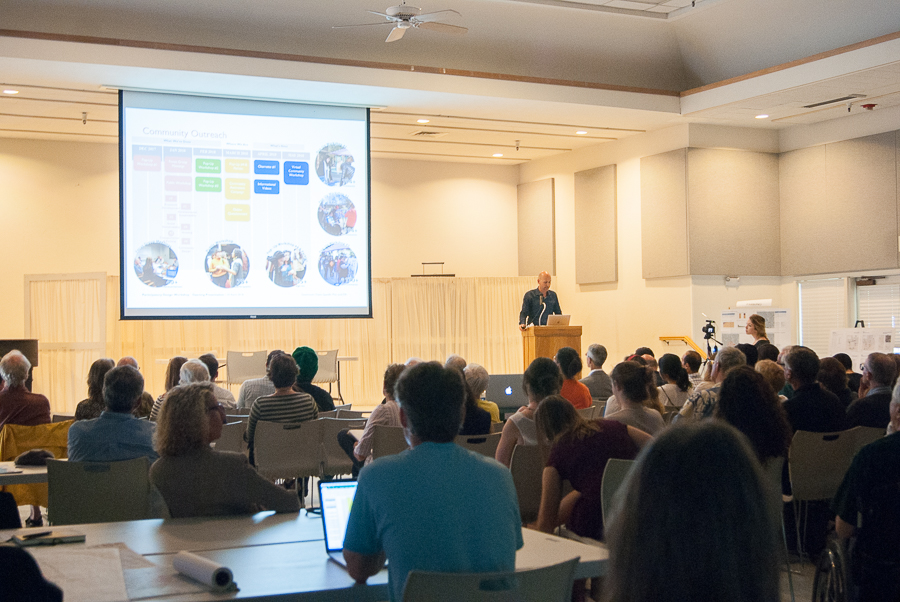
From April 24 to 27, the Davis Downtown Plan Advisory Committee held a participatory workshop where members of the Davis community had the opportunity to give their input on the future of downtown Davis. For four days, the DPAC was stationed in the Davis Community Church, where Davis residents could walk in and look at the current plans for the future of downtown.

The DPAC is one of the branches of Davis’ Core Area Specific Plan, also known as the Downtown Davis Plan. The committee was hired by the city of Davis to rewrite the zoning regulations. According to Daniel Parolek, a DPAC civil designer, DPAC has been spending the past four to five months working on an existing conditions report to fully understand the current state of downtown. This team includes an economist, a transportation engineer, a parking consultant and many specialists.

While there have been smaller pop-up design workshops in the past, this is DPAC’s first multi-day event. The workshop began with an opening presentation on Tuesday night. Open studios were held from Wednesday through Friday along with brown bag lunches for specific topics. The event concluded with a closing presentation on Saturday evening.

The past mini pop-up workshops have been at locations with a specific demographic: local high schools, UC Davis, downtown. But this workshop, Parolek explains, was meant for the whole community.

“Our outreach consultant has done a really great job of trying to reach out to as many different segments of the population as possible,” Paroleck said. “We’re really trying to make sure that we hear all of the voices — including the students and the younger population — so we’ve made a pretty large effort to do that.”

Parolek and DPAC are also hoping to strengthen the relationships between downtown and the students at UC Davis. However, they are also trying to accomodate the Davis residents that don’t have any connection to the university.

“There are a lot of people in our community that aren’t students that want types of activities for them as well, so I think that it’s actually a great thing for downtown to be able to serve both the students and the rest of the community,” Parolek said.

According to Davis resident Alison Kent, the open house and workshop was a great place to express one’s opinions on getting involved in the transformation of downtown. And since the workshop was a multi-day event, it fit most people’s schedules. Kent has lived in Davis for 20 years and hopes for renovations in some of the less-known or vacated areas in downtown. Additionally, she wants to see more areas catered to pedestrians and bikers.

“What I’m hoping will happen is that there are more pedestrian bike-only spaces — it’s a really nice blend between the university and town,” Kent said. “It’s a good interface space.”

Alan Hollander, another Davis resident, has similar feelings. He expressed his hope for a more centralized downtown area rather than having areas of interest primarily on the edges of downtown.

“It’s a good downtown in terms of interests and activities, and there’s reason to go downtown, but I kind of feel that it suffers from sort of a periphery problem,” Hollander said. “There’s not really a core of a core for downtown — like the arboretum area [is] pretty nice, but that’s still peripheral to the downtown.”

Another workshop will be held in July that will focus on transitions from downtown into the residential areas. Afterwards, DPAC will analyze the data it has collected and create a final proposal that it will present to City Hall in late 2019 or early 2020.

“Having community input is a really important part of all of the plans we create,” Parolek said. “We work with the city for this multi-day participatory workshop. We found that this multi-day design charrette process is the most effective way to engage the community members to get their input and actually begin to draw and illustrate what some of their ideas might mean.”


Written by: Hannan Waliullah — city@theaggie.org


Picnic Day 2018

TAYLOR LAPOINT / AGGIE

Event featured parades, science shows, animals

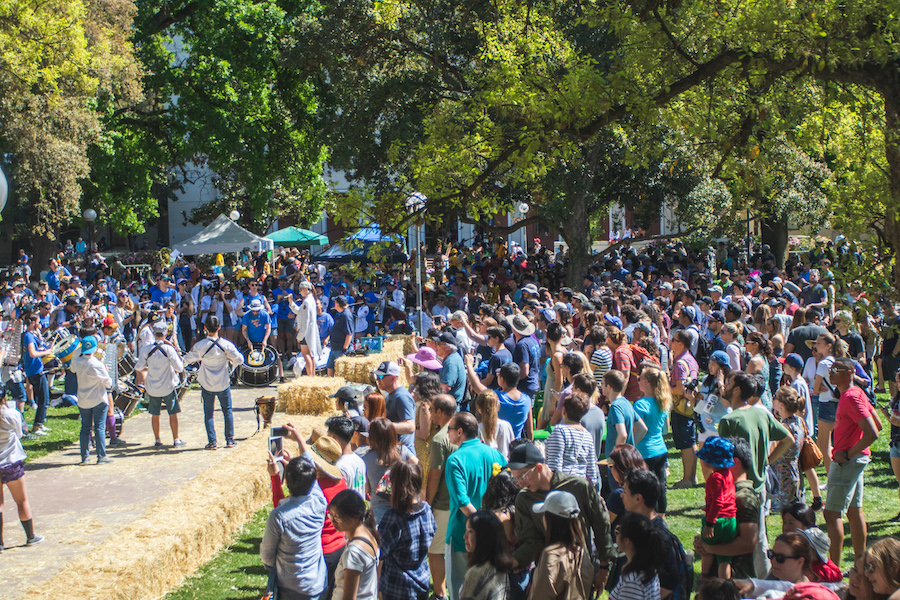
Picnic Day 2018 once again drew large crowds and great excitement with a wide range of activities from cow milking to parades and science shows.

The Band-uh! kicked off the parade with its lively music and marching. Floats and processions from more than 80 different organizations in the school and the community followed.

Among the notable processions were the Animal Horse Barn, which featured individuals riding horses, while the Entomology Club showed off a giant replica of a black spider. The International House sent flags from dozens of countries, and KDVS featured a live band performing on its float. And, of course, one float featured a giant cow head.

There were also plenty of events hosted all over the campus.

The Department of Entomology and Nematology offered a variety of insect-related activities in Briggs Hall. Visitors had the opportunity to taste an assortment of honey and create “maggot art” by having maggots dipped in paint crawl around their paper.

“I really like when the Entomology Department puts on events like this, because normally I don’t like insects, but this gives me a different insight into the insects without being afraid,” said third-year biochemistry and molecular biology major Jordan Keys.

Meanwhile, Hutchinson Field hosted booths from various animal rescue and adoption centers where visitors could view and interact with all sorts of animals, including kittens, doves and parrots.

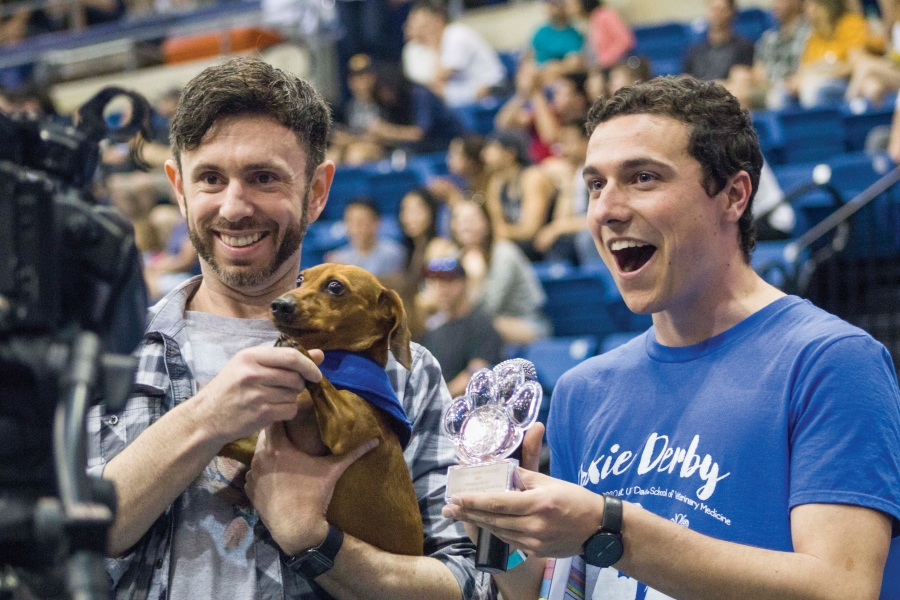
At the center of the field was a frisbee dog competition hosted by the Canine Medicine Club at the UC Davis School of Veterinary Medicine. Some of the competing canines were elderly or had disabilities, but this didn’t stop them from leaping into the air and catching their frisbees.

“We weren’t expecting it, but the dog show was awesome,” said fourth-year mechanical engineering major Michael Lyons.

Among the many highlights of Picnic Day, the science shows are always popular with students, and this year was no exception.

The Material Advantage Student Chapter hosted a Harry Potter-themed magic show centered on a muggle who used his knowledge of science to perform feats that resembled magic, such as standing on a wine glass, moving books with magnets and popping balloons with lasers. The Chemistry Show also drew large audiences, with a series of exciting experiments involving fireballs, explosions and liquid nitrogen.  

“I thought it [the Chemistry Show] was really cool and interesting to watch, and it also shows how chemistry does not always go as planned,” said second-year aerospace and mechanical engineering major Christine Anderson.

As the day stretched into late afternoon and most of the events came to a close, the Battle of the Bands was still going strong. Bands from all across California competed against the Band-uh! to be the last school standing without repeating any songs.

“I love seeing the bands from different campuses,” said third-year biomedical engineering major and Band-uh! Member Jotera Conway. “Even though it’s a competition, I still get the feeling that they like music and I like music too, and it’s all really friendly competition.”


Written by: Clara Zhao — campus@theaggie.org