

55.7 F
Davis

Davis, California

Monday, December 22, 2025
Home Blog Page 596

Humor: Sorority neighbor gets annually angry toward parody songs

KISHJAR? [(CC BY 2.0)] / FLICKR
Dave Bishka has had it up to here with parodies

Dave Bishka, subpar pastry shop owner, hates two things: children and parodied versions of songs from the ‘80s. Ever since Bishka moved in next to a house with a bunch of Greek letters on it, he has been consistently flabbergasted each time the last week of September rolls around and his house is bombarded by the not-so-sweet tunes of collegiate women singing.

“I am completely blindsided every year!” Bishka said. “They leave a note that says, ‘Sorry for the noise!’ but I’d thought they were just apologizing for their breathing… FINALLY.”

The members of Bishka’s neighboring sorority are just as confused as he is. They were holding an evening to promote their philanthropy — helping orphans get the Beanie Babies of their dreams — and their neighbor started cussing up a storm.

“Philanthropy? Not on my watch,” Bishka said.

Worse than Beanie Babies, of course, is singing. The girls began to sing (scream) their rendition of “It’s Not Unusual” by Tom Jones. Bishka, through several sobs, rumbled about why this upset him.

“They,” he sobbed, “ruined,” he sobbed, “my favorite song with lyrics about friendship.” Bishka was inconsolable.

This year, Bishka revved up his battling heart and also revved up a chainsaw. He took to their shared fence, breaking the barrier between yards for the first time since Neighbor War I, in which two women lost their pins and one lost an eye.

“Heeeere’s Bishka!”

But here’s the twist: The women weren’t even in the backyard. It was a boombox, playing a recording of them singing. Little did Bishka know, they had planned to charge at his house with pitchforks and torches, but due to budget cuts were holding the flashlights on their phones and sporks. The declaration of Neighbor War III rang through the streets.

“This is ridiculous!” another neighbor hollered as the street began to go up in flames. “We should all be allowed to sing our favorite versions of Tom Jones’ hits. This is just like Footloose, but with less cinematic flair.”


Written by: Olivia Luchini — ocluchini@ucdavis.edu

(This article is humor and/or satire, and its content is purely fictional. The story and the names of “sources” are fictionalized.)

Confucius Institute of Davis Holds Mid-Autumn Festival Celebration on Oct. 7

DIANA LI / AGGIE

Festival celebrates important Chinese holiday

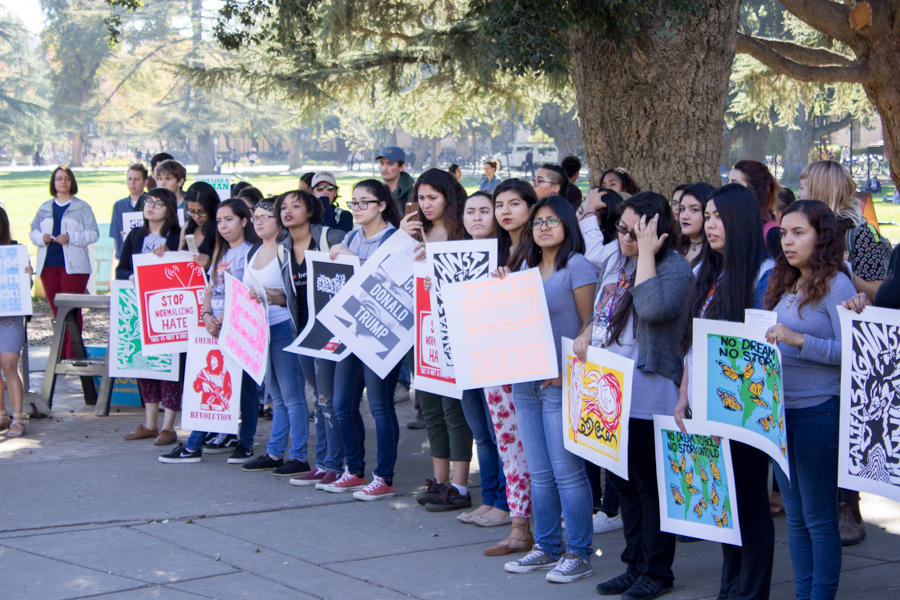
On Oct. 7, the Confucius Institute (CI) of UC Davis held its annual Mid-Autumn Festival Celebration at the International Center. Although the event required registration beforehand, it was free for students as well as members of the public.

The CI is a unit of Global Affairs, which seeks to introduce international culture to the Davis community. Every year, the CI puts on a multi-performance festivity to celebrate the Mid-Autumn Festival.

The Mid-Autumn Festival is a traditional harvest-time celebration “observed at the time of year when the moon is at its roundest and brightest,” according to the event’s webpage.

“The Mid-Autumn Festival is the second most important celebration in Chinese culture,” said CI Director Michelle Yeh.

This year, the festival featured a number of performances, including a zither solo –– a traditional Chinese instrument –– by a Davis High school student, a martial arts performance by the Davis Wushu Club as well as two symphonies performed by the Great River Chinese Musical Ensemble. Each performance showcased a part of Chinese legend or culture.

“I think [the Mid-Autumn Festival] is a pretty good overview of Chinese traditional entertainment and culture,” said third-year linguistics and Chinese double major Ellie Wan, who volunteered at the event. “It’s great to have a lot of people from different ethnicities get a taste of what Chinese festivals are like.”

At the end of the performances, audience members also got to enjoy a buffet with traditional Chinese delicacies such as egg rolls and mooncakes.

“The festival symbolizes families getting together during times of harvest and is an opportunity for friends and families to express their love and longing for each other,” said Kate Zhang, one of the masters of ceremony at the event. “For many Chinese people living overseas, it’s an opportunity to express their longing for home. For people of other cultures, it’s a chance to learn about Chinese culture.”

The CI also holds many other events throughout the year, including cooking workshops, Chinese painting and calligraphy classes and tea culture lectures.


Written by: Clara Zhao –– campus@theaggie.org

California protects undocumented immigrants with Senate Bill 54

VENOOS MOSHAYEDI / AGGIE FILE

What SB 54 means for City of Davis

On Thursday, Oct. 5, Gov. Jerry Brown signed SB 54, which will take effect on Jan. 1, 2018. This senate bill utilizes the state’s power to counteract the Trump administration’s actions taken toward undocumented immigrants.

“This bill would, among other things and subject to exceptions, prohibit state and local law enforcement agencies, including school police and security departments, from using money or personnel to investigate, interrogate, detain, detect, or arrest persons for immigration enforcement purposes, as specified, and would, subject to exceptions, proscribe other activities or conduct in connection with immigration enforcement by law enforcement agencies,” the bill reads.

With the signing of SB54, undocumented people are better protected from being subject to deportation for things such as reporting a possible crime to the authorities.

“This is an action that basically asks ICE to not hold people without probable cause,” Davis Mayor Robb Davis said. “You can’t unconstitutionally hold someone without probable cause.”

In addition, since the California Constitution requires that state reimburse agencies for state-mandated costs, the bill could require reimbusements if deemed fit. California law enforcement agencies are also not allowed to inquire about immigration status or make arrests based solely on civil immigration warrants.

As for the City of Davis, there is little projected effect, seeing as Davis has already been a sanctuary city for a long time.

“We’re a sanctuary city,” Davis said. “What this basically does for the state of California is what we’ve also committed to doing as a city.”

Davis went along to add that this new bill would be beneficial in terms of public safety.

“I think it has a very positive effect on public safety because one of the concerns that undocumented people have is fear of approaching a police officer — if they’re subject to deportation, they’re more likely not to come forward,” Davis said. “It is absolutely clear that this has a positive impact on public safety.”

In addition, the City of Davis does not have an internment facility, so detainees would never be held within the city.

“Davis is already a sanctuary city, and we do not actually have jail facilities — that’s done at the county level,” said Davis Mayor Pro Tempore Brett Lee. “I don’t think [SB 54] will make a large difference in either direction. The state bill is fairly symbolic — I think that a lot of municipalities have already had their police forces work on local issues and not immigration issues. Most large metropolitan areas of California already have some guidance in place sort of similar to what the state legislation is requiring. I think it’s an important symbolic measure really kind of differentiating what the majority of the Californians feel compared to what’s going on at the national level.”

Lee also elaborated on the difference between state and federal powers in regard to the senate bill.

“There are certain powers that are set aside for states and for the federal government,” Lee said. “Constitutionally, the state is not able to tell the federal government what they can and can’t do […] As much as we don’t like some of the foreign wars we’re involved with, that’s not really under the state’s control. Immigration, from my understanding, is a federal function. [SB 54] is an important symbolic gesture. I’m just not really sure that the state has the ability to curtail the federal government’s powers that are given to it by the constitution.”

Since Davis was declared a sanctuary city in 1986, Chief Darren Pytel of the Davis Police Department does not expect SB 54 to have a major effect on the city.

“I don’t anticipate that it will have any effect on the City of Davis since our policy is substantially in line with SB 54 already,” Pytel said.

With the increasing amount of protests from Dreamers in response to DACA’s repeal, this new senate bill seeks to provide some sort of sanctuary in the state of California as well as relief for undocumented people. Davis went on to reiterate what Davis as a city has already been about for several decades.

“We’re fully supportive of it,” Davis said.


Written By: Kaelyn Tuermer-Lee — city@theaggie.org

California law shields undocumented immigrants; UC Davis leaders, students voice support

VENOOS MOSHAYEDI / AGGIE FILE

Minimal changes anticipated at UC level

On Thursday, Oct. 5, Gov. Jerry Brown signed Senate Bill 54 into law, granting some protection to California’s undocumented immigrant population.

“[SB 54 will] prohibit state and local law enforcement agencies, including school police and security departments, from using money or personnel to investigate, interrogate, detain, detect, or arrest persons for immigration enforcement purposes,” the bill states.

SB 54 will take effect on Jan. 1, 2018. Across the University of California (UC) system, campus police already limit the extent to which they comply with federal immigration policies, due to UC President Janet Napolitano’s pledge in November 2016 that individuals would not be detained, questioned or arrested “solely on the basis of (suspected) undocumented immigration status.”

In addition to the UC’s pledge of continuing support and protections for undocumented students, the city of Davis is a sanctuary city. Due to the policies already in place at both the university and local levels, both UC Davis Chancellor Gary May and ASUCD President Josh Dalavai said they do not expect to see any immediate changes once the bill takes effect.

“We’ll do what the bill indicates best,” May said. “Our law enforcement folks will not have to cooperate with federal enforcement, unless we are talking about a criminal situation. In general, we’ll continue to support and protect the undocumented people that are within our jurisdiction.”

May said he hopes the signing of SB 54 will provide undocumented students a sense of comfort.

“I think it gives them some sense that they are supported within the state of California,” May said. “Hopefully, that will keep them confident and using the various public systems within the city and the state without fear of identifying themselves and having the [threat] of being deported.”

On Wednesday, Oct. 4, the 10 UC chancellors met in Oakland, where they discussed their commitment to supporting DACA students. After Brown’s signing of SB 54 the following day, Napolitano drafted a letter in response to the bill, which was then circulated among the 10 chancellors for review. A statement from the UC Office of the President is scheduled to be released on Oct. 16.

Second-year neurology, physiology and behavior major Enrique Lopez, who is an undocumented student, said he appreciates the statements made by UC administrators thus far in support of undocumented students. Lopez emphasized the importance of SB 54 becoming law, stating that he believes it will provide a sense of stability for undocumented individuals in California.

“The bill is trying to do three big things — one of them is [to] improve confidentiality so people are not feeling unsafe when they go to the DMV or they go to schools,” Lopez said. “It’s going to prohibit the allocation of local funding to communicate with ICE or immigration authorities, which is also really good. [And] it’s going to [prohibit] public schools and hospitals […] from communicating with immigration authorities. These three [points] are connected [in] making undocumented people feel safe, wherever they are — in schools, hospitals [or] reaching out for police help.”

Lopez serves as the chair of the ASUCD DREAM Committee, which works closely with the AB540 and Undocumented Student Center to advocate for undocumented students. This year, the DREAM Committee received its first budget from ASUCD. Lopez said having resources on campus specifically for undocumented students has been helpful for him, especially at the current political moment.

“Regarding [the] DACA repeal, […] it makes me feel unrepresented and really out of place,” Lopez said. “But thanks to groups like the AB540 Center and the DREAM Committee, […] I feel way more safe, and I’ve learned a lot. It has helped me, and I’m sure it helped others feel more welcome [and] more safe.”

Both Dalavai and ASUCD Vice President Adilla Jamaludin emphasized their dedication to addressing the needs of undocumented students.

“If there’s one declarative statement we can make, it’s that […] it’s a firm belief of the ASUCD Executive Office that [undocumented individuals] are great people that have just been horribly and unfairly targeted and whose everyday lives are being affected by bigotry,” Dalavai said. “We’re very committed to helping undocumented students however we can.”


Written by: Hannah Holzer — campus@theaggie.org

UC Davis women’s soccer undefeated in Big West

BRIAN LANDRY / AGGIE

Aggies win 2-1 over Mustangs, now 2-0 in conference play

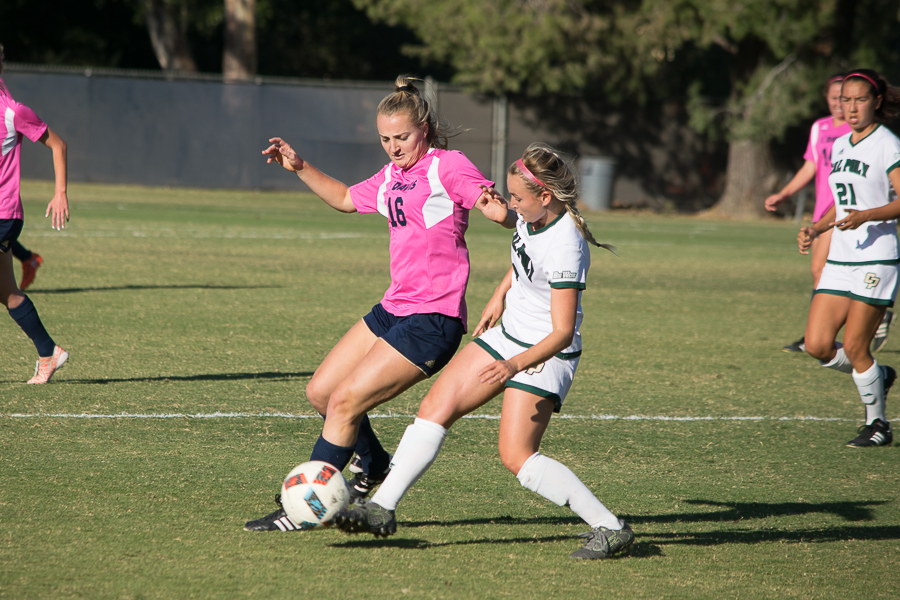
The UC Davis women’s soccer team remains undefeated in the Big West Conference after an exciting 2-1 win over the Cal Poly Mustangs, who are now 0-3 in Big West play. While sporting pink jerseys for their “Play Pink” game in honor of Breast Cancer Awareness Month, the Aggies overcame a rocky preseason, a red card and a questionable goal on their way to victory.

Within the first few minutes of play, sophomore defender McKenna Moriarty kept up her momentum from the Hawaii game and scored on the Mustangs, putting the Aggies on the board. The Aggies would remain the only team on the board for the remainder of the first half.

The second half of the game saw a lot of tension and aggression on the field. With 28 minutes left in the game, the Mustangs scored on the Aggies. Cal Poly’s sophomore defender Senna Brennan’s corner kick snuck its way into the goal from the left side. With some players thinking the ball went out of bounds, the ball was lost in the confusion and eluded the defense. Coming off that tying goal, sophomore defender Haileigh Rose was red-carded and the team was left a player short.

“This team has dealt with so much this year,” said head coach Twila Kaufman. “They just find different ways to handle it. I’m really proud of Haileigh Rose. She handled it like a champ, and our team stepped up and figured out a way to score a goal.”

With eight minutes left on the clock, freshman forward Mahlah Catline scored the game-winning goal. This goal was her first career game-winner. Coming in from the left side of the net, Catline fought off Cal Poly’s sophomore goalkeeper Sophia Brown.

“That was nice,” Catline said of her goal. “It’s kind of my job, though, isn’t it? If I don’t score, I’ve done something wrong. It’s always nice to score, but I think it’s a team thing. There are ten other people on the pitch, and I wouldn’t be able to [do it without them].”

The Aggies ran out the remaining eight minutes on the clock. Junior goalkeeper Alexis Smith blocked a final corner attempt by the Mustangs’ Brennan.

“I think it was a great team win,” Smith said. “[It was] definitely a team effort, especially those last eight minutes there. We’ve been talking a lot this week about taking games moment by moment, so that’s what I was doing.”

Catline echoed her teammate, “I feel it went really well,” she said. “I thought we persevered. I don’t think it was our strongest game, but I think, we won and and that’s what we’re here to do. I think great teams win when they’re not playing their best and it’s only up from here.”

This weekend, the Aggies will head south for games against UC Irvine and Cal State Fullerton.

“We’ll have to shuffle the deck again,” Kaufman said, in anticipation of the weekend’s games. “We’re going to be working on things a little differently. Once you get to this part of the season, there’s a lot of familiarity. So we kind of know what our next opponents do and we’ve already kind of sneakily, with our team, been layering things in that we need to do to be successful with our next two opponents. It’s going to be a great game.”


Written by: Liz Jacobson — sports@theaggie.org

UC Davis women’s volleyball ends skid against Long Beach State

0
RAUL MORALES / AGGIE

White, Bowman dominate on way to 3-1 victory

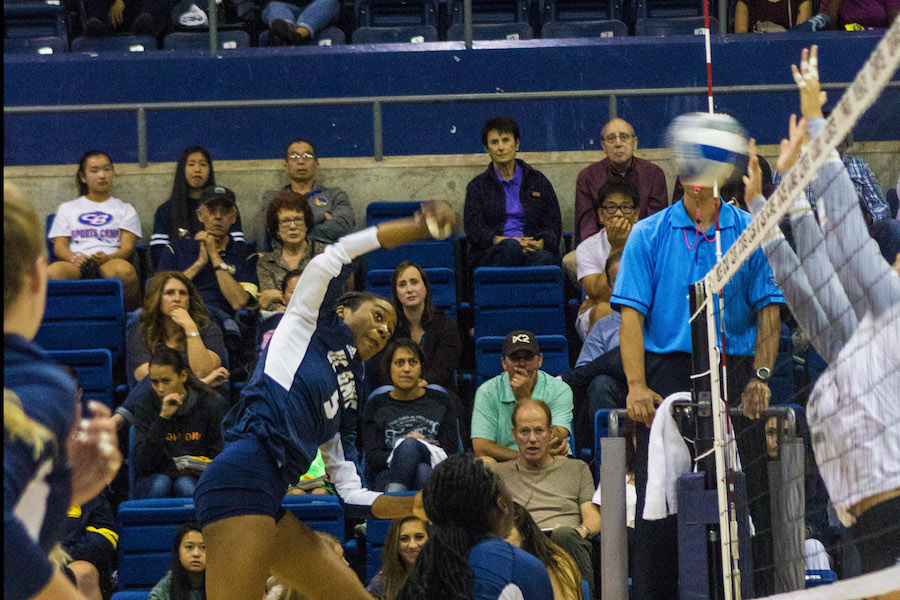
With four straight conference losses heading into the match on Saturday, Oct. 7, the UC Davis women’s volleyball team knew that it would need to right the ship as it heads into the latter half of the 2017 season. In the opening game against the Patriots of CSU Long Beach, it did just that. The Aggies dominated the first two sets on their way to a 3-1 victory where they scored 84 points to Long Beach’s 53.5.

UC Davis came out aggressively to secure the first set win. It was freshman setter Paloma Bowman who set up her team’s run, amassing 57 assists, many of which were finished by freshman hitter Mahalia White, who began the match with three kills on the team’s first five points before eventually finishing the night with 23 kills en-route to her 25.5 point outing.

Bowman knew the importance of getting back in the win column, and was overjoyed to finally get there after the team’s recent skid.

“It was good to finally win,” Bowman said. “We’ve been working for it for a long time, so it’s nice that it finally paid off. I think we’re getting a lot better. We’re improving every day.”

Bowman’s play also caught the eye of head coach Dan Conners, who credited his setter with embracing the challenge in her first year at the college level.

“The passing was awesome. The passing did a great job, and the hitters were just fearless and ruthless and they were just getting after it,” Conners said. “[Bowman is] only a freshman and she still has a lot to learn about the game. She’s just working on her consistency, and she’s understanding the game more and more, and as she gets better the team gets better.”

For White, a great performance like this was needed, a sentiment that was echoed by her coach. The effort wasn’t lacking in the four conference losses that preceded this game — it was just a matter of putting everything together.

“We were just very hungry for a win tonight,” White said. “We always say how we’re going to come out fired up, and today we just came out there wanting the win, wanting to keep playing aggressive the whole time.”

Despite the great performances from White and Bowman, this wasn’t a two-person show. The entire team showed up, including sophomore outside hitter Lauren Matias amassing 17 kills of her own and 17.5 points, junior outside hitter Emily Allen finishing with 13 points on 11 kills and junior middle blocker Lauren Jackson racking up 12 points on 10 kills. Overall, the team accumulated 84 points on 67 kills, with 26 errors.

Not every set went smoothly, however. The team ran into some struggles in the third set, where despite matching the pace of the Patriots for most of the set, the team was unable to overcome a late three-point deficit. It was the response to this adversity which gave White hope in her team.

“We totally just wiped it out of our memories,” White said. “We were just like, ‘You know what? This set right here, we’re just going to reset the way we were playing the first two sets, and we’re just going to go out there and kill it.’”

Going forward, the team hopes to build off this exciting win, as there are still many games to be played. Conners hopes the team can draw from both the negatives and the positives to continue its upward trend into the next game, when it takes on UC Riverside on the road.

“Just to remember what it feels like to play with that level of determination and focus and energy and aggressiveness,” Conners said. “The moments where we backed off and got tentative were toward the end of that third set and part of that fourth set. We’ve just got to remember the consistency of our mentality is vital to how we want to play the game.”

The team will go on the road for two games before returning home on Tuesday, Oct. 17, to play UC Santa Barbara at 7 p.m.


Written by: Bradley Geiser — sports@theaggie.org

A game of inches

0
ALEXA FONTANILLA / AGGIE

UC Davis football comes up just short against Eastern Washington

Saturday night’s contest at Aggie Stadium featured a head-to-head collision of the Big Sky Conference’s top passing Eastern Washington Eagles’ offense and UC Davis’ top-ranked passing defense. After a hotly-contested, back-and-forth ballgame, the Eagles attack gained the upper hand, handing the Aggies a 41-38 loss.

This highly-anticipated matchup drew sparks from the outset, in front of a crowd buzzing from the UC Davis Brewfest that took place in the hours before kickoff. Eastern Washington marched right down the field on its first possession, scoring on a 40-yard touchdown pass on the fourth play of the drive. The Eagles missed the extra point, putting them ahead 6-0 early. The Aggies, on the other hand, relied on the big play ability of junior receiver Keelan Doss to get things rolling offensively. Sophomore quarterback Jake Maier hooked up with Doss for a 26-yard completion to get things rolling. It was junior quarterback CJ Spencer, however, who found the end zone for the Aggies some 11 plays later, sneaking in from just a yard out. A successful extra point from sophomore kicker Max O’Rourke put the Aggies in front 7-6.

The scoring cooled down for the remainder of the half. UC Davis failed to score any points, despite being set up with optimal field position after senior defensive end Brandon Weaver tipped and intercepted a third down pass from Eastern Washington’s quarterback Gage Gubrud. The teams traded touchdowns as the game rolled into the second quarter, but the scoring dried out, and the Aggies went into break with a 14-13 lead.

After a relatively low-scoring first half, UC Davis came out in the third quarter running the ball ten straight times — but it was a trick play that sprang its offense to life again. Maier threw a quick lateral to Spencer, who then opted to pass the ball downfield, completing his only pass attempt of the night to a triple-covered sophomore tight end Wesley Preece for a 24-yard gain. On the next play, it was Maier’s turn to launch the ball downfield, completing a 16-yard touchdown pass to Doss, who sprawled out to make the catch. Doss’ fifth touchdown in six games gave the Aggies a 21-13 lead.

Eastern Washington’s Gubrud tossed his third touchdown on the ensuing Eagles drive, again putting his team within one. But just two plays later, Doss made what was most likely the catch of the year for UC Davis. With a defender draped all over him, Doss dove to make an electrifying one-handed grab for a 21-yard gain. Doss’ impressive hands propelled the Aggies to a score just five plays after. Off a play-action fake, Maier delivered a pass in between defenders to freshman tight end Christian Skeptaris, who held on for his first career touchdown with time running out in third quarter.

UC Davis’ momentum rolled on into the early part of the final frame. Junior defensive back Vincent White broke on a pass from Eastern Washington’s Gubrud, intercepting the ball and nearly returning it for a touchdown. The game’s second turnover was enough to set up a 26-yard field goal from O’Rourke, extending the Aggie lead, 31-20 with 11:38 to play.

Up two scores, UC Davis looked to have the upper hand, but there was still plenty of time on the clock — especially for the explosive Eagles offensive. Showing just how explosive it could be, Eastern Washington scored on the very first play of its next drive when Eagles speedster, Nsimba Webster, torched the Aggie defense for 71 yards on a pass from Gubrud. A failed two-point conversion following the touchdown made it a four-point contest, but Eastern Washington was only just beginning to mount its comeback. A three-and-out by the UC Davis offense gave the ball right back to Eastern Washington, which scored again just 57 seconds later, this time succeeding on the two-point conversion.

With their backs to the wall for the first time, the Aggies put together a resilient 11-play drive capped by Spencer’s third rushing touchdown — a career-high. Spencer found a hole in the Eagles defense, stomping into the end zone from 10 yards out to pull UC Davis in front 38-34.

“Everybody on this team has a job,” Spencer said. “Whether you’re getting one play a game, or you’re redshirting, or you’re playing every single snap — everybody has a role. And [the coaches] came up to me and said, ‘You need to run the ball, you need to score some touchdowns in the red zone.’ So I accepted my role and I followed by o-line and Derek [Baljeu] and just did my job.”

Even after this late score by UC Davis that injected life back into Aggie Stadium, the Eastern Washington offense did not waver. On the ensuing drive, the Eagles gained 23 yards on a key fourth down to move the chains and finally scored on Gubrud’s sixth touchdown pass of the night — a beauty that floated high into the corner of the end zone. Now trailing by three points with 1:32 to play, UC Davis ran 12 plays to get itself in position for a 49-yard field goal attempt.

“The mindset [in that situation] was to take what [Eastern Washington was] giving us,” Maier said. “Give ourselves a chance, get us in a situation where we could take it down to the last play. I know the mindset that our coaching staff has is we want to go for the win — we’re very aggressive. Credit to [Eastern Washington], that’s a great team. We have to work even harder from here on out. If we want to have success and if we want experience that glory again, we have to work even harder for it.”

The Aggies hoped O’Rourke could send the game into overtime, but his kick came up well short of the goal, sealing UC Davis’ fate. Head coach Dan Hawkins, although obviously disappointed with the result, remained level-headed and proud of how his team performed.

“When you play these kind of games, the margin of error is just real small,” Hawkins said. “But our guys […] did not back down and were not phased at all by the moment or the score. We got beat by a pretty good football team, but it was a spectacle.”

The loss was UC Davis’ third this season, dropping the team’s record back down to an even 3-3. There were, however, plenty of bright spots for UC Davis in the otherwise negative result. The Aggie offense racked up 551 yards of total offense, out-gaining their Eastern Washington counterparts by 50 yards. Doss recorded a career-high 208 yards receiving. His quarterback, Maier, had another stellar outing, throwing for over 300 yards for the fifth consecutive game — while adding in two touchdowns and no turnovers. Despite giving up 41 points, UC Davis also forced two interceptions on the evening, but could only muster just three points off these two turnovers. Hawkins was pleased with how his defense made plays against such a difficult opponent.

“[Eastern Washington] is hard to defend, just like we’re hard to defend,” Hawkins said. “It’s hard to shut [Eastern Washington] down. We tried to keep them off balance, keep them off rhythm. You got to maximize your opportunities to force their hand, so I thought our defense did a great job.”

Even after a heartbreaking loss, Hawkins had nothing but emotional, heartfelt words for his players, calling them “the real deal” and praising each player for accepting his role within the team. Saturday night was a legitimate chance for UC Davis to pick up a win against one of the best teams in the conference, but ultimately became an evening that just got away from the Aggies. The team will have a chance to return to its winning ways after a week of rest, when it travels to Northern Arizona on Saturday, Oct. 22.


Written by: Dominic Faria — sports@theaggie.org

2017 Davis Art Studio Tour

BRIAN LANDRY / AGGIE

Davis Arts Center gives a behind the scenes tour of Davis-based artists’ studios

Attending a gallery filled with vibrant paintings can be a mesmerizing experience. Sometimes, that’s all you really see: a room full of captivating shapes and colors. More often than not, a painting simply looks like a painting; audiences are not usually given the entire context of the artwork, making it difficult to find meaning in something created by someone else. That’s exactly what the Art Studio Tour does for its viewers: break the mystery. This year, the Davis Arts Center is hosting another studio tour, showcasing Davis artists’ workspaces and revealing the steps involved in making their work.

Joanna Kidd, one of the event’s featured artists, specializes in printmaking, sculpture and video installation, using various mediums and materials. She also teaches Studio Art and Art History at Yuba College, Woodland Community College and the UC Davis Craft Center.

“I’ve been participating [in the Art Studio Tour] for about four years,” Kidd said. “The tour is more of a direct experience than a gallery because some artists do demonstrations, so you can actually see the process of how they make their work and ask them questions. There are sculptors, painters, printmakers and people who make jewelry. Whatever the artist specializes in is what you’ll be seeing in their studio. When you see how something is made, sometimes it makes it more accessible and helps you understand. I think it’s also nice to know what the artist was thinking while they were creating their piece. It gives you a different perspective.”

While art’s meaning is largely open to the audience’s interpretation, the process behind an art piece is often personal to the artist. More importantly, there is greater depth to a finished art piece than meets the eye. Featured artist Christopher Dewees uses a unique medium to make his final products look like ordinary paintings. In actuality, though, they contain literal impressions of real fish.

Gyotaku, otherwise known as Japanese fish printing, is a traditional medium in which the artist uses a dead fish in a similar manner to block printing. Using real fish as the primary tool, there are opportunities for complexity through added shapes and textures.

“[Japanese fish printing] is an artform that’s been around for 50 years, and I’ve been doing it for about 50 years,” Dewees said. “People are usually kind of amazed by how I do it because it’s an unusual artform. It’s an awful lot of fun, and I do a lot of demonstrations during the tour and give examples of how I do my art. It’s like block printing except instead of a wooden block you’re using a real fish. It’s round, it’s wet and it can be slimy, so you just need to use your experience and little tricks to get it to turn out the way you want. Afterwards, I wash off the fish and eat it. I don’t want to waste it.”

Dewees didn’t acquire an affinity for Gyotaku out of the blue. He attended graduate school and eventually pursued a career in fisheries, which fostered his love for fish and inspired him to use them in his artwork.

“A lot of times when people first see my work without knowing how it’s done, they think it’s a painting or drawing,” Dewees said. “When I tell them I use an actual fish and describe the process, they are pretty amazed. I learned it when I was in graduate school. My career was in fisheries biology and ocean fish science. I’ve always been around fish, and I like fish. It’s almost natural.”

The Davis Art Studio Tour is a venue where artists can communicate and grab ideas and advice from one another. Moreover, it provides a different angle on visual arts to an audience that is only accustomed to seeing the finished results of artists’ works. Deputy director Michael Azevedo thinks that’s what makes the studio tour an enjoyable experience for artists in Davis and all members of the community.

“A gallery situation is totally different in that there often is no context of the artwork in a gallery,” Azevedo said. “It’s different when you go see where the work is created, the sketches behind it and having the opportunity to talk to the artist. We had someone come in to buy the tickets, and she was really excited. It’s just a lot of fun. Even though you may be unaware of it, you’re connecting a piece of artwork with an experience. You can buy a painting, hang it in your house, and talk about what it meant to the artist who made it and why you bought it. It’s a more personal experience being able to see the work and know the context and process of it.”

Art doesn’t have to be a large, abstract concept. It can be interactive, direct and even more beautiful than initially perceived.

The community event is open to anyone who is interested. Tickets can be purchased on Eventbrite for $10 for ages 13 and up. The studio tour will take place on Oct. 14 and 15 from 10 a.m. to 5 p.m.


Written by: Becky Lee — arts@theaggie.org

Editor’s note: The Eventbrite page has now closed, but tickets can still be purchased in person at the Davis Arts Center or the Hallmark Inn


John Natsoulas Gallery to hold 10th Annual Davis Jazz & Beat Festival

MORGAN TIEU / AGGIE

Relive the Beat Generation, experience live jazz, poetry, art

While some may only recognize it by the giant cat sculpture at its front entrance, the John Natsoulas Gallery is a Davis landmark. The gallery, located on the corner of First and E streets, has brought major historical and forward-thinking exhibits to the Davis community for over 30 years, helping to shape the ever-expanding art scene of northern California.

From Friday, Oct. 13 to Saturday, Oct. 14, the “beat goes on” as the John Natsoulas Gallery brings its 10th Annual Jazz and Beat Festival to downtown Davis — completely free of charge. With over 200 musicians, painters and poets performing, the Jazz and Beat Festival fosters an intimate jazz experience for all members of the community. In addition to the live musical performances, festival-goers will also enjoy a collaboration of jazz and poetry in the Jack Kerouac Poetry Contest on Friday.

“The Natsoulas Gallery is a really unique part of downtown,” said second-year biology major Kerri Ritter. “I think it’s cool to have a space in Davis that is dedicated to giving artists a platform to show off their talents.”

Inspired by the collaborative culture of the Beat Generation, the Jazz and Beat Festival was born out of a celebration for jazz, art and spoken word. This year, the festival’s first poetry contest winner, Indigo Moor, will be returning as the event’s featured poet. Additionally, jazz painter Laura Hohlwein will lend her artistic talents to the stage as she paints alongside a live performance.

Gallery founder John Natsoulas emphasized jazz’s influence as a cultural art form in this day and age and how the Beat Generation has evolved since its beginning.

“What I want members of the community to take away from the festival is that improvisation is really what it’s all about in life,” Natsoulas said. “You’re all living in a different age than I did, and everything you do you can post. The difference is that for us, that performance is all we have, and the musicians didn’t plan some of that music. It just happened.”

Curated by Tony Passarell, all the live musical acts will be running throughout the afternoon and into Saturday night. Passarell, a longtime member of the local jazz community, will also be participating in some of the live musical performances.

“We’ve done this for so long, and it’s always been free to the public,” Passarell said. “It’s pretty amazing that we can pull the whole thing off and for really not that much money.”

In the curating process, Passarell works to find a well-rounded selection of groups and musicians to perform at the festival. This year, the event will feature a variety of performers, including headliners Bobby Bradford Quartet, local jazz group Triism and the Byron Colbron Trio.

“Its very difficult for us to find major musicians that are still being creative and aren’t falling into the ‘concert concept,’” Natsoulas said. “What I like is going to see a house concert. It’s a lot more loose, and it’s not as formal. But if we go to one of the major halls, like the Mondavi Center or Crest Theater, what happens to us? We’re constricted, we’re not free to get up and dance around. The idea is to make the musicians comfortable and really make everybody comfortable.”

The 10th Annual Davis Jazz and Beat Festival will take place Friday, Oct. 13 and Saturday, Oct. 14 at the John Natsoulas Gallery at 521 First Street. More information can be found on the Natsoulas Gallery’s website.


Written by: Sydney Odman — arts@theaggie.org

Perspective in Politics: Current policing strategy has polarized the public

WALT STONEBURNER [(CC BY 2.0)] / FLICKR
Trust is the key to ending police violence

When people talk about the police, the subject of police brutality often comes to mind. Eight years after the shooting of Oscar Grant in Oakland, cases of excessive force at the hands of police continue to reach national coverage. Despite years of research and deliberation, the debate remains polarized and stagnant.

The main impediment to any widespread solutions is the question of how to mend relations between communities and the police. All sorts of strategies exist to try to build trust. There are attempts to create racial diversity in the police force and get the police to talk and get along with community members. These are worthy strategies, but they have not brought the end to police violence that many people demand.

A lack of significant policing changes encourages many to turn to more extreme demands, like calling to abolish all police. This argument may sound perplexing to some, but in communities where repeated studies demonstrate racial profiling and excessive force used by police, it seems that such communities would be better without them. Public trust in the police has been incredibly low for the last several years, and it doesn’t help when stories of police being acquitted — or not charged at all — for unjustifiably violent force circulate across social media.   

On the other hand, your perspective of the police may not be too negative if you live in a quiet town where physical crime occurs only on television. If you have a local business in Ferguson, Missouri. that was ransacked by angry people after the acquittal of Officer Darren Wilson, you might have a desire for police to treat widespread theft with greater force.

Current policing strategy prevents any real appearance of protecting the public. Police have for a long time become notetakers, only reacting after a crime has occurred. In my experience and others, they show up an hour after a house is burgled and complain that they lack the resources to even find the criminals. What people claim prevents crime — the widespread security cameras — is more of a way to identify suspects rather than discourage people from committing crimes. The police who ride around in their police cruisers are looking for criminals but divert too much of their time on conducting traffic stops and giving people tickets. If the public doesn’t trust the police’s authority, then law enforcement can’t do their job of protecting the public even if they want to.

Tactics that have been implemented to prevent crime have simply widened the rift between the police and the public. The broken windows policing theory, an attempt to stop future severe crime by policing low-level offenses, has just encouraged widespread jailing and criminalizing — mainly of minorities — for crimes as insignificant as jaywalking.

The only way to properly change policing strategy for the better is to come up with a way to build trust and prevent crime at the same time. Law enforcement will have to do more than talk with locals at a Starbucks to gain their trust. Cops must not view themselves as non-civilians and must act instead as important community members. They must not think of their jobs as strictly combatting crime, but rather as a mix of social work and neighborhood watch. Rather than just hiding in their police cruisers, there’s an incredible need for interaction with regular people. The police must show that they truly care about the area they serve, as they’re now part of the people that inhabit the neighborhood. Trust takes years to build, but if the police can take that first step in reaching out, the public can eventually change its opinion of law enforcement to a more positive image.


Written by: Justin Chau — jtchau@ucdavis.edu

Disclaimer: The views and opinions expressed by individual columnists belong to the columnists alone and do not necessarily indicate the views and opinions held by The California Aggie.

Humor: UC sues Trump over DACA: “Do you know how much money those students give us?”

BRIAN NGUYEN / AGGIE FILE

The University doesn’t care about you.

The University of California has filed a lawsuit against the Trump Administration for unlawfully repealing DACA, arguing that 800,000 students (or as the UC calls them, monetary contributors) would be lost at the whim of an executive order.

Janet Napolitano, the President of the UC, claimed that the executive order was unlawful because it would deprive hardworking students of everything they’ve accomplished.

“The Dreamers shouldn’t be punished for being born into an immigrant family,” Napolitano said. “These are people. They deserve to be here and their money deserves to be in my wallet.”

“They’re not Dreamers, they’re, they’re Nightmare-er’s,” Trump said after learning that DACA wasn’t Dachau, which he had originally thought it was.

“Trump was rambling about getting rid of Dachau, which he called ‘DACA,’ and I told him that he was thinking of the wrong thing, he’s supposed to be getting rid of DACA, but he tells me that he’s very smart and knows what he’s talking about,” Mike Pence said in a garbled statement.

“DACA… It’s more like CACA,” Trump said. “They’re not sending their best. They’re sending rapists, murderers, drugs, crime. They’re not sending you. You couldn’t get into college — not because you’re illiterate, not because you dropped out of highschool. I’ll tell you why: You couldn’t get in because all of these — these people with problems — from Mexico, they’re debasing you —” [Pence whispers to Trump] “ — I mean displacing, they’re displacing you. And it’s bad. Real bad.”

“We intend to sue the Department of Homeland Security and the Trump Administration for all of the money that those students would have given us, however much that amounts to,” said Napolitano.

The big problem now is that the UC is trying to find a way to fill the void after all these Dreamers are tossed out and left forever dreaming.

“Well,” Napolitano said, “we’ve been trying to find a way to help these students, but the reality is, we just don’t actually care about them. The universities will suffer a huge loss that will need to be made up somehow.”

When asked how the university handles loss and what their strategies are for increasing profits, or “funding,” as some call it, Napolitano said, “Generally we just bring in more out-of-state or international students. It’s like, I’m sorry that your state or country is unbearable and you want to live here, but we just have to make it clear that, if you do come here, your bank account is going to get railed.”

“I think this will be great for us,” said Mitch Gallagher, the manager of a Davis car dealership. “It’s mostly international students who buy our Corvettes, so I don’t see a problem with the DACA elimination. In fact, I’m glad I voted for Trump.”

One of our interviewers asked Trump if he would consider changing his mind, to which he said, “I don’t see how I could do that. My head doesn’t screw open like that lizard Hillary, my mind is staying where it is,” to which the question was reiterated and dumbed down, to which Trump then said, “The real problem right now is that these people are taking a knee during the national anthem. You take a knee if you’re under Bill Clinton’s desk, and see where that gets you!”

Trump has yet to reply to any further questions, as he has locked horns with “Rocket Man” and is still dealing with the NFL’s threat to national security.


Written by: Drew Hanson — andhanson@ucdavis.edu

(This article is humor and/or satire, and its content is purely fictional. The story and the names of “sources” are fictionalized.)
Protect California’s undocumented immigrants

HANNAH LEE / AGGIE

SB 54 provides additional security, peace of mind to law-abiding residents

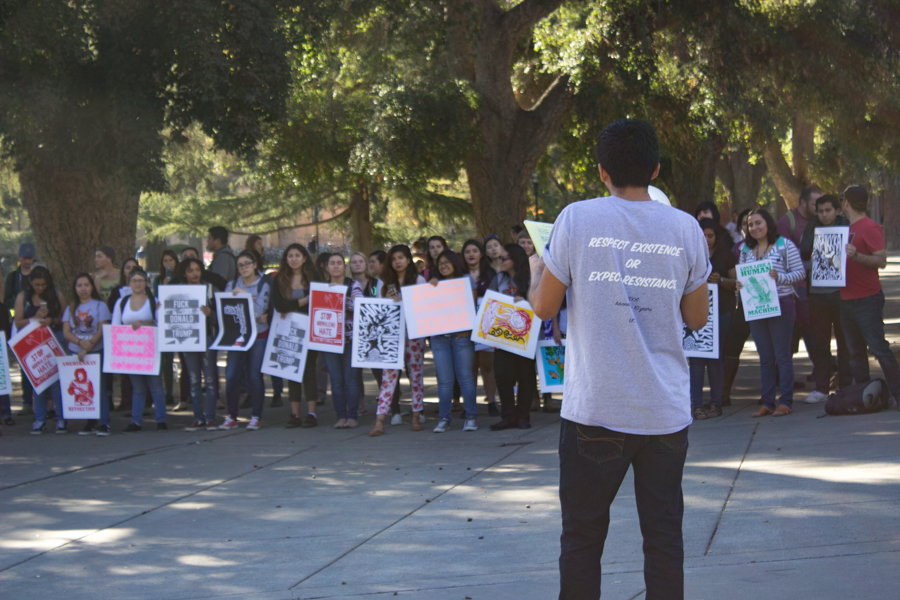
Senate Bill 54, or the California Values Act, was signed into law by Gov. Jerry Brown on Oct. 5. SB 54 helps protect undocumented immigrants from deportation by restricting how state and local officials cooperate with those in federal immigration. It will provide some modicum of safety to a group of people who are largely nonviolent and law-abiding.

According to the most recent data available, over 2 million undocumented immigrants are estimated to live in California. These people live in constant fear of deportation, yet abide by the law, contribute to the state economy and drive their children to school each day. These people have lives and families.

Local law enforcement will not inquire about immigration status during regular interactions, helping undocumented immigrants feel more comfortable reporting crimes without fear of being ousted as an unauthorized resident of the state. SB 54 does not prevent people from being deported, but rather prevents California from working in conjunction with federal immigration policy.

There are exceptions, of course. Federal agents can still interview people who are detained within the state, although they will need judicial warrants to do so. Local law enforcement can still work with federal authorities to detain people who violate any of a long list of offenses; in short, this bill does not support the bad guys.

The law will provide policy guidelines that limit assistance with federal immigration authorities in areas around public schools, health facilities, courthouses and other locations. One should never feel unsafe in these spaces, and this legislation aids in making that a reality.

The California Values Act does not serve as an ultimate protection from deportation. It does not create a so-called “sanctuary state” — far from it. Federal authorities have massive resources available to them and will still be able to operate with few restrictions in the state of California.

The Editorial Board supports this move, which adds a level of security for those who, save for their lack of official visas or citizenship documents, are law-abiding residents of the state of California.

In the wake of heightened federal immigration policies and threats by the current presidential administration, it is imperative that California fights to protect those who need it most. This is a stepping stone toward an ultimate protection for undocumented immigrants. Hopefully it will set a precedent in showing what we gain when we accept diversity rather than shun it.


Written By: The Editorial Board

Analyzing Aggie Football Weeks 4 & 5: A Much Maligned Line

0

As Davis’ offensive line goes, so too goes the offense

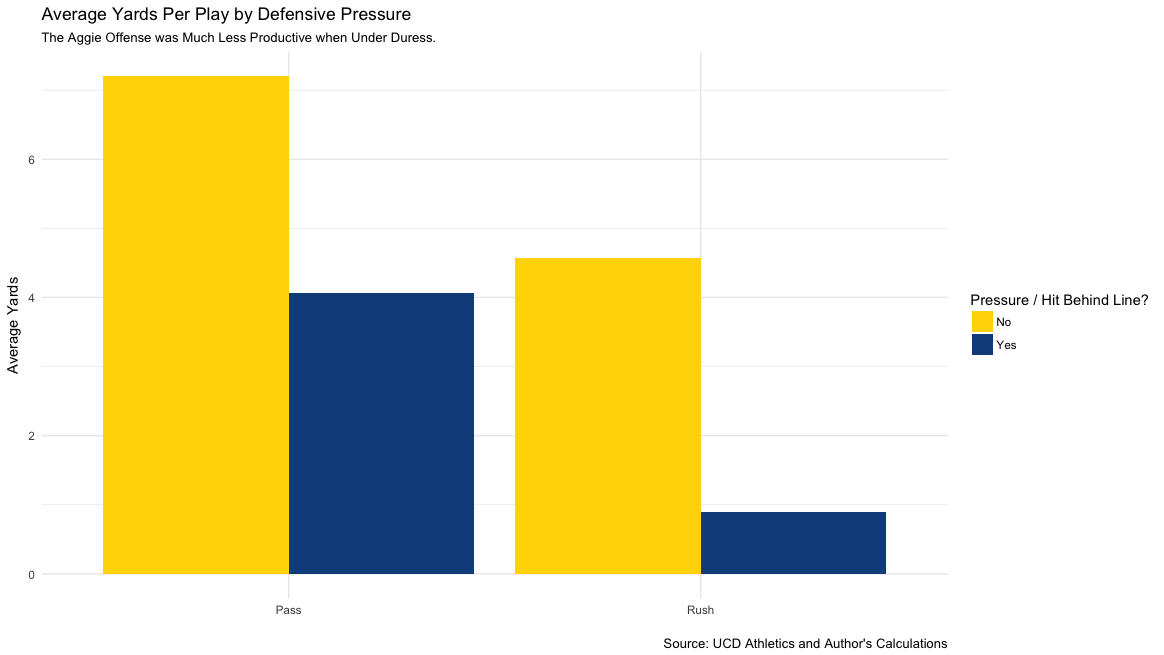
The Aggies went on the road to Weber State and things did not go well. The following week they faced North Dakota at home and things suddenly went very well. What gives? Three words: offensive line play. Against Weber, sophomore quarterback Jake Maier was under frequent duress, and as a result had less time to find receivers down field for big plays. Similarly, the Aggie rushing attack was inhibited, with the Weber defensive backs frequently contacting Aggie runners behind the line of scrimmage, resulting in fewer yards per carry. Against North Dakota, the offensive line was far more successful. The result was a more efficient and explosive offense with a higher proportion of its plays resulting in greater average gains in yardage.

Digging In

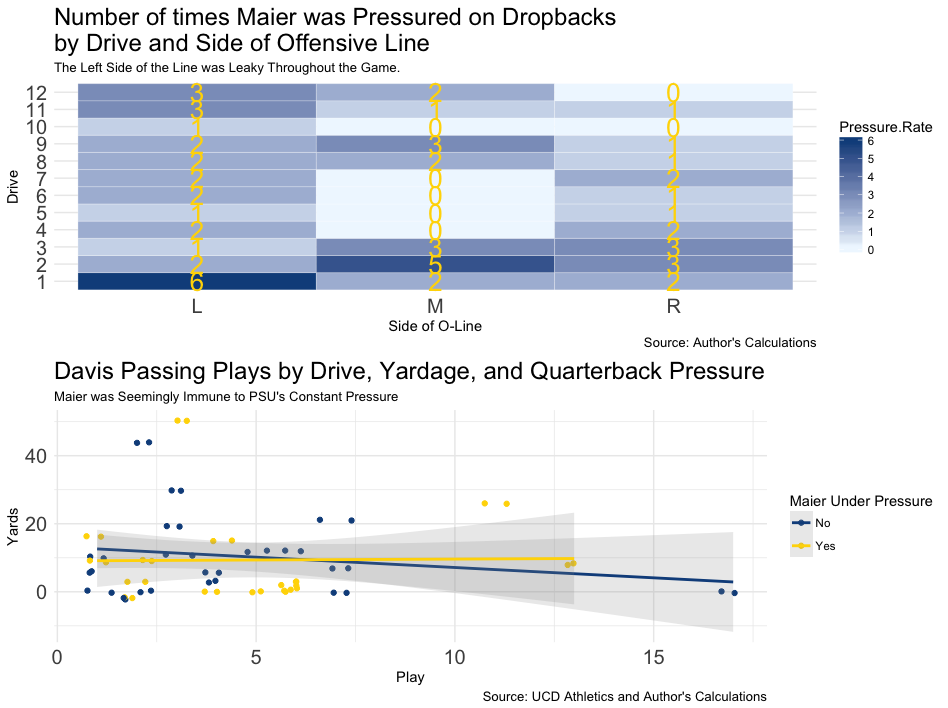
You may remember that during the Portland State game, the left side of the Aggies’ offensive line was somewhat porous. In that game, sophomore quarterback Jake Maier was under near constant duress from the left, but managed to scramble, buy time, and not allow the pressure to affect him. As a quick reminder, here’s two plots illustrating the point.

This was all fine during the Portland State game, because the blitzes weren’t getting home, and Portland State struggled to generate points by any means. Less so versus Weber State, which brought the pass rush early and often.

Two Steps Away from the County Line

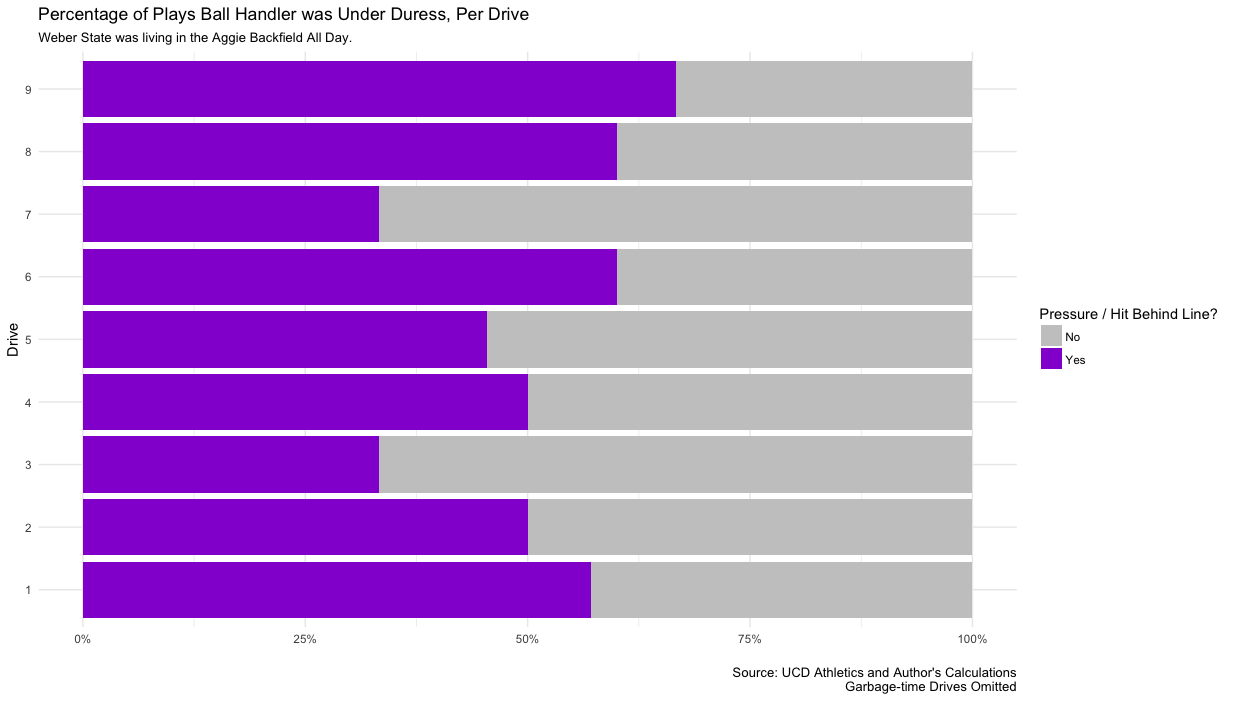
Here’s a bald statement that doesn’t get said enough: offensive line play matters. Columnists don’t typically discuss line play because audiences don’t typically pay attention to it. Why? Likely because most audiences are watching the ball, and guess who rarely touches the ball? You got it, the big fellas up front. Instead, we talk about running backs who accumulate absurd yardage totals, or a quarterback’s stunning efficiency . It’s much harder to appreciate the right guard’s ability to pull to the left side, seal the B-gap, and generate a nice running lane for his H-Back. Nevertheless, offensive line play matters, and it mattered against Weber. Here’s two plots that encapsulate why the Aggies got blown out in Utah.

Yikes. That’s not what you want to see. During the Aggies’ nine, non-garbage time offensive drives, the quarterback was pressured or the running back was hit behind the offensive line 48.1 percent of the time. Okay, no matter, maybe lightning struck twice and it was like the Portland State game, where Maier navigated the pocket so well the pressure didn’t affect him?

No, that didn’t work out quite so well in this contest. As one would expect, Maier threw for fewer yards on plays in which he was forced to elude the Weber front seven, and the two primary ball carriers in this game — running backs Namane Modise and Tehran Thomas — were far less successful on plays they were hit before making it back to the line of scrimmage. Contrast these outcomes with the rebounding win over North Dakota where the protection was much better and everyone on the Aggie offense got to live their best life.

Watch Maier’s eyes and footwork on this play. Shortly after taking the snap, he drops back and glances right as he sees a North Dakota defender bearing down on him, likely triggering flashbacks in Maier of what had befallen him the week before. However, upon seeing the running back and right tackle upend the defender with a combo-block, Maier calmly plants his feet, strides forward in the pocket and delivers a tight spiral to all-conference superhero junior wide receiver Keelan Doss.
Similarly, let’s see what life was like for the rushing attack in this game.

That’s some good, clean living for junior running back CJ Spencer, who isn’t touched by a defender until he’s inches from the goal line. Senior right guard Julian Bertero does a fine job pulling from the right side of the formation to the left and blocking the safety who steps up to try and make the emergency tackle at the goal line, to no avail. The result is Spencer cruising to the goal line, letting his momentum carry him the rest of the way. Life is good when you can hold the line.
Just how much better is it?

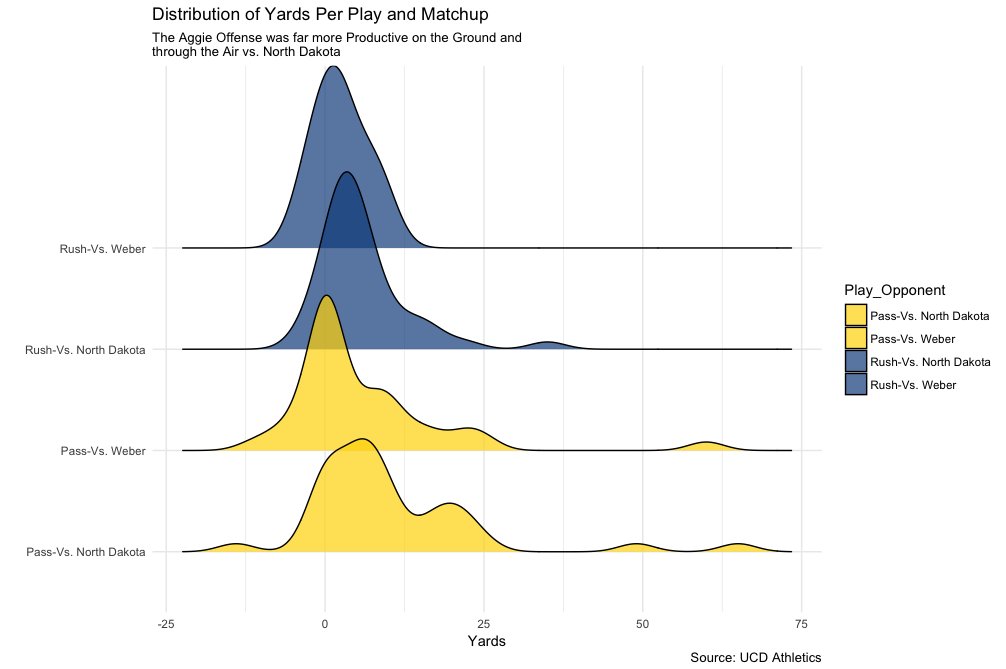
Yeah, it’s a lot better. Notice those distributions from the Weber game are both clustered at or around zero. That’s because the Aggies averaged 2.5 yards per rush against Weber, and 5.8 yards per pass. In contrast, against North Dakota, the offense averaged 5.9 yards per carry and a whopping 10.3 yards per pass. Those differences should speak for themselves, but to reinforce the point, recall an efficient first down play is one that generates 50 percent or more of the needed yardage, meaning an average of 2.5 yards per rush is grossly inefficient, while 5.9 yards per rush will keep your offense humming and on schedule.

Red Light, Green Light

College football stats heads will likely know that there are five factors closely correlated with winning football games. The fifth of these factors is the notion of finishing drives, or what some call “Green Zone Offense.”
Most regular consumers of football are familiar with the “Red Zone”—i.e. when the offense is within 20 yards of the opponent’s goal line. Expanding the “Red Zone” gives us the “Green Zone,” or any time the offense is within 40 yards of the opponent’s goal. This may seem generous, but think about it: if you cross the 40, you’ve either put together a drive that’s worked for at least a few plays, or you’ve inherited excellent starting field position. This means if you have a drive that’s worked so far, it would be a shame to waste it and come away with no points. Couple that with the importance of explosive plays (it’s hard to string together a bunch of little plays), and the impressive range of some kickers, and you can see why the ability to finish drives is a strong predictor of who wins the ball game.
How did the Aggies do at finishing drives against Weber? Well, they only scored three points, so I’ll spare you having to look on that visualization. Let’s jump to the game against North Dakota instead.

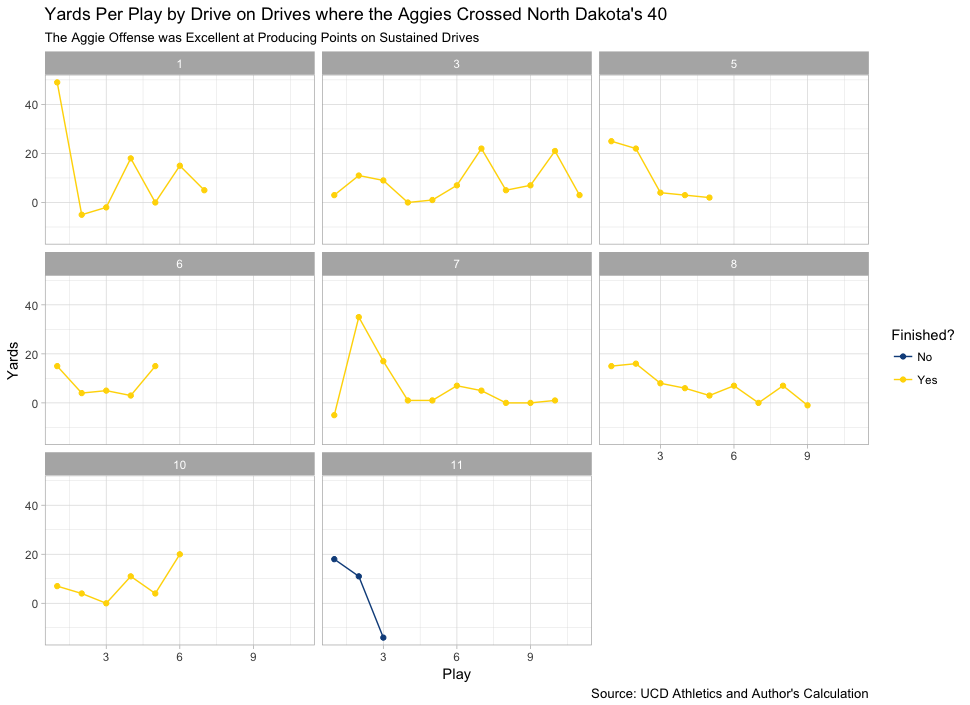
That looks pretty good! On all but one drive where the Aggie offense entered the “Green Zone,” they successfully finished the drive and came away with points. More specifically, the offense generated 5.125 points per drive on drives crossing North Dakota’s 40 yard line. Per Football Study Hall over at SB Nation, a team averaging between five and five and a half points per drive on such drives, goes onto win the game 68.4 percent of the time. Couple this with the knowledge that the Aggie offense was also quite explosive, see:

and life starts to look pretty good.

Dispelling Myths

On a final ancillary note, I wanted to take the old adage that teams who run the ball more, win. The intuition behind this follows the thinking that a tough, gritty football team, willing to run the ball more, will inevitably tire out its opponent, and go on to win the game. In fact, it has long been shown this statement inverts cause and effect. In truth, teams who are winning run the ball more.

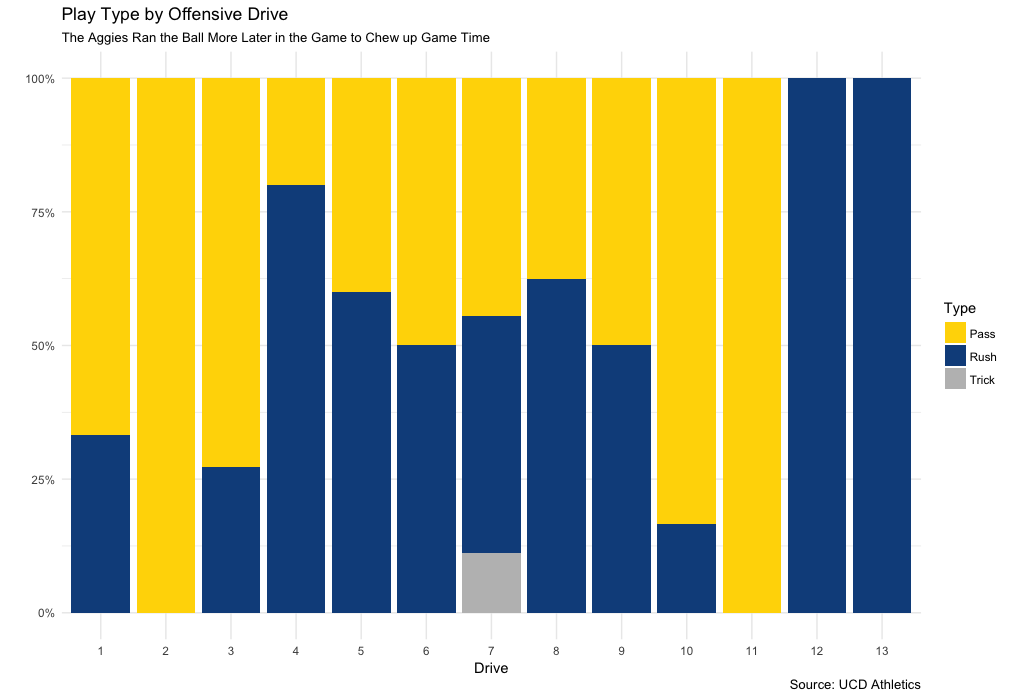
Here we see the distribution of passing and rushing plays by offensive drive. Note that earlier drives are composed of a little more than 50 percent passing plays. However, at the end of the game, the Aggies’ final two drives are 100 percent rushing plays. Why? Because running the ball does two things: it limits turnovers from interceptions, and it keeps the game clock moving by reducing the number of clock stoppages from incomplete passes.

Wrapping Up

Thanks for spending some time parsing the numbers and tape with me. Football is a challenging game to discuss rigorously because of the number of moving parts and sheer number of players associated with each play. The problem is compounded by the dearth of deeper statistics to work with. For example, in scrutinizing quarterback play, average air yards per attempt (how many yards the ball traveled through the air) is often a better indicator of a quarterback’s skill throwing the ball, than more familiar stats like yards per completion. Unfortunately, richer data is often hard to find for FCS programs, as they garner less media attention and generate less revenue.
Regardless, I hope you’ve found this statistical deep dive into the program helpful and enlightening.

Written By: Justin Goss — sports@theaggie.org

Disclaimer: The following content was a guest article written for The California Aggie by a class of 2014 UC Davis alum Justin Goss. For more access to articles written by Goss, visit his content here.

The story behind the scholarship

0
JAMIE CHEN / AGGIE

The families, foundations that support UC Davis students

Less than a year before graduation, a tragedy struck the UC Davis community as a student set to graduate lost his life in a car accident. To honor the memory of Omar George Mahshi, who was a fourth-year student in aeronautical and mechanical engineering, relatives and friends established a memorial scholarship in 1994 for future students whose characteristics aligned with Mahshi’s.

The Omar George Mahshi Memorial scholarship is offered under the College of Engineering, but other scholarships are available to deserving students in all of the university’s respective colleges.

“The amount of scholarships varies from year to year,” said Ron Bynes, the assistant director of Undergraduate and Prestigious Scholarships. “We have about 300 that are endowments, meaning [students] get money every year, and then we have anything from 50 to 150 that are just gifts.”

In the College of Letters and Science, one such scholarship is the Daniel J. Crowley Memorial Scholarship, named after a professor in 1960 and meant for students majoring in the humanities who also have a physical disability. The Kathleen C. Green Memorial Scholarship, in the College of Biological Sciences, recognizes the outstanding academic achievements of female biology students.

As for the College of Agriculture and Environmental Sciences, this college offers by far the most scholarships for students within this college’s range of study.

“You have to look at the history [of UC Davis],” Bynes said. “We started as Berkeley’s agriculture school, [and then] we started moving toward becoming our own UC Davis. [The College of Agriculture and Environmental Sciences] was the only college, so for a while you’re just getting a lot of agricultural-based scholarships and that is what we are known for.”

Undergraduate and Prestigious Scholarships is a student service unit where students can go to seek assistance in their process to attain scholarships. However, there are more opportunities beyond undergraduate scholarships that students can earn.

“My family endowed a scholarship through the [Cal Aggie Alumni Association], and mine is called the Stegura-Vanden Bos Family Scholarship,” said Debby Stegura, the president of the Cal Aggie Alumni Association. “It’s for any [incoming] student from L.A .County.”

Stegura graduated from UC Davis in 1979 and double majored in political science and mass communication. Stegura’s scholarship awards a handful of students anywhere from $1,000 to $4,000 to help with the cost of tuition, books, transport, rent, and more. She has also started donating to the Dream Scholarship for undocumented students.

“When I was here my tuition was $212.50 a quarter,” Stegura said. “There’s obviously a need for funds, even if it’s a small amount of money. I wish that other donors would also recognize the need and see the big gap between […] the decreased funding and what it costs students to come through campus now.”

Stegura is a proud donor, who recognizes the need for students to pay for college and supports the opportunities those students can grasp in order to fulfill those needs through scholarships.

“A college degree, no matter where you go, is the biggest social mobility tool that we have,” Stegura said. “Davis has been recognized as one of the best schools for social mobility, so I think it’s a good investment as a donor.”

Donors and students also often have the opportunity to meet one another, whether it’s through the Alumni Association or a different entity of campus. Stegura has met previous recipients of the Stegura-Vanden Bos Family Scholarship as well as the most recent recipient.

“The alumni association has a couple points of contact between the donors, if they wish, and the recipients,” Stegura said. “They usually have a reception or a lunch. This fall […] they’re having a reception in the evening, and the recipients are asked to be there and if you want to come as a donor you are welcome to come.”

Neda Rezvani, a fourth-year biotechnology major, attended one of these receptions after receiving a scholarship from the William and Charlotte Lider Trust

“A few quarters ago there was a reception for people who actually received scholarships, like a ‘thank you’ to the donors,” Rezvani said. “They had an entire reception with donors [and] recipients. The dean came, but unfortunately my donors never came. I wanted to meet them and say thank you, and I ended up sending a thank you letter to them anyway, but I was hoping to meet them in person.”

Rezvani encouraged other students to take advantage of scholarships offered at UC Davis, not only for the financial aid, but also for the recognition of a student’s merit — a gift for exhibiting a talent or something special.

“There are a lot of things that students gain from scholarships,” Bynes said. “It’s also something you get to add to your resume and help you [develop] skills. We build [the application] so you’re working on those skills and we try to do workshops and things around those so we can get students to understand that this is a skill that’s going to help you later on.”


Written by: Marlys Jeane — features@theaggie.org

Student Hunger: A Predicament to Battle

0
CHRISTIE NEO / AGGIE

Yolo County, Code For America, GetCalFresh working to close hunger gap

Every year, a group called the California Food Policy Advocates looks into all 58 counties in California and compares consensus data on poverty information in each county. By studying food stamp rosters, the advocates are able to find and understand disparities between poverty and food stamp use. Five years ago, out of the 58 counties, Yolo County was rated 56th.

A wider variance between food stamps and poverty numbers indicates people going hungry, because this shows that people are not utilizing help to access food.

“Ideally, food stamps are based on poverty, so if your food stamps numbers match your poverty numbers, you are doing it right,” said Nolan Sullivan, the branch director of service centers for Yolo County’s Health and Human Services Department. “So the wider the variance supposedly the worse you’re doing and the closer the variance the better you’re doing.”

Sullivan runs Yolo county’s MediCal, CalFresh, CalWORKS and all of the county’s employment programs. He explained that the board of supervisors commissioned a study to find out why Yolo County had such a high disparity. It found out that out of the four major cities in the county —Winters, West Sacramento, Davis and Woodland — Davis was doing the worst, with a 15 percent hunger rate. Upon further examination, they found that out of a population of about 62,000 people in Davis, 32,000 are students.

Realizing that UC Davis was supplying more than half of Davis’ overall population, Yolo County launched major efforts to reach out to students and help them access government programs they may qualify for. Code for America has stepped in to further this effort.

“Code for America is a non-profit and network of people that helps make government work for the people, by the people, in the 21st century,” said Maria Buczkowski, an associate at Vrge Strategies (and representative of CfA), via email. “Essentially [it’s] helping make government services be more efficient.”

In order to meet students where they are, Code for America has created an online platform called GetCalFresh, where students can apply for food assistance in about 10 minutes from their smartphones.

There are about three million individuals who are eligible for CalFresh but are not receiving the benefit,” said Caitlin Docker, the senior manager of public partnerships at Code for America. “We launched a service called GetCalFresh which helped folks navigate the process for applying, submitting their verification documents and having interviews with the county. It takes about [10] minutes for a student to apply and they can opt in to receive texts from the GetCalFresh team to get friendly reminders to upload verification documents. It’s really a service to make sure that if a student has a question, they have somewhere to go to for the answers.”

There are, however, more steps to this process. After the initial application, students must attend a half-hour interview with the county, either in person or over phone, for verification and a few other questions. In the final step, students must submit a handful of documents, including a class schedule, financial award documents and pay stubs (if applicable). They don’t, however, have to submit their parent’s tax information, which has been a misconception. Another myth to dispel is the idea that this food assistance program is like welfare or that it affects students’ current financial aid — both of which are false.

“It’s not welfare, it’s a food program — it’s how you eat,” Sullivan said.

The county will get back to the applicant within 30 days of each step, meaning the maximum duration of the process is two months. However, if the student applicant finishes their end of the application as soon as they can, the process can be expedited. The final food award is an EBT card which functions much like a debit card, and can have a maximum award of up to $194 per month.

“You can use an EBT card at any major grocery store, and I know there are venues across UC Davis that do accept EBT cards as well,” Docker said. “It’s to buy any groceries. You can buy packaged snacks […] or things like milk or eggs, fresh produce and meat.”

Yolo County has even sent one of their officials, Max Vaca, to be on campus five days a week in order to inform and assist students in accessing CalFresh.

“We’ve got about 400 applications since he’s been on campus over the last two years,” Sullivan said. “Basically what we are trying to do is target students who are working over twenty hours a week or that are on work study or that have kids because they are likely eligible to qualify.”

Docker encourages all students to simply check if they are eligible to utilize CalFresh.

Just think of it as another financial aid tool in their toolbox,” Docker said. “We know as students enter the school year, budgets are already stretched and most aren’t even aware that they may be eligible for food assistance.”

Written by: Sahiti Vemula — features@theaggie.org