55.1 F
Davis

Davis, California

Saturday, December 20, 2025
Home Blog Page 620

On the beat: student DJs and producers

HANNAH LEE / AGGIE

Student electronic musicians talk technique, EDM culture

Electronic producer Anthony Gonzalez, a third-year technocultural studies major, also known as Anthony Lost, started with a Facebook video. A simple ping or boop can prompt an idea for a mesh of electronic sounds. The pattern of his soundwaves builds off the simple sound of a video. That recording could be the next chart topper; that simple note will, almost comedically, be the building block for his unique electronic sound.

The art of electronic music has grown to be a massively popular genre.

“I will put a recorded sound in a program, from a sound from an instrument to a sound from a Facebook video, and in there I can play with the sound and it becomes its own creative process,” Gonzalez said. “You can play with pitch and a bunch of different effects. It gets so convoluted in all the different ways that you can change the sound it can often lose the original meaning of the sound, and it creates something completely new. I can add drums or whatever i think will go with it and it can create something you’ve never heard before.”

According to Sammy Seaver, a second-year music and communication double major, electronic music stems from the music style of DJing, or disk jockeying.

“DJing is a style that started in Chicago that used turntables and scratching with the objective to make one continuous song,” Seaver said. “You have a collection of various pre-recorded or downloaded songs and connect them to make one song.”

A DJ is more than the person who plays top 100 hits at a party. Especially in the college scene, this style of music and performance has become a passion for many students, including fifth-year music major Gregory Dibs, also known as God Dibs.

“I like having a library of downloaded tracks and being able to beat match; it is its own kind of skill,” Dibs said. “When you are out at a party it becomes less technical, and you more have to feel the crowd. You could get a good reaction from the crowd or you could get a bad reaction and then you have to make adjustments. A lot of it is from hands on experience.”

The craft of DJing, therefore, is one that requires both an awareness of the crowd and the technical skills to provide such vibes.

“For a live DJ, you want to keep a certain vibe throughout the whole set,” Dibs said. “You want to keep the tempo and the speeds of the song similar, and you want to tell a story. You want to show your ability to mix keys and layer drops in together to make your live mashup. I will never press a sync button that will automix and change the tempos. I think the personal changes is what makes the art of DJing — to actually make a good transition, weaving the songs together and having a good idea of the genres.”

In order to further differentiate and vary his skills as a DJ, Dibs explains that he occasionally plays his trombone in addition to his live DJ set.

“It surprises people because not a lot of musicians mix in live instruments,” Dibs said.

By incorporating live and pre-mixed songs, Dibs has entered into a realm of micro-producing. Producing follows DJing, incorporating a similar electronic background. However, instead of mixing pre-recorded songs, producing is original, authentic work.

“A producer, an aspiration of mine and most, is to compose your own music and to ‘DJ perform’ what you have made,” Gonzalez said. “Bigger DJs around the world do that.”

According to Seaver, once DJing moved out of Chicago and went abroad to places like London, it became more underground in the United States. At this stage, producing electronic music started its trajectory as a popular genre of music.

As Seaver explained it, like a talented rapper will make his or her own “beats,” a good producer will do the same.

The beauty of electronic music, to Seaver, was the genre’s ability to flip what he knew about music — the techniques, the production — on its head.

“I studied music for so long, and you could hear a sound you’ve never heard before — it’s like discovering a new color,” Seaver said, “You don’t know what to make of it, it’s new. It follows the same patterns as other songs, it just a new dimension. If you study classical music, Beethoven and Bach wrote the rules for how music should be made and for centuries it followed. But now we have computers and can basically make new instruments.”

For Gonzalez, electronic music opened a Pandora’s box of what he could do as a musician — what would be musically and artistically acceptable.

“In 2011, Skrillex was one of the first-time artists without lyrics who got on the radio,” Gonzalez said. “That opened my eyes that a producer can be their own person, do their own tour and be on the radio. Before, usually a producer would have to give away your music away to some other person to perform, so seeing a DJ open the realm to being your own artist changed everything what is means to be an electronic artist.”

A distinct creative process has thus emerged in electronic music, allowing inspiration to stem from various places. Moreover, the accessibility and openness associated with the genre has limited the amount of technical training needed to be deemed a musician.

“You have the ability to bypass the acoustic and training aspects of music,” Gonzalez said. “You could have no knowledge of music theory and still be talented. I have a friend who is like that  — he just clicks different sounds in and keeps doing that, and it sounds really good. He is one of the best musicians I know, he doesn’t even know how to play an instrument.”

However, electronic music does not only imply a mastery of button-pressing.

“The same musical principles apply in EDM music — I have a whole grand electric piano,” Gonzalez said. “I am using technology to allow my acoustic performance to be integrated into it. I am trying to get that live feel. With technology becoming so prevalent in music-making, acoustic and electronic music are becoming more of the same. Now you can click and make something sound like an acoustic sound. With microphones, you can record acoustic instruments and then layer them to make them sound electronic.”

That meshing of electronic and acoustic sounds can allow for a greater play with sounds in general. Indeed, the strict configurations of genre seem to bleed in between the lines.

“My style has changed so much, and it feels like even monthly it is evolving,” Gonzalez said. “For me, I started making electronic music, but now I have found I can incorporate singing, bass and guitar. A lot of people think of electronic music as the style of EDM, but a lot of music is nonetheless made electronically on a computer one way or another.”

For some, this accessibility of electronic music has diminished its seriousness in the music industry.

“I was at Coachella a couple years ago, and Arcade Fire said ‘shoutout to all the people who are playing real instruments here,’” Seaver said. “It kinda separated people into what is real music now and what is not. A blues guitarist will respect an electric guitarist in one way. Even though they are different styles of guitar, they are all the same type of music that they are talking about. EDM and electronic music is in a different category — it is like a painter and a graphic designer. None of them are better than the other, it is just different.”

Skill and technique seems to be a factor that differentiates this style of music as a serious art from a mere hobby.

“It’s like the ideas that iPhones give everyone a camera — anyone can call themselves a photographer, but becoming a paid photographer has become even harder than it was before,” Seaver said. “Everyone can technically do it, so to be another level is even harder.”

That same accessibility is part of the beauty of electronic music.

“In the end whatever gets good music made is good and I think technology allows us to do that,” Gonzalez said.

Electronic music, thus, can still hold merit and be used as a platform for musical growth. Seaver’s brother, popular electronic musician Mako, utilized the popularity of electronic music as a catalyst for his music career.

“EDM can be a way to get your foot in the door because it is so popular and then you can expand upon it after,” Seaver said. “My brother knew that he would have to start doing EDM, but now that he got his foot in the door, he has been able to expand. Now, mixed with his electronic sets, he has a full band up there with him.”

Don’t be mistaken; EDM music, primarily focused on melodies and killer beats rather than lyrics, can still foster intense emotions.

“One of my favorite songs of all time is ‘Sea of Voices’ by Porter Robinson. It is just noise and a lot of layers, but when I first heard it, it was so powerful,” Seaver said. “On the surface, EDM can seem like it’s just for fun. It’s like a beer die tournament — you are not going to find the meaning of life with a beer die tournament — but there can be more to it.”

Even without an emphasis on lyrics, electronic music can still convey poignant sentiment. Indeed, techniques can speak louder than words.

“There is a ton of culture in EDM,” Seaver said. “It is representative of our younger culture. It comes at a really good time in our lives.”


Written by: Caroline Rutten — arts@theaggie.org

 

Spoon UCD presents Food Truck Mania

JEREMY DANG / AGGIE

Spoon University to hold first food truck extravaganza on May 18

Spoon University at UCD, co-hosted by SactoMoFo, presents Food Truck Mania — an on-campus food truck extravaganza. This event consists of food trucks like Bacon Mania, Wandering Boba, Hefty Gyros, Cowtown Creamery and others. In addition to a DJ, expect a relaxed atmosphere that’s perfect for sitting back and enjoying an endless supply of food.

Spoon University is an online international food publication with over 200 chapters at schools worldwide. At the Davis chapter, they write articles about anything and everything related to food. They also have a photography team, video team and marketing team.

Alyssa Wang, a fourth-year computer science and psychology double major, is the head of the marketing team for Spoon University at Davis. They invited 10 food trucks to come to the Quad.

“The food trucks are from the Sacramento area and a lot of them were here for Picnic Day,” Wang said.

The club started back in fall of 2015 with no money and no name on campus. They have been fundraising furiously to make this event happen — something that, to them, initially felt impossible.

“We have been trying to plan this event for over a year because this school has a lot of regulations, and each permit for the truck is $500, which was an obstacle we couldn’t overcome for a little while because we were just starting out as a club and didn’t have the money,” Wang said. “So we decided to partner with the food truck management company SactoMoFo.”

SactoMoFo is already contracted with the school, making it easier to get the trucks to campus.

Joyce Luk, a third-year communication major and member of Spoon University’s marketing team, is in charge of planning and promoting the organization’s events on social media.

“Our job is to make sure everything is spread out on social media and it’s doing a lot better than we thought it would,” Luk said. “About 1400 people have RSVP’d that they are going and the food truck company was scared they wouldn’t have enough food for all the people and would have to get more trucks.”

The trucks will be on the streets adjacent to the Quad closest to Wellman and Dutton Hall.

Nadia Doris, a third-year nutrition science major, is the photography director for the club.

“I’m excited to see the unique style each food truck brings to the event,” Doris said. “Each one seems to have its own story and personality so it’ll be cool to see them all come together.”

The event will be held on Thursday, May 18, from 5 to 9 p.m. on the Quad. Admission is free, but make sure to bring money to buy food from the trucks. For more information, please visit the Facebook event.


Written by: CaraJoy Kleinrock — arts@theaggie.org


Progress in reshaping the hunting ground

LUCY KNOWLES / AGGIE

Sexual assault awareness; advocacy in UC Davis, larger community

Sexual assault is defined by the Center for Advocacy, Resources and Education (CARE) as any unwanted, nonconsensual sexual act in which a person is threatened, coerced or forced to comply against their will, or where a person is unable to give consent because they are a minor, unconscious, asleep or incapacitated due to drugs or alcohol.

But is addressing this issue as straightforward as defining it? Resource centers such as CARE and Student Health and Counseling Services, both of which took part in April’s Sexual Assault Awareness Month, along with various UC Davis students and ASUCD members, are trying to help survivors navigate this complex experience and work to raise awareness about this issue on our campus and in our community.

Anastasia Ruttkay, an ASUCD senator and a fourth-year international relations major, ran on a platform of sexual assault advocacy. She first became involved with this issue when she joined Georgia Savage’s staff and collaborated on her “Let’s Talk About Sex” campaign.

Me being in Greek life, and Greek life being a high risk population, I thought that was something really important that we should be participating in,” Ruttkay said.

Continuing to work toward Savage’s goals in her own term as senator, Ruttkay has drawn some of her inspiration and the template for her work from that of students fighting against sexual assault in greek life at UC Berkeley.

“I reached out to Berkeley at a symposium that I went to and I saw that they have sexual assualt prevention posters within every chapter house, […] like a safe space initiative,” Ruttkay said. “Especially with all these open parties happening all the time, Greeks pledging against sexual assault [is] a step in the right direction.”

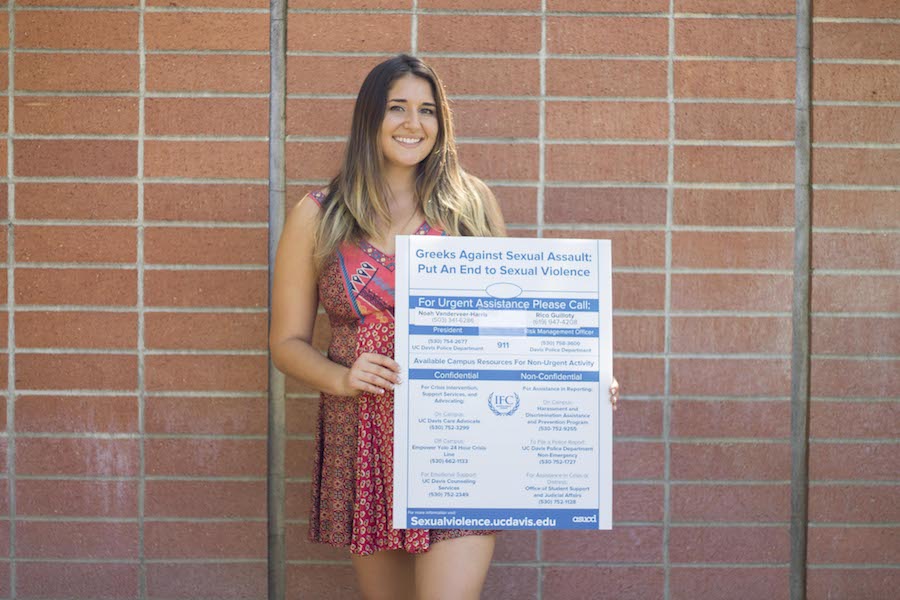
Modeling her work after Berkeley’s prevention posters, Ruttkay created posters headed with the words: “Greeks Against Sexual Assault: Put an End to Sexual Violence.” They contain the contact information of the president and risk management official for the house, the UC Davis and Davis Police Departments, and a list of confidential and non-confidential resources. Ruttkay met with Panhellenic, CARE, IFC and Student Housing to implement her design, and finally, the day before this year’s Picnic Day, was able to nail in these boards.

“These are now up in every [social] fraternity and sorority house,” Ruttkay said. “It’s basically a pledge against sexual assault and it’s keeping chapters accountable for what goes down in their chapter house. This is not an incentive to point fingers at anyone. The point of these is to make [each] chapter a safe space and hold them accountable for what goes down in [their] chapter.”

These posters are symbols of progress and accountability, and Ruttkay believes their physical presence is hard to ignore.

“These posters are up — they’re not a sheet of paper; they’re nailed into the walls,” Ruttkay said. “Chapters know what they are. The members know what they are. It’s taking a stand against sexual assault.”

However, Ruttkay and Rachelle Fishbin, a third-year women and gender studies major, and chair of the Sexual Assault Awareness Advocacy Committee (SAAAC), both agree that this progress is relatively recent, and that progress in general when advocating for this issue is slowed by stigma and a lack of sufficient support from campus administration.

“It wasn’t until my junior year that I saw that [sexual assault advocacy] was something students were passionate about,” Ruttkay said. “[It] was getting shoved under the rug for way too long, and needed to come out. I don’t think we started transforming this culture until last year.”

Fishbin and her committee are trying to make up for the lost years in advocating for this issue by addressing the cross-section between politics and sexual assault.

“The committee [… is] really centered around policy and laws,” Fishbin said. “Especially right now, there’s like a lot of crap happening with [gender violence issues] because of the Trump Administration. So I think we are coming in at a good time to educate students.”

Fishbin is especially concerned about Betsy DeVos’ appointment as head of the Department of Education and how this will affect justice for students in public institutions.

“When Betsy DeVos was appointed, that was a huge concern to a lot of advocates and people who do work within sexual assault,” Fishbin said. “She, until this date, has yet to commit to upholding Title IX regulations for dealing with sexual assault.”

Although Title IX gives students the rights and a venue with which to file reports, filing a report itself can be a long-winded and frustrating process for anyone to navigate, let alone a survivor who must also deal with the emotional scars they are left with.

The process when it comes to filing a report is kind of burdensome,” Ruttkay said. “It’s very complicated, and I honestly say that’s why a lot of students deter from filing a report. A lot of the times [the report] will get looked at and [discarded with the notion that], there [wasn’t] enough evidence to prove [it].”

A UC Davis fraternity, Theta Xi, has been under investigation for almost a year now. According to Ruttkay, the case has yet to result in a conviction.

“It’s just really sad to watch that someone had the courage to report, and yet [heard that] there’s not enough evidence to validate that report — it hurts me to my core,” Ruttkay said.

Marginalized communities such as the LGBTQIA community are especially vulnerable. They often suffer from higher rates of abuse, but their voices are not heard at an equivalent volume.  

“Rates of sexual assault are usually a lot higher in [the LGBTQIA] community, especially for transgender women,” Fishbin said. “Trump and DeVos have rescinded guidelines put in place by Obama that specifically protect the transgender community and specifically mandate that Title IX be applied to all students regardless of [their] gender identity. That’s really concerning. Without it, doesn’t seem like there’s any way to hold schools accountable who don’t protect transgender survivors.”

Another marginalized population that suffers from sexual violence is the incarcerated. This population is not one that is often thought of, and even when media does highlight it, it is overridden by misconceptions and romanticised notions.

Anusha Sundar, a second-year cognitive science and philosophy double major, is the president of Tutors For Inmates, an organization that reaches out to various state prisons and juvenile halls and tutors the inmates to help them succeed academically. As a part of sexual assault awareness month, they held a prison sexual assault awareness seminar.

“It’s been my personal intent to start this sort of awareness in this local community, because so many people have misconceptions and preconceived notions from the media about sexual assault and rape in prisons,” Sundar said. “You see those kinds of misconceptions in prison rape jokes — no one really takes it seriously — and it dehumanizes [the inmates].”

While Orange is the New Black, a popular television series available on Netflix, may provide fulfilling entertainment to some, it certainly skews the perception of this already complex scenario.

“In Orange is the New Black, they have two characters who they portray as falling in love,” Sundar said. “One is a guard and one is an inmate. That’s not a really good portrayal, mostly because it’s not very accurate. No sexual act between a staff [member] and inmate is ever consensual […] you can’t with the structure and the hierarchy within a prison. A staff member is in a position of authority, and there is no way for an inmate to say no. There is no true consent.”

As is evident, UC Davis students, despite the setbacks, are tackling the issue of sexual assault from multiple angles and are trying to help diverse communities both on campus and in our larger universe. Whether it be through spreading word about resources, safe-space initiatives, designated awareness months or even advocating for those we don’t ever see, Aggies are courageously fighting a tough battle.

“I think a common thing that [should be looked at] is humanizing people,” Sundar said. “One person at our seminar asked why it is that in those victims’ videos, the crime he or she performed [isn’t mentioned]. Another person [responded that] it doesn’t matter [what the crime was]. No one deserves to be raped.”


Written by: Sahiti Vemula — features@theaggie.org

Orchard Park set to be demolished

CIERA PASTUREL / AGGIE

Replacement to better meet current housing standards

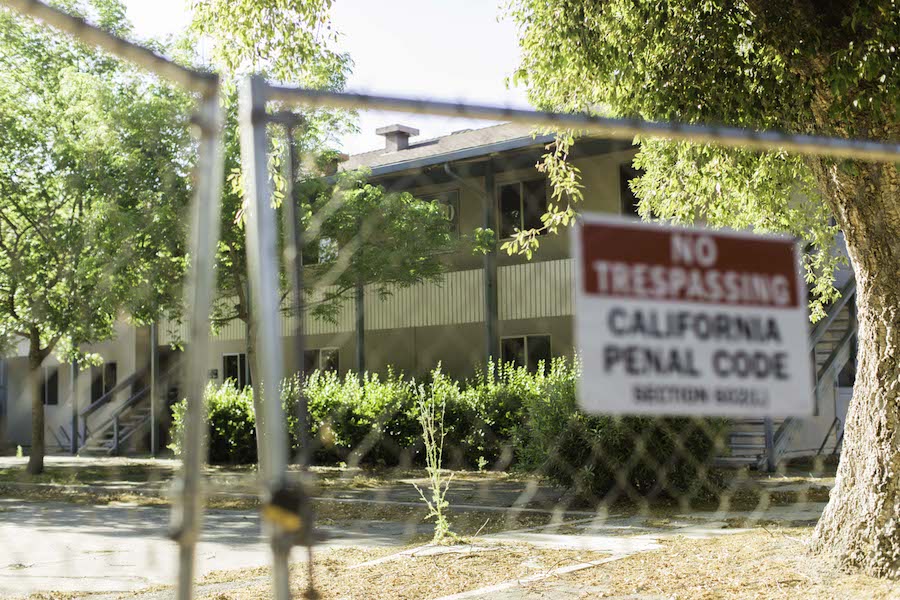
During the summer of 2017, Orchard Park Apartments will be demolished and replaced by an updated apartment complex. In May, after three years of planning, UC Davis will request bids from those who wish to move into the new complex, which is scheduled to be completed by Fall 2020. Although the focus of the complex will be to provide housing for students with families, they will not be the only ones with access to living there.

The request for proposal for the new development includes a mix of both apartments for student families and apartments for single graduate students,” said Emily Galindo, the associate vice chancellor of Student Affairs, via email. “Students who request to lease in these facilities are required to provide documentation of relationship status to the lease (birth certificate, marriage certificate or domestic partnership) or have a roommate who is also a full time registered student.

Although officially closed and fenced off in 2014, demolition of the property was postponed in order to first receive the community’s opinions.

“At the time the complex was closed, residents and students raised a range of concerns about the redevelopment,” said Grant Rockwell, the assistant vice chancellor for Capital Planning and Real Estate, via email. “We did not want to proceed with demolition without additional feedback, so we paused redevelopment for a thorough consulting and planning process, including a report by a specially commissioned committee on family housing including student representatives.”

Orchard Park was originally shut down in 2014 due to the rapidly declining standards of the area relative to current housing standards, according to Rockwell.

“[Orchard Park] would have required significant capital investment to bring [the buildings] up to current housing standards, including, for example, ADA requirements,” Rockwell said.

The name and exact features of the new complex are unknown as project developer has yet to be selected; however, Rockwell assured that the intention is to incorporate as much of the original property features, while still upgrading the facility as a whole.

“The intent is to incorporate some of the same property features as at the old Orchard Park,” Rockwell said. “These features could include: open green space, recreational amenities for both children and adults and perimeter parking to avoid vehicular traffic within the community […] this project will focus on affordability, facility design and quality of life.”

Daniel Nagey, a second-year managerial economics major and an ASUCD senator whose platform includes student housing, supports the long-awaited plan as it should partially alleviate pressure from the housing crisis.

I’m excited, of course, that new housing is being considered at Orchard Park since the structure is old and in need of a remodel,” Nagey said. “It has been pending construction for way too long. The progress being made year to year is incredibly slow considering the high need for housing. We are in a housing crisis right now and this is not the time to be putting off something so important.”


Written by: Emily Shintani — campus@theaggie.org

UC Davis men’s tennis team bids five seniors “adieu”

IAN JONES / AGGIE FILE

A look back at the 2016-17 UC Davis men’s tennis season

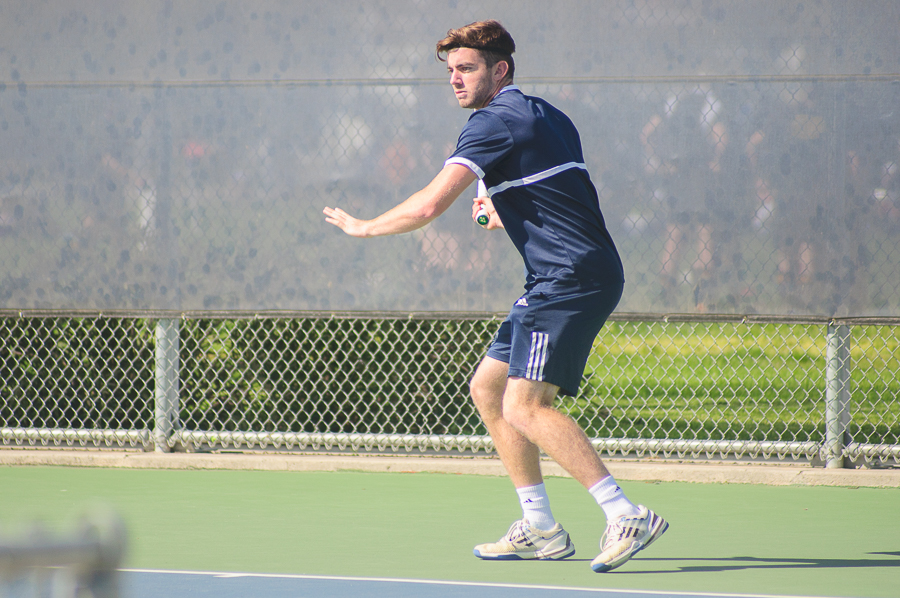
The UC Davis men’s tennis team concluded its 2016-2017 season on Friday, April 29. The Aggies finished another successful season under head coach Eric Steidlmayer.

“We had a good year,” said senior Alec Adamson. “We finished second in conference regular season and we had some good wins over teams we’d never beaten before like [UC] San Diego, San Diego State and Fresno State.”

The Aggies finished with a 14-7 regular season record and a 4-1 record in Big West play. Despite the regular season success, the Aggies’ season abruptly ended in the Big West tournament semifinals with their eighth and final loss of the season against a nationally-ranked Cal Poly team.

The Aggies posted a series of big victories over the regular season, beginning with a 4-3 comeback win over UC San Diego, Steidlmayer’s alma mater, in February.

“We were down in the doubles point, then we came back and [freshman] Max [Pham] and I clinched it in doubles,” Adamson said. “We came [all the way] back and won 4-3. That was a pretty good win.”

Fast forward to the beginning of Big West conference play in March; the UC Davis men’s tennis team opened against Cal Poly, which began to take on a nemesis role after ousting UC Davis in last year’s Big West Tournament semifinals. The Aggies set the tone for this year’s regular season conference matches with a gutsy 4-3 win over the Mustangs behind the strong play of Adamson, junior Everett Maltby, senior Bryce McKelvie and senior Eli Whittle.

Unfortunately, the regular season success didn’t quite transfer over to the Big West Tournament, as the Mustangs posted a 4-2 victory to oust the Aggies for the second straight year.

“They have a lot of talented guys on their team and they’re known for being a pretty rowdy group,” Maltby said. “They’ve proven to play pretty solid in the tough moments as it gets closer to the end of the year.”

With the exception of Maltby, the Aggies were a senior-laden squad led by Adamson, McKelvie and James Wade.

“We had five seniors this year, most of them playing in the starting lineup,” Adamson said. “We had a lot of experience.”

Wade and McKelvie combined to form a potent doubles duo that led the Aggies doubles teams with 16 wins. They finished out their careers as number one and two respectively on the career wins list in UC Davis men’s tennis history.

“Bryce and James have had a lot of big clutch wins over the last four years, they’ve held down their spots really well,” Adamson said. “They’re great guys, they work hard in practice and they’re really good competitors.”

Adamson is no slouch either. One of the most decorated UC Davis men’s tennis players ever, he was honored as the 2015-2016 Big West Player of the Year and earned a trip to the NCAA Regionals. This year, he finished with his fourth straight first team all-conference honors in both singles and doubles play.

The seniors’ success is a testament to Steidlmayer’s work. He arrived in 2012 and his swift turnaround of the UC Davis men’s tennis program has been a joint effort between his senior recruits and his coaching staff.

“He’s taken the program a long ways,” Maltby said. “We’ve now beaten teams that we weren’t even contending with a few years ago.”

With half the team graduating, the Aggies will need players to step up next year. As one of the team’s two soon-to-be seniors, the other being current junior Tommy Lam, Maltby feels as though he can help fill the void.

“I want to be able to lead the team next year,” Maltby said. “We’re going to be a pretty young team, so I want [Lam and I] to take charge and get us to where we want to be, which is winning that tournament next year.”

While it may be the end of a UC Davis men’s tennis era, a strong freshman recruiting class is hungry for its shot in the spotlight. If Aggie fans need any indication as to the direction of the program, it was announced on the morning of May 4 that freshman David Goulak was honored as the first ever UC Davis men’s tennis Big West Freshman of the Year.


Written by: Rowan O’Connell-Gates — sports@theaggie.org


MAX Challenge opens up downtown

JERO REAL / AGGIE

New gym in downtown Davis offers 10-week program to a healthier lifestyle

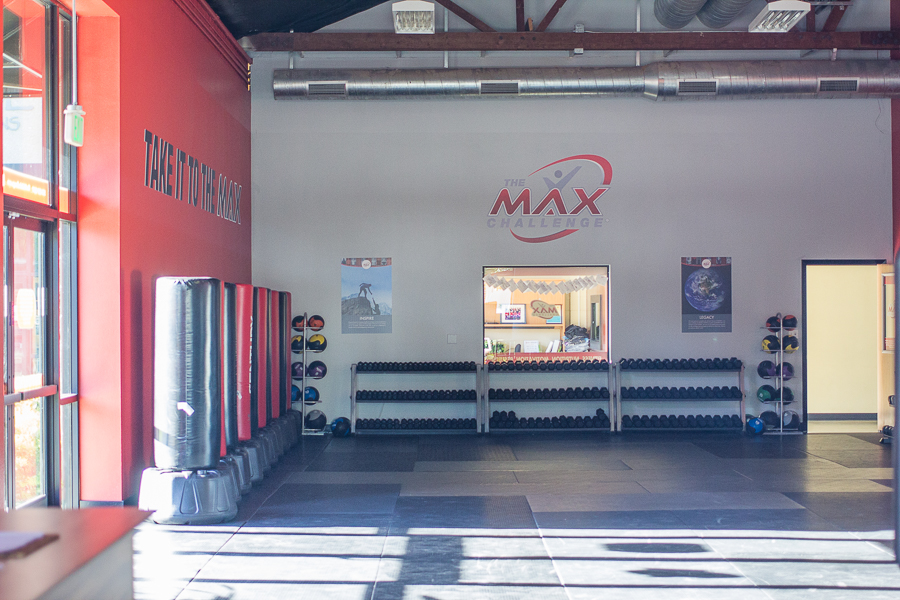
An explosive new gym has opened in downtown Davis — MAX Challenge, consisting of a 10-week program that aims to positively reshape client’s health. Besides physical goals, MAX Challenge promotes healthy eating and hopes clients leave leading an overall healthier life. MAX Challenge is new to all of the West Coast including Davis.  

“We are the first one standalone on the West Coast, outside of New Jersey,” said Richard Baciarini, a MAX Challenge of Davis coach. “Our Woodland location opened about two years ago, so that took off very successfully. Then we opened one up here.”

MAX Challenge is growing quickly with over 60 locations, but Baciarini said the start of MAX Challenge came from one person’s motivation.

“My friend started this franchise, in New Jersey,” Baciarini said. “He went through a funk where he gained a lot of weight, had his kids, kinda got distracted from taking care of himself. One day he realized he needed to take care of himself to take care of his family. Went through full nutrition training, private workout, you know, trainings and really developed this for himself. Then realized ‘Wow, it’s amazing.’ Opened it in a martial arts school and kinda took off from there.”

The 10-week program starts with clients choosing an obtainable goal. While many people arrive seeking to just lose weight and stay in shape, Baciarini said MAX Challenge tries to find the real reason people want to work out.

“So basically the first week you are kinda digging deep on more than just a superficial goal,” Baciarini said. “For me it was, I wanted to lose weight. But then when I dug deeper it was: you know what, I want to be a role model for my young kids. I want to live to see them graduate. I want to live to see grandkids. And I don’t want to, you know, have a heart attack before my daughters are, you know, I don’t want to leave them too early. I get emotional talking about it, because that’s my Why. […] When I start thinking about that, I don’t miss a class.”

Piyush Dahal, a client halfway through her 10-week program, also shared her goals.

“I have a wedding coming up in July, so to feel comfortable and confident in my wedding dress,” Dahal said. “But also I’m a teacher in Sacramento, so [I want to] be a role model for my students.”  

To keep clients committed to the goal Baciarini puts in extra effort to make the classes entertaining.

“I want them having fun!” Baciarini said. “I don’t want this to be chore. […] I want someone to say, ‘I can do this five days a week. I can do this for the rest of my life.’ […] Sweating is number two, if they aren’t sweating I’ve failed, right? I want to make sure they’re moving, you know? You’re coming here for a forty-five minute workout and we want to give you the best workout possible. […] Smiling, sweating and motivation, is what I would say. Everyone leaves inspired.”

Baciarini outlined what a usual week looks like in the program. Mondays and Wednesdays are composed of workouts focused on the legs and core. Tuesdays are for the arms and Fridays are for kickboxing. While much of the work is intense and physical, some is also about bettering eating habits.

“We got the full nutrition,” Baciarini said. “And it’s not like you gotta have a meal plan or buy stuff from us. It’s really about the right food, the right portions, and the right times.”

The purpose of the program is to begin a new healthier lifestyle, but it doesn’t always feel like work.

“We are not just in class, get out, who’s next, turning people over,” Baciarini said. “We’ll cap our classes out at about 35. It’s a community first and foremost, and that’s the motivation that is very powerful.”  

Natalie Flynn, a first-year French major who is interested in the program, sees how a tighter workout community could help one get in shape.

“I see advantages of having a community, it helps you stay engaged and motivates you,” Flynn said.

MAX Challenge is located at 912 5th Street, Suite 100. More about MAX Challenge as a whole can be found on its website.    


Written by: Nicolas Rago – city@theaggie.org


UC Davis commits to American Talent Initiative

MORGAN TIEU / AGGIE

Initiative holds shared goal of educating 50,000 more low-income students by 2025

UC Davis has joined the American Talent Initiative (ATI), an effort to educate 50,000 more low-income students at U.S. colleges and universities by 2025. The initiative began in December 2016 with 30 members and now has expanded to 68 members. It is coordinated by two nonprofit organizations, The Aspen Institute and Ithaka S+R, with support from Bloomberg Philanthropies.

Elizabeth Davidson Pisacreta, a senior researcher at Ithaka S+R, said that the idea for the initiative began in 2014 and 2015, when Aspen Institute and Bloomberg Philanthropies held discussions to tackle the issue of socioeconomic diversity at the nation’s top colleges. Top colleges are defined as having graduation rates above 70 percent.

“The ATI was formed in response to participant consensus that, in order to increase access and opportunity, colleges and universities needed to come together around a set of shared goals,” Pisacreta said via email. “To achieve those goals, member colleges and universities would need to work collectively to share effective practices so as to amplify successful strategies and to identify and overcome barriers to progress. ATI began initial membership recruiting in 2016, coordinated by the Aspen Institute’s College Excellence Program and Ithaka S+R and supported by a grant from Bloomberg Philanthropies.”

Institutions are eligible to join ATI if they consistently graduate 70 percent or more of their students, according to Tania Nguyen LaViolet, senior program manager and project co-lead of ATI at The Aspen Institute.

“After we launched in December 2016, senior leaders at UC Davis reached out to us about joining the Initiative,” LaViolet said via email. “Not only does UC Davis have an above-sector-average lower-income student enrollment, but in the last five years, UC Davis has had a six-year graduation rate of over 80 percent — well above our eligibility criteria. We’re very excited to have them as partners in this work as we learn about the best practices in increasing access and success from across the membership.”

Institutions will be committing to their own efforts to enroll, support and graduate more students in addition to joining an initiative-wide exercise based on their four focus areas. LaViolet explained the focus areas: recruiting students from diverse socioeconomic backgrounds through robust outreach, ensuring that admitted lower-income students enroll and are retained, prioritizing need-based financial aid and minimizing or eliminating gaps in progression and graduation rates between students of different income levels.

“In addition to their individual efforts, institutions are committing to learn from each other, share knowledge through a vibrant practice-sharing community and engage others — students and families, the general public, other institutional leaders — around the issue and importance of increasing opportunity for lower-income students,” LaViolet said.

ATI will be holding institutions accountable to the shared goal of 50,000 graduated students by 2025. The Aspen Institute’s College Excellence Program and Ithaka S+R will study effective practices that lead to progress and will publish reports and papers with strategies to increase ATI’s success.

“Each year, ATI will collect and pool data from member institutions to measure and publish our collective progress,” LaViolet said. “If there are individual institutions that struggle more than others, ATI will be there to provide assistance in connecting them to the support, research and partnerships that can help them make progress over the long run.”

UC Davis is one of four UC campuses that is part of ATI, along with UC Berkeley, UC Irvine and UCLA.

“As one of the national leaders in enrolling and graduating promising students from all socioeconomic backgrounds, we have much to contribute to this shared work,” said Ralph J. Hexter, the interim chancellor at UC Davis, to University News. “There is also much to gain in developing strategies for even more inclusiveness and more equitable outcomes for all student constituencies.”


Written by: Jayashri Padmanabhan — campus@theaggie.org

Laughter as medicine

AARON KEOKHAM / AGGIELAUGH

Research shows laughter can create positive emotional associations

A courtroom artist was arrested today for an unknown reason. Details are sketchy.

Your response to that painful joke might have been an open mouth with a ‘haha,’ a jerking of the body and probably loss of breath. It’s laughter — something that we all should experience more often because it has positive associations with our emotions, social relations and responses.

Emotion theorists have studied the transition from negative to positive emotions that laughter can create. They’ve shown that if a person is undergoing a stressful situation, a quick way to relieve it is to increase positive emotion through laughter. Dacher Keltner, a professor of psychology at UC Berkeley, studies laughter. In one of his articles, he describes the relationship between laughter and the mind.

Keltner explains that the first step of laughter involves “a shift in psychological state, from negative to positive emotion,” as well as a movement from “incongruity and violated expectations to understanding and insight.” The second characteristic of laughter involves a “reduction in the distress associated with negative emotion.” Finally, Keltner says that when laughter reduces distress, it creates positive states of feelings such as “humor, amusement, or exhilaration.”

Laughter can also create and improve social relationships with your friends and loved ones through a simple contagious process, according to the study. It has the ability to increase success “with romantic couples [and] solve personal conflicts.” In addition, Keltner shows that laughter has the ability to cause more intimate relationships with greater satisfaction and reduce loneliness. The research proves just how great a method laughter is in helping us become more sociable. Students may find it hard to relate to others on campus, so why not try a painful joke? Someone might find it rather punny and it could spark your next relationship.

Laughter also has immediate effects. You can annoy your friend with bird puns, but they will eventually come to the realization that they toucan play the same game. While you laugh, Keltner has found that, almost instantly, you will have improved psychological functioning, especially during periods of stress. The study also shows how making someone laugh can help reduce the “negative effects of stress.” Participants, after a humorous moment, even “showed lower scores of depression.”

In his book Laughter: A Scientific Investigation, Robert Provine, a neuroscientist and professor of psychology at the University of Maryland, argues that laughter can bring people together. It can also help shape one’s character, making them seem “warm [and] cooperative.” Laughter is a positive emotion, and Provine illustrates how “laughter could produce a benevolent body chemistry conducive to health.” The book says that the power of positive emotions, like laughter, is more widely accepted by the medical world and can decrease “stress, anxiety, and anger.”

It’s during times of overwhelming stress that students should engage in humorous activities. UC Davis has a variety of ways to engage in laughter, such as improv shows on campus, open mic nights, humor columns in The Aggie and even just sharing a joke with a stranger. Remember, when you want to make a joke about sodium, it is Na… a very good idea.


Written by: Marison Beas — mbeas@ucdavis.edu

Disclaimer: The views and opinions expressed by individual columnists belong to the columnists alone and do not necessarily indicate the views and opinions held by The California Aggie.


Netflix’s Girlboss review

NICKI PADAR / AGGIE

The ups and downs of Nasty Gal

Last month, Netflix dropped a new original show called Girlboss, based on the life of the creator of the company Nasty Gal, a vintage-type clothing company that started out as an online retailer.

The show follows the life of Sophia Amoruso from her humble start selling clothes on eBay to the successful launch of her website. This show has received mixed reviews, because it’s so hard to sympathize with the main character; this is a good show to binge if you want to watch something so bad it’s good. However, the rags-to-riches story is a common tale and hits home with many American ideals.

Sophia is a mess, to put it lightly, and we see this throughout the show. It begins with her life going nowhere but her attitude going everywhere. She is rude, tough and cocky, which causes a lot of problems for her. She can’t keep a job for her life so she decides to make her own business. She has a knack for finding pieces of clothing, transforming them and selling them on eBay. She then becomes the biggest seller of vintage clothing on eBay, and because of her success, the other sellers feel threatened. They boot her off of eBay and inadvertently give her the idea to start her own business.

This gives her the opportunity to sell herself as a brand; the name Nasty Gal arises as representing everything Sophia stands for. The show itself is shot in a grungy style that helps the viewer insert themselves into her life. She is a heroine who is sometimes hard to root for, as she is overwhelmingly selfish. At the beginning of the season we see her more as a child, but as the season grows, so does she. She is full of ups and downs that go along with learning how to be an adult, which adds a degree of relatability to the show. By the end of the season, I felt sympathetic for her and wanted to see her succeed, but her overbearing attitude was overpowering.

The show’s timing is a little unfortunate given that, in November, Sophia stepped down as CEO and Nasty Gal filed for bankruptcy. To make it worse, the show was announced in February.

Just like Sophia, the show is messy and is in its early stages of creating a successful show. The dialogue is amatuer, to the point where I’m tempted to call the writers and help out. I love the idea of making a show about a successful woman business owner, but I wish the show portrayed Sophia as more than a bossy alpha female.


Written by: CaraJoy Kleinrock — arts@theaggie.org

UC Davis practices sustainable sourcing

NICKI PADAR / AGGIE

Dining Commons leads in sourcing food from local, organic, student-run farms

Ranking 18th on the The Daily Meal’s Best Colleges for Food List, UC Davis goes above and beyond to provide students with tasty, sustainable meals through its Dining Commons (DCs). Davis’ DCs exceed the UC Sustainability Policy goals for all UCs, but where does this seemingly limitless buffet of food come from, and what exactly does sustainability in food service mean?

UC Davis’ Sustainability and Education Program, partnering with other student-led groups, informs DC patrons of the sustainable background behind meals on campus. A recent bulletin board of such information intrigued Justin Zhao, a first-year managerial economics major who eats at the DC daily.

“[The program] gives you information on […] the process of how this food is made,” Zhao said. “You could eat unlimited food for this price so that’s why it’s interesting. How is it that I can swipe [in] once and then get 18 steaks?”

A complex chain of production lies behind every plate served in the DCs, and UC Davis Dining Services tries to make every step in this process eco-friendly. The DCs’ advocacy of energy and water conservation, pollution prevention, solid waste reduction, green building and incentives for emission-reducing employee commutes certify it as a Sacramento Area Sustainable Business.

“About 50 percent of our produce is sustainable, meaning either local or organic,” said Kiko Barr, the sustainability and education coordinator for UC Davis Dining Services. “We have a produce distributor and a lot of our local produce comes through them. They tell us what’s local and what’s available.”

Ordering ingredients from sustainable farms accounts for a large reduction in UC Davis’ environmental impact, as the university uses produce from environmentally-friendly farms instead of industrial farms that rely on harmful practices, such as the use of fossil fuels and pesticides. With 50 percent of produce coming from sustainable sources, UC Davis is ahead of the UC Sustainability Policy goal of having 20 percent of produce in all UCs from sustainable sources by 2020 and has increased this amount of produce in the past year by 23 percent.

Many of these green initiatives are driven by UC Davis’ thriving community of environmentally-concerned students, some of whom are members of UC Davis’ chapter of the Real Food Challenge. This national network of student food activists has successfully lobbied UC Davis’ Dining Services to partially shift away from industrial farms and junk food toward “local and community-based, fair, ecologically sound and humane food sources.”

The selection of ingredients used in the DC depends on guidelines like those adopted from the Real Food Challenge in addition to guidelines such as seasonal availability, pricing and taste profiles offered by UC Davis’ food distributor, Fresh Plate.

However, special partnerships with select farms expand the array of ingredients DC chefs can consider using for their recipes. Rue & Forsman Ranch, an organic rice farm that has been owned by three generations of UC Davis graduates, provides all of the DCs’ white and brown rice. Michael Bosworth, the latest owner, was an agricultural and resources economics masters student.

“[Bosworth] was a UC Davis graduate and is really passionate about organic rice and creating a habitat for wildlife, especially birds that need places to stay during their migration,” Barr said. “California used to have a lot more wetlands and because they’re disappearing, rice fields have taken [place] of that. A lot of migratory birds go north and they need resting places and places to get food.”

Other student-led efforts promote campus-based food sources, such as Aggie Grown, an award-winning student group that works directly with DC chefs to order ingredients from the university’s resources.The Meat Lab, run by the Animal Science Department, offers students hands-on opportunities in the animal and meat industry. The Olive Center, originally a creative solution to reduce the olives that would cause hazards on bike paths when they ripened and dropped, is now a world-renowned leader of research in the olive industry. Russell Ranch is a 300-acre facility that is part of UC Davis’ Agricultural Sustainability Institute and partners with the university to perform agricultural research and provide field trips and internships for students.

The Student Farm’s organic Market Garden, a production field on campus established in 2011, is staffed by a community of 40 to 60 students who work there daily to provide produce for the DCs.  

“[The garden] was created as an alternative agriculture space by a group of grad students who didn’t like all of the conventional agricultural research that was going on around Davis,” said Lexi Fujii, a fourth-year sustainable agriculture and food systems major and Student Farm community events organizer. “They really wanted a space to try alternative farming, which is really just a lot of organic farming methods.”

The growth of the Student Farm’s production has been rapid. Composed of only seven acres of land, it now grows about 3.8 percent of all of the DC’s produce compared to only one percent last year. In spring 2016 alone, the Student Farm sold the Dining Commons 970 pounds of cabbage, 407 pounds of beets and 270 pounds of potatoes, and it is continually expanding production.

Despite these staggering quantities, the order and delivery process is simple and streamlined.

“We order from our student farm on Google Sheets, they pick it, and our students pick it up and deliver it,” Barr said. “Sometimes it’ll be [harvested] the day of […] and then it’s served.”

Close proximity of ingredient sources enable consistently fresh food shipments arriving  two to three times per week. To many UC Davis students, these sustainable food practices are a no-brainer, but finding out how food gets from the farm to the DC plates can enlighten even the most frequent of DC visitors.

“Maximize the location [by sourcing locally] for good food,” Zhao said.  “I like it. It saves money, and it’s fresher.”


Written by: Kristen Leung — features@theaggie.org

Celebrate Davis: 100 years in the making

DAVIS CHAMBER STAFF / COURTESY

City event brings businesses, residents together with a fun twist

The Davis Chamber of Commerce will host its annual Celebrate Davis on Thursday, May 18, as it successfully continues to support and showcase a significant part of the community: businesses and organizations.

The free festival will take place at the Davis Community Park from 4:30 to 9 p.m. and will finish with a short fireworks show.

“[Celebrate Davis] fits well within our mission of promoting, supporting and advocating the general economic vitality of our membership, and the quality of life for the community,” said Christina Blackman, the CEO of the Davis Chamber of Commerce. “It is also a great opportunity to celebrate many of our fantastic businesses and nonprofits. We are striving to educate the community on the importance of celebrating and shopping local.”
This year will mark its 15th year as a successful and growing tradition after being ranked second in the Davis Enterprise Reader’s Choice 2017 list for Best Community Event.

“This event […] shows off the best our community has to offer,” said Bob Bowen,  public relations manager for the City of Davis. “I think it is important that students from all backgrounds get to know the community.”

Blackman described the event as family-fun orientated and a perfect opportunity to visit, meet and learn about community businesses and organizations at their booths while enjoying food, drinks and games.

“Most of our entertainment are from local bands or performers, […] we like to keep everything centered around Davis and give as many people as we can an opportunity,” Blackman said.

Bowen and Blackman both encourage individuals to come out and support their community, as well as get in touch with its history and progress.

“The history of the [Davis Chambers of Commerce] goes back to 1905 even before the city was incorporated [in 1917], the chamber and several business owners got together and campaigned to bring the university farm school to the Davis community, so that’s always been a really important part of what our business model,” Blackman said.

Events like Celebrate Davis continue to celebrate the city’s success and contribution to the state of California.  

“Here we are 50 years later [on the anniversary] for the bike lane and 100 years later for the city,” Bowen said. “[Events] such as Celebrate Davis really celebrate the history of Davis.”

Robert Hayes, a long-time Davis resident, looks forward to the event every year.

“Fun and exciting community events like [Celebrate Davis] really represent what Davis stands for and what it means to be a part of a unique city,” Hayes said.

Bowen believes that, whether or not students plan to stay in Davis, getting to know the community holds value since they can spread the spirit that keeps the Davis community alive and prospering elsewhere.

Although this event is not specifically targeted to students, Blackman said it is still a great way to get acquainted with the community and it is a perfect opportunity to get involved.  

“We are really lucky to have wonderful members that are dedicated to the community,” Blackman said.


Written by: Ray Ruano – city@theaggie.org


Best Coffee: Temple

ALEXA FONTANILLA / AGGIE

What is the only thing that can get UC Davis students through a tough week of midterms? Coffee, of course. Caffeine-dependent students can take a moment and step out of the hectic environment in downtown Davis and enter a mini coffee oasis at Temple Coffee on the corner of G and 3rd streets.

Temple creates a comfortable and relaxing atmosphere, which is a breath of fresh air for busy students. With an overall minimalist feel, the shop features a long table in the center with many seats surrounding it to create an area for UC Davis students to study. Large windows throughout the store allow for natural lighting to shine through and add to the peaceful energy.

The founder of Temple, Sean Kohmescher, envisioned Temple being a “community gathering place,” according to its website, and this is exactly what it has accomplished, according to Temple Coffee employee Christy Smith.

“I would say we have a really good community here,” Smith said.

In addition to a great community, Temple also takes pride in the quality of its coffee beans. As a craft coffee shop, Temple’s baristas go through a training program in order to learn the art of coffee and ensure high quality customer service.

“[We] make sure everyone is getting really good coffee,” Smith said. “There is no one else really in Davis that makes it the way that we make it.”

Whether a coffee connoisseur or someone looking for some Instagram-able latte art, Temple’s got all coffee lovers covered.


Written by: Elizabeth Marin  — features@theaggie.org

Best Campus Snapchat Filter: The White Water Tower

ANH-TRAM BUI / AGGIE

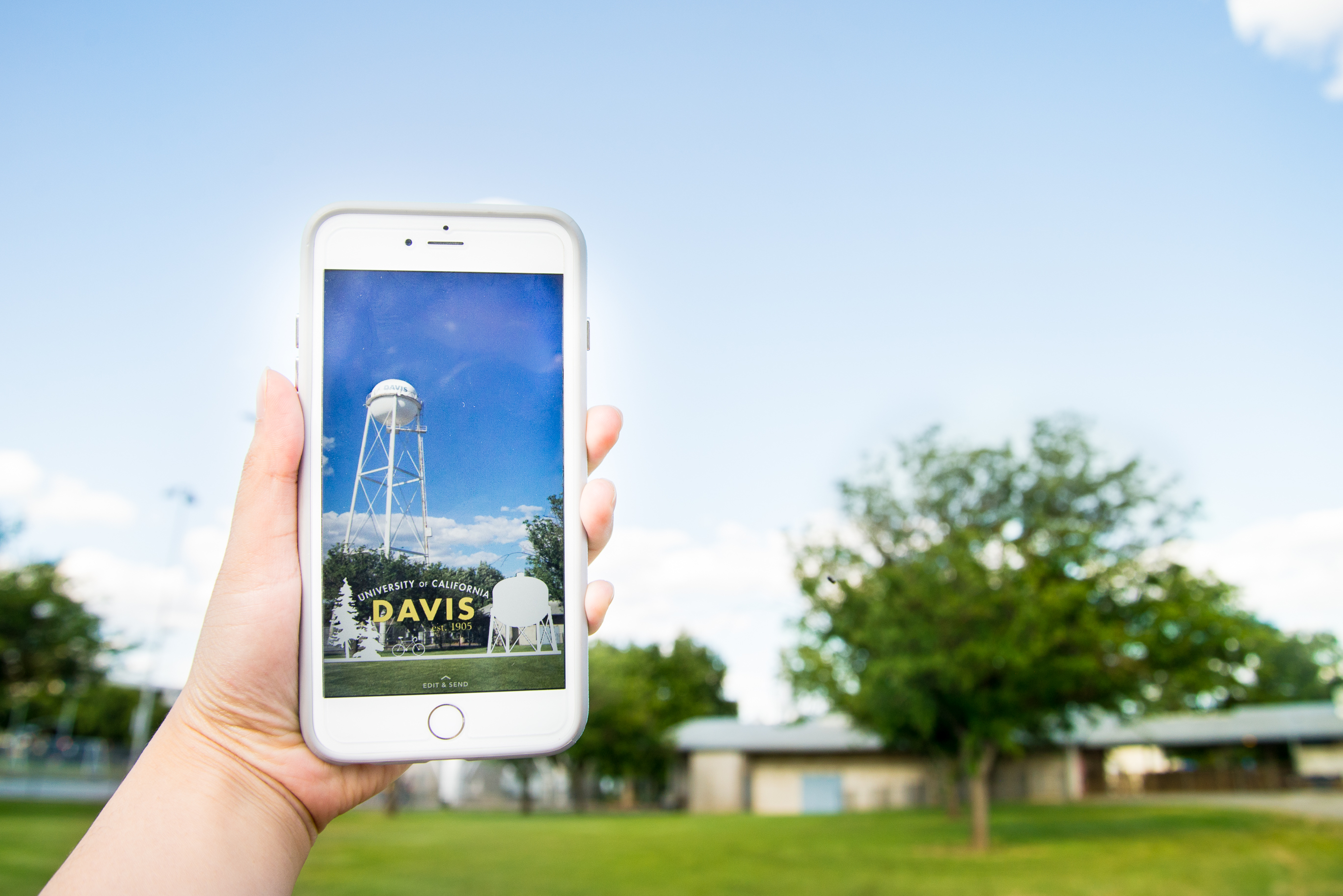
The classic white water tower Snapchat filter has graced the phone screens and embellished the snaps of countless individuals in the UC Davis student community. Alluring due to its powerful design and logo, it transforms many a snap into a piece of art.

“I used the whiter water tower filter when I took a scenic picture of the campus,” said Ashley Salazar, a third-year wildlife, fish and conservation biology major. “I thought it was a cute, simple filter that best represented UC Davis.”

This filter draws inspiration from the iconic water towers on campus, one located by the Arboretum and the other by the Dairy Field on Hutchison drive. The UC Davis logo imprinted across these towers welcomes visitors to the campus and distinguishes these towers from others in the City of Davis. Though primarily used to circulate water throughout UC Davis, these water towers are also great for the aesthetic appeal of the campus. That same aesthetic appeal is conveniently captured by the filter on Snapchat.  

Other competitors did not have the appeal of the white water tower. It is safe to say that the beloved white water tower filter has earned a warm place in the hearts of UC Davis students.  


Written by: Harnoor Gill — features@theaggie.org

Best Place to Buy Groceries: Trader Joe’s

JORDAN KNOWLES / AGGIE

The 2017 winner of Best Place to Buy Groceries is the Hawaiian shirt paradise that is Trader Joe’s.

Open since 2010, Trader Joe’s is the grocery store located closest to campus on the corner of Russell Boulevard and Sycamore Lane in University Mall — only a quarter-mile away from the Segundo Residence Halls and across the street from the Cuarto Residence Halls.

Trader Joe’s offers a wide variety of fruits, vegetables, meats, frozen meals and more. Even though Trader Joe’s is much smaller than larger grocery stores in Davis like Safeway and the Davis Food Co-op, Trader Joe’s prevailed.

Affordability is a major selling point for grocery stores, and Trader Joe’s markets itself as a store with upfront pricing on all its goods.

“‘Value’ is a concept we take very seriously,” the Trader Joe’s website reads. “And by ‘Value,’ we mean great everyday prices on all of our great products — no sales, no gimmicks, no clubs to join, no special cards to swipe.”

Upon walking into the bustling store, one can turn to their right to see the array of produce and ready-to-eat meals the store serves. Another marketing tactic Trader Joe’s employs is their seasonal offerings, including their pumpkin pancake mix in the fall.

Scott Bowden, a third-year English major, values more than just the affordable pricing at Trader Joe’s.

“They have a wide variety of foods that I like, and it’s at a really low price, so I don’t feel like I’m spending too much money when I shop here,” Bowden said.
Written by: Kenton Goldsby and Brody Fernandez — features@thaggie.org

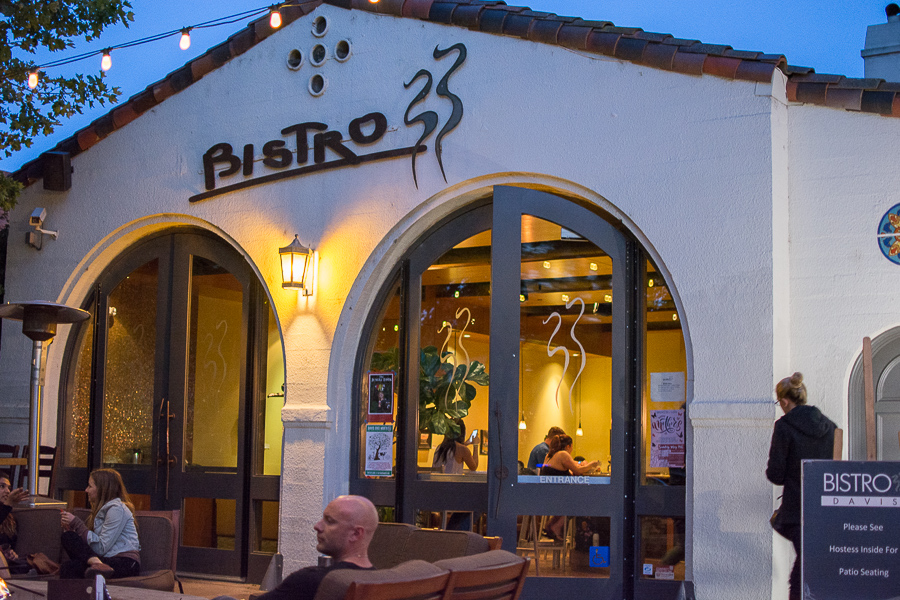
Best Bar Special: Mojito Night at Bistro 33

NICOLE WASHINGTON / AGGIE

Bistro 33’s Mojito Night keeps Thursday nights in downtown Davis lively, according to students who voted the bar special as the best in Davis.

The Mojito Night special is available every Thursday from 6 p.m. to midnight, during which buyers can treat themselves to an entire mojito pitcher for just $12.

“The special is great; everyone here loves it,” said Dalia Lopez, a hostess at Bistro 33. “You can get a pitcher of mojitos for $12 instead of getting one drink for 10 dollars, which is really nice. The bar area is also really big, so it can fit quite a lot of people there.”

Conveniently located on the corner of F and 3rd Streets in Downtown Davis, Bistro 33 also serves a plethora of breakfast, lunch and dinner options.

On Thursday nights, Davis students and residents can enjoy their drinks on the patio and relax to the music of DJ Smilez, a local DJ artist. Bistro 33 also boasts its own outdoor fire pit for chilly nights when the temperature drops.

After a long week of classes and studying for exams, UC Davis students seem to agree that Mojito Night at Bistro 33 is the best way to kick off the weekend in Davis. Restaurant goers should plan to arrive early as Mojito Night typically draws in large crowds as the night progresses.

“[It’s crowded] as long as there are no midterms!” Lopez said.


Written by: Emma Sadlowski – features@theaggie.org