57 F
Davis

Davis, California

Monday, December 22, 2025
Home Blog Page 648

The Lounge Lizards present: No Instruments Attached

LUCY KNOWLES / AGGIE

UC Davis winter a cappella showcase

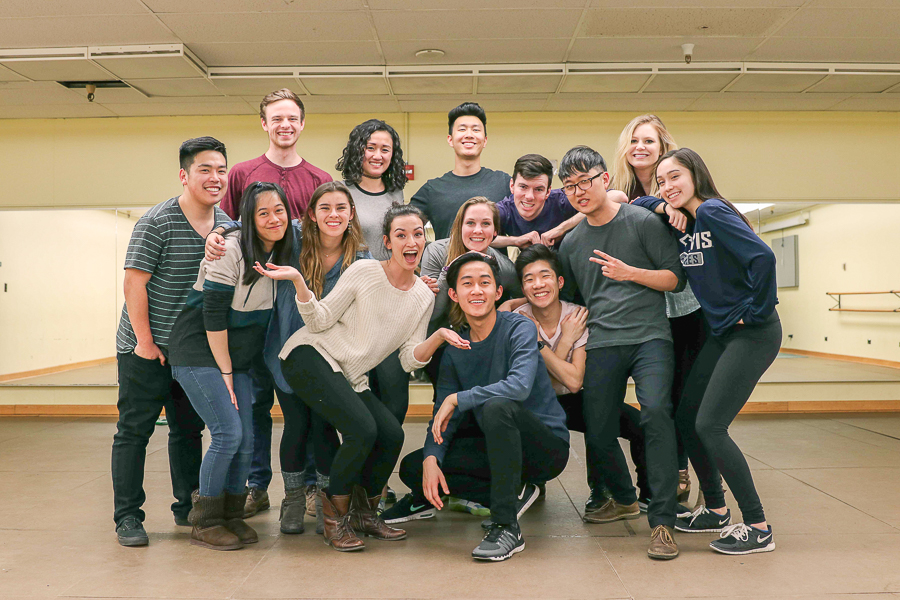
Need a break from the Davis rain and studying? Come watch UC Davis’ longest-standing a cappella group, The Lounge Lizards, perform at its annual concert, No Instruments Attached. The event, which is on Friday, March 10 in Science Lecture Hall 123, will feature other UC a cappella groups such as The Spokes and The Liquid Hotplates from Davis, along with Acquire and Cloud 9 from Santa Cruz.

“It is going to be a sonic mind boom,” said Jake Greenshields, a fourth-year computer science major and second-year member of The Lounge Lizards. “It is going to sound absolutely amazing. All of the groups are incredibly talented. It’s going to be a lot of fun musically. I’m sure there will be some groups that are going to incorporate choreography, so it’ll be one big performance.”

The Lounge Lizards connect with several other choirs across California.

“We reach out to the other groups,” said Patrick Tierney, a third-year forensic chemistry major and treasurer for the group. “A lot of a cappella groups in NorCal have connections with other groups. We especially work a lot with Santa Cruz. We have been friends for a while.”

It remains a mystery as to what the other groups will perform, but audiences can expect a wide variety of song genres from the Lizards.

“We carry over a lot of our repertoire,” said Kellina Doerr, a third-year food science major who has been singing in the group for three years. “We will sing some new songs, as well as some old ones that we have been doing since the group existed. We have a special song for one of our members. It is going to be a really emotional and special performance. People should come just to see that.”

The Lounge Lizards have been recruiting and maintaining members for over 20 years. Founded in 1995 in the Tercero dorms, this group shows what it is like to work as a successful and passionate team.

“After I auditioned, they came to my door,” said Brendan Caskey, a second-year genetics major and member. “I was excitedly confused and shirtless […] That was the moment I knew I didn’t want to go to any other callbacks.”

The group rehearses two times per week on top of whatever events they are booked for.

“There is something about the Lounge Lizards, where you feel something,” Doerr said. “We have been through a lot. Even if we have the worst rehearsal ever, we are all there together. It is really special.”

Doors open at 7:30 p.m. and the show starts at 8 p.m. The public can purchase presale tickets online, or from a member for $5. Tickets will be $7 at the door, cash or Venmo. For more details, please visit the Facebook event.

The Lounge Lizards will be holding auditions for new members in Spring Quarter. If interested, please find and contact them on Facebook, Orgsync and Instagram.
Written by: Myah Daniels — arts@theaggie.org
ASUCD Senate members opt out of meeting in solidarity with “A Day Without Immigrants”

NICHOLAS CHAN / AGGIE

Senators gathered informally to discuss how ASUCD can better support immigrant rights

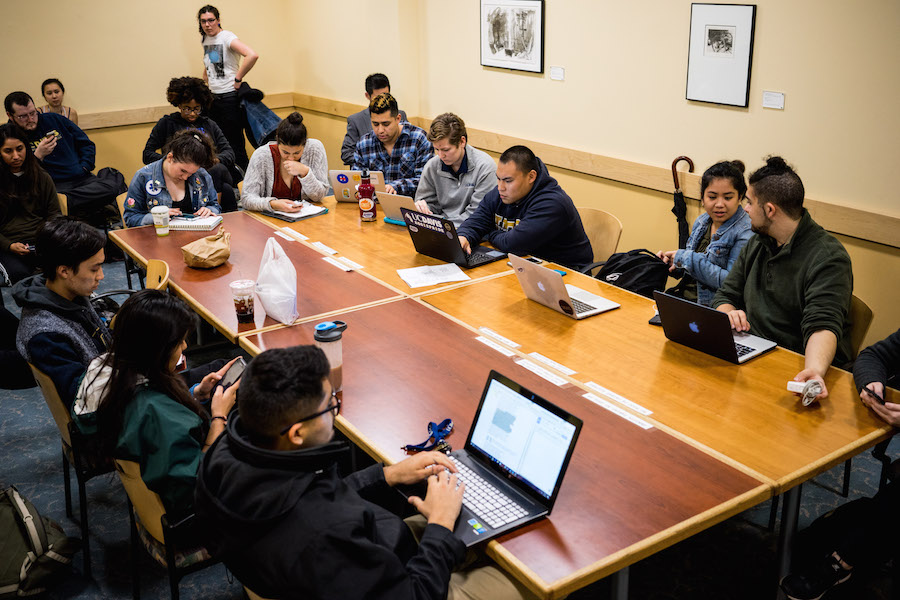
In lieu of the regular weekly meeting, ASUCD Senate members held a resolution meeting on Thursday, Feb. 16 in solidarity with the “A Day Without Immigrants” movement. The alternative meeting was held in the Moss Room of the Memorial Union from 6 to 7 p.m and was attended by members of the public as well as the majority of ASUCD Senate members, excluding three unnamed Senate members who had signed the statement but were absent due to illness, interim Senator Michael Chan (who did not sign the statement but was briefly in attendance) and Senator Matt Yamaguchi (who did not sign and did not attend).

According to a statement issued by ASUCD on Thursday, the nationwide movement, which originated from the nonprofit organization Voces de la Frontera’s “A Day without Latinxs, Immigrants, and Refugees,” led to the cancellation of classes within UC Davis’ ethnic studies departments. Samantha Chiang, ASUCD senator and a third-year English major, directed the meeting for a resolution on how ASUCD could potentially support the campus’ immigrant community in light of President Trump’s immigration bans.

According to Chiang, the idea to call for the meeting was inspired by professor Robyn Rodriguez of the Asian American Studies Department, who cancelled class and encouraged her students to conduct research and get their organizations involved in the movement. During the meeting, concerns were raised regarding the co-opting of immigrant safe spaces as well as defining the members and scope of the movement.

“There are several issues in this movement,” Chiang said. “One, it doesn’t clearly delineate who we’re talking about per se. Two, there’s an issue of whether outliers can and should participate. We need to define who we are supporting, in terms of immigrants. It’s been very unclear from the organizers of the movement. I think the way our associated student body is set up, we would like this to be as intersectional as possible without still not detracting from the original purpose. We have to remember that this came originally from a Latinx and Chicano perspective in order to uplift those voices, but then it expanded into a movement for immigrants as a whole.”

Sarah Shemery, a fourth-year gender, sexuality and women’s studies major and the deputy director of the Office of Advocacy and Student Representation, voiced her opinion that the resolution should de-emphasize the economic value that immigrants bring to American society and instead underscore universal human rights.

“In regard to immigrants and refugees, I don’t want to hear [we support immigrants and refugees] because XYZ,” Shemery said. “I want to hear ‘because they are human.’ [We support immigrants and refugees] not because of what they economically contribute but because they are human beings too.”

A general consensus was reached that ASUCD should work directly with on campus community-based organizations to establish the vocabulary to be used in the public resolution statement. Sara Williams, ASUCD external affairs commission chairperson and a fourth-year history and political science double major, spoke on additional services that ASUCD could provide.

“It’s important that the 20 of us in here educate ourselves, but there are also 27,000 undergraduates who need to know these things,” Williams said. “If we could get law students to come on campus and hold ‘Know Your Rights’ workshops, these are things that are open to the public but forums that we could provide. In this way we could reach out to community organizations to ask if this would be something they’re interested in co-hosting, or something they want to host themselves and have us help out.”

To resolve these issues, the meeting concluded by establishing an immigrant community outreach agenda for the following week, during which members of the Senate and the public will reach out to community organizations on behalf of ASUCD, asking specifically if there is anything ASUCD can do to help immigrant, refugee and undocumented students.

Organizations planned to be contacted in the resolution include the departments located within Hart Hall, the AB540 and Undocumented Student Center, Asian Pacific Islander  organizations, Filipino American groups, the International Student Association, Middle East/South Asia Studies, the Student Recruitment and Retention Center and Black Family Week.
Written by: Kaitlyn Cheung — campus@theaggie.org

Three Generations of Rockers: A review of The Hendrix Experience

DANIEL TAK / AGGIE

Buddy Guy, Billy Cox, Johnny Lang, among others at the Mondavi Center

With its roots grounded in slavery, blues music is the basis of the modern American sound. Braided deep under the soil, the history of blues music stabilizes all that grows forth: the hefty trunk of rock and roll; the sprawling branches of soul; the leaves of punk; the blossoms of EDM.  

My own love of music has a similar lineage. My grandpa was a native San Franciscan during the 1960s, a firsthand witness to the burgeoning rock scene, and my dad was a self-proclaimed teenage metalhead and spectator of 1990s grunge.

So when the three of us arrived at the Mondavi Center on Feb. 23 holding tickets to The Hendrix Experience, the night had an overwhelming sense of heritage.

DANIEL TAK / AGGIE

“From fruits to roots,” explained Janie Hendrix, the CEO of Experience Hendrix and the sister of Jimi Hendrix. Featuring a variety of musicians such as the legendary Buddy Guy and Johnny Lang, the show was memorable in its explicit homage to Hendrix and his diverse sound.

In fact, as Zakk Wylde thrashed his guitar against his teeth (“strummed” is too soft a word to describe the cacophony of twanging guitar), my grandpa assured me: “That’s a Hendrix move.” He added, with a grin, “I’ve seen him do it.”

Jimi Hendrix wasn’t the only highlight of my grandpa’s concert-going experiences. While the three of us slurped eggplant at Sophia’s Thai Kitchen before the show, we wrote down all the shows my grandpa could recall attending: B.B. King, Cream, The Doors, Santana, Jefferson Airplane, The Grateful Dead, Chuck Berry, Miles Davis, Jeff Beck and Janis Joplin, among others. Either from jealousy or the spicy eggplant, my eyes were hot with tears when he added that each concert included three performers a night — at the low, low price of $5.

So of course, my dad’s first concert was with his dad: the Rolling Stones’ “Tattoo You” tour. Together they’ve seen Tom Petty, Foreigner and even met Judas Priest backstage. I, too, have been to shows with my dad, albeit less legendary in scope: cellist Ben Sollee and bluegrass group Punch Brothers.

“Three generations of rockers,” my grandpa called us — and that we are.

Watching the two consume music was in itself an educational experience. I observed how to “rock” and how to “roll” without their uttering a single word. When your head bounces and the music is messy, and the guitarists are coloring outside the lines — this is rock. When you feel a lateral sway, a sort of sideways gravity yanking your gut — this is roll.

Though the audience at the Mondavi Center was diverse in age, it was predominantly made up of older fans who, like my grandpa, were reliving the renaissance of rock music. But among these fans, few had an excitement that matched the tone of the show. My dad and grandpa, on the other hand, were as engaged as the musicians themselves. From melodic oohs and ahs to girlish squeals to grunts, they were easily the most authentic fans in the grand tier of the Mondavi Center.

DANIEL TAK / AGGIE

When Keb’ Mo’ uttered his first growl, or when Kenny Wayne Shepherd absolutely wrecked on guitar (alternatively, he “slathered the Mondavi Center in gasoline and set it on fire,” according to my dad), there was a uniformity to our movement. Like dominoes, the three of us leaned forward, heads bobbing, approaching the edge of our seats as if the extra two inches would improve our hearing.

When I turned to my grandpa, his eyes wide with excitement, hands thrashing around as he further analyzed the night’s wonders, I understood that my own fervor for music was merely a reflection of his own — he the roots, and I the fruit.
Written by: Ally Overbay — arts@theaggie.org

Cha-ching!: How students make extra money

MORGAN TIEU / AGGIE

Creative ways students support hobbies, career interests

The broke college student is an all too relatable visual, but UC Davis students have found creative ways to fill their pockets and supplement money going toward rent, utilities and tuition. From catering, to starting popular TV show fan-bases, to capturing the beauty of everyday people, Aggies continue to prove that when there is a will, there is a way.

Steven Collins, a fourth-year managerial economics major and computer science minor, has turned his love for the show Avatar: the Last Airbender into a profitable side business.

“I think it all kind of started my sophomore year,” Collins said. “I started doing it because I got involved with a facebook fan page. The page slowly gained an audience of 15,000 likes, and then I kind of realized that I had this audience I could advertise to if I wanted to make something and put it out there.”

Creating graphic T-shirts with quotes and images from the show, Collins began his enterprise through a crowdsourcing site called Tee-Spring. The site allows users like Collins to place designs onto shirts, hoodies, mugs and other items.

“I did a sale on [Facebook], and ended up making 150 dollars in a month,” Collins said. “Since everyone on the Facebook page was there because they liked the show, all the designs I made were geared towards that.”

After starting his new business, Collins discovered Repro Graphics, an on campus graphics business run by UC Davis located in Hoagland Hall. Collins made use of its quick production and prices of $5 per shirt to expand his sales.

“I started making shirts in small batches and tried new designs to see what people liked,” Collins said. “Some [of the shirts] had quotes or inside jokes [based on the show]. One of my favorites was a watercolor type painting by my friend of a mask that a character wears in the show.”

As with most businesses, Collins’ faced various fluxes in demand. While the show and its sequel, Legend of Korra, were on the air, many people showed interest in the shirts.

“Now it’s kind of like a slow trickle-in [of sales], but when the show was more active, [the shirts] would sell a lot more,” Collins said. “I haven’t decided yet whether to branch out to target different audiences or anything like that.”

Collins found his business to be a low-pressure, creative way to make some extra money.

“Anybody could follow the path that I did to make a little money on the side,” Collins said.

Esmeralda Vera, a first-year Chicano/a studies major, is an independent makeup artist. Like Collins, she began her side business as a fan of the material. Her intrigue for makeup art began at an early age, and has grown from fandom into a passion.

“I started doing my own makeup since I was in sixth grade,” Vera said. “I started watching Youtube videos, and that’s how my interest grew.”

As she grew up, Vera also made friends who had similar interests, and together they would discuss their reviews of new makeup products and share ideas. Vera also had a very supportive family to back up her work.

“I have five siblings — two brothers and three sisters,” Vera said. “I practiced on my sister and mom all the time. I never practiced on my brothers, but I wish I had.”

In terms of revenue, Vera doesn’t set strict prices, and is still working on turning her side hobby into a side business. She hopes to be able to offer her services to Davis students.

“I mostly just do it for fun, but I’ve done it on other people, and they’ve given me money,” Vera said. “I usually don’t expect any money, but clients generally give me around 20 dollars [for a session]. I want to gain more practice and definitely want to [expand into a side business].”

Vera believes this endeavor has made her a more confident person, one who is able to give helpful tips on demand.

“Always set your face twice: once with spray and once with setting powder so that it stays,” Vera said.

David Suh, a third-year design major, is an aspiring photographer that runs David Suh Photography. Photography began as his hobby, and has now evolved into his life passion that he wants to make a career out of.

“Photography was a very hobbyist kind of mindset in all my friends,” Suh said. “But I got to know more about photography and went to this big photography conference in St. Louis. Being surrounded by actual professionals and those that have dedicated their time to building their brands showed me its not even just about photography anymore. There’s a whole business element about getting behind sales, and that’s when [photography] turned into a career [for me].”

Suh’s photography also evolved greatly in its subjects and style. He is now focusing on building his brand and specializing in photographing the everyday woman in the style of contemporary magazines.

“It started from street photography and shooting cats and bottles and stuff to shooting people as well, kind of like Humans of New York,” Suh said. “I found that more interesting, with all the different personalities on the street their different fashions. From there I got into portrait photography.”

Suh realized that photography as a career involves much more than just taking pictures, and has been working on building and advertising his business.

“I have gone through a rebranding period, and the last couple months have been about rebuilding my portfolio,” Suh said. “I just finished marketing and getting some local connections. Now I’m really started to get some clients and get busy. I’m also building a promotion for  Mother’s day and the upcoming graduation season.”

Suh’s progress has, quite literally, come at a price. He cut down his personal spending in order to invest the money he makes back into his business to develop it for the long run.

“During my freshman year when [photography] was more of a hobby, I [was] supplementing myself for everyday expenses, but now I’m looking more into a longer game,” Suh said. “Building a business and brand isn’t something you can do overnight — success doesn’t come overnight. It’s really about reinvesting that money back into the business.”

Most importantly, these out-of-classroom experiences are invaluable learning opportunities.

“Find your ‘why’ in school,” Suh said. “Many students are so stuck on short-term stuff like handing in assignments and getting good grades that they don’t really figure out what they want to [do]. In college, as long as you play by the rules and get good grades you’ll be fine, but once you get out into the real world, the market doesn’t have set rules.”
Written By: Sahiti Vemula — features@theaggie.org

Building communities and mentorship: First-Year Aggie Connections

GENESIA TING / AGGIE

Program provides incoming students with support, role models

This past fall, Jessica Chalfin, a second-year animal science major, was matched to mentor a group named #Flawless, comprised of students with a common interest in Beyoncé. This group was a part of First Year Aggie Connections (FYAC), a program that launched during Fall Quarter of 2016 to provide an inclusive environment for students to bond over shared interests and discuss pop culture with one another.

FYAC supports new students, both freshman and transfer, as they transition into life at UC Davis.

“Because UC Davis is this big research university, it is really hard to transition,” said Julianne Smith, FYAC coordinator. “[UC Davis] is very different from any community college [and] is very different from high school, so FYAC is really here to help support students academically and socially as they adjust.”

At their summer orientation, incoming students learn about the program and are then able to register for a connection — a themed group of 25 students. During Fall Quarter, FYAC offered about 150 connections with different themes. Some previous connections offered include the “Get Your Board Game On” connection, the “How to Adult” connection, the “Social Justice” connection and many more.

“Each connection has a different theme or shared interest,” Smith said. “Some themes are academic and some themes are more co-curricular.”

Some connections are offered for credit and can be registered for through schedule builder. Most other connections are not for credit and can be registered for through the Student Academic Success Center website. Usually, each connection meets weekly for one quarter to hold discussions and activities related to their theme. Connections for credit account for attendance while connections that are not for credit are completely voluntary.

All connections hold discussions about topics like transitioning to the campus, advising resources, exploring majors and careers, health and wellness and more.

“No matter if you’re in a for-credit or not-for-credit connection, no matter what your theme is, you talk about these key important topics that we know as staff members [are] really important for students to understand as they adjust to life here,” Smith said.

Each connection is facilitated by a professional staff or faculty member and is focused heavily on student life, which makes it different from other programs or clubs on campus.

“You’re really talking about how to balance your academic life with your social life with other things going on and how to be a successful student here — that’s the point of all these meetings,” Smith said. “Being in a connection means talking a lot about campus culture and talking about the transition in that setting.”

The staff and faculty members that facilitate connections propose the theme for their specific connection.

“They propose a theme — so [it’s] something they feel is missing or needed, or something they just feel passionate about,” Smith said.

FYAC also hires peer mentors for each connection. Though they may not participate in all of the connection activities, peer mentors focus on planning events to connect the students outside the program.

“Based off the big group of peer mentors that we’re hiring now, we do a matching process that kind of looks like an NFL draft or something,” Smith said. “We try to match a peer mentor to a connection that we think will be a good fit based on interest or major or anything like that.”

Chaflin applied to be a peer mentor after she spent her first year in a career discovery connection. Chaflin was also matched to mentor a freshman cohort connection in the College of Biological Sciences during Winter and Spring Quarters.

“It’s really great to be a peer mentor because we’re kind of the ones setting up all the activities [and trying] to get people together,” Chaflin said. “There’s been good and bad — it’s kind of hard to get people to go out to events, but […] our goal [is] to get people oriented with the school and meet more people.”

Emmanuela Cao, a third-year human development major, is also a peer mentor for a the freshman cohort connection in the College of Biological Sciences. Cao didn’t have a smooth transition into college during her freshman year as a first-generation college student. After hearing about this program through Facebook, Cao applied to become a peer mentor.

This program has been a learning process for myself,” Cao said. “Being a mentor has enhanced my communication skills with peers and faculty and has helped me develop as a leader. It’s been rewarding getting to know these students on a personal level and having some sort of positive impact on them, even if it’s the slightest one.”

Cao usually plans around two to three events per quarter that take place without a facilitator. Past events for her connection students have included trips to the Arboretum, the Davis Farmers’ Market and the Manetti-Shrem Museum.

Like Chaflin, Kiara Cuevas, a second-year animal science major, was in the Creative Discovery connection her freshman year. However, Cuevas also joined another club in which she had the opportunity to meet older students and ask them questions about campus life. These relationships inspired her to become a peer mentor.

“I thought being able to be that person for freshman is really important because that’s what I wanted and what I got when I was a freshman,” Cuevas said.

According to Smith, a lot of students who were in connections their freshman year are coming back and applying to be peer mentors. From these students and other participants, FYAC has received a lot of positive feedback.

“We wanted to create this small group environment for every student who wants it,” Smith said. “[We want them] to be able to have a community, to have a staff member they can ask questions to [and] to have a peer they can ask questions [to] and have fun with.”

Written by: Fatima Siddiqui  – features@theaggie.org

De Vere’s Irish Pub to host annual St. Baldrick’s event

NADIA DORIS / AGGIE

Funds to go to childhood cancer research

De Vere’s Irish Pub is hosting its annual St. Baldrick’s event from 5 to 9 p.m. on March 9 at 217 E Street to raise money for childhood cancer research.

“It’s an event where everyone comes together to show their support by fundraising for childhood cancer,” said Danielle Brown, general manager of the pub. “A lot of our staff shave their heads.”

Volunteers raise money by collecting donations from family and friends; they also shave their heads in solidarity with childhood cancer patients.

To get involved, participants can assemble teams to help fundraise for the event or they can join the de Vere’s Davis Pub team. This is the 5th year that the staff at the Davis pub has held the event for cancer research. The restaurant’s Sacramento location has featured the event every year since 2010.

“The Sacramento location has been doing it for several years since they opened, Brown said. “It’s been a tradition for them.”

According to the St. Baldrick’s Foundation, over 460,000 heads have been shaved in support of childhood cancer research since the foundation’s establishment in 2000. This year, over 800 head-shaving events have been registered.

Volunteer-run events like these help fundraise millions of dollars toward pediatric cancer research every year. St. Baldrick’s is the largest non-government funder of childhood cancer research grants. The foundation has funded more than $200 million dollars in research grants since its establishment.

According to a worldwide report released in 2016 by the International Agency for Research on Cancer, approximately 215,000 cancer cases are diagnosed per year in individuals younger than 15 years old, and about 85,000 cancers cases are diagnosed for individuals ages 15 to 19 years old. Although significant progress has been made in the fight against cancer, it is volunteer events and volunteer-raised funds that help protect the futures of children who are affected by cancer.

It is showing support for children battling cancer that prompted Mikayla Hartford, a second-year civil engineering student at UC Davis, to participate for the first time at the Davis event by shaving her head in solidarity.

“I’m participating because supporting cancer research is extremely important, and I’m honored to have the opportunity to support cancer patients,” Hartford said.

While she is nervous to shave her head this year, Hartford won’t let that stop her from taking part in the event. For those who might be on the fence about shaving their heads, Hartford argued that participation is valuable.

“It’s important to set aside any preconceived notions of beauty or any pride because bald is beautiful,” Hartford said.

For more information about participating in the Davis de Vere’s Irish Pub event and donating to the cause, please visit the St. Baldrick’s Foundation webpage.


Written By: Anya Rehon — city@theaggie.org

Aggie Style Watch: surviving the winter

BRIANA NGO / AGGIE

The queen of mixing and matching

Kexin Zhao, a second-year material science and engineer major, believes in the practice of mismatching. She is an advocate of wearing comfortable clothes and stepping outside one’s pattern comfort zone. Zhao combines different aspects of her life into her style, such as making her old high school choir jacket chic again.

ASW: What is your style inspiration?

Zhao: I follow a lot of bloggers on YouTube and Instagram. Most times I just try to mix and match. I don’t have that much time to pick my outfit everyday in the morning so I just go with what I feel comfortable with. I recently found a new blogger on YouTube, she’s from the Netherlands and she’s also Asian, which helps me visualize her outfits on me. It’s very hard to look at the European fashion bloggers because their look and style doesn’t match me.

ASW: What is your go-to outfit?

Zhao: Probably sneakers, ripped jeans and v-neck t-shirt.

ASW: Where do you usually buy your clothes? What’s your favorite store?

Zhao: Asos is one of the main places I shop but I also find random places online. Urban Outfitters is my favorite store because they always have the nicest model pictures and even though you may not like the item, you see it on the model and have to try it, although it never turns out to be the case that you actually like it.

ASW: Where did you buy what you are wearing?

Zhao: The jacket is actually from my high school choir, the sweater is from Gap, the shoes from Doc Martens, the jeans are from Abercrombie & Fitch and I don’t know where the scarf is from because it was a gift.

ASW: When did you start getting interested in fashion?

Zhao: In freshman year of high school people don’t really care what they are wearing to be honest, but once in college, there are so many people around who dress nice. It makes me want to dress the nicest.

ASW: What is your biggest fashion regret?

Zhao: I used to have the really chubby sweatpants with the flared legs and a extremely chunky jacket that I would wear together. People used to say, “I don’t know why she is wearing that” and “those pants are only to worn at home.” Looking back I don’t know what I was thinking except that it was really comfortable!
Written by: CaraJoy Kleinrock — arts@theaggie.org

Women’s basketball defeats UCSB in final home game

MEENA RUGH / AGGIE

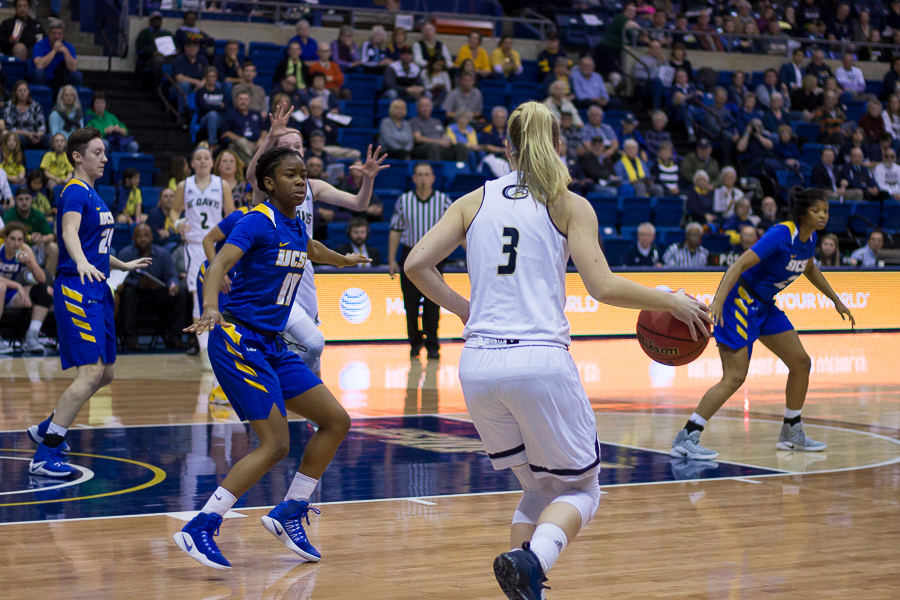
UC Davis women’s basketball team defeats UC Santa Barbara Gauchos 70-61, remains at first in Big West Conference

It was the UC Davis women’s basketball team’s final home game last Saturday at the Pavilion as the Aggies prepared to face the UC Santa Barbara Gauchos. Coming into the matchup, the Gauchos had lost their last two games on the road and sat in fifth place in the Big West Conference. It was before the game, however, that the Aggies showed their closeness as a team as they paid tribute to their lone senior forward, Lauren Beyer, in a Senior Night ceremony.

“She has been so special for our program,” said head coach Jennifer Gross. “She’s the most selfless kid I have ever coached and she is a special young woman who is going to be very successful in life.”

After the ceremony, the game commenced, and would determine if UC Davis remained alone in the first-place position in the Big West.

Going on an 8-0 run in the first quarter, the Aggies were able to close a small deficit early on. Continuing their runs into the second quarter, a 10-2 run gave the Aggies the largest lead of the game at 28-15, with 5:19 left to play until the half. By the time that the half rolled around for UC Davis, they were leading 39-27.

MEENA RUGH / AGGIE

In the third quarter, the Aggie defense was the big factor, as the Gauchos only scored eight points in the period, limiting their shots to just three of 16. The UC Davis offense took off, as a three-pointer by sophomore guard Kourtney Eaton gave the Aggies a 17-point lead at the end of the third, bringing the score to 52-35. UC Davis scored 10 of their last 12 points in the third quarter with only 4:57 left.

The Gauchos outscored the Aggies 26-18 in the fourth quarter, but the 17 point deficit at the end of the third was too much for UC Santa Barbara to make up. The Aggies’ lead was never less than seven points in the fourth, and they won 70-61.

“It was a big win for us,” Gross said. “Santa Barbara has a lot of different weapons and they pressure the ball. I thought to start the game we were very focused defensively and I feel the stops we got won us the game.”

Overall, UC Davis shot 49 percent from the field and 50 percent from the three-point line, going 10-20 on the night. After scoring 25 points earlier in the week, junior forward Pele Gianotti scored 19 points, nine of which came from three-pointers and four rebounds. Sophomore forward Morgan Bertsch finished the game with 15 points, four assists and a game-high seven rebounds.

“I think that we have been putting up the reps in practice,” Gianotti said. “Everyone has been really confident coming off of these wins and we all know that we are great shooters. The whole team worked together and that’s what gave us the confidence to win.”

Junior guard Dani Nafekh made her mark in the record books on Saturday, after three assists in the game gave her 277 career assists, placing her at number 10 on the UC Davis all-time career assist leaders.

“It was awesome,” Nafekh said. “I love being a part of this team and I love the way we play. It is a great testament to how great everyone is to help each other out, make shots when we need to make shots […] I just love it.”

This win marked the eighth win in a row for the UC Davis women’s basketball team, the best winning streak since the start of Division I play for the Aggies. Their current home record of 12-3 is also a tie for the best home record during the D1 era, after the 2010-2011 team finished its season with the same record. The Aggies’ overall record sits at 21-6, and this game marked the third out of the last five seasons that the UC Davis women’s basketball team has had at least 100 blocks in a season, showing its strong defensive ability

“I think we are a versatile group,” Gross said. “When we need to rely on our defense to win we can do that and the same for our offense. I didn’t know that about our team before this year. They work so hard and to know exactly what you are gonna get on game day is awesome.”

UC Davis has two more games left in conference play, one at UC Riverside on March 2 and the other at CSUN on March 4.

“We are going down and playing two really quality teams but right now we are focused on Riverside,” Gross said. “If we come out and play with great intensity and urgency, we have a good chance to win the game.”


Written by: Ryan Bugsch — sports@theaggie.org


Students reminded of their rights post immigration ban

NICOLE WASHINGTON / AGGIE

AB540 and Undocumented Student Center, Muslim Student Association host Know Your Rights presentation

The AB540 and Undocumented Student Center hosted a Know Your Rights (KYR) presentation at 8 p.m. on Feb. 15 in collaboration with the Muslim Student Association (MSA) in hopes of educating members of the UC Davis community of their rights amidst concerns of student immigrant deportation.

Amy Barnett, a UC Davis attorney fellow, and Saad Sweilem, a member of the Council on American Islamic Relations, led the presentation for approximately 30 attendees. Though the center has been hosting KYR presentations since last quarter, this workshop had a special emphasis on the recent executive order passed by President Donald Trump regarding restrictions on immigration.

The 90 day immigration ban took effect on Jan. 28 and prevents visa holders from entering the United States from 7 majority Muslim countries: Iran, Iraq, Syria, Yemen, Somalia, Sudan and Libya. Though the ban does not affect DACA students, Barnett said there are still many students on campus who are undocumented and have higher chances of being impacted by the order.

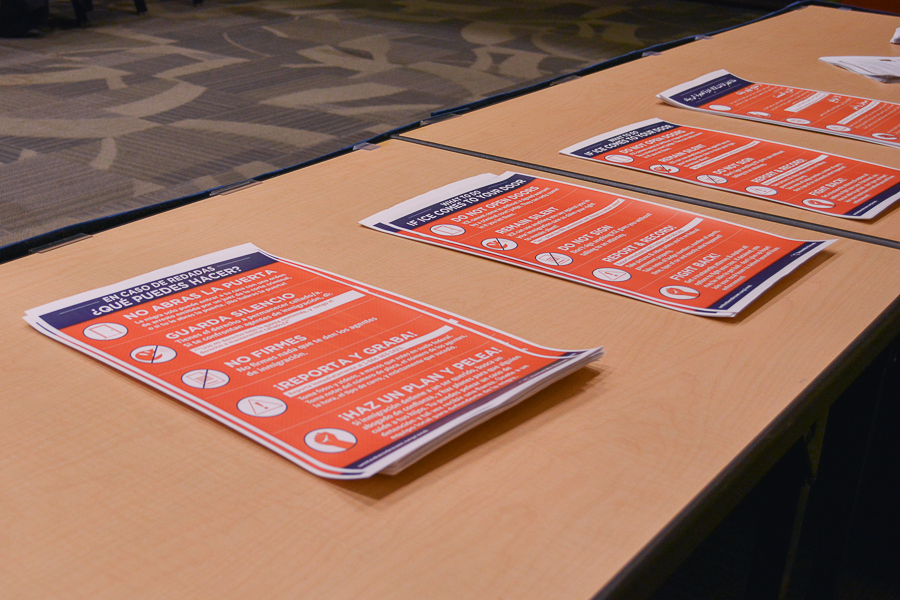
Barnett and Sweilem provided tips on how to interact with Immigration and Customs Enforcement (ICE) if confronted by an officer. They stressed the importance of remaining silent and refraining from signing any documents since officers often deceive uninformed people into authorizing their own deportation agreement.

“The biggest issue is people providing evidence against themselves,” Barnett said.

Barnett added that UC Davis will stay a sanctuary campus, meaning it will maintain the confidentiality of its students by not sharing any information with ICE. Nonetheless, the most advantageous approach is to prepare for any situation, according to Barnett.

“It remains incredibly important for everyone to learn their rights,” Barnett said via email. “Even if you are a green card holder or a US Citizen, we encourage you to learn your rights so that you can invoke them in order to protect yourself and your loved ones if necessary.”

Barnett and Sweilem also provided attendees with constitutional amendments booklets, cards declaring the right to remain silent and tip sheets explaining what to do if approached by an ICE officer.

Recognizing the value of the KYR workshop, MSA cancelled its protest from earlier that day, instead encouraging its members to attend the presentation.

“We wanted to do something proactive,” said Nida Ahmed, the MSA internal vice president and a fourth-year global disease biology major. “You’re most powerful when you have the right tools, and you have the right tools when you’re knowledgeable about what your rights are. […] Knowledge is power.”

Omar Abdel-Ghaffar, the MSA external vice president and a fourth-year political science major, believes it is important for students to respond peacefully to the recent hate crimes in Davis by channeling their emotions into standing up for each other.

“MSA community members […] have taken initiative and transferred fear and anger into something proactive,” Abdel-Ghaffar said.

Barnett noted that every student at UC Davis deserves to feel secure in their everyday environment, both physically and mentally.

“Knowing your rights is a great way to feel empowered and to be able to protect yourself and to just feel safer in your own space,” Barnett said.

Sweilem hopes students will apply the tools they learned from the presentation in any encounter with ICE or other law enforcement officers.

“If you take one thing away from [here] today, I want it to be this: no matter what situation you are in with law enforcement, no matter how bad it is, […] you always have the right to remain silent,” Sweilem said. “They can never take it away from you and they can never use it against you.”


Written by: Jeanna Totah — campus@theaggie.org

Community participates in search for new police chief

ASHLEY LUGO / AGGIE

Faculty, students, staff voice concerns at town hall meetings

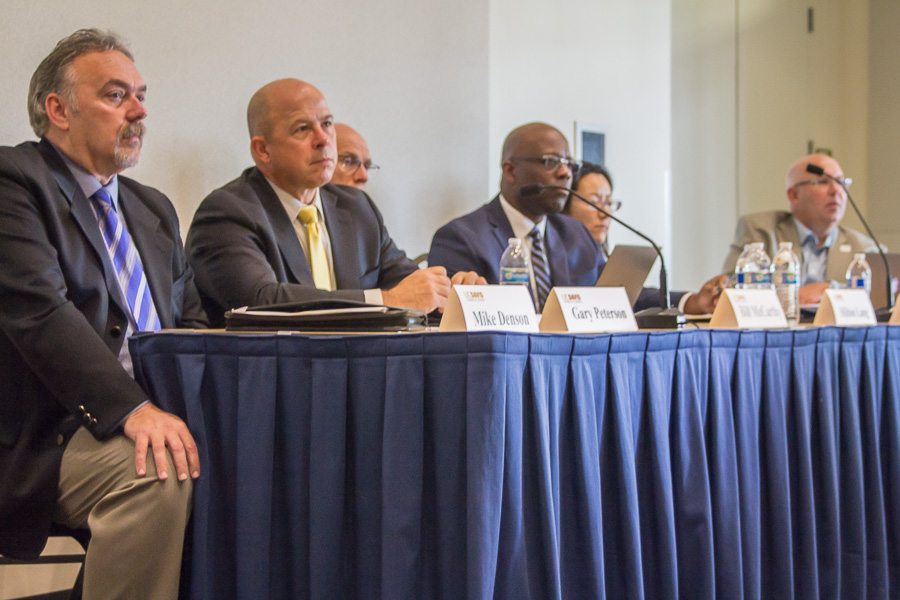
Three town hall meetings were held at the Student Community Center (SCC) on Feb. 15 to discuss what the Davis community would like to see in its new police chief.

Five individuals representing the entire police chief search team led open discussions that took place at 10 a.m., 2:30 p.m. and 5:30 p.m. Faculty, staff and students were encouraged to attend to voice their opinions and ask the team questions.

According to Gary Peterson, a representative from executive search firm Ralph Andersen & Associates, this process is very important to the overall search. The feedback they received at the town hall meeting will shape the candidates pursued, as well as influence potential interview questions.

“I think this type of forum with not only faculty and staff and of course the students is essential for the search process,” Peterson said. “Getting everyone’s inputs on the traits and characteristics of the next police chief will help shape the recruitment. When we go out and recruit for the next chief, we want the person [who’s] going to fit here at UC Davis. Getting the thoughts and ideas from the constituents and groups is the way to go.”

At the first town hall meeting, fewer than 10 people were in attendance; they consisted mainly of UC Davis staff and faculty. Those in attendance responded to questions posed by the search committee and spoke openly about what they would like in the candidate. Many audience members expressed the desire to have a police chief who integrated into the community of Davis. One individual noted that they enjoyed seeing former Police Chief Matt Carmichael around town and participating in the Picnic Day floats.

One of the facilitators of the town hall, Paul Cody, the assistant director of the Center for Student Involvement, agreed with the attendants at the town hall and offered his own take on the future chief’s integration into the community.

“This campus is really about relationships,” Cody said. “There are many times where a person in that position of power doesn’t necessarily interact with a lot of constituents on campus. This is a great opportunity to be a part of the community where often times people have a voice, which could also be a challenge.”

An open discussion was held toward the end of the the town hall meeting. One attendee mentioned that they felt there was a lack of involvement from the police force at the UC Davis Medical Center in Sacramento. This individual hoped for a leader that would show more support to the center and help bridge the divide they felt existed.

The meeting adjourned at 10:50 a.m. after there were no more comments during an open floor discussion.

The committee hosted its third town hall meeting of the day at 5:30 p.m., one that was specifically for students. The meeting initially had no students show up to participate, so Associate Vice Chancellor for Student Life Milton Lang asked students in the nearby vicinity at the SCC to enjoy some free pizza and offer their feedback. Students then entered the multipurpose room and engaged with the committee representative in an informal discussion.

Students were asked what would make a new police chief successful at Davis. Many students voiced a desire for transparency in the new chief, citing the 2011 pepper spray incident. Additionally, students noted that they hoped the next chief would be visible in the community and understand the way of life within a college town. Lang noted that the committee was currently using this criteria in its search.

“We have been talking about this as a committee that whoever is hired has a higher level of tolerance when students are protesting and are able to work with students who are doing protests,” Lang said. “We are looking for somebody who can really understand a college campus culture and the diversity that come with that.”

Students also commented that they hoped the chief would be approachable and not quick to resort to using force. ASUCD President Alex Lee commented that he liked that Carmichael was tolerant of student parties on weekends and instead focused on student safety.

The student town hall adjourned at 6 p.m.


Written by: Lindsay Floyd  – campus@theaggie.org

Protect trans students

HANNAH LEE / AGGIE

Gender-inclusive restrooms are a basic human right

Signs on single-stalled bathrooms with girls in triangle skirts and boys in plastic pants are to be removed all over the UC Davis campus and replaced by gender-inclusive triangles by the end of this month. The single act of transforming gendered or unisex bathrooms into inclusive bathrooms signals an effort on campus to make restrooms a safe space for those who identify as transgender, genderqueer and gender nonconforming.

The idea is not necessarily new — the Obama administration issued statements on the subject, calling on the nation’s public schools to provide gender-inclusive bathrooms for students. To deny students this right, the statements declared, would be against federal anti-discrimination laws.

The Trump administration plans to actively change these new policies regarding bathrooms, starting with rolling back protections for transgender students. In a two-page letter, the Trump administration explains the need to withdraw previous memos on gender-inclusive bathrooms because the memos did not contain “extensive legal analysis,” nor did they “go through any formal public process.” The Editorial Board vehemently denounces this regression in public policy.

Much like previous actions of the Trump administration, this revokes the rights of a marginalized community in the US and is not only detrimental to the progress UC Davis has made in creating a safe space for transgender students, it is also a violation of anti-discrimination laws and alienates the students that the Obama administration aimed to protect. This step brings us as a country back to the absurd notion that genitalia dictates how one should use the bathroom, regardless if a trans person has already transitioned.  

Overturning gender-inclusive bathrooms in public schools is in part a response to several state bills, such as House Bill 2 from North Carolina, calling for separate bathrooms with no distinction for trans people. The bill mainly focused on male to female transitioning adults, with the fear of sexual predators. Proponents of the bill cited cases that occurred in the past, before gender-inclusive bathrooms came to fruition, in which males would put on feminine clothes and go into the female bathroom to engage in non-consensual sexual behavior.

However, comparing, in any way, trans people to sexual predators is deeply offensive. It conjures previously held stigmas against gay men and the antiquated idea that men of homosexual orientation were pedophiles, an idea that has long been held as utterly bigoted.

In fact, the people who seem to be overwhelmingly targeted in public restrooms are, in fact, trans people.

According to an NPR article, that cited a recent survey of 93 gender-nonconforming individuals in the Washington, D.C. area, about of 70 percent of the sample reported experiencing being denied access to restrooms, being harassed while using restrooms and even experiencing some forms of physical assault.

This Editorial Board calls on the administration of UC Davis to first and foremost uphold the value that gender-inclusive bathrooms are not only safe spaces for gender-nonconforming individuals, they but are also a human right. We hope that other public schools at every grade level will follow this example and resist the bigoted claims against gender-inclusive bathrooms

Humor: Score! Man at party knows how to fix “the system”

This man just saved politics

2017 has been a rough political year for Americans. Donald Trump’s election has raised questions about who we are as a nation and what true American values are. It’s a difficult time, to say the least, and it’s hard not to speculate about the influence of money in politics, the integrity of the media and whether or not we are going to be alive in eight years. But there is hope on the horizon, and he’s wearing a backwards Supreme snapback.

Jason McBride is a third-year political science major with a film minor, and he has some pretty radical ideas to “fix the system” that you must hear. And you really need to hear them if you are at Kirsten’s party on J St., because sources say Jason talks super loudly.

“People are just sheep,” Jason said as he re-racked a diamond for Todd’s next beer pong shot. “They just do what society tells them to do.”  

The California Aggie spoke to Rebecca, who had only come to the party to see if Alex was going to be there, but stuck around because Jamie was her ride and she was trying to hook up with James. “Jason kept talking about the ‘means of production’ and asking us if we knew what ‘hanging chads’ were. I wasn’t totally sure what he was talking about, but his neck got really veiny while he was talking so I assume he knows what he’s talking about.”

Jason explained the concept of “the people’s uprising” to The Aggie.  “All it takes is a figurehead like Che Guevera or Bernie Sanders or like, that Nelson guy. What’s his last name? It’s like Candelabra… Is it Candleabra? JANINE! JANINE! HEY, JANINE IS IT NELSON CANDELABRA?” When The Aggie spoke to Janine, she had “no idea what he was talking about.”

When Jason was pressed for further comment, he said he would be happy to “break it down” for The Aggie later. But Matt had just punched Dillon in the face and he was “a little bummed out about it right now.”

Don’t be anxious, America! Take solace in knowing that in just a few short years, poli-sci majors like Jason McBride will be taking the reigns.
Written by: Parker Nevin — phnevin@ucdavis.edu

Aggies edge out Hornets in Causeway Classic

IAN JONES / AGGIE

UC Davis men’s tennis takes down Sacramento State, 5-2, in classic rivalry

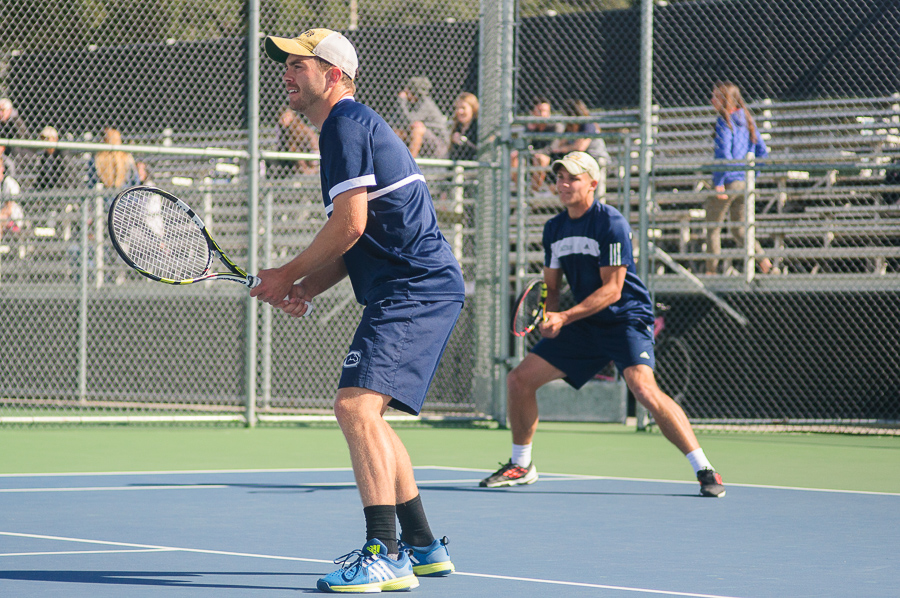
After originally postponing the match due to weather, the UC Davis men’s tennis team took down the Sacramento State Hornets in a Causeway Classic showdown this past Saturday. With this victory, the Ags kept their homecourt win streak alive, pushing it to 20 consecutive wins at the Marya Welch Tennis Center.

“The Causeway Cup is a big win, a big deal,” said head coach Eric Steidlmayer. “Anytime you beat Sac State at UC Davis, it’s a big win.”

The Aggies started out strong in doubles play, sweeping the Hornets 3-0. Freshman David Goulak and junior Tommy Lam led the way, posting a 6-4 victory. Senior Alec Adamson and freshman Max Pham then clinched the doubles point and consequential lead for the Aggies in a 7-5 win to continue their domination on the doubles court.

IAN JONES / AGGIE

To complete the sweep, seniors Bryce McKelvie and James Wade won their match in a 7-6 tiebreak.

The Ags started slow at first in their singles matches, with Wade and Adamson falling in two sets 6-2, 6-4 and 7-6, 7-5, respectively. Junior Everett Maltby put UC Davis back on top with a 6-3, 6-3, win of his own. McKelvie posted a singles win in three sets, 7-5, 3-6, 6-0 to put the Aggies up 3-2, and Lam clinched the victory point for UC Davis with a comeback victory of 5-7, 6-1, 6-2. Freshman Max Pham finished up the singles matches with his close tiebreak match 7-6, 5-7, 10-8.

“[The weather] has been a little spotty sometimes with practice, sometimes with matches so it makes it a little harder to get a consistent feel, but I feel like the guys are doing good,” Steidlmayer said.

For Pham, the team hasn’t been brought down and this was an especially great win for his first match at home.

“The Causeway Classic has a lot of history here and I think we did pretty well as a team,” Pham said.

With this win, the Aggies advance to 5-3 on the season. The men’s tennis team heads on the road for a slew of away matches, and will return home for the Golden State Invitational on March 10.


Written by Nicolette Sarmiento — sports@theaggie.org


Guest: Make mental health services more accessible

SAM ALAVI / COURTESY

Provide organizations with the resources to help those struggling

As a third-year student at UC Davis who considers mental health of the utmost importance because it affects how we handle stress and the way we relate to one another in society, I want to express my concerns regarding the lack of mental health services in the United States. According to the Association for Psychological Science, over 60 million Americans experience mental illness in a year, and 40 percent of individuals with serious mental illness do not receive care. This suggests a lack of access to mental health services and alludes to possible barriers to treatment for such issues.

These barriers are particularly concerning when you consider that Basic Needs, a non-governmental organization that provides care to countries around the world, says that without accessible mental health services and the ability to seek treatment, individuals can experience a dramatic loss of income and their family members will increasingly deal with stressful living conditions. Stress can impede other individuals from progressing. Kids may need to work to provide for their families instead of going to school.

I urge you all to spread awareness of mental health and access to mental health services to communities through partnerships. It’s important to recognize that mental health is a prevalent issue in communities across the nation. Mental health services can help individuals receive support and care which can bring positive life changes in the long run. This will be done through collaborating with residents, community advocates, schools and public health specialists. We can build strong partnerships with public health agencies, board members, public health organizations and mental therapists. For example, many public health organizations, including Active Minds, which has a branch here on campus, could provide services such as health and wellness workshops and mental health awareness campaigns.

There could certainly be more discussions of mental health and research to improve evidence databases about mental health in the United States and mental health services with specialized care. Public health organizations could create databases in order to help and find the nearest mental health resources and clinics. The strong partnerships and collaboration bring a greater awareness of mental health and accessible mental health services for individuals seeking help.
Written by: Michelle Wang

Disclaimer: The views and opinions expressed by individual columnists belong to the columnists alone and do not necessarily indicate the views and opinions held by The California Aggie.

Aggies strike gold against 49ers

JAY GELVEZON / AGGIE

Despite some ups and downs, men’s basketball triumphs behind Moneke’s double-double, Graham’s heroics

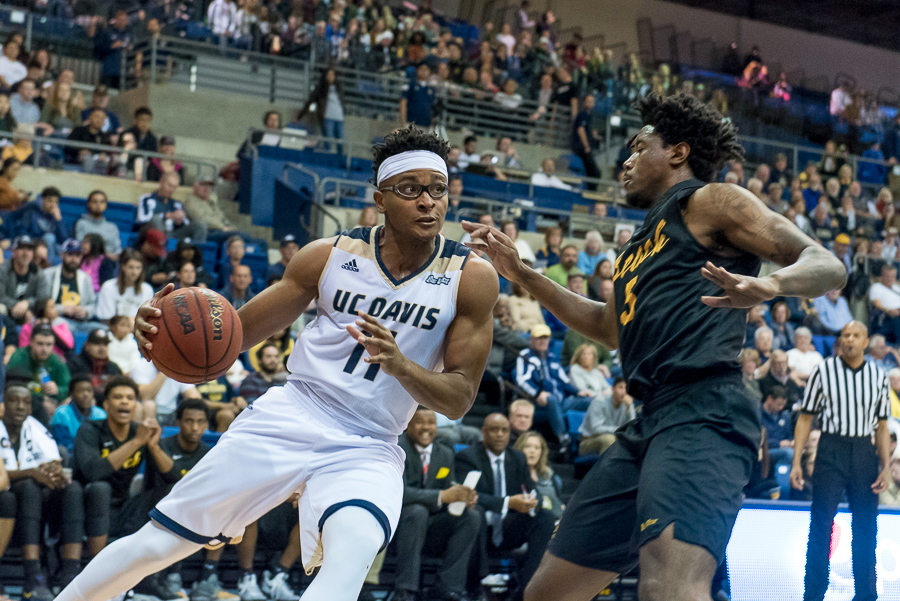
With a national TV audience and a packed house at home, the UC Davis men’s basketball team came into the game on Saturday, Feb. 25 knowing that it was not only expected to put on a show for its fans and its family, but also to win a game on the big stage. With Long Beach State, a team that had recently beaten the Aggies on Feb. 16, the challenge was tough.

After a hard-fought game that included 12 lead changes, 11 ties and a waved-off game-winner by junior forward Chima Moneke, the game was finally settled in overtime, where the Aggies cut away toward a 75-71 victory over the 49ers, further securing their current spot atop the Big West Conference standings.

JAY GELVEZON / AGGIE

It was not an easy win for the Aggies. Despite leading for a majority of the game, the Aggies were never able to go ahead by more than six points, and the 49ers never led by more than four. With Long Beach’s 6’7”, 255-pound sophomore forward Temidayo Yussuf below the basket, Moneke and senior forward J.T. Adenrele were tasked with keeping the 49ers out of the paint and head coach Jim Les applauded them for taking the task, which eventually led to Yussuf fouling out.

“I thought J.T. and Chima ran to the fight tonight,” Les said. “I thought they stuck their nose in, and they battled. Their aggressiveness fouled him out, so I really liked their approach.”

The Aggies knew that they needed to call upon their leaders and their two leading scorers, Moneke and senior guard Brynton Lemar. Each responded. Despite struggling from beyond the three-point line, shooting just two for 10, Lemar shot six for nine from inside the arc on his way to 25 points. Moneke had his 11th double-double of the season with 18 points and 17 rebounds. Graham finished with 13 points of his own. The team also responded on defense, where no 49er scored more than 13 points.

The final three minutes of the game saw the Aggies both trailing by four and leading by four after Graham was fouled on a made two, sunk the free throw, and scored a late three-pointer to beat the shot clock. Unfortunately for the Aggies, a pair of fouls and an ill-timed turnover tied the game back up before Moneke tipped in a buzzer-beater at the end of regulation. However, after replay review, the referees determined that the shot was too late, sending the game into overtime. Moneke knew that he had to stay in the right mindset, despite the fact that he did not know whether the shot would count or not.

JAY GELVEZON / AGGIE

“Basketball is a game of runs, and you’ve seen some crazy stuff happen,” Moneke said. “So, the game isn’t over until it’s zero. [I said] ‘They’re going to review it, it’s not over.’”

For Graham, the crowd and the atmosphere played a huge part in securing this victory for the Aggies, and the players had it marked on their calendars.

“It’s funny, I was being dropped off by Mikey (Henn) last night,” Graham said. “And I told him, I said, ‘You’ve never experienced anything like this, that you’re about to experience tomorrow.’ This is last night, and I was like, ‘This is going to be crazy.’ And it was definitely that, and more.”

Despite the well-fought victory on national television, Les knows that the team has to move forward if they want to finish the last two games strongly.

“I don’t know where this one ranks, I just know that it was a heck of a win,” Les said. “It was a win that we absolutely needed, and this team has great pride playing here in The Pavilion, and a refuse-to-lose attitude, and any way we can get it done, we get it done. Other than that, it’s kind of, we’ll enjoy this for 24 hours and get back to work, because we have a big senior night coming up on Thursday.”

The Aggies will play one last game at home on Thursday, March 2 at 7 p.m. before closing out the regular season on the road at Irvine.

Written by: Bradley Geiser — sports@theaggie.org