54.1 F
Davis

Davis, California

Tuesday, December 23, 2025
Home Blog Page 673

UC Davis Athletic Department Fall Overview

0
JAY GELVEZON / AGGIE

As fall seasons slow down, it’s time for an overall look at the athletics department

As the various fall athletic seasons wind to a close, the first academic quarter under new UC Davis director of athletics Kevin Blue is just about in the books. The change at the top of the administrative hierarchy has not yet improved on field success among the various athletic programs on campus, however. Both the men’s and women’s water polo continue to be dominant national forces, both soccer programs and women’s volleyball continue to hover around .500 and the football team struggled through another season.

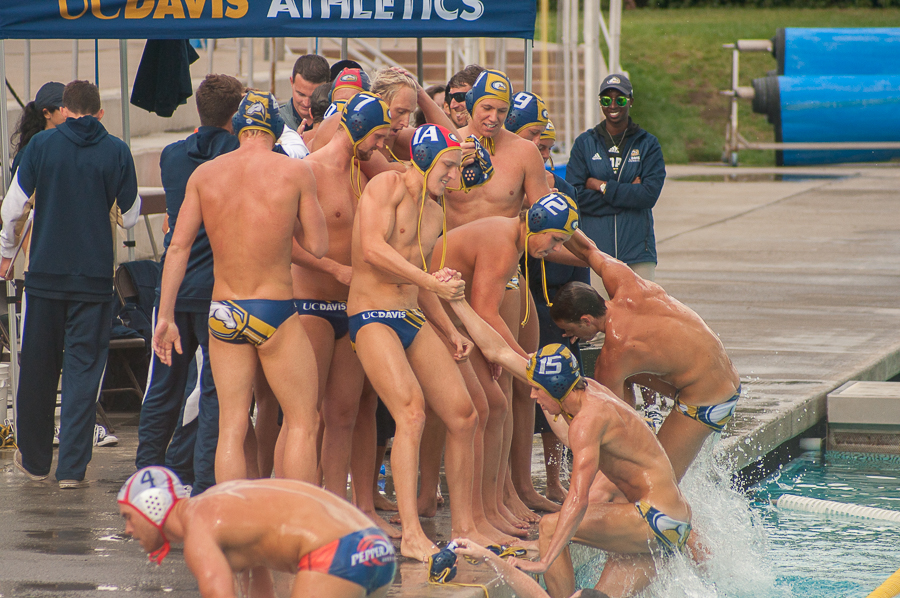
The water polo program produced the only two teams on campus with solid winning records in the fall quarter. The UC Davis men’s water polo team finished a historic 23-5 regular season record with a 12-8 win over UC San Diego to capture the first conference title since 1997 and punch a ticket to the NCAA Championship. The Aggies face the winner of Bucknell vs Harvard in the quarterfinal game hosted by UC Berkeley at Spieker Aquatics Complex on Dec. 1.

The women’s soccer team finished with a 7-8 record overall and 3-3 in conference play. Its male counterpart ended similarly at 8-9 overall and 4-6 in the Big West. The men’s team fell in penalty kicks to two-time conference champion Cal State Fullerton in the opening round of the Big West tournament, and the women’s team closed out the season with a double overtime draw to Cal Poly.

The women’s volleyball team finished the season with a 14-15 record after a sweep by Cal Poly in the season finale. The Aggies hope the addition of former two-time All-Big West honoree Katie Quinn as assistant women’s volleyball coach for the upcoming season will break the playoff drought.

After four seasons of losing records under head football coach Ron Gould, the Athletic Department decided to release Gould two days after defeating Sac State in the Causeway Classic for the final game of the season. The victory was too little, too late for the former UC Berkeley running back coach, after posting a 12-33 record during his four-year tenure at UC Davis. Gould was only the fourth head coach for Davis in the past 46 years, following an incredibly successful trio in Jim Sochor (156-41-5), Bob Foster (30-11-1) and Bob Biggs (140-78-1). According to Blue, a nationwide search for Gould’s replacement is now underway.

Written by: George McConnell sports@theaggie.org

An earful: a holiday playlist

Cindy Cheung / AGGIE

Non-traditionals takes on traditional winter-time tracks

Holiday music appeases two types of people: those anticipating Nov. 1 with their fists still clutching melted Halloween candy, and the second, more traditional, post-turkey-day-only kinds of listeners. Either way, two months of shuffling through the same 100 songs can inspire anyone to spike the eggnog until DJ grandpa finally forgets how to use Spotify. To save you the trouble, here’s a short list of nontraditional holiday re-makes:

Don’t Waste Your Wishes album by The Killers

Alternative rock band The Killers recently released their Christmas album, Don’t Waste Your Wishes. The album’s proceeds benefit RED, an organization that fights against AIDS, adding another reason to purchase their work. This year’s album includes all the usual tracks, but also has a special rendition of “I’ll Be Home for Christmas,” in which lead singer Brandon Flowers sings a duet with his fourth-grade music teacher, who originally taught him the song. Any Killers fan is guaranteed to enjoy the album, but it also serves as a compromise; it will appease the more traditional listeners while relieving you of the “Santa Baby” monotony.

“What Are You Doing New Year’s Eve?” by The Head and the Heart

Hailing from Seattle, the Head and the Heart are known for their charming acoustics and beautiful harmonies — and this track proves no different. Originally recorded in 2012, this classic song is arguably from the band’s better days, before the pop evolution of Signs of Light. Jon Russell’s vocals are deep and husky, reminiscent of the real classics — Bing Crosby, Frank Sinatra, Tony Bennett — but with a folksy twist. And, for anyone dreading the holidays, what a better way to look past them than a forward-thinking “What Are You Doing New Year’s Eve?” chorus. This track (and most on this playlist) are taken from Holidays Rule, an album featuring various artists from all genres and walks of fame.

“O Come, O Come, Emmanuel” by Punch Brothers

This stunning track by bluegrass band Punch Brothers serves not as a teary-eyed track for Christmas Eve nor as a bedtime lullaby for excited, Santa-anticipating children. With its banjo, mandolin and incredible acoustics, this song serves as nothing better than the ideal soundtrack to America’s real favorite holiday: Black Friday.

While customers play bumper cars with shopping carts and suburban moms shoot laser beams from their eyes, hum this tume. While a shopper waits all night in line to buy their daughter the newest iPhone, don’t steal the last matching Kate Spade phone case, but instead, sing aloud: “O come, Thou Rod of Jesse, free / Thine own from Satan’s tyranny / From depths of Hell Thy people save / And give them victory o’er the grave.”

“Blue Christmas” by Heartless Bastards

As a traditional rock band, Heartless Bastards intentionally toned down their characteristically growly vocals for this rendition. Perhaps it was done in the spirit of the holidays, or even with the idea of experimenting in sound. Either way, Erika Wennerstrom’s voice sounds suppressed in a wonderfully pleading manner. Perhaps Wennerstrom, too, has become fed up with her family’s obsession over the arrangement of the tree’s ornaments, and began hoping those reindeers ran her over instead of grandma.

Written by: Ally Overbay — arts@theaggie.org

Here’s the Scoop

MEENA RUGH / AGGIE
MEENA RUGH / AGGIE

The Aggie investigates Davis’ ice cream offerings

It seems ironic for someone who is lactose intolerant to be covering a story on ice cream, but I was looking for any excuse to eat one of my favorite desserts again. I guess I’m just really dedicated to journalism. I taste-tested some of downtown Davis’ favorite ice cream spots, factoring in student budget and, of course, flavor.

Read on to get the scoop:

Davis Creamery:

An employee explained to me that the favorite flavors that week were Avocado Coconut and Trifecta, each voted in by the Bracketology board, a Davis Creamery feature which allows their customers to pick their favorite flavors each week. I got one cone of each, eagerly awaiting the first bites.

Trifecta is a blend of Reese’s peanut butter cups, Butterfinger and Oreo with underlying tones of vanilla. This flavor is definitely for anyone who eats Reese’s on the daily. The ice cream was pretty standard overall, and could have been improved by having real chunks of Reese’s and Butterfinger evenly dispersed with the Oreo bits.

MEENA RUGH / AGGIE
MEENA RUGH / AGGIE

I was extremely skeptical of the Avocado Coconut ice cream, as it was a suspiciously pale green. As much as I love avocado, I prefer my sweet and savory foods to stay separate. Luckily for me, coconut was the overpowering flavor, and the avocado made the dessert creamier. To me, though, the flavor was too weak, and it tasted like eating a cleansing face mask, not a sweet treat.

Each scoop is $2.75 each, but if you go on Mondays from 5 to 10 p.m. the ice cream is $1.75 for each scoop, providing a reasonable price point for the money-pinching college student.

Gelato Classico:

Connected to the Varsity movie theater, Gelato Classico was definitely populated by an older crowd. This is probably because a child’s size ice cream is an outrageous $4.00. The flavors were definitely more adventurous, however, featuring options such as Honey Lavender and Fresh Ginger. I sampled Fresh Ginger first, a flavor which packs a punch with chunks of ginger folded into the ice cream. This one will definitely help clear the sinuses. Honey Lavender was the perfect harmony of tastes. Slightly sweet with a tinge of lavender essence, it’s an adventurous choice but is grounded in familiar flavor profiles. Overall, Gelato Classico leaves your stomach happy but your wallet hurting.

CREAM:

MEENA RUGH / AGGIE
MEENA RUGH / AGGIE

Most of us have probably been to CREAM or at least seen a long line out the door. Their famous ice cream sandwiches and cheap prices ($2.50 for one scoop) attract students desperate to improve their Instagram feeds and who want to indulge after a long study session. I ordered one of their best-sellers, Salted Caramel, which has a vanilla base with ribbons of salted caramel coating the ice cream. This flavor is for those of us who have a serious case of the sweet tooth. This flavor represents CREAM as a whole: a traditional and simple flavor executed pretty well.

The Verdict:

I would recommend stocking your fridge with Ben and Jerry’s and not leaving your room at all. More ice cream at a cheaper price and less movement required. Wins on all fronts.

Written by: Abigail Wang — arts@theaggie.org

Writing through the writer’s block

AMY HOANG / AGGIE
AMY HOANG / AGGIE

National Novel Writing Month is over — now what?

Over the course of the past month, writers all over the globe have been furiously typing away, accompanied by endless amounts of stress and flowing creativity, determined to meet one goal — write 50,000 words.

For those who are unfamiliar with the phenomenon of National Novel Writing Month, more commonly known as NaNoWriMo, it is a web-based challenge run by a non-profit organization on a mission to inspire creative minds to find their voices. No fuss, no editing, just continuous writing. The objective of the challenge is to finish a 50,000 word novel within the span of 30 days, which does not leave any room for any excuses or procrastination.

As December is finally here, the challenge has come to an end, meaning that there will inevitably be winners and losers — those who completed their word goal and those who did not. However, whether or not participants finished the challenge, the end of November is hardly the finish line for most.

“I definitely am going to keep writing,” said Caitlyn Sampley, a first-year cinema and digital media major, who reached the 50,000-word mark a week before the deadline. “Even though I won the challenge, I still don’t really consider myself finished because my story isn’t done yet.”

Sampley began outlining her novel well before the starting day, which ultimately aided her in completing the challenge on time.

“[For those who want to do NaNoWriMo next year], I would say plan as much as you can beforehand,” Sampley said. “Plan well enough ahead of time, so that you’re sort of winging it, but you’ve still got a strong outline to go off of.”

As a first-year student myself, I had the special opportunity this fall quarter to participate in NaNoWriMo, thanks to my freshman seminar which focused specifically on completing the challenge. The class provided a supportive community and useful insight throughout this stressful endeavor. Without the seminar, I would have never even known what National Novel Writing Month was. As part of my grade, I took on the 50,000 word challenge and wrote vigorously for 30 straight days. I found that although the experience was demanding, (as many of my classmates would agree), the overall writing process has been enlightening.

I believe that NaNoWriMo process has not only made me a stronger writer but also forced me to simply keep on creating, even when my mind wanted to give up. I found that the infamous “writer’s block” does not truly exist, and that I could keep writing as long as I didn’t let my own self-doubt get in my way. I also discovered the true meaning of time management, as writing an average of 2,000 words a day was no easy feat. Along with classes, midterms, social activities and extracurriculars, fitting in the time to sit down and write for at least an hour a day appeared practically impossible in the beginning. However, there was always a way to make it work in the end.

NaNoWriMo is truly such a unique event, as one can never really understand what it takes to write a novel until actually doing it. I would urge anyone with enough will and determination to take on the challenge.

After all, November’s only 11 months away. Time to get planning.

Written by: Sydney Odman — arts@theaggie.org

The collective effort for individual well-being

0
HANNAH LEE / AGGIE
HANNAH LEE / AGGIE

Students, faculty aim to promote wellness

Chemistry professor Andreas Toupadakis makes sure to ask the 400 plus students in his lectures questions which allow him to learn more about them. His questions range from whether they would prefer that he upload homework assignments online to whether they know about the Reflection Room in the Student Community Center.

With a passion for helping others, Toupadakis’ name has become associated with his genuine care for the well-being of his students. Although he loves teaching chemistry courses, Toupadakis said teaching first-year seminars about student success and wellness is what keeps him at UC Davis.

“I had a driving force inside me to really see people happy,” Toupadakis said. “For years I [have been] teaching two seminars [that] are very, very successful; the comments are extremely positive. I’m acting like a catalyst to bring [students] together, [to] talk to each other [and] help them navigate through the things that they’re going through. I’m very thankful for these programs.”

Toupadakis teaches two first-year seminars: From Self Awareness to Inner Growth for True Success in and After College as well as World Music as a Means to Embrace Diversity and Reach Self-Discovery. In addition to the resources offered through the university, such as the Student Health and Wellness Center (SHWC), faculty members and students alike are pioneering new efforts to promote student well-being.

Sylvia Sensiper, the director of The Guardian Professions Program, which helps former foster youth throughout California go to graduate school, also teaches two first-year seminars.

“The Science of Well-being [seminar] looks at meditation [and] gratitude, and we also do a physical practice — sometimes it’s tai-chi sometimes it’s yoga — to look at how that keeps people centered in their mind [and] body in a holistic way,” Sensiper said. “[The seminar on] Contemporary American Buddhism is more like a cultural, historical look at different traditions, and we [engage in] different meditative practices.”

Sensiper said that maintaining stability is essential to achieving personal stability.

“Well-being is the ability to remain stable and flexible in the face of endless change, because there are very many things that are not in your control,” Sensiper said. “We’re all in the midst of a flux of change, and just knowing the resources on campus, knowing when you need to ask for help, knowing when you can just settle down and sit with something and let it go — that’s well-being.”

This personal and external awareness is relevant in the videos Sarv (aka Sodid) Mithaqiyan, a fourth-year philosophy major, creates for his YouTube channel Elevated & Meaningful. Mithaqiyan asks random passerbys meaningful questions, such as “What is Human Nature?” to build awareness about the community, society and ourselves.

“I try to raise the kind of questions that [explore] the kind of knowledge about who we are as human beings,” Mithaqiyan said. “There [needs to be a] catalyst to start the process of talking about things that matter, things that do contribute to well-being — either spiritual or mental or physical. I’m trying to show that people are capable of doing more than they can imagine. We can do more [and] we can construct a more meaningful life if we have higher goals.”

Mithaqiyan has joined a group of students on campus who attempt to engage classmates by offering a constructive, open dialogue. The National Alliance on Mental Illness (NAMI) club at UC Davis focuses mainly on eliminating the stigmas surrounding mental illness and aims to providing a safe space for students to talk freely. Kim Shuster, a fourth-year psychology major who serves as the speaker coordinator for NAMI, said mental health is at the heart of well-being.

“When I first started my psychology major, I thought that mental health [was] more important than physical health,” Schuster said. “But the longer I’ve been here, I’ve started to realize there’s a lot of intersections. It’s hard to be mentally well if you’re not physically well. [It’s] so important to have a holistic [health].”

The promotion of holistic health is at the crux of the efforts of the Naturopathic Medicine Club (NMC), a student club started this quarter. Naturopathic medicine is a branch of medicine which stresses alternative forms of treatment and emphasizes patients’ individual needs to find the most effective solutions for them.

“Instead of [just] prescribing someone medicine, [naturopathy tries] to focus more on [the patient] as a whole,” said Talha Kilic, a second-year neurobiology, physiology and behavior major and public relations official for NMC. “Whether it’s mental health […] meditation [or] acupuncture, [the focus is on] soothing you as a whole. As a holistic health [club], we’re able to touch on a lot of different areas.”

Kilic said that the NMC is planning to bring in different professionals from the naturopathic medical field as well as from alternative treatment processes, such as Chinese acupuncturists.

Similarly, both Toupadakis and Sensiper utilize meditation in their seminars to lower stress levels, as it is a practice that is becoming more popular and more secular. Toupadakis said he hires a professional to come to both of his first-year seminars every quarter to lead yoga meditation for two hours. Sensiper requires her students to observe the effects of meditation and other soothing activities, such as writing in a gratitude journal, on students.

“My goals are for them to discover on their own what they can [learn] about these practices, [as] meditation is [an] internal [reflection]” Sensiper said. “Anything I teach externally is not really going to be helpful to anybody until they internalize it and find some benefit for themselves.”

Mithaqiyan, who said he wants to promote reflection as well as introspection through his videos, believes that asking questions and starting conversations has the power to create a large ripple effect that could potentially change current cultural climates.

“The kinds of interactions I try to encourage are ones […] that are directed towards bringing peace, bringing unity and even analyzing what […] that means,” Mithaqiyan said. “More and more individuals [could be] working together and […] coming up with, hopefully, the kind of actions we need to come up with that will stop violence, stop arrogance, stop disunity and hatred and racism.”

Toupadakis also focuses on opening up the dialogue on mental health as well as decreasing stress and anxiety amongst students. Toupadakis said that faculty have a responsibility to reach out to their students. He was recently given the UC Promoting Student Mental Health Guide meant for all faculty and staff and said he finds it incredibly useful.

“I wish I was given this guide years ago,” Toupadakis said. “I truly believe every subject teacher should be equally [if not] more devoted to the well-being of the students [and] this is the guide that could do it. The final solution [is to] cultivate compassion.”

Furthermore, both Sensiper and Toupadakis feel that requiring each first-year student to take a course that deals with topics such as well-being would have a huge impact.

“When [students] come in, there should be required classes about well-being of students,” Toupadakis said. “Your peace and health is more important than anything else.”

Written by: Hannah Holzer — features@theaggie.org

Sparks fly in Light the Fire

CHARLES MIIN / AGGIE

Local author Matt Biers-Ariel’s latest novel

Many believe that standardized testing is a measure of how smart students are, as if multiple choice answers could account for creative thinking. However, Light the Fire, Matt Biers-Ariel’s latest book, challenges this idea.

Davis resident Biers-Ariel is a local English teacher in Winters. His book delves into student-teacher relationships and stresses how much schools and our society overlook creative thinking in favor of standardized testing. Biers-Ariel, however, frowns upon this practice.

“Standardized testing doesn’t measure creative thought, and I think a lot of problem-solving goes beyond critical thinking. You need to have creative thinking, and t’s impossible to measure that for standardized testing,” Biers-Ariel said.

Biers-Ariel has taught college preparatory English as well as Advanced Placement English Literature for the past 15 years. Before teaching in Winters, he grew up in L.A. and attended UC Berkeley.

Light the Fire isn’t the first book Biers-Ariel has written; all together he has published six books as well as satirical essays for magazines. Much of his inspiration for his latest novel stemmed from teaching, jotting down ideas from the classroom. However, most of his writing took place during the summer since there was little to no time to write during the academic year. One of his English courses read an earlier book of his as a class, and several students have also read Light the Fire in their own time. He hopes that many people read Light the Fire and work away from standardized testing, encouraging students to think outside the box.

“Official policy of the school is to not teach toward the test. Clearly, there is pressure to teach toward the test, or there’s pressure to have high scores,” Biers-Ariel said.

“Teaching toward the test” is becoming rather common as students look to improve their grades and test scores for college admissions. Creative projects are substituted for worksheets and multiple choice tests, which aren’t helpful for students who tend to draw connections and interpret things in alternative ways.

“I do less [creative writing projects] with the AP class because those kids do take a high stakes test at the end of the year that counts for them –– the AP test,” Biers-Ariel said. “The AP test does not reward you for creative thinking; it only rewards you for critical thinking and critical writing, so I mostly focus on that. But my regular English class does do a lot of creative work.”

The overall message that Light the Fire tries to portray is the disillusionment in standardized testing. It does not suffice to say that one is not smart just because they do not do well on multiple choice tests and worksheets; instead, students should be encouraged to think outside the box and work creatively.

“Every so often, a book tries to capture the dynamics between teachers and their students in a public school. Usually they miss the mark, but Light the Fire hits the bull’s eye,” said Dean Vogel, former teacher and president of the California Teachers Association. “As an educator for over 45 years, I am thoroughly impressed by Biers-Ariel’s ability to translate the feel of a classroom into a novel. This book is real. If you’ve ever wondered what it’s like being a teacher or –– gasp –– want to relive high school, you must read this book.”

For those who simply want to gain a new perspective on how schools tend to gear their students toward standardized testing, the book has been highly commended.

It was a great pleasure to read this book,” said Pamela Ronald, a reader of the book in an Amazon book review. “I could not put the story down–read it in two days and wished for more. I enjoyed all aspects of this impressive work: the characters, the twists and turns, the humor and the empathy.”

Written by: Kaelyn Tuermer-Lee city@theaggie.org

Bike Campaign offers bicycles to those who cannot afford them

NICKI PADAR / AGGIE FILE

Volunteer program distributes bicycles, aims to foster positive biking experiences

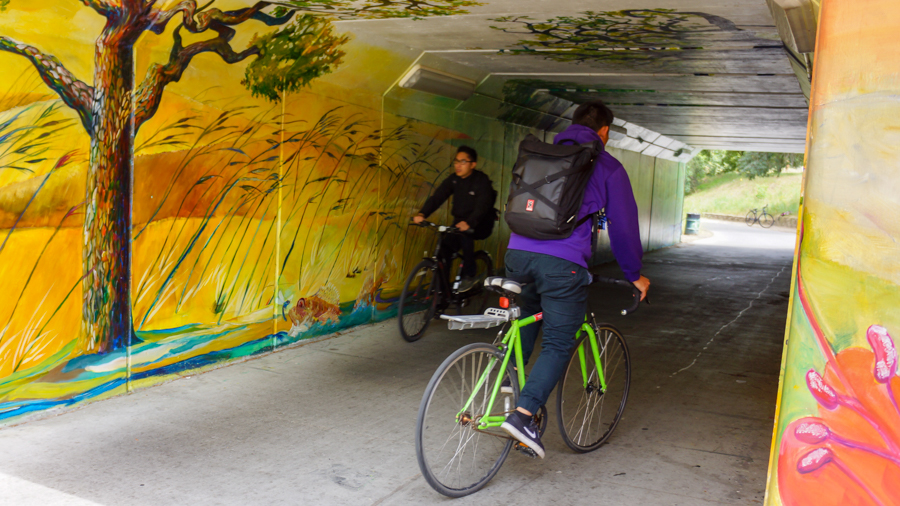
Davis, California — home to thousands of cyclists and bicycles. It is the city that introduced bike lanes to our country, and it is often referred to as “The Bicycle Capital of the U.S.” The Davis city logo proudly features a penny-farthing, 98 percent of the city’s streets have some sort of bicycle provision and navigating a bike circle for the first time is a rite of passage for incoming UC Davis students.

Judging by all of this, one might imagine that all Davis residents and all UC Davis students like bicycles — but that is not the case. According to the recently released 2015 to 2016 UC Davis Campus Travel Survey, only 45.3 percent of UC Davis students bike to class. Commuting to campus from out of town contributes significantly to the amount of students who don’t bike, but some simply do not like bicycles. Sarah McBride, a third-year psychology major, does not enjoy biking around campus.

“I liked [bicycles] a lot when I was younger, but I don’t really like riding them around Davis,” McBride said. “There are so many bike riders here that it’s not an enjoyable experience anymore.”

Brett Stults, a third-year English major, cites a general lack of awareness for the rules of biking as a reason he does not bike.

“[Bikes are] vehicles, so they have to stop at stop signs, they have to ride in the correct direction of traffic, they have to not ride on sidewalks,” Stults said. “That’s a big pet peeve of mine. It’s a sidewalk, not a sidebike. I think that if you’re going to do it, you need to do it with proper respect for all those who are involved.”

Maria Contreras Tebbutt, a local biking advocate, believes that training and guidance can go a long way for those who don’t like biking. She aims to help more residents and students have positive experiences with biking through her nonprofit volunteer project, The Bike Campaign. The Bike Campaign provides bicycles to those who cannot afford them, holds bike clinics, provides bike training for riders of all ages and runs a bicycle garage in Woodland where you can have your bicycle repaired by volunteer mechanics or learn how to work on bicycles yourself. The overall goal of The Bike Campaign is to build appreciation for bicycles.

“Riding a bike was not on your SAT, nor is it in your DNA,” Tebbutt said. “So, you need people to guide the way for you, to share information with you. You’re not going to find it on the Internet, because it’s something that you physically do. Every situation is different, every bicycle is different, every rider is different. And finding all those pieces that come together so you have bliss, that’s what we’re aiming for.”

Tebbutt has been passionate about biking since the age of 12 and does everything she can to share her passion with the community. She believes biking is not only a useful alternative to driving, but a lifestyle with great community and health benefits.

“I would wish for more people to be able to enjoy what we enjoy in Davis, which is a lifestyle,” Tebbutt said. “I think [biking] causes us to care more deeply about the people around us, our environment, I think bike riders just have that opportunity to be much more aware, much more alive and alert and, you know, tuned into what’s going on around them. […] It’s way better than taking a multivitamin. It helps support your health.

The Bike Campaign restores abandoned bicycles and donates them to those who cannot afford to buy a bike on their own.

“If we can harvest [abandoned bicycles], restore them, and then present them to somebody with some basic bike appreciation information so that they have a great experience, I’d like to do it a thousand times over every year,” Tebbutt said.

Tebutt encourages anyone who would like to get into biking to contact her. She can be reached from 9 a.m. to 5 p.m. at (530) 753-1125, or via e-mail at funmaria@sbcglobal.net.

General information about The Bike Campaign can be found at its website.

Written by: Raul Castellanos Jr. — city@theaggie.org

Memorial honors victims of police violence

PROFESSOR NATALIA DEEB-SOSSA / COURTESY

971 individuals were killed by the police in 2016

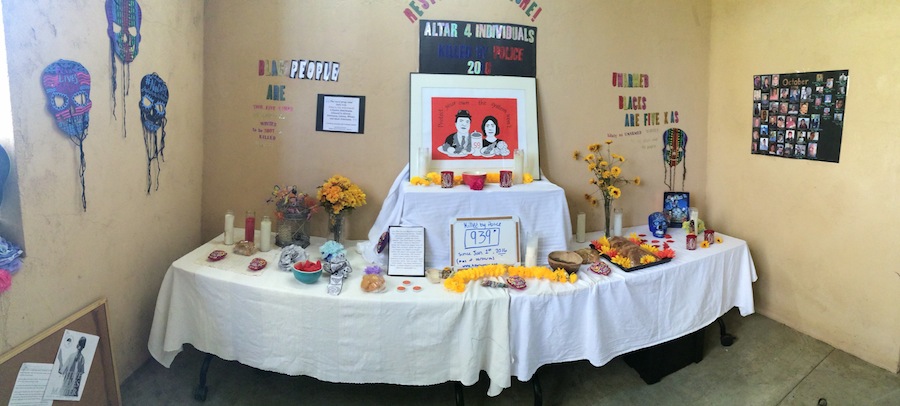
Every year, the Department of Chicana/o Studies creates an altar for Dia de los Muertos with staff, students and others in the ethnic studies departments. This year, the department built a community altar in memory of victims of police violence in 2016. The altar was located in the Hart Hall stairway corridor from Oct. 18 to Nov. 14.

Additionally, the department hosted a reflection and discussion about the meaning of Dia de los Muertos and police violence on Nov. 7.

“This year, given the huge number of victims of police violence in our communities (i.e, Native American, African American, Latina/o and Trans, for example), it was decided that the altar should honor and reflect on the victims of police violence in 2016,” said Natalia Deeb Sossa, a professor in the Chicana/o department, via e-mail.

Since Nov. 11, 2016, 971 people have been killed by the police.

The altar and artwork at the memorial included photos of all of the victims, calacas and calaveras (skeletons and skulls), flowers, posters and food offerings.

The altar became a space to discuss and address police violence.

“Given the prevalence of police violence in the media (and hidden from the media) the altar became a space, built in community, to address the issues currently affecting our communities […] knowing that this is a very difficult and painful subject, we offered a space to reflect, heal and discuss police violence in our communities,” Sossa said via e-mail.

Written by: Yvonne Leong — campus@theaggie.org

Students walk out of classes to protest potential tuition hikes

BRIANA NGO / AGGIE
BRIANA NGO / AGGIE

Students respond to termination of UC tuition freeze

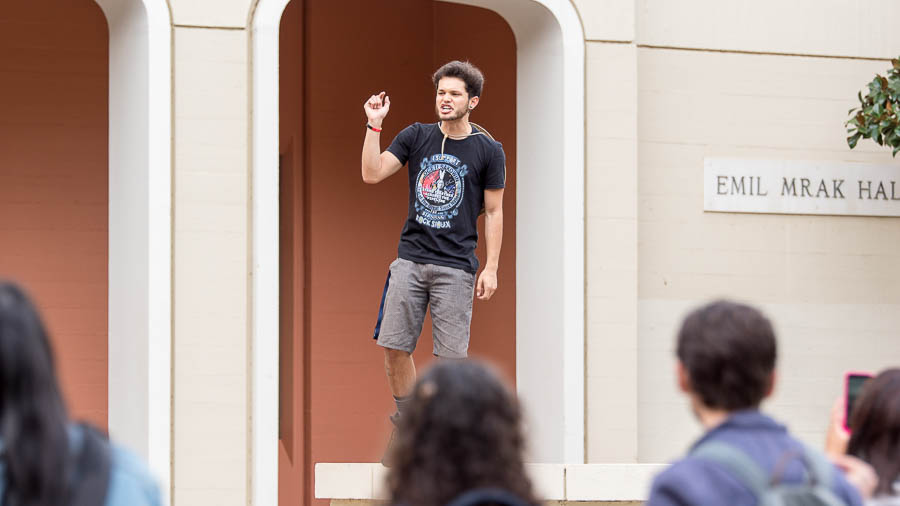
On Monday, Nov. 21, approximately 30 students gathered at the Memorial Union and marched through the Coffee House to Mrak Hall from 12 to 1 p.m. to protest potential UC tuition hikes.

The protest, which was advertised in a Facebook event for UC Davis students, was inspired by the UCSB Student Activist Network’s own tuition protest.

“Two years ago, the UC tried to increase tuition across the board [by 5 percent] every year for the following five years,” the Santa Barbara Student Activist Network stated on Facebook. “After students mobilized, the UC instituted a tuition freeze for in-state, undergraduate students. That tuition freeze is now over, which means it’s time, once again, to mobilize.”

BRIANA NGO / AGGIE
BRIANA NGO / AGGIE

The UCSB Student Activist Network called for UC students to get involved in the tuition hike protests.

“We need to show the UC administration that students will not settle for another partial tuition freeze, but demand a rollback on tuition,” the UCSB Student Activist Network said. “The UC Administration, the UC Regents and the State of California need to prove that they prioritize students by addressing the structural problems faced when funding the UC.”

UC Davis students participated in the walk-out with chants such as “Hey hey UCD, no more tuition fees,” “Education is a right, and so we’re gonna fight” and “Hey hey, ho ho, tuition hikes have got to go.”

Dexter Hampton, a first-year environmental science major, believes that the tuition surges are absurd, especially since he is already paying a significantly higher amount as an out-of-state student.

“I came here from Ohio and what do I get? $40,000 a year in tuition,” Hampton said. “I’m going to be in debt the rest of my life trying to fix the problems that these bastards are creating.”

BRIANA NGO / AGGIE
BRIANA NGO / AGGIE

Once the protesters made it to Mrak Hall, students spoke to the group about how administrators have large salaries while students work hard to afford college. Demonstrators chanted: “Hey, hey UCD, cut those admin salaries” and “Your paychecks are big, your brains are small, your ivory tower soon will fall.”

Matthew Bridges, a third-year transfer ecologic management and restoration major who participated in the protest, suggested students write a letter to campus administrators informing them of student frustrations regarding inflated tuition rates.

“I’m here because I don’t think the university should be increasing tuition when there’s a lot of other inefficiencies in the system that could be cut,” Bridges said. “The students shouldn’t be the ones who are taking that burden, especially if they have to take on debt.”

Bridges said that, although the protest was not well-organized and had an ambiguous message, it is important for all students to express their opinion on the tuition issue.

“The fact that we made our presence [known] and there were high-level people walking around [Mrak Hall], to see us […] was effective,” Bridges said.

Students who participated in the walk-out plan to protest further moving forward to ensure that their voices are heard.

Written by: Jeanna Totah — campus@theaggie.org

Guest: Jewish Voice for Peace Davis stands in solidarity with Davis Islamic Center

HANNAH LEE / AGGIE
HANNAH LEE / AGGIE

In the wake of the heinous hate letter sent to the Davis Islamic Center on Saturday, Nov. 26, the Jewish Voice for Peace chapter at Davis expresses solidarity with Davis’ Muslim community and reaffirms our commitment to fight Islamophobia and racism.

As community members, and especially as Jews, we understand the gravity of such threats. This act of hate, as we well know, is not just an isolated incident, but a reflection of the unfortunate cycles of bigotry and scapegoating that befall those deemed as the “other.” By invoking the Holocaust as a threat against American Muslims the letter demonstrates that anti-Semitism and Islamophobia are joined at the hip.

We would like to reiterate the promise made by Jewish Voice for Peace on Nov. 9, following the election results: “To join with Muslim, South Asian, and other communities impacted by and organizing against Islamophobia, white supremacy, and anti-Arab racism.” We will not stand silent as our Muslim siblings are threatened with genocide.

We also call on our fellow Jews and Jewish leaders in Davis and in the region to take a strong stance against such vile bigotry. It should be made clear that when Jews declare “Never Again” we invoke a responsibility not simply to protect our own community, but to never let the horrors of prejudice befall anyone anywhere.

In Solidarity,

Jewish Voice for Peace Davis

Jewish Voice for Peace Davis is a student led organization that seeks an end to the Israeli occupation of the West Bank, Gaza Strip and East Jerusalem; security and self-determination for Israelis and Palestinians; a just solution for Palestinian refugees based on principles established in international law; an end to violence against civilians; and peace and justice for all peoples of the Middle East.

Neanderthal genes survive in modern humans

GENESIA TING / AGGIE

UC Davis researchers believe population size has driven natural selection in neanderthal, human hybrids

Nearly 40,000 years ago, neanderthals ceased to exist. Today, only a small fraction of their genes can be found in modern humans.

Previous studies hypothesized that a diminishing prevalence of neanderthal allele variants could be attributed to a genetic incompatibility between neanderthals and humans. That is, upon interbreeding, neanderthals and humans were not capable of producing an evolutionarily fit hybrid offspring.

However, researchers at the UC Davis have conducted a study that suggests otherwise.

Our goal was to find out what could explain the observed level of neanderthal ancestry in the genomes of modern humans,” said Simon Aeschbacher, a postdoctoral student who spent two and a half years at UC Davis. “Previous studies have found that a certain percentage of our genomes is derived from neanderthals. It’s between one and four percent. Some people have more, some have less.”

In an effort to discover what caused the observed patterns of neanderthal genes in modern humans, Aeschbacher and a group of researchers relied on previous work that uncovered the sequence of the human genome. Upon recovery and sequencing of neanderthal DNA from Europe and Asia, the group of researchers at UC Davis were able to compare the sequences of neanderthal DNA with that of modern humans to see what pieces of the neanderthal DNA remained.

Our explanation for why we see what we see, in terms of neanderthal ancestry in humans, is that differences in population size drove natural selection in neanderthal and human hybrids,” said Graham Coop, a professor in the UC Davis Department of Evolution and Ecology.

Variations in population size can cause natural selection to act differently. Natural selection acts more efficiently in larger populations where more variation exists. In smaller populations where individuals are more genetically similar, it takes much longer for natural selection to eliminate an unfavorable variation of an allele.

“When you have a small population, basically everyone is related to each other. This means that if someone has something that is slightly deleterious, then it’s highly likely that the others in the population will also have this bad allele just because they are all related,” said Ivan Juric, a population geneticist who previously worked with Coop and Aeschbacher. “Basically, it’s harder to remove this slightly deleterious allele from a smaller population. When you have a larger population, individuals are less related to each other. Because of that, they’re less similar. This allows for selection to be more efficient in removing these deleterious alleles.”

Natural selection works in a way that attempts to conserve the functions of the human genome. In regions of the genome where selection is very strong, a smaller quantity of neanderthal DNA will be found. In small neanderthal populations, certain alleles were able to persist due to individuals in the population being genetically similar.

However, when these neanderthal alleles were introduced into much larger human populations through hybridization, a type of purifying selection worked to efficiently remove these deleterious alleles in order to conserve the functions of the human genome.

It is important to note that not all neanderthal alleles are intrinsically deleterious or incompatible with those of humans. Really, the elimination of neanderthal alleles upon hybridization was due to differences in population size. If neanderthal populations had been larger, it is very likely that we would possess more of the allele variants they possessed.

“So, if the neanderthal population had been larger, selection in that population would be more efficient, so you would have fewer bad alleles. At the time of hybridization, fewer of these bad alleles would come into humans. If something is not deleterious, then it takes longer to be selected against,” Juric said.

Based off of the research they conducted, Coop and his team of researchers are now able to predict the future of neanderthal genes in the human genome.

“Our research would suggest that they [neanderthal allele variants] would further decrease in future generations,” Aeschbacher said. “The process would be very gradual, but our research predicts that neanderthal DNA will continue to be removed from the human genome.”

Written by: Abigail Saenz — science@theaggie.org

Student Fashion Association to offer fashion show planning class

NICKI PADAR / AGGIE
NICKI PADAR / AGGIE

Student-run class provides students with experience in event planning

Every spring, the Student Fashion Association (SFA) hosts an elaborate charity fashion show in which student designers can showcase their work. An incredible amount of effort, organization and planning goes into the annual event for it to run smoothly, and this is all accomplished by the students who participate in the SFA Fashion Show Planning Class, held every Winter Quarter. Facilitated by the board members of SFA, this one-unit class helps students expand their knowledge of what it takes to plan and organize such an exciting event.

Camille Ramos, a third-year textiles and clothing major and SFA social media coordinator, touched on the club and class’ welcoming environment for students of any major.

“We’ve very inclusive […] our members can range to an animal science major, to a pre-vet student, pre-law, to textiles and design majors,” Ramos said. “Especially during the fashion show planning class, you get to be in contact and learn how to communicate with professionals, whether that be designers, the entertainment or photographers, and we try to enhance those skills for [students] to become better communicators and be able to facilitate such a huge event.”

The board members are in charge of facilitating the student-run class, and it becomes a collaborative effort to bring all aspects of the fashion show together. The class is split into different committees — decorations, marketing, fundraising, stage design and talent. According to SFA president Jeannette Chiu, “It’s all about group work!”

Chiu, a fourth-year design and communication double major, strongly believes that the value of teamwork is essential for any student’s success.

“When we graduate, we’ll have to work in groups, so it’s building on communication skills and leadership skills,” Chiu said. “Even if you’re not very vocal, you can still be a leader.”

Alana Williams, a second-year design major and SFA club member, also emphasized the benefits of the fashion show planning class, regardless of major.

“Anyone outside of the design and textiles major could take the class, because you get to meet new people and network,” Williams said. “We work with a lot of clubs on campus, and you get to learn business aspects for what it takes to run a fashion show, or anything in general.”

Even for those who have no prior experience, SFA has them covered, too.

“It’s all a learning process, and you’ll have many people to support you if you don’t have any experience,” Williams said.

The theme for last year’s fashion show was “Wanderlust,” and all funds from the show were donated to the Children’s Literacy Foundation.

“Our funds helped the organization give books and school supplies in areas where they don’t have the educational materials that are needed, and this also encourages [kids] to grow their passion for reading and writing,” Chiu said. This year’s theme and charity choice are still undecided.

There may be a lot of work involved, but it’s worth it to the students involved, who are doing what they love.

“It’s a lot of planning, but it all comes together because we have a common goal,” Chiu said.

For more information, readers may check out SFA’s Facebook page and its website, sfaucd.com, for information and videos of past fashion shows. The class will be held Tuesdays from 7 to 8 p.m. in Wellman 216. The course is P/NP, and the CRN is 42413.

Written by: Pari Sagafi — arts@theaggie.org

That’s AlottaCappella

JAY GELVEZON / AGGIE FILE

Liquid Hotplates host annual showcase this Saturday

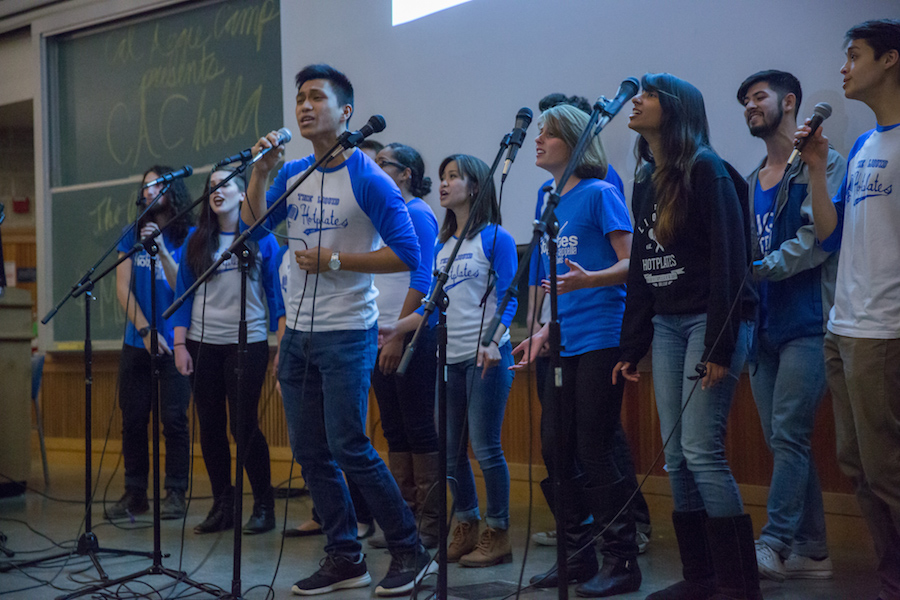
The Liquid Hotplates, a co-ed a cappella group on campus, is here to offer students a gleeful time in the form of AlottaCappella 2016, its annual concert.

“[Singing] has been a part of my life for as long as I can remember, so joining a college a cappella group was the next logical step after a lifetime of choir, and the Liquid Hotplates was my personal favorite based on the quality of their sound,” said Kiersten Allison, a third-year animal science major and co-public relation chair for the Liquid Hotplates. “I absolutely love being a member of this group, and it is by far the highlight of my college career.”

This quarter, the Hotplates has been preparing for the International Championship of Collegiate A Cappella (ICCA) in April 2017, a competition for top-notch student groups around the globe.

“Right now, it’s not just the competition [though],” said Cole Hofberg, a third-year civil engineering major and co-music director. “[We] try to figure out what the group wants and then decide what arrangement we want to do, and how we want to spend our time. One of our goals is to do the competition but as well as one of our biggest shows: AlottaCappella.”

Most of the Davis a cappella groups will be performing, including Davis Chamber Choir, The Spokes and the Lounge Lizards. The majority of songs performed in the show will be R&B, soul and pop music. As the host of the show, the Liquid Hotplates will perform several songs, including “Hey Ya” by Outkast and “Here,” an R&B mashup song by Alessia Cara.

“We are so excited to perform at AlottaCappella again this year,” said Amanda Beardsley, a fourth-year psychology major and president of The Spokes. “In the fall, we usually travel to LA and Berkeley for various showcases and it’s so much fun. With being so busy, it’s so nice to end the quarter with a show in Davis surrounded by a great a cappella community. The Liquid Hotplates always put on an amazing show and we are very excited to hear them perform.”

For the Hotplates, one of the most exciting parts of the performance this year will be its new sound equipment. In past years, the host rented sound equipment for performances, and had all the performing groups share four microphones on stage.

“This is the first year we will be using our own sound equipment, and we will also ramp up the decorations more than ever this year. SciLec will truly be glowing with musical bliss,” Allison said. “Those attending should prepare themselves for a night of wonderful music and being endlessly entertained by the variety of talented voices performing in the show!”

AlottaCappella 2016 will be held on Saturday, Dec. 3 from 8 to 11 p.m. at Science Lecture Hall 123. Pre-sale tickets are available online for $10. For more information about the show, please visit its Facebook event page.

Written by: Betty Wu — arts@theaggie.org

Black Mirror: our disturbing reality

NICKI PADAR / AGGIE
NICKI PADAR / AGGIE

Wildly popular Netflix drama speaks to unease of current generation

Black Mirror doesn’t hesitate to be full-on effed up from the get-go: the pilot episode is about the kidnapping of a British princess who can only be saved if the British Prime Minister agrees to perform sexual intercourse with a pig and broadcast it live internationally. It’s bizarre, yes, but in a way, it captures the insanity of the modern age.

Black Mirror, a British break-out hit available on Netflix, isn’t just a TV show; it’s smart, sharp commentary on 21st-century technology development and consumption. Copying the stand-alone dramatic style of The Twilight Zone, each episode of Black Mirror has a different plot that cuts deep into our psyche which has become so closely braided with the mysterious nature of contemporary technology. The Twilight Zone and Black Mirror overlap in not only framework, but in concept as well. The Twilight Zone aired in the midst of the Cold War and featured the confusion and dismay of the time as many episodes’ plots centered around the end of the world, bomb shelters and neighbor against neighbor.

It is no wonder why Black Mirror has taken so much inspiration from the cult classic — the show deals with a similar anxiety but in a modern context. In each episode, the show explores psychological and societal problems that stem from social media and technology. The episode “White Christmas” features chips planted in people’s heads that copy an individual’s consciousness to then be placed into a device that controls a Smart House based on that specific individual’s likes, dislikes and daily patterns. The program knows just how an individual likes their toast, and seems to know people better than they know themselves — an eerie thought in an era of smartphones and self-driving cars.

Another subtly haunting example occurs at the end of the first episode. As the Prime Minister sits in a bathroom covered in sweat and vomit (after his sexual encounter with the pig), his cell phone continues to ring as the frame slowly turns black — even in our most vulnerable moments, an omnipotent social media presence still reigns supreme. There is no personal space. Silence fails to exist.

Black Mirror is not the only show currently exploring the repercussions of technology. Mr. Robot portrays a social outcast, Elliot, who gets involved in a revolutionary computer hacking group named fsociety that plans to take down a major tech corporation. Both shows express the subconscious fear and anxiety surrounding society’s increasing dependence on technology. Moreover, both shows tap into this unease and translate it to fit a larger, more accessible platform. Black Mirror has plots that are absolutely insane and downright creepy, but are relatable at the same time. That’s the truly scary part.

As for Mr. Robot, it portrays the subtle isolation embodied in technology — genuine social interactions are gone, as demonstrated by the socially isolated Elliot. Nonetheless, underlying the show is an anger concerning the control technology possesses and ultimately leads to a social revolution in the show. Maybe something similar is on the horizon in reality.

The haunting party of these sci-fi shows is that while the ideas may seem far-fetched, they really are not once reflected on. With the current trends and progression of contemporary technology, the concepts of both shows are somewhat feasible. There lies the dualism of technology: while it provides us with the gift of limitless information, it also poses the potential for horrifying results.

Entertainment is entering a new stage of content, one that centers around the anxiety of our current age. Like in the The Twilight Zone, having content that was able to express the population’s emotions and anxiety served to motivate discussion, to prevent a bottling-up of emotions. These shows are well written, well-produced and, most importantly, make their large audiences think; that’s the beauty of entertainment.

Written by: Caroline Rutten — arts@theaggie.org

Team of the Quarter: Men’s Water Polo

0
IAN JONES / AGGIE FILE

UC Davis men’s water polo continues exceptional season, wins WWPA Championships

With an overall record of 23-5, an undefeated conference record of 6-0 and a secured Western Water Polo Association Championship, it is no surprise that The California Aggie’s choice for Fall 2016 Team of the Quarter goes to men’s water polo.

Looking back at the 2015 season, the team was undefeated in conference but fell short in the WWPA championship final against UC San Diego. Coming into this season, head coach Daniel Leyson defined the goals for the team that ultimately contributed to its success this year.

“Our goals are the same every year,” Leyson said. “We want to have a top 10 ranking, we want to be in the championship game in our conference tournament, and we want a team GPA above 3.0. Those were the goals when I came here four years ago, and they continue to be the goals for our program now.”

This season for the UC Davis men’s water polo team has been nothing but successful. Its 23 overall wins has surpassed the school record of most victories in a season, previously set by the 2007 and 2011 teams with 22 wins.

The 2016 season is the second season that the team has been undefeated 6-0 in conference, but this year was the year men’s water polo was able to win the WWPA Championships against UC San Diego 12-8, beating the team that had defeated them in the conference championships one year prior.

“It’s a one-of-a-kind feeling,” Leyson said. “We are arm-in-arm on the pool deck, and close to the end we knew it was over. We could just sit and wait and watch the clock go down and jump in the water together. It’s a feeling like no other.”

To go along with the success of winning the WWPA Championship, sophomore attacker Ido Goldschmidt received Western Water Polo Association Player of the Year honors, joining sophomore utility Sasa Antunovic on the All-WWPA First Team. Two more players, sophomore attacker Marcus Anderson and junior goalkeeper Spencer Creed, received second-team honors, while junior attacker Cory Laidig earned honorable mention and freshman attacker Yurii Hanley made the WWPA All-Freshman Team.

“I’m especially happy for the guys as a validation for all the work they have gone through and especially the feeling of disappoint from last year’s loss,” Leyson said. “I also feel that this win wasn’t just for our current guys, but also for the past guys that have been so close and have come up short.”

It was tough for Leyson to define the season in one word, but he eventually found the right one: “Satisfying.”

“But it isn’t over, and we want to get to the final four. We have to keep going,” Leyson said. “I think that there is no question that these guys have an outstanding work ethic. I put them through a lot, and they always respond. It’s a great group.”

UC Davis men’s water polo was drawn to compete in the NCAA championships and will play in the quarterfinal match and face the winner of Bucknell vs. Harvard on Thursday, Dec. 1 in Berkeley.

Written by: Ryan Bugsch — sports@theaggie.org