55.9 F
Davis

Davis, California

Tuesday, December 23, 2025
Home Blog Page 725

Active Minds hosts End the Silence on Quad

ASHLEY LUGO / AGGIE
ASHLEY LUGO / AGGIE

Student mental health advocacy group laid out 1,100 diplomas to raise suicide awareness

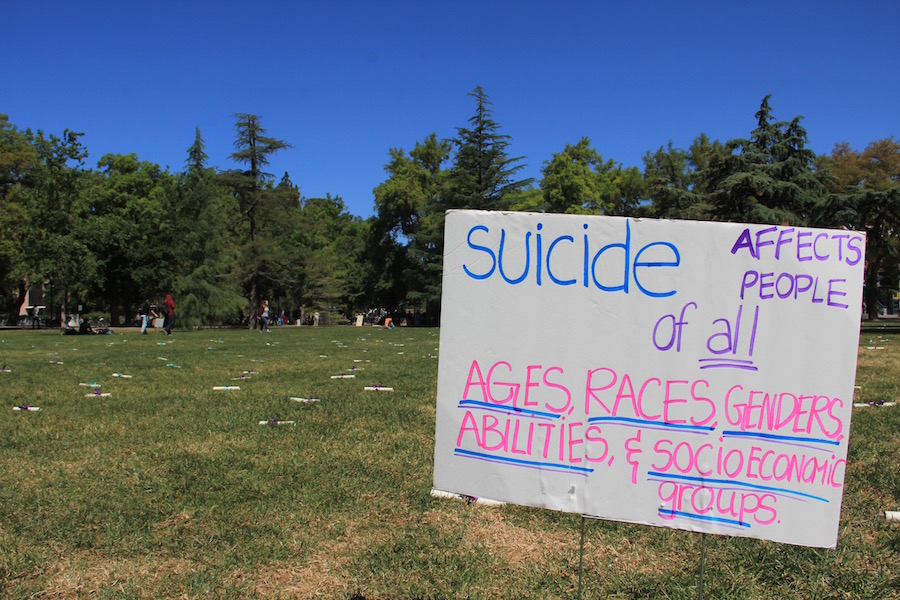
UC Davis student health organization Active Minds is hosting its second annual End the Silence event on the Quad this week, on Monday, April 25 and Tuesday, April 26.

The event is intended to raise awareness of the prevalence of mental illness in students attending American universities, and displays 1,100 diplomas individually laid across the Quad to represent the annual number of suicides of college students in the U.S.

Each diploma featured varied statements centrally focused on the destigmatization of mental health advocacy. In addition, the statements called for a greater emphasis on creating a more inclusive environment for students struggling with mental illnesses including depression, suicidal thoughts and anxiety.

“That visual representation [illustrates] how large of an issue suicide is nationwide. It really shows [suicide at universities] is not just an odd occurrence you hear on the news once every couple months,” said Brenna Williams, president of the Davis chapter of Active Minds and a psychology and evolutionary anthropology double major. “These are issues that way more people are dealing with.”

Williams added that one of the goals of the event was to provide information to students who are battling mental illness but have been discouraged from sharing their experiences or seeking out resources provided by the university.

“I would like to see people feel more safe actually explaining their issues, explaining that they’re struggling,” said Active Minds co-vice president and fourth-year psychology and human development double major Julia Flickinger. “Nobody understands that the university is a safe place and that people are struggling with the same things they are too and that there are resources for them to get help.”

According to fourth-year psychology major Ian Nool, a student wellness ambassador for the Campus Health and Counseling Service (CAPS) as well as outreach coordinator for The Mind Spa, many students, especially first-years and transfers, are hesitant to utilize resources offered by the university.

“From my perspective, as a freshman I wasn’t aware of all the resources on campus. The university has done a good job with outreach and putting on events,” Nool said. “It’s just a matter of students knowing that these resources exist and pushing forward so students can know.”

Chaaya Vandha, a third-year psychology major and fellow student wellness ambassador, echoed Nool’s sentiment.

“Sometimes people don’t feel comfortable going to CAPS or to The Mind Spa. They’re scared to come in and make a mistake, and we want to emphasize to freshmen and transfers that there are no mistakes nothing wrong can happen. We won’t yell at you, we’re here to help,” Vandha said.

Vandha emphasized the accessibility of the mental health resources offered by the university.

“It’s the first step of asking someone for help. It could be your RA, it could be anyone who knows about even some of the resources,” Vandha said. “Starting in one place can get you to so many places because the resources on campus are very intertwined. They all know about each other. They all know what purpose each of us serve.”

ASUCD Senator and second-year English major Sofia Molodanof, who ran on a platform of extending mental health services for UC Davis students, believes the event could greatly benefit the student body and faculty.

“There are all these different aspects of mental health that no one really talks about. Having a whole event on it could give students the tools to get past that stigma,” Molodanof said. “Once we can get past it, there will be more conversations to have, so instead of talking about ‘What did you do last week?’ it could be ‘How are you? How are you feeling? Can I help you in some way?’”

Molodanof explained that she also believes the event can better prepare all students, including those not currently struggling with any mental health issues, to create an inclusive and uplifting environment for their peers suffering from mental illness.

“This [event] would help students know the tools to help others. They may not be struggling with [depression], but they may have a friend who is struggling with mental health and they might not have any idea about it,” Molodanof said. “They don’t know how to talk to them or they don’t know how to help them. Learning about all these resources and being able to start the conversation can really help their friend. Getting the conversation started is what’s most important.”

Written by: Jack Raineri – campus@theaggie.org
UC Davis researcher finds disparities in age, race for state spending on autism spectrum disorder

BRIANA NGO / AGGIE
BRIANA NGO / AGGIE

Dr. Paul Leigh’s research team finds white residents with autism spectrum disorder receive more state funding than any other racial group

On March 25, Dr. Paul Leigh, a UC Davis researcher under the Department of Public Health Sciences, and his team of researchers released a study entitled “Spending by California’s Department of Developmental Services for Persons with Autism across Demographic and Expenditure Categories” which found large racial disparities in state spending on autism.

Funded by Autism Speaks and the National Institute for Occupational Safety and Health, Leigh’s research is one of the few studies conducted so far which measures non-medical costs stemming from autism spectrum disorder (ASD) in relation to adults under varying demographics. These demographics include race-ethnicity, gender and age.

Leigh and his team concluded that there were large disparities in spending by the California Department of Developmental Services (CDDS) in terms of race and age. According to a press release of the study, the disparities in spending were quite massive when age and race were factored in together, while per-person spending for gender remained equal between males and females.

“Spending differences based on race and ethnicity were more profound for adults with ASD. Compared to whites over the age of 18, average per-person expenditures were nearly $13,000 lower for Hispanics, $8,000 lower for Asians, $6,000 lower for others (including nonresponders, Native Americans and Pacific Islanders) and $4,000 lower for African Americans,” the press release said.

The methodology used in the study involved analyzing the spending of the CDDS. CDDS is one of California’s major governmental service providers for individuals diagnosed with ASD. More specifically, the research utilized data from CDDS’ non-medical fiscal spending during the 2012-13 year. Examples of non-medical spending include transportation, secondary care, aid for employment and other miscellaneous aid.

When asked why these disparities exist, Leigh pointed to a variety of factors that could possibly cause these differences amongst spending. For one, Leigh suggested factors specific to the region of ASD support centers. Leigh provided a theoretical example using the demographic of Hispanics.

“It could be that the counselors available in Fresno or in Sacramento for that matter, these counselors’ wages are less than the counselors in San Francisco or L.A. So Hispanics may be receiving the same amount of services in Sacramento or Fresno in terms of […] hours of counselor time but the hours are billed at a lower rate in Fresno than they are in San Francisco,” Leigh said.

Leigh’s mention of regionalism and systematic discrimination is not a new connection, especially in the realm of health care. Just recently, Antron McKay-West, the president of Upgrade Mississippi, explained to the Huffington Post the challenges that communities in Mississippi faced when accessing services such as healthcare.

“I know people who were trying to sign up for health care coverage, but they don’t have Internet at home, they don’t have email addresses,” McKay-West said. “When they tried to sign up by telephone, the assistants on the other end often told them to just go to the library and use the Internet there to sign up and check their email,” McKay-West said.

Paul Krugman, an American economist, makes a more direct claim between health care and its supposed ties with racism. In an op-ed published in The New York Times, Krugman questioned why certain states chose to block the Affordable Care Act’s expansion of Medicaid when Medicaid would be able to support many citizens and their provider. According to Krugman, that may be due to the history of certain states.

“Only one former member of the Confederacy has expanded Medicaid, and while a few Northern states are also part of the movement, more than 80 percent of the population in Medicaid-refusing America lives in states that practiced slavery before the Civil War,” Krugman said.

“In general, we spend an awful lot of money in the United States and we just don’t get a return in our investment. It’s a mess […] how much money we spend on medical care versus how much we get out of it,” Leigh said.

Leigh believes that further study must be done before certain connections between health care and racism can be established. However, he does hope that his research — an intersection between health and economics — can help raise awareness concerning problems within the health system and better support the people who need it most.

Written by: Katrina Manrique – campus@theaggie.org
UC Davis women rooting themselves in STEM

LUCY KNOWLES / AGGIE

UC Davis women in STEM share experiences in and out of the classroom.

Considerably fewer women than men pursue degrees in the fields of science, technology, engineering and mathematics (STEM) overall. But, this gap is slowly narrowing — especially at UC Davis, which on March 29 was named number one on Forbes Magazine’s list of The 13 Most Important STEM Colleges for Women.

The physical sciences have always been a passion for chemistry graduate student Elyse Towns, but it was her undergraduate years at UC Davis which made her realize that her passion could turn into a career.

“I started doing undergraduate research my junior year and I just loved that,” Towns said. “I really enjoyed the problem-solving aspect of it and that was what convinced me to go to graduate school to use analytical chemistry to study how changes in model cell membranes affect the body.”

UC Davis helped Towns develop her interest in STEM, even allowing her to co-lead the university’s Equity in STEM and Entrepreneurship (ESTEME) program, an outreach and leadership training program designed to increase underrepresented professionals in STEM fields.

“ESTEME is a graduate organization on campus that promotes diversity in STEM and entrepreneurship that anyone can join,” Towns said. “We have outreach events where we have presentations by people in different fields who will talk about their careers and how being [part of an] underrepresented community has affected their lives.”

Towns’ time at UC Davis has encouraged her to expand beyond the stereotypical gender roles, to which many women feel they are constricted by, and instead remain dedicated to the sciences.

“I always thought I’d go to college, make money, and some day when I have children, I’d stop working. But now after being in graduate school, I can’t imagine stopping work to fulfill the stereotypical stay-at-home mom role,” Towns said. “The hardest part for me was getting the confidence that I could do it and I think that’s probably common for a lot of women, so I think it’s just being prepared to try even if you may fail.”

ESTEME is just one of UC Davis’ programs for promotion of women in STEM. The Women in STEM (WiSTEM) club on campus has helped fourth-year environmental toxicology major Krisha Yadav-Ranjan solidify her place in the sciences and find empowerment during difficult times.

“At first, it was a struggle maintaining my love for science in college where I had a harder time,” Yadav-Ranjan said. “One of the best things I did was join a support space, such as the WiSTEM club. For me, the club symbolized support and empowerment, and made space for us to reflect on the fact that as women, we face the possibility of being gendered in the classroom.”

According to Yadav-Ranjan, WiSTEM, tutoring and the university’s teaching assistants are all resources meant for women to succeed, but having the right support system is another necessity for women pursuing STEM at a professional level.

“I can really say that once I started to use my resources on campus and found a community for myself, I [felt] strong and confident in my capabilities,” Yadav-Ranjan said. “No matter what anyone tells you, you know yourself the best and you will always have more strengths than weaknesses. There’s always somebody to help you, you just have to seek for it.”

Associate professor and chemist in the Food Science and Technology Department Daniela Barile came to UC Davis as a graduate student from Italy. She enjoyed the campus so much that she later returned to establish her career at the university, studying bioactive compounds in human milk.

“What I really like about UC Davis is that both men and women [are] very supportive of young career scientists and they will encourage me and push me to do more, which is something that I did not experience in Italy,” Barile said. “There’s much more support, more encouragement and much more equality here compared to other places I’ve been. It might not be completely there yet but it’s a great improvement compared to the place I come from.”

Barile encourages young women pursuing STEM to attend networking opportunities and seminars early in their studies — doing so gives them the opportunity to see other women who have worked hard to achieve success.

“In Davis, there are so many outstanding models of women that have achieved high positions in science and administration and that means a lot,” Barile said. “I would suggest to do a lot of internships, go to conferences and work hard, because in my experience when someone sees someone working hard, they will open doors to them because they see that they want to be successful.”

Although the fight for gender equality in the classroom and in the workplace continues, both students and faculty at UC Davis continue to work hard to send smart, thoughtful and well-rounded STEM women into the world.

“I have found empowerment being involved in WiSTEM and have realized that any obstacles I face in the future are things that will drive me,” Yadav-Ranjan said. “The word ‘empowering’ is just a word, but the feeling of it is eclipsing; it’s something that you want to share with so many people.”

Written by: Gillian Allen — features@theaggie.org

“Let’s Talk About Sex” campaign hosts art show

LET'S TALK ABOUT ART / COURTESY
LET’S TALK ABOUT ART / COURTESY

Let’s Talk About Art promotes comfortable conversation

The “Let’s Talk About Sex” campaign will be hosting its first art show on Thursday, April 28 from 11 a.m. to 5 p.m. near the Memorial Union.

“The art show will feature a variety of different types of art pieces showcasing different opinions and expressions on sex,” said Bernadette Fox, a fourth-year international relations and gender, sexuality and women’s studies double major.

This display will open up dialogue about sex, a topic that is often stigmatized in society, and will allow people to express themselves about the subject in a comfortable way.

“Art is a really nice way to enter that conversation probably in some ways that are more comfortable, and approach it in a different way than sitting down and talking and saying ‘this is what we’re talking about,’” Fox said.

The show aims to stimulate conversation surrounding sex in a way that does not force thought or opinion.

“People can create art and people can look at art,” Fox said, “Art creates a space to have thoughts.”

The art show strives to share students’ experiences and voices concerning sex according to the event’s co-organizer and fourth-year gender, sexuality and women’s studies major Sara Connor. She hopes that the display will bring a variety of mediums and attract many individuals.

“Pieces will be somewhat related to the theme of the month,” Connor said. “Sex is such a broad topic though, and we’re welcoming people to go anywhere with that.”

The display will also feature an interactive art project, according to Fox. It will be similar to a collage, and attendees will be able to share their experience with the show.

“It’ll probably be a collage sort of thing, with multiple aspects, like finger painting and writing words, on what they got out of the experience,” Fox said. “People will be able to interact and work toward one collaborative piece.”

“Let’s Talk About Sex” month will also feature events such as Take Back the Night, workshops in sexual education, and a showing of the movie The Hunting Ground. Event co-organizer and third-year global disease biology major Melina Tessier encourages students to attend.

“Sex is often considered a taboo topic, although it should not be,” Tessier said.  

For more information, please visit the Facebook event.

WRITTEN BY: Jennifer Duong – arts@theaggie.org

This week in sports

TIFFANY CHOI / AGGIE

UC Davis athletics from  April 18 to 24

Baseball (9-24)

UC Davis at St. Mary’s (L,7-6)

UC Davis vs. UC Irvine (W, 9-6)

UC Davis vs. UC Irvine (L, 4-6)

UC Davis vs. UC Irvine (L,11-1)

UC Davis only had two hits in the first innings but was able to get six hits in the ninth to tie the game on April 19. The Aggies were unable to keep the St. Mary’s Gaels from scoring in the bottom of the ninth, allowing them to win the game with a walkoff. Redshirt junior infielder Mason Novak started off the scoring with a pinch-hit RBI in the sixth.

On April 22, redshirt freshman left-handed pitcher Robert Garcia struck out six and only gave up three hits over 6.1 innings.The UC Davis offense was able to get 11 hits off of the Anteaters pitchers, and senior outfielder Cameron Olson had two doubles and finished 3 for 3.

The Aggies rallied to tie the game 3-3 in the fourth inning but could not hold the Anteaters from scoring late in the second game. In the sixth inning, the Anteaters broke the tie with a three run inning. Freshman catcher Logan Denholm was 3-for-3 on the day.

The Aggies fell to the Anteaters and lost the series, falling in the third game 11-1. UC Davis had the lead until the third inning when UC Irvine scored four runs and took the lead from the Aggies for good. UC Davis only had five hits in the game. Redshirt sophomore outfielder Ryan Hooper finished 2-for-3 in the game and hit .500 in the series and had his second multi-hit game of the season.

UC Davis next plays at Nevada on April 26 at 4 p.m.

Men’s Tennis (16-6)

UC Davis vs. UC Irvine (W, 4-3)

Junior Bryce McKelvie beat UC Irvine’s Justin Agbayani in three sets to help UC Davis get the win 4-3 over the Anteaters. McKelvie and sophomore Tommy Lam won their doubles match 6-2 and improved their record to 16-2 for the season. The Aggies completed a 10-0 run at home this season and has not lost a home match since April 1, 2014.

Read up on a recap of the match, by Nicolette Sarmiento.

The Aggies next play in the Big West Championship on April 27 against a to-be-announced opponent.

Track and Field

Brutus Hamilton Challenge  

Senior jumper Catherine Li won the women’s long jump at Cal while freshman jumper Steven Childs took the win for the men’s long jump. Junior thrower Morgan Dutra came in second with a 151-11 in the discus event.

Freshman jumper Kyle Clancy came first in the men’s high jump while senior pole vaulter Ariel Maroon and junior jumper Holly Tokar tied for second in the women’s pole vault.  UC Davis scored 96.5 to come in third on the women’s side and 64 points to come in fifth on the men’s side.

The Aggies will travel to Sacramento State next on April 29.

Lacrosse (7-7)

UC Davis vs. Fresno State (W, 16-6)

UC Davis at San Diego State (W, 7-6)

UC Davis at USC (L, 14-4)

Senior attacker Sam Axenroth scored a hat trick in the final Aggie home game of the season on April 19. Senior midfielder Courtney Neff and senior attacker Ellie Delich also scored hat tricks and helped lead UC Davis to a win over Fresno State. Delich also had 11 assists on the night.

Check out a recap by Veronica Vargo here.

On April 22, the Aggies won in overtime against San Diego State to secure a spot in the Mountain Pacific Sports Federation tourney. Senior attacker Ellie Delich and freshman midfielder Shannon Cross each had two goals on the game.

Two days later, UC Davis fell to USC 14-4. Freshman midfielder Shannon Cross scored two goals and had an assist against the Trojans. In the first half, USC outshot UC Davis 17-2 and the Aggies suffered from 25 turnovers. USC only allowed the Aggies one shot on the cage in the first 22 minutes.

UC Davis next plays in the MPSF tourney hosted by Stanford  as the fourth seed on April 28.

Softball

UC Davis vs. UC Riverside ( L, 7-2)

UC Davis vs. UC Riverside ( L, 3-0)

UC Davis vs. UC Riverside ( L, 4-2)

Senior first baseman Kelly Zboralske drove in the first run for UC Davis in the first inning. Zboralske then drove in another run in the third inning. The Aggies were unable to overcome a four run deficit and lost the game.

In the second game, UC Riverside won 3-0 by scoring in the fourth, fifth, and sixth innings. Senior infielder Christina Guidry batted 2-for-3. The Aggies also reached base on seven walks but were unable to get their runners to score, leaving eight stranded.

Freshman infielder Meghan Bradbury hit a triple in in the fifth inning of the third game that allowed Zboralske to score. An error on a wild throw to get Bradbury out allowed her to score as well, tying the score 2-2. The Highlanders were then able to score one run in both the sixth and seventh innings, bringing the score to 4-2 and giving UC Riverside the win.

The Aggies next play at Cal on April 26 at 2 p.m.

Women’s Tennis

UC Davis vs. CSUN (L, 4-3)

UC Davis vs. Hawai’i (5-2)

The Aggies were unable to keep their winning game streak alive as CSUN won 4-3 and stopped their streak at four. Senior Tiffany Pham won her match 6-4 and 6-2 against Kristen Poei. Sophomores Kristy Jorgensen and Jessie Lee also won their single matches to give the Aggies  three points. Both Jorgensen and Lee had wins in the double digits with Lee having 14 on the season and Jorgensen having 10.

Read a recap by sports writer Katie DeVore here.

The following day, the UC Davis women’s tennis team lost to Hawai’i in their last regular season game of the year, 5-2. Jorgensen and sophomore Lani-Rae Green won their doubles match 6-3, while Pham and Lee won their singles matches, going 4-6, 6-1, 7-5, and 4-6, 6-3, 10-3 respectively.

The Aggies next play in Big West Women’s Tennis Championship on April 27 as the seventh seed, against UC Santa Barbara, the second seed of the tournament.

Women’s Golf

Junior Paige Lee shot a 1-under-71 and won the Big West Women’s Golf Championship, helping the Aggies to finish third in the tournament. Lee battled with Kassidy Teare of Long Beach State for the top spot. Shooting a birdie on the 18th hole, Lee was able to remain one stroke ahead of Teare, who was unable to make up the stroke, giving Lee the championship. Senior Andrea Wong finished fifth while senior Betty Chen tied for ninth.

Written by Lindsay Yim – sports@theaggie.org

UC Davis women’s tennis ends 4-match winning streak, falls to CSUN

ASHLEY LUGO / AGGIE
ASHLEY LUGO / AGGIE

The Matadors defeated the Aggies 4-3 in a tight conference match on Saturday, April 23.

The women’s tennis team suffered a devastating 4-3 conference loss against California State University, Northridge on Saturday, ending the Aggies’ 4-match winning streak. CSUN secured the doubles point and also split the singles wins with UC Davis. Senior Tiffany Pham and sophomores Jessie Lee and Kristy Jorgensen were the sole victors of the singles matchups for the Aggies.

Pham began her singles set a little later due to an overlap with Bryce McKelvie of men’s tennis’ match-winning game. Pham did not waste any more time and fought right off the bat, winning straight-set games 6-4, 6-2. Pham’s victories added the first point of the day for the Aggies, redeeming the team from CSUN’s 3-0 lead.

Lee also contributed a point for her team after battling CSUN superstar Skyla Alcon. Lee recorded her 14th singles match victory of the season 1-6, 6-4, 10-8. She is the second UC Davis player to hit double digit singles wins this season.

Following Lee, Jorgensen lost her first set 3-6 against the Matador’s Vivian Lin. Even though her first set started off rocky, Jorgensen pulled a total 180. She came back to completely devastate Lin 6-0, 6-2 in the second and third sets.

“I wasn’t feeling like I was playing well [during the first set],” Jorgensen said. “I needed some time to get into my zone. [Lin] didn’t change her game that whole match — it was just me battling myself.”

The Aggies are now 10-10 overall and 2-5 in the Big West conference. Head coach Bill Maze hopes to improve their record to 11-10 on Sunday vs. Hawai’i.

Written by Katie DeVore – sports@theaggie.org

UC Davis edges UC Irvine in Senior Day season finale

LUCY KNOWLES / AGGIE

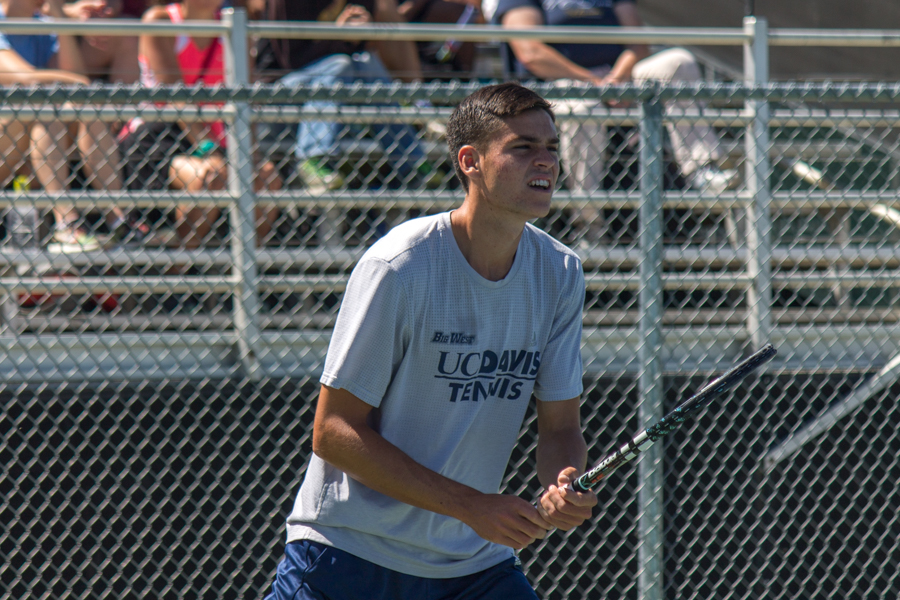
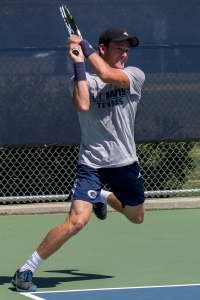
The UC Davis men’s tennis team defeated the UC Irvine Anteaters in a thrilling 4-3 season finale.

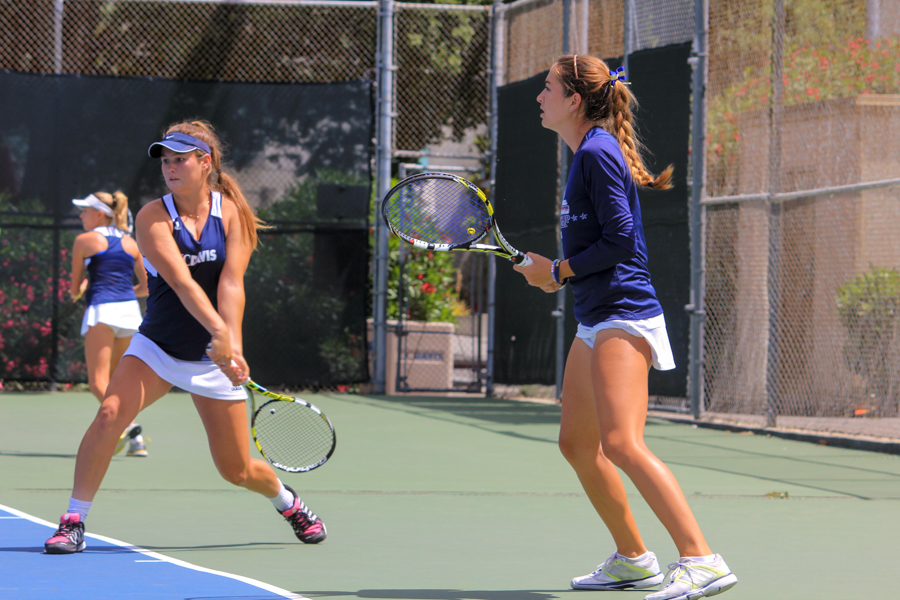
Coming home after a three-game losing streak on the road, the UC Davis men’s tennis team edged out conference rival UC Irvine, 4-3, in an exciting Senior Day season finale on Saturday. This victory puts the Aggies at 3-2 in the Big West Conference and 16-6 on the season, tying UC Davis’ record for most wins in a season.

LUCY KNOWLES / AGGIE

Over 200 fans crowded the bleachers at the Marya Welch Tennis Center to cheer on Aggie seniors Brett Bacharach and Adam Levie for their final match. UC Davis had a lot on the line going into Saturday’s match, trying to defend their two-season winning streak at home and going into their last conference game of the season before the Big West Conference Tournament.

The Aggies struggled to get anything going during their doubles matches, with Levie and junior Alec Adamson losing quickly, 6-1, but UC Davis bounced back with sophomore Tommy Lam and junior Bryce McKelvie winning their match 6-4. Bacharach and junior Eli Whittle secured the doubles point, defeating UC Irvine 6-2 with major break points.

UC Davis had trouble during their singles matches as well, with Lam and Bacharach both going down in two sets, 6-2, 6-1 and 6-4, 6-2 respectively, giving UC Irvine a 2-1 lead. However, sophomore Everett Maltby evened it out with a 6-3, 6-3 win.

Adamson also fell in two sets, 6-2, 6-4, giving the Anteaters a 3-2 lead. After Wade tied it up again with a 6-3, 6-4 win, it was left to McKelvie to get the win for the Ags.

McKelvie started off strong with a 6-4 win in the first set, but faltered in the second, forcing an intense third set tiebreak. After taking a 5-4 lead, McKelvie raised the Aggies to a 4-3 victory off a break point.

LUCY KNOWLES / AGGIE

For the seniors, seeing such a massive amount of support for their final match at UC Davis meant a lot. As Levie looks back on his career, Saturday’s win has been one of the highlights.

“To have a 3-3 deciding match with our biggest crowd of the year and the last match of my career, to come down to it that way and have everyone cheering for us — it’s never been better than that,” Levie said. “[Keeping our undefeated streak at home] is something I’ll be proud to leave as a legacy because it shows the support we have here is [the reason] we always do so well here.”

Fellow senior Bacharach agrees that their final victory for the fans was one he will always remember.

“Serving for the match in doubles and having all my friends behind me cheering me on [is the highlight of my season],” Bacharach said. “I was smiling ear to ear the whole time.”

UC Davis heads to Indian Wells to start post-season play at the Big West Conference Tournament on Wednesday, April 27.

Written by Nicolette Sarmiento – sports@theaggie.org

Her Rugby Matters

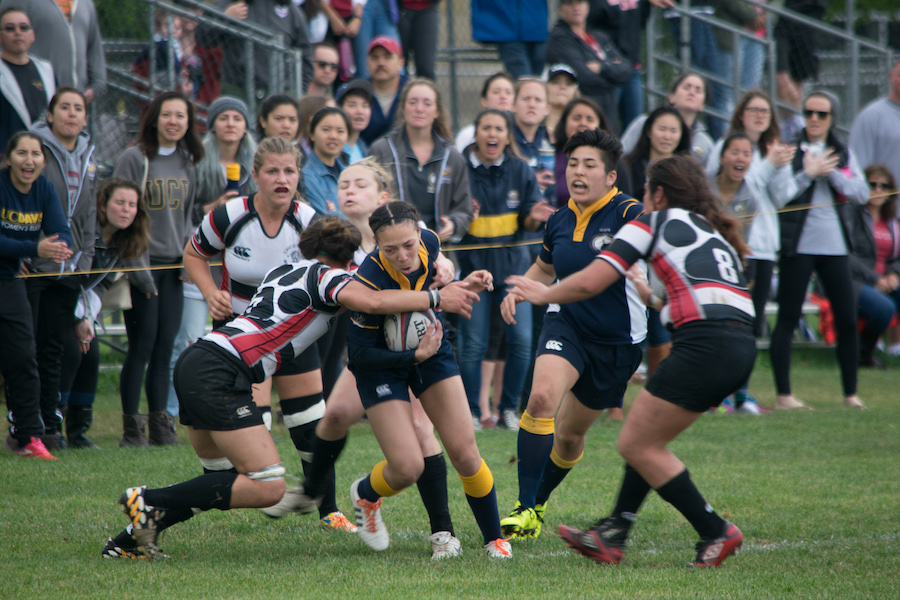
The UC Davis women's rugby club team dominated the Chico State Wildcats, 35-5, at Russell Field to advance to the Spring Championship final in May. (BRIAN LANDRY / AGGIE)
The UC Davis women’s rugby club team dominated the Chico State Wildcats, 35-5, at Russell Field to advance to the Spring Championship final in May. (BRIAN LANDRY / AGGIE)

UC Davis women’s rugby club fed up with negligence after USA Rugby cancels the 2016 Division I National Championship Title game.

The UC Davis women’s rugby club team is frustrated.

From April 9 to 10, UC Davis hosted the West Coast Women’s Rugby Round of 8 Divisions I and II Playoffs. The Lady Ruggers did not just host, however. They dominated their DI opponents on both Saturday and Sunday, shutting out Washington State University, 44-0, and defeating Chico State, 35-5.

BRIAN LANDRY / AGGIE

These victories advance the nationally ranked UC Davis women to the Spring Championship game at Saint Mary’s College in Moraga, Calif. on May 7 against University of Virginia. This is the first time in UC Davis history that the women’s rugby club team has qualified for a USA Rugby championship game.

You’d think with all this good news, the Aggies would be celebrating. So what exactly are the Lady Ruggers upset about?

Every year, per USA Rugby rules, the best collegiate teams on the East and West Coasts compete in two separate playoffs one in the fall for the East Coast teams and one in the spring for the West Coast teams. The champions for both fall and spring would then meet in the National Championship Title match to represent their respective coasts. However, things changed this year.

The California Aggie sat down with offensive forwards captain Caroline Sequeira, a fourth-year art studio major at UC Davis, to talk about her team’s current situation. Defensive backs captain Justine Joya could not make the meeting due to a concussion from Sunday’s game. Sequeira mentions this as if it’s not the most uncommon thing to happen. She’s used to this since she has been playing rugby long before she came to UC Davis. If anyone knows rugby, it’s her. She has seen how ugly rugby can be, both on and off the pitch.

So when USA Rugby canceled its Division I Women’s National Championship after an alleged scheduling error with fall champion University of Connecticut’s graduation, Sequeira decided she had enough and wrote an open letter on behalf of all female rugby players with the hashtag #herrugbycounts. She published the strongly-worded article to The Breakdown, a website dedicated solely to women’s rugby.

Sequeira addressed the gendered inequality and double standard that comes with being a female rugby player.

BRIAN LANDRY / AGGIE

“I know that USA Rugby does not single-handedly perpetuate the stereotypes of this sport for women, but their lack of action speaks volumes of how little they value women’s rugby,” Sequeira wrote. “Furthermore, canceling a national championship perpetuates these stereotypes by denying publicity and press of what women’s rugby is really about: a community that builds support, confidence and family with one another.”

What makes this such a big deal for every women’s rugby team in the nation is that it’s not only a National Championship, but a DI National Championship. In Sequeira’s experience, she knows that this would not have happened had it been the DI men’s rugby National Championship.

According to USA Rugby and The Breakdown, the No. 6 ranked Lady Ruggers are favored to beat the No. 9 ranked Cavaliers and be crowned this year’s DI spring champions. This would have meant a potential shot at a National Title, playing against the east coast champion, UConn.

James Wilber, USA Rugby’s National Championship Series and Competitions Manager, declined to comment on the matter after various accounts and speculation of the cancellation have surfaced.

Goff Rugby Report, a website run by Alex Goff that reports on all nationwide rugby, released an article putting some of the blame on UConn for the hiccup.

UConn stated they couldn’t play due to finances, but managed to afford a trip to Scotland this spring,” Goff wrote.

He also talked about how the spring championship game should be considered the DI National Championship game. Sequeira disagrees. She thinks that her team is being cheated out of proving they’re the best in the nation.

“I would love for there to be an actual DI National Championship instead of just a spring champion and a fall champion. [What Goff wrote isn’t true],” Sequeira said. “It’s not getting any representatives from the east coast, so I couldn’t call it a National Championship because we don’t even know how we compare to the teams on the east coast. I’ve never played any of them. So how could I say it’s a National Championship?”

This sets a precedent for future women’s rugby competitions across the country. If USA Rugby is able to deprive all women’s clubs of a chance to compete in a National Championship match, then does all rugby, specifically her rugby, really count at all?

Written by Nicolette Sarmiento – sports@theaggie.org

Humor: School commissions giant picnic blanket for Picnic Day

DIANA LI / AGGIE
DIANA LI / AGGIE

The Center for Student Involvement (CSI) at UC Davis has come up with a new way to engage various clubs and organizations on campus, as they do every year. Two years ago, each club was tasked with designing and painting a step on a ladder that the fire department would use on one of its trucks.

This year, each organization designed and sewed their very own five-by-five-inch patch for an enormous picnic blanket that covered the entire quad on Picnic Day. Each group was encouraged to submit ideas, and, upon approval, given the OK to begin the sewing process. Athletics, religious groups and everyone in between were encouraged to participate.

“We wanted to show the unity that each group has on campus,” said Tim Mittens, vice president of CSI. “This connectedness allows for our student community to form. The sewing together of patches is a metaphor for how tightly knit our student body is.”

In a school of over 30,000 people, it may be difficult for one to find their place, but the blanket was an attempt to patch up relations between student groups. However, students were not given the materials needed to make their portions of the quilt, which meant the money used came out of their own budgets.

“There was no chance that I was going to spend my own money to make a quilt,” said Oliver Tate, the head of the club croquet team. He took issue with the fact that the quilt would be trampled by visitors and the booths. “Why do we need something covering the entire quad? For what purpose? Among the many other fundamental issues that I have with this, festivities on Picnic Day are simply going to ruin our art. There are other ways to engage to community without making us pay.”

The school planned on having over 200 clubs make a patch, but only 14 signed up and six actually took part. The blanket was used to cover one table in the CoHo.

You can reach ETHAN VICTOR at ejvictor@ucdavis.edu or read the nonsense he posts in the Twittersphere @thejvictor

Club rugby team on the road to nationals

SOPHIE LONSKY / COURTESY

The UC Davis club rugby team plays this weekend for a spot in the Division I-AA rugby championships

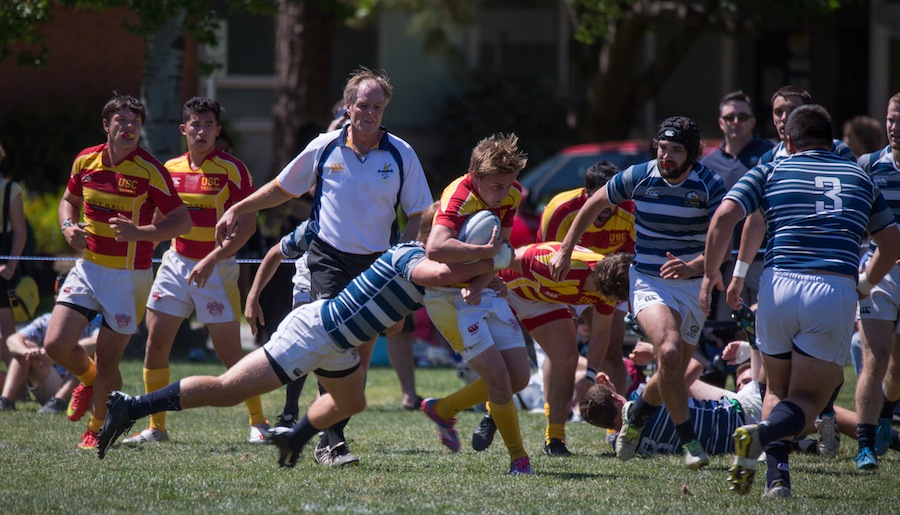
At the 2015 USA Rugby College 15s National Championships in Kennesaw, Ga, the UC Davis men’s rugby club team overcame a 15-3 deficit at halftime to stage a comeback against two-time defending champions University of Central Florida. Amidst a 700-people strong Gators crowd, they won the match 18-15 with just 90 seconds remaining on the clock and became the champions of Men’s Division I-AA.

“We had 20 girlfriends and moms there,” head coach Kal Incendysaid. “It was great to hear that whole crowd subside as we got closer and closer to winning.”

This season the Aggies are en route to replicating last year’s success. Currently undefeated in the West Regional, they have faced off against opponents including UC Santa Cruz, UCLA, Stanford and San Jose State.

The Aggies recorded a 53-7 win over Sac State back in January and a 68-0 shutout against San Jose State in February. Recently, they played against visiting USC and won 29-12, increasing their record to 11-0 overall and 8-0 in league play.

They hope to continue their winning streak at the regional tournament, which is being held on home turf. Along with Sacramento State, Utah State and Arkansas, the Aggies will be competing for a spot in the national championships this upcoming Saturday, April 23 and Sunday, April 24. Each team will play one game per day on Russell Field. If the Aggies defeat Sacramento State on Saturday, they will move on to play the winner of the Arkansas and Utah State matchup in the semifinals. From there, the winner will secure a spot in the May 7 championship finals held at Saint Mary’s College in Moraga, Calif.

Beginning competition in the fall, it has been a six-month journey for the rugby team to get to this point. The team has also had to adjust to losing twelve starters from last year’s lineup, with only three returning players.  

“We had to work a lot on finding our flow and our pattern with this team,” said team captain and fourth year sociology major Joshua Farnsworth. “But this team is, I believe, stronger, faster and all around a tighter unit this year.”

The players’ camaraderie and dedication to the sport has kept them motivated throughout the weeks of competition and adjustments.

“Most of the rugby guys live in one of two houses and you get a lot of cohesion on and off the field,” said Cole Collings, club president and fourth year civil engineering major. “The guys get along and it translates perfectly into playing.”

The team has its eyes set on the championship title and will continue to practice throughout the week in preparation for the tournament. All of the players are full-time undergraduate students who have made time for practice and games in between their other commitments. Team captain Farnsworth juggles rugby, school and an on campus job.

“It’s [going to be] a long weekend of rugby with little rest time, but that’s what we live for, that’s why we play the game,” Farnsworth said.

The club accepts all players, from beginners to those who have some experience in the sport. With fifty athletes in the club, players are divided according to ability into A-side, B-side, and C-side. While A-side consists of the top players, B-side has also seen success in their league, going 8-0 and winning divisional championships.

Written by Julia Wu – sports@theaggie.org

Enter Shikari shakedown at Ace of Spades

KATE SNOWDON / AGGIE

Enter Shikari, openers cause bruises, rumbles in Sacramento

You’d think that forgetting my memory card before I was supposed to review and photograph the British rock band, Enter Shikari, wouldn’t bode well for the evening. And how wrong you would be. Despite being trampled on by large angry fanboys, right-hooked by smaller angry fangirls and having to beg a memory card from a fellow photographer, Enter Shikari and their support wowed the crowd and showed that their new drum and bass remix album fits right in with their older tunes.

KATE SNOWDON / AGGIE

Local band Colossal Dream opened the night with an incredible amount of energy, possibly enhanced by the fact that I was so tired, and couldn’t quite wrap my head around what the frontman was doing. Most bands will never expend as much energy as that one human did, as his bandmates watched on, churning out background noise to his exploits. Whilst Colossal Dream still has a lot of musical growth to do, their enthusiasm and attitude got the night off to a great start, priming the crowd for the crazy energy of the following bands.

White Noise also played strongly, opening by telling the crowd they were from L.A. “but they’re a bunch of assholes. Will you guys be our new hometown?” The crowd seemed amenable to this, and White Noise made it worth their while. They featured foul language, an angry agenda and, for me, exactly the right degree of messy but measured punk attitude and influence.

Hands Like Houses was the main support, and the first thing that struck me was their curious looks. Their outfits looked like your dad’s holiday wardrobe mixed with the shameful hippy hair and beard he doesn’t talk about but still remembers fondly. Only their skinny jeans remained as a testament to the post-hardcore to which they belong.

Having said that, it would be hard to box them into just post-hardcore. Whilst they do layer their clean vocals over awesome riffs, breakdowns and unexpectedly heavy bass, with some cheeky screaming thrown in now and again, there are also aspects of indie and alt rock chucked in the mix, all adding up to a singable, danceable, moshable and surprisingly heavy combo. They definitely warmed up the rest of the house for Enter Shikari.

KATE SNOWDON / AGGIE

The build up started early for Enter Shikari, with an electronic message announcing that the show would start in eight minutes, and there was still time to get a cool beverage. The countdown went on from there, continuing as politely and inanely as it started, with the crowd becoming visibly agitated as it went on. As the strobes flashed two minutes, then one, they settled, and as Enter Shikari came on in the dark, were strangely silent. Until the opening riffs.

Enter Shikari played through a massive selection of their top hits, including “Solidarity,” “Sorry You’re Not a Winner” (which I’ve been waiting since the dawn of time to see) and “Mothership” amongst others. They also dropped remixes of “Anaesthetist,” “The Last Garrison” and “The Mindsweep.”

Watching people mosh and thrash against the barrier for song after song was incredible, and as “The Last Garrison” broke into its main riff, I joined the pit, a decision I do not regret, despite my nose getting clipped. The England-born gang interacted cheerfully with the whole crowd and was clearly proud to show off their new set. Enter Shikari’s varied and energetic set, with absolutely spot on vocals and awesome energy from the whole band, showed Sacramento what the UK is capable of.

WRITTEN BY: Kate Snowdon – arts@theaggie.org


Not all heroes wear capes, some do taxes

TREVOR WONG / COURTESY

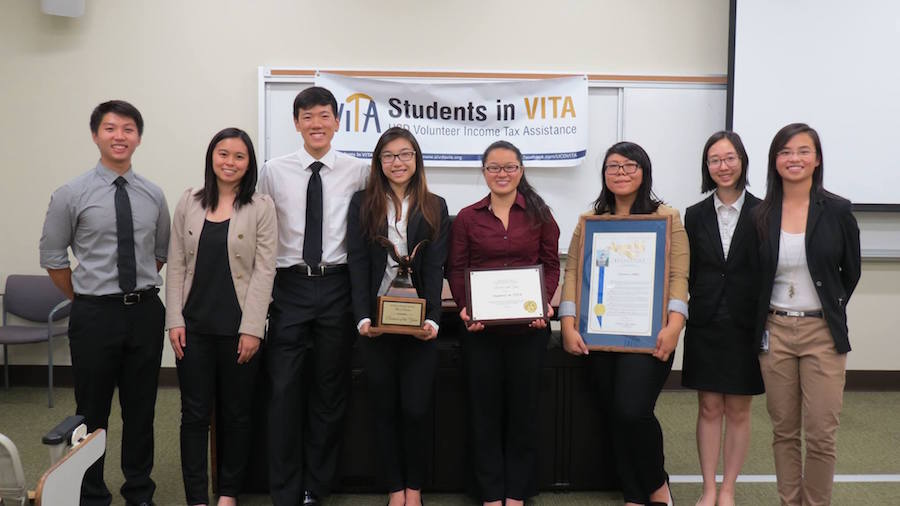
Students in VITA offer tax services for community at no charge.

It’s safe to say that a majority of people share a common attitude toward tax season. Preparing taxes is tedious, but the payoff on a tax return is all the reason to endure the long process. Unfortunately, finding the right tax preparer can be both daunting and expensive, especially for those living in low-income conditions who may not be able to afford their local tax services.

This is where the Davis Volunteer Income Tax Assistance (VITA) organization comes in. Also known as Students in VITA, the organization provides free tax services to low-income individuals and families in Yolo County. VITA is a nonprofit organization run by students that are IRS-certified interns, and it provides income tax preparation at no extra charge.

“Our three aspects are community service, education and financial literacy,” said Jenny Wong, a fourth-year managerial economics major and Students in VITA president. “Service to the whole community, education towards students and clients, and financial literacy to help clients understand their current financial situation and how it affects their taxes entail those aspects.”

Students in VITA extends from the larger chain of the Volunteer Income Tax Assistance program. The group introduces students to financial literacy topics and teaches members how to prepare tax returns, as well as giving them the leadership and marketing skills necessary to pursue their future endeavors.

“For me, as a man econ major, [VITA] gives me the professional experience. I’ve gained a lot of leadership skills, but it’s also community service. It’s rare to have an internship club on service,” said fifth-year managerial economics major co-site coordinator for Students in VITA Linda Chee. “I joined VITA and I stayed because I really liked that dual aspect — developing myself and helping the community as well.”

The organization opens intern applications in mid-October, and after final acceptances are released in late November, newly-recruited VITA members undergo a series of various workshops that train them in tax law and tax return. These workshops cover topics like income and deductions, and prepare them for getting their certifications, which must be finished by January.

“At first, when I was going into the internship program, I was a bit nervous, because I went in with no experience at all,” said Shelly Zeng, third-year managerial economics major and marketing director of Students in VITA. “But after the training we had and studying together for the certification program, I became confident in applying what I’ve learned to help people file taxes during tax season.”

Together, they hope to return as much of their clientele’s tax dollars as possible. By doing so, families become financially stable while saving both time and money not having to look for affordable preparers. In fact, any family or individual making $54,000 or less can receive assistance from the organization in preparing their taxes.

“The three tax years have been a very rewarding experience,” said Erica He, a fourth-year managerial economics and statistics double major and Students in VITA lead intern director.  “Since our sites are at the mutual housing, there are a lot of people like families that don’t have legal presence. So you have to be careful when communicating with them. I have helped students claim education credit and the look on their face when find out they get a couple extra hundred dollars back makes me really happy.”

Since its establishment in 2010, Students in VITA has already helped numerous citizens in Yolo County. In 2015, the club served and filed 337 tax returns to residents, and gave back an average of $57,600 to low-income residents. That same year, Students in VITA helped the community receive $230,800 in federal refunds. As a result, residents have reacted positively to the assistance they’ve received.

“The very first time I was handed someone who had to do an itemized deduction,” said Viola Mai, a fourth-year economics major and vice president of Students in VITA. “It took a while, but lo and behold, I gave her a refund. This woman was single, supporting herself, low-income and paying a mortgage. You let her know she has a refund and you see the stress melt away. People seem to be happy, and learn something about their finances as well.”

The efforts of Students in VITA have not gone unnoticed. The UC Davis chapter recently received the Award of Excellence by the IRS. The award extends from chapters in Oregon through a majority of California, but the students here in Davis proved through service and hard work that good deeds do not go unnoticed. Even when it comes to tasks as daunting as taxes, the folks in Davis show nothing but commitment to being their best for the community.


Written by: Alan Castillo and Jennie Chang — features@theaggie.org


Loopalooza encourages family biking

ANH-TRAM BUI / AGGIE

Local organization promotes exercise, safe biking

On May 1, Davis Bicycles will host the annual Loopalooza, an event to promote safe bicycling for elementary school children.

Davis Bicycles, an organization dedicated to promoting bicycling in Davis and increasing safety for cyclists, created the Loopalooza in 2010 to better acquaint children with the Davis Bike Loop and to encourage kids to use it to get to and from school safely. The loop is a 12-mile paved path around the city which connects to schools, parks and neighborhoods and passes through the university, downtown and other significant parts of the city. It is free of cars, making it a safe method for cyclists to travel to and from school or work.

“It’s good for kids’ physical health and fitness to be getting exercise in the morning. It is good for the environment because for every kid that walks or bikes, they’re not coming in a car so it reduces air pollution and car congestion on the road, which also makes our roads safer,” said Rachel Hartsough, program manager of Street Smarts, who partnered with Davis Bicycles for the event.

The Loopalooza is a family-oriented ride with 12 stations. The first three stops are dedicated to safety and the remaining nine are fun stations. At the first, volunteers will check helmets and at the second booth, volunteers from local bike shops will check the bikes to make sure that they have working brakes and tires. Another stop will have participants demonstrate knowledge of basic riding skills and teach participants proper signaling and yielding.

The remaining stations set up activities for participants where kids can participate in bike decorating, coloring or other children’s activities.

City of Davis staff will be at one of the booths giving out bike bells as well as DIY bike reflectors.

“We use the scrap material from our street signs, the really heavy duty reflective vinyl that’s used on all the signs on our streets, and people can make stickers with it and put them on their bike or their helmet,” Hartsough said.

Participants can pick up an event passport at any station and get the passport stamped at each station. Children are encouraged get their passports signed at every station; those who complete the 12-mile ride and stop at each of the stations are given a Loop Completion Certificate. Participants who get their passports stamped at three stations are given smaller prizes. Energy bars will also be available at each station for participants to enjoy.

The many bike paths and the bike friendly culture makes it easier and more convenient for children to walk or bike to school instead of having their parents drive them.

“My wife walks the kids to school every day. They have a lot of fun and it always feels like an adventure for them,” said James Thompson, Davis resident and father of two elementary school aged children.

Forty years ago, it was not uncommon to see children walk, bike or line up at their neighborhood bus stop waiting for the yellow school bus to take them to school every morning.

According to the National Center for Safe Routes to School, in 1969, 48 percent of students in kindergarten to eighth grade usually walked or biked to school and by 2009 that number decreased to only 13 percent.

Hartsough explains that the decrease in students who walk or bike to school is partially a result of more parents choosing to drive their kids to school instead.

“Usually, when kids walk to school or bike to school, they do it with somebody else so it promotes a sense of community; it oftentimes engages kids in their neighborhoods more,” Hartsough said.

Hartsough adds that walking and biking to school allows children to see things that they wouldn’t notice from a car.

“When I was in middle school there were a lot of kids my age in my neighborhood and we used to all walk to school together in groups and it was fun. That’s one of my best childhood memories because we bonded together,” said David Garcia, who grew up in Sacramento in the ’90s.

In addition, Hartsough explains that many studies show that kids who get physical exercise in the morning by either walking or biking to school actually do better academically, and are able to concentrate more during the day.

“We see at the schools that we’re working with incrementally slow increases in the number of kids who are walking or biking. For kids it’s a really big sense of independence,” Hartsough said.

Written By: CARLA ARANGOcity@theaggie.org

Your brain on words

DEVIN McHUGH / AGGIE

UC Davis researchers tap into brain activity when reading.

Whether studying textbooks for an exam or opening up a crisp new novel to enjoy, reading is a part of many people’s everyday lives. We learn how to read at such a young age that it almost appears surprising that so much goes into it. The science behind reading thus became a topic of interest for John Henderson, UC Davis professor of psychology and research member for the Center for Mind and Brain, who recently completed a study that examined neural mechanisms while reading.

“I’ve been interested in the cognitive processes associated with reading for a long time and recently became interested in the cognitive neuroscience of reading,” Henderson said. “So what brain processes support the component processes of reading. Things like how do we recognize words, how do we retrieve the concepts of the words we’re recognizing and how do we put it all together when we’re reading.”

The study is a notable breakthrough in the field — up until now, neuroscientists have only been able to study participants reading single words and not larger content using functional magnetic resonance imaging (fMRI). But by using a new method known as fixation-related fMRI, or FIRE fMRI, they are able to study larger processes — like reading.

“Lots of subprocesses are happening during that time,” Henderson said. “So what we wanted to do was come up with a way where we could tie the neural signal like in an fMRI experiment, to what they’re specifically attending to in the text at that moment. We tracked their eye movements while reading and we do fMRI at the same time.”

The research itself is rooted in two theories for how people understand and read words. The first theory comes out of philosophy and deep thinking, theorizing that words get their meaning by how they’re connected in a network. The second theory states that words get their meaning by what they actually refer to in the world.

To test for the understanding of words while reading, Henderson tested words based on “manipulability,” words that are concrete and manipulable versus words, like “love,” that are not as concrete. This allowed scientists to see how the brain acts in response to words that vary in how they can be manipulated.

“It turns out that when we’re reading, the more concrete the word, the more activity there is in perceptual areas and areas that have to do with motor planning and motion in the world,” Henderson said. “That really fits with the grounded cognition.”

Henderson also looked into if grammar and syntax are handled by specific neural mechanisms in the brain, or if they are handled by general purpose systems that also perform other functions. Using the same method, Henderson tested how difficult it was for subjects to read a complicated word compared to ones not as syntactically difficult.

“We find two regions, both in the left hemisphere, whereas syntactic difficulty goes up those regions show more neural activity,” Henderson said. “That suggests that those regions are specifically working on syntax and grammar.”

Research on these neural mechanisms has furthered the current understanding of how we perform processes like reading, and even confirms previous notions in the realm of cognitive neuroscience. According to Dr. Arne Ekstrom, associate professor for the UC Davis Center for Neuroscience and Department of Psychology, it also cements concepts like cognition and functional localization.

“The research supports the idea that different brain areas are involved in different aspects of cognition,” Ekstrom said. “It advances our understanding of cognition, however, by suggesting that even complex tasks, like natural reading, can still be distilled into relatively simple cognitive processes, like object identification when we see nouns.”

For students like third-year psychology major Kim Schuster, the new insights into cognitive neuroscience have sparked both interest and curiosity as to where the research will go next.

“I like the improvement in cognitive science and the insights it can give us for understanding disorders like dyslexia,” Schuster said.

As far as future directions go, Henderson still sees area for more discovery and intends to go further now that there is an understanding of how people read. For instance, are nouns and verbs treated differently when reading and if so, are other parts of speech are processed similarly? Reading development is also of interest, in order to see what changes occur over time through different stages of development.

“We also want to look at differences in the brain between people who read normally and people who have deficits,” Henderson said. “So I think the more we understand about how the brain works when we’re reading normally, the more we look to see how the brains of say dyslexic readers look when they’re trying to read.”

Written by: Alan Castillo — features@theaggie.org