52.4 F
Davis

Davis, California

Tuesday, December 23, 2025
Home Blog Page 727

Rising Bay Area rappers join Sage the Gemini at Ace of Spades

VINCE WILCOX / FLICKR

Sage the Gemini and Nef the Pharaoh rule Ace of Spades   

The Bay Area has produced many musical icons, such as Mac Dre, E-40 and Too Short, all of whom played significant roles in helping the Bay Area music scene gain exposure. The Bay Area is one of the most trendsetting areas and well known for the creation of the “Hyphy” movement back in 1994, which is an ever-evolving culture, and influential for many natives. The Bay Area is known for having a lot of rappers that are popular on a local scale, but rarely reach global success. Recently, there has been much attention given to an up and coming rapper from the Bay Area.

Enter Sage the Gemini, 23-year-old San Francisco and Fairfield native, who now raps, writes and produces for Universal Republic Records. Sage has come a long way since working at Chipotle. He is currently touring with Fetty Wap and Iamsu, and has collaborated with Chris Brown and Juicy J.

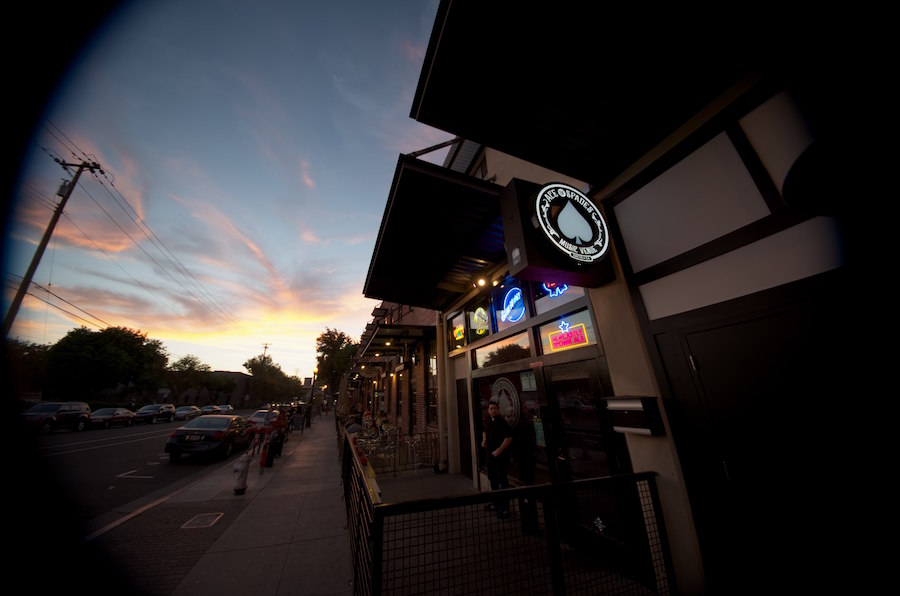
I had the chance to see Sage the Gemini perform live on April 14 at Ace of Spades in Sacramento. Working his way up the top 40 charts with his rap and hip-hop music, Sage is a rising name in the music industry, and not exclusive to the Bay Area anymore.

The intimate venue was packed with fans who danced and sang along with the opening performers. Sage, who remained casual in a red T-shirt, jeans and an In-N-Out hat, engaged with the enthusiastic crowd throughout his hour long performance. He paid special attention to the ladies in the crowd, yelling out, “Where are all my single women at?” and asking, “Who wants to join me on stage?” About halfway through his set, he tore off his shirt, and my ears rang with the sound of girlish screams. I am now officially aware of his heartthrob status.

Towards the end of his performance, Sage jumped into the audience and crowdsurfed. Throughout his set, he was accompanied by about 10 other performers who danced around him and took videos, pictures and Snapchats. Sage played all his hit singles, including “Good Thing,” featuring Joe Jonas.

After the show was over, I had the brief opportunity to interview Sage as he walked out the back exit of Ace of Spades to greet fans and take pictures. As I spoke to him, I could tell why he was given the name Sage — his green eyes were distinctly bright.

I asked him who he thought was the most influential Bay Area rapper.

“Iamsu. He’s a great person and has helped me throughout the years,” he said. Iamsu, the founder of The Heartbreak Gang (HBK), met Sage after being invited by him to feature on his single “Gas Pedal.” Sage soon after became part of the HBK gang.

I also had the chance to catch Nef the Pharaoh, who opened for Sage and is known for his single “Big Tymin.” Nef is a Bay Area local and grew up in South Vallejo. He is currently on tour around the U.S. where he is opening for Sage the Gemini, G-Eazy and Wiz Khalifa. As he walked towards his black Mercedes-Benz tour bus, he stopped to tell me what it’s like to work with Sage.

“Sage is like my brother, so performing with him is nothing. We talk to each other on the phone and hang out all the time,” Nef said. “Just performing in Sacramento in front of ya’ll, it’s like we’re having our own little party.”

Overall, the performance was similar to a party. Both rappers brought high energy to the stage and engaged with the audience, prompting everyone to dance and scream.

As a San Francisco native myself, it’s always amazing to see the rappers I followed since the beginning of their journey finally gain success. The Bay Area is a close community of people who are all interconnected. Sage the Gemini and Nef the Pharaoh represent young Bay Area locals spreading West Coast sounds around the world.


WRITTEN BY: Sami Bass – arts@theaggie.org

The UC Davis public relations disaster

HANNAH LEE / AGGIE
HANNAH LEE / AGGIE

2011 PR campaign actually draws more negative attention to pepper-spray incident

According to documents obtained by The Sacramento Bee, UC Davis spent at least $175,000 on consultants to improve its online reputation after the infamous pepper-spray incident on campus in November 2011.

In a desperate effort to save the tarnished image of the university and Chancellor Linda P. B. Katehi, the projects focused on minimizing negative search engine results to better represent the ‘good’ aspects of UC Davis.

In a campus-wide email sent on April 15, UC Davis Provost Ralph J. Hexter claims that it is impossible to eliminate stories from the Internet. However, as a part of its public relations campaign, the university issued a higher number of positive press releases and articles. This purposely diluted the Internet of rhetoric regarding the university’s pepper-spraying and calls for Katehi’s resignation.

Sure, you can’t actually eliminate stories from the Internet. But, with enough money, you can definitely make sure people have to dig deep to find them.

The Editorial Board understands that managing public relations is important, especially after a storm of negative media, and hiring third-party help is often critical to ensuring success. But, it is also important to remember that the pepper-spraying incident is known as one of the worst actions of police brutality on a college campus.

So, instead of covering up mistakes in a futile attempt to make the public forget about what happened, why not funnel efforts into rebuilding the university’s image by making stronger decisions in the future? If the administration truly believed in the importance of free speech and protest, they would not have spent thousands of university dollars to hide behind their mistakes.  

An effective PR response to the pepper-spray incident would have done a better job of acknowledging mistakes publicly, by arranging town hall meetings to maintain transparency and putting funds towards new university-sponsored programs promoting student voice.

Rather than trying to change public opinion by actively working to fix campus problems and listen to student concerns, UC Davis administrators decided to use private funds (that could have been used to better campus life) to weaken opposition and boost our university’s image.  

UC Davis is a great university for a lot of reasons, but our achievements are overshadowed when our administration makes shady decisions. We call upon the Chancellor’s office to take an active approach to future campus conflict. A vague Frequently Asked Questions webpage is not enough.

A riveting river expedition

JOE PROUDMAN / UC DAVIS

UC Davis students of ecogeomorphology class journey through Colorado River and Grand Canyon

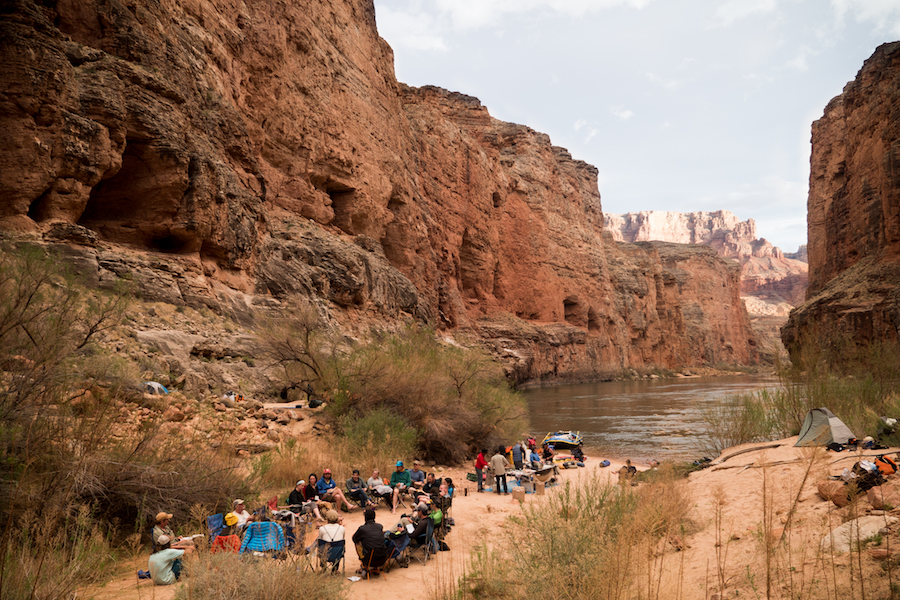
Steep, rocky cliffsides. Raging river rapids. A camp underneath a night sky brightly lit with luminous stars. These were the classrooms of Geology 136: Ecogeomorphology, a course offered by faculty from both the UC Davis Department of Earth and Planetary Sciences and the Center for Watershed Sciences.

The ecogeomorphology class is offered to undergraduate and graduate students pursuing degrees in the physical sciences, biological sciences and engineering. The course mainly focuses on topics such as river management and riparian ecology, but also has an interdisciplinary aspect to it, incorporating fields like science communication and economics.

Aside from a class that meets once a week within the classroom setting, the course also includes a field study opportunity where students travel to wilderness areas for a few weeks to enhance their studies.

“To me, [this class] is a lot of what UC Davis is,” said Nicholas Pinter, professor in the Department of Earth and Planetary Sciences. “It’s cutting-edge science — not just any science, not just one flavor of science, but it’s multidisciplinary science. And it’s doing that in incredible wild, scenic locations, rivers in particular.”

Last quarter, the class concluded with a trip along the Colorado River during spring break. In order to apply what they learned in the classroom, they explored and examined the intricate ecological and geological features of the river and the Grand Canyon. Students rafted, hiked and gave presentations on their surrounding environments, sharing their areas of expertise with one another.

“[Students] did barefoot lectures, typically in the evening or someplace on the cliffside during the day or wherever was appropriate,” Pinter said. “The blackboard was sometimes this two [to] three-thousand-foot-high cliffside behind you, the river passing by, the fish down in the river.”

Twenty-seven graduate students attended the trip, as well as several instructors, staff and guides from Campus Recreation’s Outdoor Adventures. The entire trip lasted 19 days and covered over 200 miles of the river. Most students participated in only half of the trip. Nevertheless, the trip was a unique, hands-on experience for all.

“Being in the environment that you’re studying, students can not only learn the complexity [of watershed sciences], but also teach each other,” said Carson Jeffres, researcher at the Center for Watershed Sciences and graduate student in ecology. “Everybody brings their own specialty to this class. Along with the professor instructing, the students are also instructing their peers.”

According to students who went on the trip, rafting along the river was quite a thrilling experience itself. The waters ranged from slow, peaceful currents to strong river rapids. The most notorious rapid was the Lava Falls Rapid, which the students encountered during the second half of the trip.

“The rapids were like a rollercoaster sometimes,” said Millie Levin, a second-year graduate student in geology who went on the entire trip. “[They] were definitely my favorite. [At Lava], everyone was really nervous. We didn’t flip, but there was just so much water pouring at us. We held on for dear life.”

To wrap up the day, the students would pull over to the edge of the river, unload their boats and set up a camp for the night. The camps were not only a time for resting and recharging, but also socializing and bonding. Students played guitars and sang songs together under the night sky.

“It’s an environment that most people don’t get very often,” Jeffres said. “You’re not checking your phone, you’re not checking your email. Everything is gone and you’re just so part of the community of people [who’re] around you. On the last day, you see this community that’s changed from being a group of students who were in a class together to a small family.”

Overall, the ecogeomorphology class is a learning experience unique to UC Davis, and is highly recommended by students and instructors.

“It was a class, but it didn’t feel like it,” Levin said. “The classroom was the river’s edge. Doing things that are active and hands-on — that’s what I like to do, and this was the perfect class for that. I wish everyone could do it.”


Written by: Jennie Chang — features@theaggie.org

Breast cancer organization holds fifth annual walk

DANIEL TAK / AGGIE
DANIEL TAK / AGGIE

Save Ourselves raises money for breast cancer support services

On April 16, Save Ourselves, a Sacramento breast cancer organization, had its fifth Annual Walk for Breast Cancer on the Jedediah Memorial Trailway along the American River. The money that was raised went to local breast cancer support services and educational programs.

Save Ourselves is an organization for current breast cancer patients and survivors. The organization provides educational forums, support groups, a 24-hour helpline, research partnerships with universities such as UC Davis as well as events like the Walk for Breast Cancer. The services they offer are free of charge and have been growing since the organization was founded in 1991.

“[I hope participants gain] a sense of support and that they’re not alone, and that there are other people on the same journey,” said Kristin Kozlowski, support group facilitator and marriage and family therapist.

The Walk for Breast Cancer was 4.2 miles but there was also a two-mile trail option. The weather was crisp and cool and there was water in the river for a change.

“Once you have breast cancer, [you] are encouraged to do things to nurture [your] mind, body and spirit and when you’re out walking in that beautiful bike trail, you’re supporting a good cause and it’s good for your spirit,” said Cass Brown Capel, president of Save Ourselves.

The walk began at 8:45 a.m. and during the program Save Ourselves gave away gifts and prizes to attendees. Some of the prizes included wine tours, massages, cruises and facials. Another important part of the program was an inspirational talk given by Edna Campbell, who is a breast cancer survivor, healthcare professional and former player for the WNBA Monarchs. Edna has been involved with Save Ourselves for a number of years.

In attendance were breast cancer patients, survivors, families and friends who were enjoying the scenery and good company.

“I feel like everyone is feeding off each other’s energy and spirit; to be able to do something that supports what Save Ourselves stands for is an honor,” Campbell said.


Written By: Mashal Ayobi – city@theaggie.org

Gong Cha opens in Davis

CHARLES MIIN / AGGIE

Boba-mania returns to Davis as Gong Cha becomes the latest boba store to set up shop

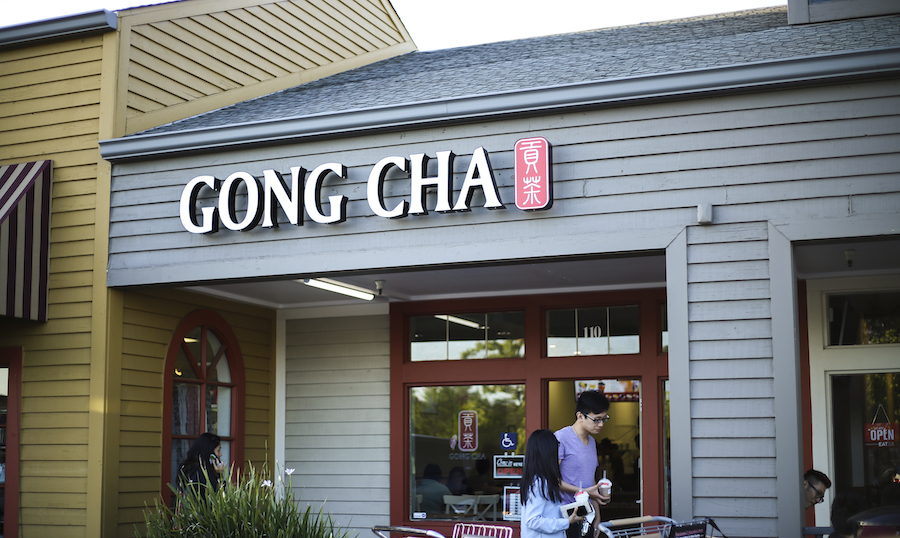
From ShareTea and Teabo Café to Lazi Cow, Davis has been experiencing a huge influx of boba stores in recent years. Now, in the spirit of competition, Gong Cha has also opened up its doors. Located at 1411 W. Covell Blvd., the store had its soft opening on April 4, with its business hours being from 12:30 to 8 p.m. The grand opening will take place this weekend, after which business hours will extend to 11 to 11:30 p.m.

Gong Cha may be known to residents and visitors of the Bay Area, where the chain has five stores, but the chain is also prominent around the world. Founded in Taiwan in 2006, the chain has 1,100 stores in 20 countries.

Larry Chen, Gong Cha USA CEO and UC Davis alumnus, helps franchise and directly run all the stores in California and was particularly excited for the opening in Davis. He recounts that when a franchisee approached him about opening a store in the Davis, both he and the franchisee recognized the potential to reach students and other new customers.

“Students have always been a very big and important part of our customer base and [we] saw the sense for us to be opening around a school and college in addition to [reaching] young professionals […] We feel like we have a very solid brand image, very good track record internationally, so we feel like it makes sense to enter the Davis market in order to win over some new customers,” Chen said.

While Chen was surprised at the amount of competition the store would face in the Davis market, so far business seems to be going well.

“Every day, they have been very very busy, especially right around this time the weather is pretty nice over there […] [The owner] has been telling us that the sales have been going really well. We kind of attribute that to the fact that some customers actually know what Gong Cha is […] A lot of customers who went there told us that they are really happy to see a Gong Cha opening in Davis because now they do not have to […] come back to the Bay Area,” Chen said.

Stacey Avorio, a team member at Gong Cha, is also overwhelmingly positive about how the store has been doing, emphasizing how busy it is throughout the day. While she says that a lot of customers already know the chain, those who don’t are given explanations and samples, so they know what they are getting.

Despite the heavy competition that the store faces, Avorio is confident that Gong Cha has an edge. This comes from its authenticity, with many of its central ingredients imported from Taiwan, the birthplace of boba.

“I’d say that we’re more authentic [than the other boba stores]… we have products and drinks that other people don’t have,” Avorio said.

Some of these unique menu items include egg pudding, oval jelly and ai-yu jelly. So far, the store seems to be resonating with its customers and Avorio has already noticed a few customer favorites.

“A lot of people get Earl Grey Milk Tea with 3J [Pearl, Pudding and Herbal Jelly]. We also have milk foam, a lot of people order that as a topping for any drink, and we also have ice cream, kind of like ice cream floats,” Avorio said.

Ellie Yeung, a fifth-year double major in biomedical engineering and computer science and engineering, was one of the first people to try Gong Cha’s newest branch and has mixed feelings about it.

“I’ve actually had Gong Cha both in Hong Kong and in Fremont […] My experience with Gong Cha before was always really nice. I went to Gong Cha here at Davis on the first day that they were open and the line was really long, it took me an hour to get my drinks […] I probably will give them a bit of leeway because it was their first day, but when I purchased the drink it was actually a bit watered down,” Yeung said.

Yeung says that Gong Cha is one of her top three favorite boba places and adds that they are better at certain drinks and worse at others. However, despite her reservations, she is still confident that the store is worth visiting and foresees an improvement once the staff becomes more accustomed to making the drinks.

“I do believe that as time goes by, when there’s less people and when the employees are a little more used to making those drinks, they’ll come out better,” Yeung said. “I’m not sure if they will meet the same standards [as Fremont or Hong Kong] but they’ll definitely be a lot better than they were on their first day.”

Written By: JUNO BHARDWAJ-SHAH – city@theaggie.org

Mercer Veterinary Clinic for the Pets of the Homeless has grand opening of permanent facility in Sacramento

NADIA DORIS / AGGIE
NADIA DORIS / AGGIE

Clinic finally owns facility after 24 years to better provide free proper treatment for the pets of the homeless within the community

On April 19, Mercer Veterinary Clinic for the Pets of the Homeless had a grand opening celebration for its new facility, the Tom Kendall Teaching Clinic.

Named in memory of the clinic’s co-founder Dr. Tom Kendall, the clinic is located in Sacramento near Loaves and Fishes. After 24 years of working in different temporary locations and conditions, such as under canopies and tarps, the clinic’s staff was glad to have a proper and adequate facility.

Veterinarian and board member of Mercer Clinic Dr. Alissa Burnett believes that having a stable facility will make it easier to provide care for the homeless’ pets.

“Mercer Clinic has been operational for the past 20 years, and it is finally permanent and it will be able to serve their clients and their pets adequately,” Burnett said. “It’s [now] much easier for us to practice some quality medicine for these pets.”

Mercer Clinic for the Pets of the Homeless was started in 1992 by UC Davis veterinary students who wanted to help the pets of the homeless. The clinic has evolved to a team of volunteer veterinarians and UC Davis veterinarian students who are headed by Burnett and Dr. Laurel Gershwin. Together, they hold a monthly clinic on the second Saturday of every month.

At their monthly clinic, students from UC Davis are overseen by veterinarians and get hands-on experience examining the pets of the homeless who are brought in by their owners. The pets are provided with treatments and examinations, such as vaccinations; flea, tick and heartworm prevention; and spaying and neutering, all at no cost.

Eileen Samitz, a retired clinical laboratory scientist from the Veterinary Medicine Teaching Hospital and Clinical Microbiology Department, is a coordinator at Mercer clinic and believes that the services provided are essential for the community.

“The services it provides are important and valuable in the prevention of disease with the vaccinations given [and] treatment for parasites, as well as pet population control through the spaying and neutering referrals offered,” Samitz said. “Helping the pets of the homeless in turn helps the greater community, as well as these pets in need. In many cases, these pets are the only family their homeless owners have, so their love, warmth and companionship is even more essential.”

The clinic has never received public funding, so it solely relies on the generosity of the community to continue. Mercer Clinic also receives funds from the annual Holiday Pet Basket program and Winter Coat and Sweater program started by Veterinary Medicine Teaching Hospital co-workers. Gift baskets are made for the pets with gifts and sweaters for the holidays. Additionally, undergraduate members at Davis work at the farmers market, selling pet toys and treats to raise funds.

Fourth-year animal science major Nicole Doan, one of the four coordinators who organizes the undergraduate volunteers, believes that a program like this is important because of the high demand and the value of a pet to a homeless person.

“Many of our clients have put the wellness of their animal before themselves,” Doan said. “Mercer Clinic is a charity project that helps alleviate the monetary costs and mental stress of veterinary care for this population who care deeply for their animals.”

The clinic’s new goal is to complete its surgical suite by buying more equipment in order to make the facility fully operational.

Those interested in donating can visit www.vetmed.ucdavis.edu/clubs/mercer/donation/.

Written by: Demi Caceres – campus@theaggie.org

UC Davis Dining Commons waste audits show lowest ever food waste

ALEXA FONTANILLA / AGGIE

All three dining commons collectively waste record low of 1.5 oz of food per person for Spring Quarter audits

From April 28–30, the UC Davis Dining Commons (DC) conducted their Spring Quarter “Love Food, Don’t Waste” audits. The waste audits took place during the lunch periods of each DC. Every quarter, the DCs collect and analyze data to determine the best ways to reduce food waste.

Students were asked to sort their food waste into four categories: edible food waste, inedible food waste, liquid waste and napkin waste.

For spring 2016, the results showed the lowest food waste per person in the history of the waste audits with an average of 1.5 oz per person for all DCs collectively. Individually, Cuarto contributed 2.79 oz per person, Tercero 2.24 oz per person and Segundo 3.27 oz per person in total for all waste categories for the entire year.

This year, the DC included an incentive of a sundae bar added to all the DCs if each DC reduced food waste numbers compared to last quarter. Each DC will be getting a sundae bar for meeting the quota, with Tercero receiving extra toppings for reducing the most from previous quarters.

Kelly Gaherty, a fourth-year communication major and waste reduction intern, said that there have been improvements from the start of the “Love Food, Don’t Waste” audits. In comparison, data from previous Spring Quarters, like spring 2011 which saw 1.96 oz of food waste per person or spring 2013 which saw 1.82 oz per person, shows the program’s progress.

Adams said that Fall Quarter’s statistics are usually higher than those in Spring Quarter. This school year, fall 2015 contributed 2.23 oz of food waste per person.

“Typically we see all of the areas trend down in spring from fall numbers. Each year is a new population for us! […] After the education throughout the year, it is an overall decrease,” Adams said.

Linda Adams, the DC sustainability and nutrition director, said that “Love Food, Don’t Waste” audits began in fall 2009 by a student’s desire to make the DC more sustainable through collecting data and educating students.

The Just Ask program, which give students the option to customize their meals, and the Try-a-Taste program, which allows students to try a bite of a dish before taking a whole serving, came about because the waste audits provided the DC understanding on how to serve food to reduce post-consumer waste.

The audits not only contribute to UC Davis’ goal of achieving zero-waste by 2020, but also seek to draw attention to food waste as well.

“These audits are definitely a measurement tool for us in reporting waste and diversion to the UC Office of the President,” Adams said. “Nonetheless, food waste is a major problem in almost all sectors of the food system, including our kitchens at home. These audits also serve to draw student/employee attention to this issue.”

Gaherty shared the same sentiments on the importance of food waste reduction.

“Food waste has a huge impact on the environment. We try to connect with the freshmen and engage with them to recognize the impact they have on campus and how much the waste affects our additive waste to the campus,” Gaherty said.

Gaherty said that a common reaction students tend to have with regard to the waste audits.

“Whenever we do waste audits we get reactions like, ‘Oh, you’re the people that make me feel bad about throwing my food out.’ We try and do all the things to stay away from making them feel bad,” Gaherty said. “We just try to make them conscious of their waste, the effect they have on campus, and to think about ways to change their habits in order to benefit the environment, our campus, and their lives in general.”

Students like William Kha, a first-year microbiology major, expressed similar reactions to the waste audits.

The audits don’t really speak much to me and I tend to ignore the tabling because it seems to be just a repetition of ‘Don’t waste food! It’s bad!’” Kha said. “In effect, they don’t present a reason strong enough to make me consume every bit of my food and be completely aware of how much food I can eat and will eat.”

Adam suggested peer-to-peer discussion to increase awareness around food waste.

“Food waste is an issue we all need to be aware of and strive to be part of the solution.  There are some students who are very engaged and others who seem oblivious to the problem,” Adams said. “I think students should advocate amongst their circle of influence for an overall increased awareness of things wasted every day and ways to decrease that waste.”

Written by: Yvonne Leong – campus@theaggie.org

UC Davis women’s tennis defeats Nevada for fourth straight win

NICHOLAS YOON / AGGIE

Women’s tennis defeats Nevada 5-2 in non-conference match

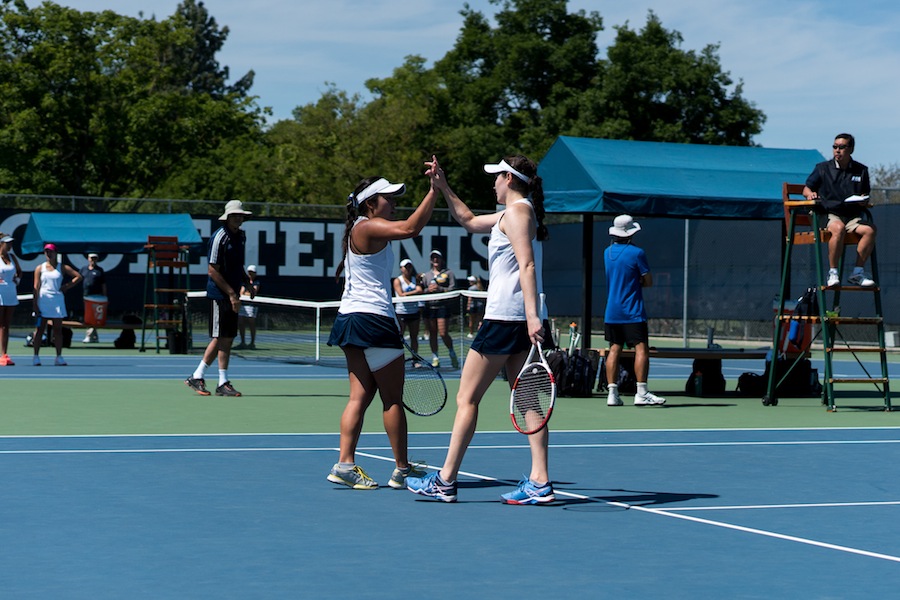
The UC Davis women’s tennis team defeated the Nevada Wolf Pack 5-2 in Friday’s non-conference match. The Aggies lost two out of the three doubles matches, but were able to secure five out of six singles wins at the Marya Welch Tennis Center to bring their overall record to 10-9.

In the three doubles matches that took place on Friday, the sole Aggie victors of the doubles competitions were juniors Kamila Kecki and Frederique Sleiffer, who defeated a sophomore-senior pair from Nevada by a score of 7-6. Nevada gained a 1-0 lead over UC Davis due to their doubles victories, but it would be the Aggies who would show their skill in the singles matches to gain the upper hand on the Wolf Pack.

The first three singles matches to finish Friday afternoon would tie the score up at 2-2. Junior Samantha Martino, who won her sets 6-3, 6-1, and Kecki, who defeated a sophomore by set scores of 6-0, 6-4, were able to secure victories for the Aggies. Sophomore Lani-Rae Green took a loss in two close sets, 6-3, 7-6 (8-6), which gave Nevada its only singles point in the match.

After the score was all tied at 2-2, it would be an impressive comeback performance from sophomore Kristy Jorgensen, who defeated her junior opponent, coming back from a 1-6 first set loss, and winning the next two sets 6-2, 6-4, to give the Aggies the upper hand at a score of 3-2.

“I had to make everything in,” Jorgensen said. “I hoped that if I stopped making mistakes I would start getting some games on her, which I did.”

Once the Aggies were able to gain the 3-2 advantage, the team did not stop as senior Tiffany Pham defeated her opponent 6-2, 6-3, and sophomore Jessie Lee won her match 6-3, 3-6, 7-5, to contribute to the Aggies’ 5-2 victory.

With this win, UC Davis women’s tennis continues a four game long winning streak and won its sixth match out of the last seven they have played.

“We’ve lost a lot of close ones this year,” said head coach Bill Maze. “[Beating Nevada] feels great and is a testament to our team.”

This weekend, the women’s tennis team will play two conference matches after a month long absence of conference games, both at the Marya Welch Tennis Center. On Saturday, April 23, the Aggies will face CSUN at 12:30 p.m. and Hawai’i on Sunday, April 24 at 11 a.m.

“We treat every match the same, [and] these upcoming matches are big matches,” Maze said. “I feel like our team is peaking at the right time and we have gotten better every day.”

From the win this weekend, the UC Davis women’s tennis team was able to push its overall record from .500 to .526. This is the first time women’s tennis has been able to push its record over .500 since Feb. 13, and the next two conference matches will be a contributing factor to the Aggies seed placement in the Big West conference tournament.

Written by: Ryan Bugsch – sports@theaggie.org

Club tennis team finishes season ranked 19 in nation

COURTESY
COURTESY

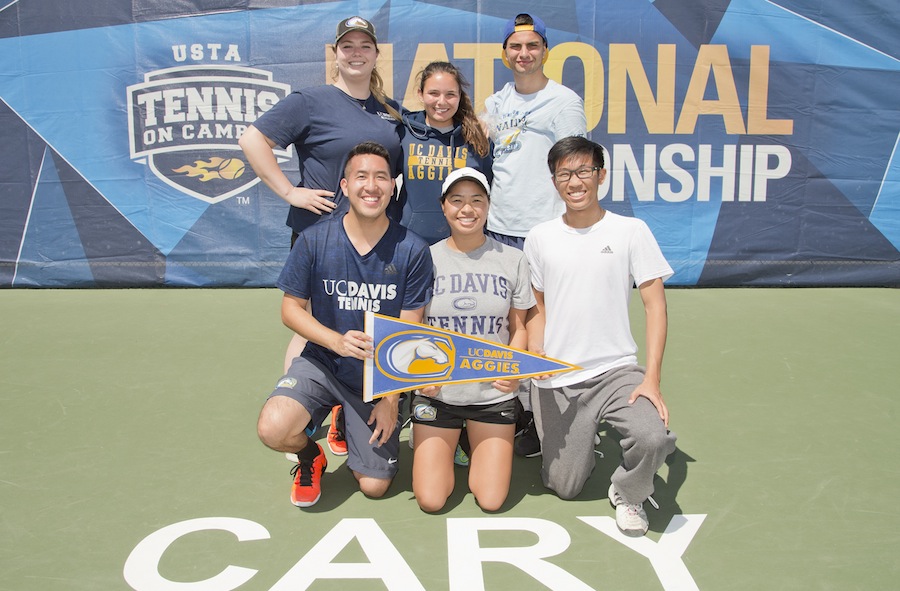
Saturday, April 16 was a day circled on most UC Davis student’s calendars since the beginning of the year. But for the club tennis team, the 102nd annual Picnic Day was not the event they were looking forward to; instead it was the United States Tennis Association (USTA) Tennis on Campus National Championship; a one-time opportunity to make history for the club tennis program. As campus flooded with alumni and already-drunk undergrads, six club tennis players prepared to represent UC Davis some 3,000 miles away in Cary, N.C.

Two days prior, the Ags took down North Dakota State (30-5) and University of Illinois, Chicago, (30-6) before falling short to the eventual winner of the tournament, Auburn University, (29-17), in pool play. The performance qualified the Aggies for the silver bracket and a chance to go further than any previous UC Davis club tennis team.

After defeating Northwestern 23-19, the Ags faced a tough Vanderbilt team in the second round of a talent heavy silver bracket. Going into the mixed doubles portion of the match the Aggies trailed by four games, but after captain Vivian Li and partner Derek Lin caught fire, winning six straight games, the Aggies finished the match with a 23-21 victory.

In the semi-final round, the Ags squared off against Northeastern, taking the women’s singles and doubles matches, to go into the mixed doubles portion of the competition with an even score. Unfortunately, the Li/Lin duo was unable to repeat the magic from the Vanderbilt match, and the Ags fell 20-21.

In the third place match, the Ags easily handled Boston College, winning 26-20 and placing 19th overall in the nation.

I’m really proud of all my teammates since it was three long days of matches which [can be] very physically and mentally challenging,” said Li, a third year economics major. “I am honored to have been able to be the captain of this team because everyone was able to step up to the plate when we needed them to and have great sportsmanship with other teams.”

The UC Davis club tennis program is unique in that anyone is welcome to join, from undergraduates to faculty to exchange students.

“We have over 100 members from beginners to highly competitive players,” Li explained. “Although there is a fall tryout to compete in sectionals (and nationals) everyone is always welcome to play.”

With the $40 membership fee comes a free t-shirt and a chance to compete for a national title. With only two losses in the National Championship tournament and two winning teams in the silver and gold brackets, the club tennis team is well positioned for an extremely successful 2017 season.  

Written by: George McConnell — sports@theaggie.org

Davis graduates create multi-media art collective: Introducing Massflow

MASSFLOW / COURTESY
MASSFLOW / COURTESY

Next Massflow event to be held this Friday at Sophia’s Thai Kitchen

“Massflow was a term we all used to explain something that was naturally cool, or just destined, something about cosmic occurrences,” says Kenji Blouin-Ito, UC Davis graduate and one of the faces of the Davis-based art collective Massflow. And years after its origin, that’s exactly what Massflow has become: something cool, something destined and something cosmic.

Started by Blouin-Ito along with friends Dylan Hackett and Jai Patel, Massflow was born from a friendship rooted in the arts but metamorphosed into the community of local artists it is known as today. Based in Davis, but collaborating with artists throughout the Bay Area, Massflow is all about synthesis; it is a synthesis of people, culture, music, mediums, ideas and, most recognizably, artistry.

Best described as a platform for local artists to express their talents and showcase their work, Massflow holds various events that Hackett describes as “giv[ing] something tangible” to the underground art world in Davis. In fact, both Patel and Hackett recognize that the Davis environment is conducive to creativity, but more importantly, is receptive to the art they make.

To put on these events, they often rent a warehouse, as they did at Third Space Art Collective for their welcoming event last May, which permitted them enough space to incorporate a multitude of mediums. Attending a Massflow event involves a stimulation of all the senses; DJ sounds reverberate onto the walls of a 3-dimensional art installation that begins as a white-walled maze, but is quickly layered by doodles and poems that you manage to scribe with one hand, while your other hand grasps a Sudwerk beer, its reflection gleaming the array of canvas on the walls.

Their emphasis on locality and collaboration is apparent; Massflow practically constructs the stage beneath these artists, providing a platform for exposure that allows their art to flourish. But partnering with local Sudwerk Brewery is only one of the many perks from such local collaborations; Hackett notes that “underground artists definitely need representation, and that’s what we’re there for.”

Blouin-Ito, reflecting on this first event at Third Space, recalls “so much positivity, good people, vibes, smiles; it flowed perfectly — mass flow.”

In a smaller venue and with slightly more limitations, Massflow’s next event at Sophia’s Thai Kitchen at 10 p.m. on Friday, April 22, won’t boast the large art installations from previous events. Nevertheless, there will be a few sets by Massflow DJ’s (including Patel, Hackett and Bluoin-Ito), a collection of visual art and a merch table with hand-made print T-shirts and stickers.

Despite the smaller venue for their upcoming event, Massflow has recently expanded to other locations, most notably their show in Oakland last December. Their ability to maintain a DIY feel — keeping connections close and art locally focused — validates the notion that Massflow is more than a community of artists, a group of friends and a creative environment: Massflow is a movement.

Throwing these events is a “double win,” according to Patel, in which “everyone is simply appreciating and enjoying each other’s art.” This duality of excitement can be found in Massflow’s undeniable passion for organizing these events. Only the artists they showcase, I would imagine, parallel their enthusiasm.

Massflow encourages anyone interested to check them out on Facebook or reach out at himassflow@gmail.com to become involved in this growing community of artists.

Written by: Ally Overbay – arts@theaggie.org

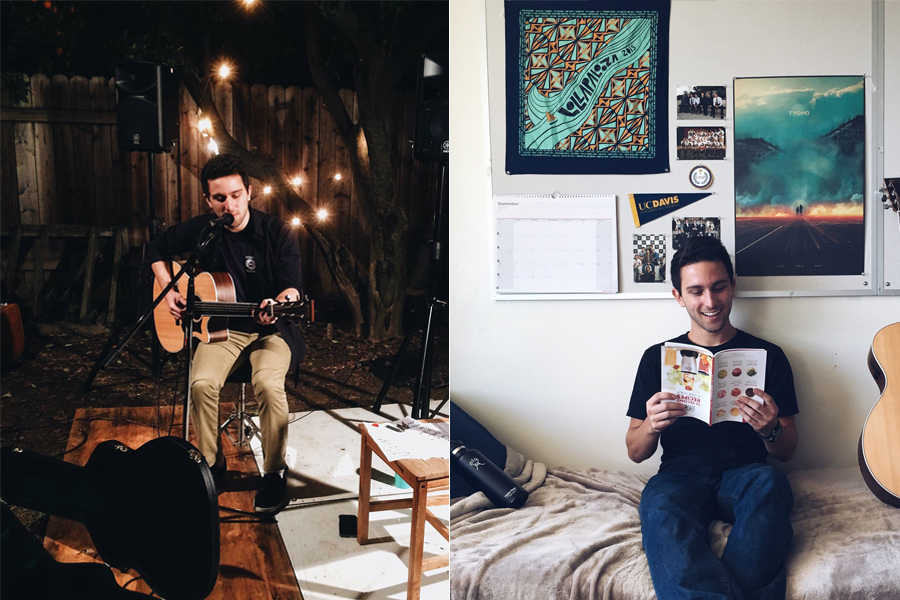
Student Sounds: Sammy Seaver

SAMMY SEAVER / COURTESY

Open Mic Night regular Sammy Seaver writes and performs songs about his Davis experiences.

From the Band-Uh!’s Picnic Day parade to Entertainment Council-sponsored events and musical theater performances, UC Davis students find a variety of ways to express themselves through music and dance. Sammy Seaver, a first-year music and communication double major, is a blossoming fixture of the performance culture at UC Davis.

Though he only began his time as an Aggie earlier this year, Seaver jumped into the music scene, performing at various philanthropic events, including Cal Aggie Camp’s CAChella fundraiser. Seaver can also be seen strumming his guitar at Entertainment Council’s Open Mic nights, where his following of enchanted freshmen girls squeal over his soulful renditions of crowd favorites like John Mayer’s “Neon.”

As one of the 140 music majors on campus, Sammy Seaver came to Davis knowing he wanted to get involved. Seaver cites his brother’s experience with music as his own inspiration to pursue a career in music.

“My brother is about eight years older than me and he is a Juilliard-trained musician for French horn. After he graduated he started getting into everything, including film scoring and electronic stuff,” Seaver said. “He is a huge inspiration to me because not only did I get to see him go into the music industry, but he was able to teach me that you don’t have to be a stationary musician you can be a ton of different genres or acts.”

Seaver describes his own style as jazz-influenced, and often covers songs by artists like John Mayer and Ed Sheeran. He has recently ventured into writing his own songs based on experiences he has had at UC Davis.

“What I write is still not very personal, but I have just seen a lot through other people. I have gotten to learn the experiences of everyone else like where they’re from or what their culture is,” Seaver said. “So I tend to write about a topic that needs to be addressed or a feeling [I] have like homesickness.”

The performance culture at Davis has been formative for Seaver’s new sounds. Though his hometown of San Diego offered a bastion of open mic nights which launched the careers of successful performers like Jason Mraz, Seaver feels a sense of community when he performs in Davis.

“I have been really surprised by how communal the performance culture is here. Everyone is just trying to build upon each other — which is amazing for musicians,” Seaver said. “You could be an engineer and go on stage and play crazy violin or guitar and people will want to know that side of you. When you embrace music in that sense, it gives you a little more dimension.”

In the future, Seaver hopes to be involved in the music industry in some capacity. His choice to major in both music and communication is indicative of his interest in the industry.

“Whether it be the business side of it, or something else, I just know I want my life to be focused around music,” Seaver said.

When not performing at Open Mic Nights and backyard parties, Seaver can be found working for Entertainment Council as a productions intern or with the Mondavi Center and Music Department in their recording department. He is looking forward to spending more time performing and writing, and will surely remain a popular performer in the Davis community for the rest of his undergraduate years.

WRITTEN BY: Sara Williams – arts@theaggie.org

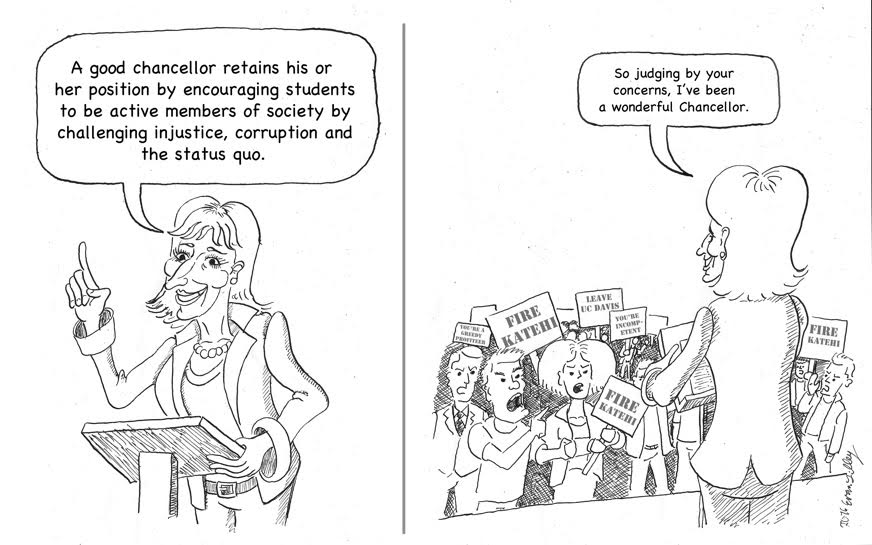
A leadership fallacy

katehicar
EVAN LILLEY / AGGIE

UC Davis has a farm, E-I-E-I-O

ARIEL ROBBINS / /AGGIE

UC Davis Student Farm brings fresh produce and opportunities to students, faculty.

Since its start in 1977, the Student Farm has been a unique part of the UC Davis campus, bringing diverse learning opportunities as well as a market for fresh organic produce to students, faculty and the Davis community.

For the past few decades, the farm’s purpose has evolved from producing only crops to accommodating a number of projects that student volunteers and interns take part in. Formal courses, such as Plant Sciences 49: Organic Crop Production Practices, are also offered through the Student Farm.

“We now have the sustainable [agriculture] and food systems major, [and because of this], we’re noticing a lot of students that are coming and getting involved,” said Mark Van Horn, director of the Student Farm since 1987. “We are getting more students who actually already know things when they come to us.”

The farm is split off into two main sectors: the ecological garden and the market garden.

The ecological garden is home to the “Kids in the Garden” program. To become leaders for the garden tours, UC Davis students take Kids in Garden and Farm (PLS 193) during Winter Quarter. Tours are led for about 1,800 grade school children each year, where students learn about gardening basics and pick their own produce to make a salad during the field trip.

The market garden is where organic produce is planted and harvested by volunteers, interns and student employees.

“The market garden has two goals. One is to train students in certified organic production practices, and the other is to generate income for the farm,” said Raoul Adamchak, market garden coordinator. “Our food is very local, it’s very fresh and it’s going to a variety of people on campus, and the income from that supports the farm.”

Volunteering at the market garden is open to anyone Monday through Friday, from 8 a.m. to noon. Students and staff can also join the Community Supported Agriculture (CSA) program, where weekly baskets of produce are delivered to participants.

“About 10 years ago we started growing more rapidly and there’s just been a lot more interest in what we do: sustainable agriculture, [as well as] food and agriculture in general,” Van Horn said. “That increased interest has allowed us to grow more food which then brings in more income, which means we can hire more students.”

The sustainable agriculture and food systems major has led to a rapid growth in Student Farm participants, however, a spike in general interest of where food comes from has been cause for many non-major related students to also get involved.

“I grew up in Sonoma [where] there were a bunch of CSA’s, and I wasn’t used to not knowing where my food was from,” said Mimi Pinna, a third-year international relations major and Kids in the Garden volunteer. “I started to [volunteer at the Student Farm] out of this social policy standpoint.”

Involvement on the farm is truly a Davis-specific experience, and one that many students have found to be a huge part of attending the university.

“Your input really matters. People want to make sure anything that can be improved upon, you can say and it will be well received,” Pinna said. “I think it brings something special to the Davis experience, and it’s brought a lot to my [own] experience.”


Written by: Austin Carroll — features@theaggie.org

California to increase minimum wage to $15 per hour by 2022

DANIEL TAK / AGGIE
DANIEL TAK / AGGIE

Governor Brown announces California to be first in the nation committed to raising minimum wage to $15 per hour

California Gov. Jerry Brown joined legislators and labor leaders on March 28 to announce a landmark agreement that makes California the first state to raise the minimum wage to $15 per hour by 2022. The plan establishes a 35 percent minimum wage increase over a six-year phasing period. Beginning on Jan. 1, 2017, the statewide minimum wage will increase to $10.50, and then continue to increase each year until the year 2022.

The plan will only go into effect for businesses with 26 or more employees. Businesses with 25 or fewer employees will have a more prolonged phasing period, which will help employers to adjust to the change. Once the minimum wage has increased to $15 per hour for all businesses, wages could then possibly increase by 3.5 percent each year to account for inflation as measured by the consumer price index.

“California is proving once again that it can get things done and help people get ahead. This plan raises the minimum wage in a careful and responsible way and provides some flexibility if economic and budgetary conditions change,” said Gov. Brown at the Ronald Reagan State Building in Los Angeles on April 4.

According to H.D. Palmer, the governor’s chief fiscal spokesman, there are provisions in the bill which will allow the governor to delay a step increase in the minimum wage under certain economic or fiscal conditions. Palmer explained that there are certain restrictions to the minimum wage deal that the governor stated in his budget summary.

“[The minimum wage plan] is going to be phased in over periods the administration believes can be accommodated by the budget and also, importantly, it includes those opportunities or off-ramps to delay the phasing of a higher minimum wage should economic or state budget conditions indicate that the timing would not be right for the scheduled increases to go into effect,” Palmer said.

Palmer explained that there are offsets to the minimum wage increase. These include decreases in programs such as Medi-Cal, California’s health insurance plan for low-income citizens, as well as CalWORKs Welfare to Work Program, which helps individuals on welfare find employment.

Colin Cameron, a professor of economics at UC Davis, specializes in econometrics, the statistical analysis of microeconomic data, including labor economics.

“If the minimum wage increases there will be winners and losers. The winners will be the ones who keep their job at the higher wage and the losers will be those who lose their job, because their employers don’t want to pay their higher wage. This will always happen,” Cameron said.

However, according to Cameron, there is a lot of uncertainty surrounding the outcome of the $5 increase in minimum wage because there has never been a study that analyzed such a drastic increase. In cities such as Davis and other cities in the Central Valley where wage rates are already a lot lower than $15 per hour, the phasing period could take a lot longer in order to allow for businesses and employers to adjust.

Cameron adds that in contrast to a local wage increase, the statewide minimum wage increase will affect all businesses in California. Thus, if prices increase as a result of the increased wage, the trend will be seen statewide, so it will not cause a loss of customers in any one area.

Cameron explains that, aside from economics, there is a political and social view regarding the minimum wage. The hope is that the increase will set employers’ standards higher, encouraging firms to invest in more capital and make their workers more productive.

“That’s my own view,” Cameron said. “We should be providing incentives to employers to increase the productivity of their workers and for individuals to get the skills to be more productive.”

Written by: SHIREEN AFKARI – city@theaggie.org