55.9 F
Davis

Davis, California

Tuesday, December 23, 2025
Home Blog Page 752

Bereavement program helps young adults cope with loss

0
HANNAH HUNTER / COURTESY

Eight week session to begin Feb. 9

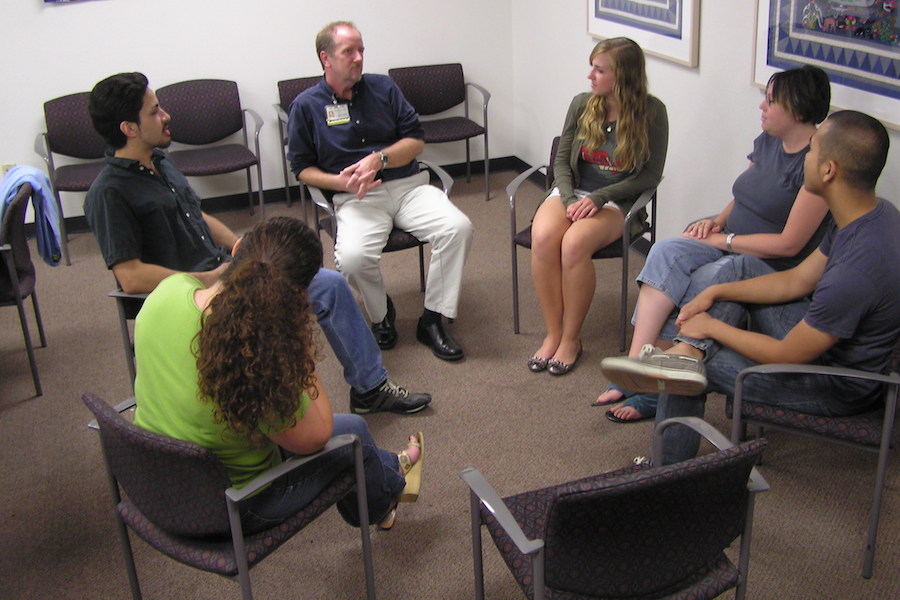
On Feb. 9, a young adult bereavement group will commence at the Homecare Services Building, located at 3630 Business Drive in Sacramento. The free group serves 17- to 24-year-olds who are coping with loss by using a combination of talk and art therapy to help them work through the problems they face. The therapy sessions are eight weeks long, take place every six months and have been running for about eight years.

Donald Lewis, the bereavement group co-founder and UC Davis Hospice Program bereavement and volunteer coordinator, has helped run the group since the first session in 2008. Lewis emphasizes that the program fills an important gap for teenagers and young adults who are transitioning into adulthood.

“[When] you are transitioning from being at home with family to getting out on your own […] it’s a time when there really isn’t a lot of support available […] Often times to just meet with people their own age and feel supported as they’re going through grief [can be very beneficial] […] [we give] them some tools to cope with what they’re going through,” Lewis said.

HANNAH HUNTER / COURTESY

Lewis highlights that the program has received an overwhelmingly positive reaction from participants who have benefited from the support. She added that Hannah Hunter, the art therapist and co-founder of the program, has been a key to the success of the group by incorporating art into talk therapy sessions.

“Talking about grief is a very difficult thing for most people […] When you have somebody who is 17 to 24, the brain is still developing, they’re in a stage where they’re […] reaching forward, you’ve got a job, you’re going to school, you’ve got a girlfriend or a boyfriend. When grief happens it kind of catapults you back, it’s a regressive thing,” Hunter said.

According to Hunter, art allows patients to express their emotions in a visual form, opening up a doorway which allows people to discuss their feelings with greater ease and comfort.

“What’s so great is you can get a circle of people […] and as soon as you give them that art project and they open up, then some of those feelings are outside of themselves. When something is outside of [you] […] it’s easier to talk about […] you can begin to process it,” Hunter said.

When the program was initially set up, it required funds and a grant from the Children’s Miracle Network (CMN) helped the idea become a reality. CMN also operates on a national level and runs a CMN branch in Davis. The local branch raises funds for the UC Davis Children’s hospital; the money funds annual projects and strategic initiatives to support research, clinical care and children’s services at the Hospital.

Jacquelyn Mills, development director at UC Davis Children’s Hospital and CMN, says that one of the main reasons that the bereavement program received funding is that it served a community that was previously lacking resources.

“The bereavement program was a really wonderful program because it [helped] […]  a bunch of people who don’t normally get access [to support services]. It was one of the programs that was scored very highly [by the grant committee] and so we were able to fund them,” Mills said.

For additional information about the group, contact Donald Lewis by email at delewis@ucdavis.edu or by phone at 916-734-1139.

Written By: JUNO BHARDWAJ-SHAH – city@theaggie.org

Political Ambiguity

0
DANIEL TAK / AGGIE
DANIEL TAK / AGGIE

chau_opWhy minor parties do poorly in America.

Minor parties will always find it difficult to gain traction in America. Our two major parties, the Democratic and the Republican parties, appeal to all areas of society, leaving little room for people to feel totally disenchanted with either. As a result of our electoral system, only the party with the most votes in a district will win. Consequently, people will often vote for candidates they think can actually win, rather than wasting their vote on an unelectable minor party. The United States also has a greater sense of national unity that discourages regional tensions, preventing the rise of parties focused exclusively on local or regional issues. On top of that, the breadth of the two-party system encompasses ideology both moderate and extreme.

With the exception of the 1992 presidential election, we have not seen any significant challenge to the two-party system in this country. Our winner-takes-all electoral system makes it harder for minor parties to come to power. In many areas of this country, we see little opposition to the sometimes one-party dominance that exists in many districts.

Despite also utilizing winner-takes-all, minor parties in the UK enjoy comparatively greater electoral success. We have seen the rise of parties all over the spectrum. They typically focus on key issues such as environmental change or immigration — areas many minor parties believe seriously need to be addressed. As in any country with similar voting systems, minor parties will usually dominate the discussion on single issues, but struggle to create a multi-policy agenda with wider demographic appeal.

Unlike the U.S., the United Kingdom appears to have a two-party system with no true left or right wing. In recent UK electoral history, the Conservative and Labour parties have occupied the center ground in British politics. The Labour administrations between 1997 and 2010 brought on a new chapter in British politics that advocated for a more moderate approach, one based upon social justice, equal opportunity and free-market capitalism. Labour’s electoral success compelled the Conservatives to also become social democrats. With these moves to the center, more extreme parties, like the Green Party and the UK Independence Party, formed on the fringes.

The U.S. does not have this problem. With Republicans and Democrats holding the traditional center-left and center-right positions, the U.S. has the perfect two party balance. The Tea Party could never have run as its own party, because it find much of its strength among Republicans. Bernie Sanders, despite spending his political career as an Independent, had little choice but to run as a Democrat to ensure the greatest amount of electoral support. The two-party system can often be used by fringe candidates to improve their odds of winning.

In the UK, party leaders hold extreme power over their members through their ability to determine the candidates they want to run for office. The U.S. primary system allows candidates to run without the approval of their party’s leadership. For example, Donald Trump and Ted Cruz are greatly despised by the Republican leadership, but they are still able to run. Putting aside special interests and media manipulation, the voters decide who they want representing their party. Candidates and politicians are generally free to deviate from party policy if they want.

In the 20th and 21st centuries, the U.S. has been generally able to maintain a common national sense of unity that transcends common social divisions. This prevents widespread regional apathy against the two parties. If our national unity fractured, the U.S. would see regional divisions and the formation of alternative parties. But there is simply not enough disapproval of the Republicans or Democrats to actually encourage people to form a party that would exclusively defend the interests of a state like California or New Mexico.

You can reach JUSTIN CHAU at jtchau@ucdavis.edu

Sunny day dampened by Aggie loss

0
Less than twelve hours after her last match, Kamila Kecki (pictured) began the day by winning her doubles match with partner Frederique Sleiffer. (MONICA CHAN / AGGIE)

UC Davis women’s tennis falls 6-1 to Santa Clara in Saturday match.

Due to uncooperative weather, the Aggies moved their first official home match on Friday, Jan. 29, to an indoor tennis facility in Sacramento. The following day, with weather on their side, the Aggies played at the Marya Welch Tennis Courts against Santa Clara University. Despite the late nights, the Aggies showed no signs of fatigue and played to their fullest capabilities, though ultimately lost 6-1.

MONICA CHAN / AGGIE
MONICA CHAN / AGGIE

Facing the offensively tough Santa Clara, the Aggies showed their true colors through resilient defense and long rallies. Sophomore Kristy Jorgensen won her first singles set 6-0, but fell 6-4 in the second set. In the third, she played to her opponent’s weakness, setting up long rallies through lobs and strategically placed corner shots that changed the pace of the game. Jorgensen came back from 5-2 to 5-4 in just a few minutes, but she made a couple of unforced errors into the net and lost 6-0, 4-6, 4-6.

“Kristy Jorgensen is very talented. Winning the first set 6-0 […] she is unbeatable when she is on fire,” said Head Coach Bill Maze. “She’s working on dealing with those times when she’s not on fire as much, but I just love how hard she fought in the match.”

Senior Tiffany Pham won her match in straight sets, 6-2, 6-0, and won the only singles point for the Aggies. Santa Clara took the other five singles matches, but the score in no way reflected the Aggie’s overall performance and skill level. Sophomore Lani-Rae Green was up 3-0 in the second set, but was overtaken and lost 6-3,6-4.

Juniors Kamila Kecki and Frederique Sleiffer took the sole Aggie win in doubles. They went on to play tight singles matches, but both fell 6-3, 6-3, to their respective opponents.

“We need to work on our aggressiveness as well as being […] defensive. You [have] to have offense and defense and smarts, so we are working on all three of those things,” Maze said.

The Aggies have four away games in the following weeks, starting with San Diego State on Saturday, Feb, 6.

Written by: Julia Wu – sports@theaggie.org

A fairytale dream come true

0
KATIE LIN / TELEMARK

Telemark’s Annual Ball: Before the Clock Strikes 12

Tele-MARK the date, because the Telemark Dance Troupe’s annual ball is on Feb. 6! Telemark is a performance-based dance group on campus featuring various styles of dancing and genres of music. This year, the theme of the ball is “Before the Clock Strikes 12,” inspired by the fairy tale “Cinderella.”

Attendees are encouraged to dress up like princes and princesses or their favorite fairytale character, and there will be a costume contest with prizes. There will also be a dance contest featuring three Disney songs from different musical genres. The contest will be judged by a professional dance choreographer, and prizes will be awarded. Telemark will be tabling at the Memorial Union starting Feb. 1, where you can vote on songs for the competition.

With three beginner lessons — waltz, salsa and swing — the club is encouraging all skill levels to attend the ball. When asked who they hope will attend the event, co-presidents Bailey Matthews, a fourth-year forensic chemistry major, and Kimmy Nguyen, a fourth-year neurobiology, physiology, and behavior major, both laughed and said “Everyone!” According to Matthews, “the event is for anyone who has ever wanted to learn how to dance.”

Ringo Sanchez, a former Telemark member and class of 2013 alumnus, described his experiences attending Telemark’s prior balls.

“[The balls] are always fun with all sorts of music and dancing,” Sanchez said. “You shouldn’t be intimidated if you don’t know how to ballroom dance as there are plenty of people who do and are willing to teach you, along with actual lessons going on at the ball.”

The annual ball is an effort to raise funds for the Telemark Dance Troupe’s spring showcase, where the dancers will perform the choreographed routines they have practiced throughout the year. It is also an opportunity for people to get involved in the dance community and with Telemark.

When asked why she joined the troupe, Nguyen said that she had always had a desire to dance.

“I was a really big fan of Dancing With the Stars,” Nguyen confessed. “I liked dancing, but I never had the opportunity because lessons are expensive.”

Nguyen encourages anyone with a similar desire to dance to attend the ball or join Telemark.

“You don’t have to be dancer. If you just want to dance, then this is a great place for you!” Nguyen said.

The Telemark Dance Troupe’s annual ball “Before the Clock Strikes 12” will be on Feb. 6 from 8 to 11 p.m. in the ARC ballroom. Tickets are on pre-sale for $10 at the Memorial Union tables and are $12.50 at the door. For more information and to stay updated, check the Telemark Dance Troupe’s page on Facebook and Facebook event page.

Written by: Sofie Bates — slbates@ucdavis.edu

Davis Poetry Reading Series welcomes Marit MacArthur, Matthew Woodman

0
BRIAN LANDRY / AGGIE

Poetry reading, open mic at the John Natsoulas Gallery.

On the first and third Thursday of every month, the John Natsoulas Gallery opens its doors to the Poetry Night Reading Series, hosted by Dr. Andy Jones, a university writing program and English professor at UC Davis and poet laureate of Davis. Beginning at 8 p.m., two poets will read a poem of their choice (this week features Matthew Woodman and Marit MacArthur), followed by an open mic at 9 p.m. and an afterparty at 10 p.m.

Jones and his colleague Brad Henderson started the poetry nights 10 years ago and began hosting in the Natsoulas Gallery, which is located on First Street in Downtown Davis, around five years ago. Jones, who now runs the series alone, saw a need for literature events in Davis.

“I felt that, growing up in Boston and studying in London, there were always so many literature events, which Davis didn’t have,” Jones said. “The English department would have occasional visiting writers, but nothing regular.”

Joey Van Buskirk, a third-year English major and intern with Jones, helps to organize and publicize the events, writing press releases and creating Facebook events. He said that one of the major benefits of his internship is that it forces him to be creative.

“It keeps me writing, as I’m not always doing a creative writing class,” Van Buskirk said. “I try and perform something every open mic night.”

Joshua Clover, an English professor at UC Davis and regular performer at poetry nights, is torn about whether or not he enjoys doing the reading series, as he finds it both embarrassing and sometimes unrewarding.

“Some nights I can get inside the poem and it feels like you’re figuring stuff out and understanding and capturing things, and that’s great,” Clover said. “Some nights you can’t, and it’s just a poem on a page and I’m saying the words and I don’t enjoy that.”

Clover and Van Buskirk are just two examples of the types of people who perform at the open mic nights.

“It’s usually a mix of town and gown,” Jones said. “More undergraduate than graduate students, and we have some music too. We also have short fiction and nonfiction performances.”

The poets who read prior to the open mic are also very varied in both location and reach, and one of Jones’ main tasks is to attempt to bring poets that will draw the biggest crowds.

“Some people come because they trust that we will recruit good poets, and others come for specific people,” Jones said.

There are also no limits on what can be performed at poetry nights, which many find liberating.

“I think the great thing about this event is you can go and see this vast spectrum of poetry,” Van Buskirk said. “There’s a common conception that poetry is Shakspeare, and it has this rhyme scheme and so on, when poetry is so much more.”

Clover himself had a hard time when asked to classify his genre of poetry, stating that no one can describe their own poetry, that poetry was first and foremost a social phenomenon.

““If I was to pigeonhole my poetry, I’d say it was militant communist poetry. For me, poetry is an interesting, transformative and sometimes effective way to look at particular problems in the world, and that’s what comes first,” Clover said. “I’m not a poet, I’m a person who has a set of concerns about the world and poetry is one of the ways I try and deal with them.”

Clover concluded his interview by musing on what poetry means to him.
“I think of poetry as a social phenomenon, a way that communities come together and try to think about poetry and the subjects in poetry,” Clover said. “The way I can define my poetry is by its political or social interests and relations to the world we live in.”

The open mic is operated on a first come first serve basis, so those intending to perform are encouraged to arrive early to sign up. For more information, please visit the Facebook event page, and the Poetry in Davis Facebook group.
WRITTEN BY: Kate Snowdon – arts@theaggie.org

Women in athletics: Tina Tubbs

0
UC DAVIS ATHLETICS
UC DAVIS ATHLETICS

Tina Tubbs describes her job best: “I wear a number of different hats.”

Aside from her role as the director of sports medicine at UC Davis, Tubbs is the athletic trainer for the gymnastics team, part of the athletic training team for the football team and manages the Sports Medicine Internship Program, formerly known as the Student Athletic Internship Program.

Her prominent role in UC Davis athletics is the result of a passion for sports medicine that began at Humboldt State University, where she played soccer for the Loggers. Starting out as a physical therapy major, she was introduced to athletic training by her teammate who recommended an introductory sports medicine class. After taking that class, Tubbs knew she had found her career.

“I fell in love with it,” Tubbs said. “What motivated me was dealing with a healthy population like the one here at [UC] Davis […] These athletes want to get back fast.”

She found that the athletes were more focused on their recovery than physical therapy patients, many of whom were pediatric or geriatric. Fueled by their desire to play, the athletes would proactively do the rehab exercises prescribed to them and had a high rate of recovery.

After graduating from Humboldt State with a degree in kinesiology, Tubbs was accepted into the master’s degree program for sports medicine at the University of Tennessee, Chattanooga. She then went to work as an athletic trainer at several colleges around the nation, including top schools such as UC Santa Barbara, University of South Carolina and UCLA. In 2012, she accepted an offer to work in an orthopedics clinic at the University of California, San Francisco. Although working at a clinic meant that she would no longer be treating athletes, she wanted to be closer to her family who lived in Northern California.

However, she quickly realized that clinical work was not her cup of tea.

“My goal all along [had been] to be in athletic training […] to work in Division I [because] I love that pressure, I love that need to keep excelling,” Tubbs said. “I explored [clinical work] and it was super boring. It made me have a bigger passion for what I do here at [UC] Davis […] As bad as any day can ever be, it can never be as bad as the clinic.”

The perfect opportunity for Tubbs came in 2013 when she was given the opportunity to become the director of sports medicine at UC Davis. Not only was the job in Northern California, but it would involve Division I athletes. She brought her years of experience working in top facilities to the Aggies.

“I set the vision for what our sports medicine apartment should look like,” Tubbs said. “Practicing the best practice of sports medicine is the standard of care. We should never be hitting below that.”

As director of sports medicine, she is involved in everything from writing policy and procedure to risk and liability, budgeting, hiring, conducting evaluations of staff, navigating medical hardships and taking care of high-risk athletes. As director, Tubbs fields concerns from parents, addresses input from coaches and works closely with the UC Davis administration to maintain the best quality care for student athletes. On top of it all, she oversees the 11 certified athletic trainers and 35 sports medicine interns who are responsible for 23 intercollegiate Division I teams.

“I think the biggest thing when I go home at night, when decisions are being made or things are being changed […] are two things,” Tubbs said. “One is […] the student athlete’s needs being met and [the second] is the needs of the university being met. And if I can do those two things, and say ‘yes’ and ‘yes’, then I feel like I am doing my job.”

Another aspect of Tubbs’ job is setting the goals for the Sports Medicine Internship Program, which allows UC Davis students to gain experience in that field and exposes them to the inner workings of athletic training. The interns are assigned to one sports team that they work with throughout the school year for 15 hours a week. They learn how to take a medical history for an injured athlete and watch athletic trainers perform various taping, icing and rehab treatments. They also receive observation hours from watching surgeries at the UC Davis Medical Center.

Since Tubbs took over in 2013, the program has undergone significant changes. Before, it was designed specifically for future athletic trainers, but with the variety of work that goes on in the athletic training room, including evaluation and rehabilitation of injuries, treatment for nutritional and psychological concerns and keeping of medical records, Tubbs has made it a goal for the program to include any student pursuing a career in health.

“We’re trying to open this up for people who are pre-physical therapy, pre-health and pre-med, pretty much any health occupation,” said Connie Luong, a fourth-year neurobiology, physiology and behavior major.

Another change in the program has been the emphasis on professionalism, which is reflected in the specific uniforms for each type of sport and the training room.

“There are different times for different uniforms and I really like how [Tubbs] set the professionality of that,” Luong said.

Having worked with Tubbs since 2013, Luong also brought perspective on Tubbs’ commitment to improving the internship program.

“No one really thinks about the management, the operations of the [athletic training] program, all the backstage, undercover, behind-the-scenes work. [Tubbs is] doing all of that and half the time we wouldn’t even know,” Luong said. “It amazes me how she can do so much and still make these types of changes to the [Sports Medicine Internship] Program.”

The director of sports medicine is an all-encompassing role, and is one that can make a difference in the lives of not just student athletes but also students aspiring to work in the sports medicine field.

Written by Julia Wu – sports@theaggie.org

Letter to the Editor — A Valentine of Gratitude to You

0

Dear UC Davis,

Thirteen years ago, while living in Davis and working at the university in the Bargain Barn, I was diagnosed with cancer.

With no close friends or family living in California, I was scared and not sure how I was going to work full-time and care for a 2-year old while undergoing surgery, chemo and radiation that would take place over the course of a year.

I received excellent healthcare at the UC Davis Cancer Center, but the UC Davis community provided the best “heartcare”.

A year of vacation time was donated through the catastrophic leave program (all anonymous), colleagues and strangers emailed, sent cards and called with words of kindness. Prayers were said, yummy meals were delivered, chores volunteered for, transportation arranged, and countless hugs bestowed upon me and my little one.

We are all aware that UC Davis is ranked top in the country and the word in countless disciplines; this personal crisis taught me that it is also ranked #1 with giving hearts.

Thank you UC Davis staff, students and faculty for the care and devotion you bring to this campus each day.


Best,

Pilar


Pilar Rivera

Stewardship Coordinator

School of Veterinary Medicine

Office of the Dean – Development

Bike Campaign encourages bicycle education

KATIE LIN / AGGIE
KATIE LIN / AGGIE

Woodland-based Bike Campaign and Garage offers free repairs and bicycle safety education.

In April 2012, the Bike Campaign and Bike Garage were founded by Maria Tebbutt with the goal of spreading the importance and beauty of biking while simultaneously educating citizens on its positive environmental and health factors.

“Our number one objective is to reduce car trips to schools and work,” Tebutt said.  “We’re the only place in the area selling street-legal refurbished bikes for under $200. People need bikes, money is one of the only things keeping people from using them.  What we ask for is for individuals to pay $20 and they receive a helmet, bike lock and bike lights as well as 45 minutes of bike ownership training.”

Located behind Douglas Middle School in Woodland, the bike garage offers free safety inspections and adjustments, teaching customers how to fix flat tires as well as how to keep their bikes safe and dependable. The garage also offers low-cost refurbished bikes for those who need a bike but cannot afford a new one. Open Wednesdays from 2 to 5 p.m. and Saturdays 9 a.m. to noon, the garage offers adult bike riding classes as well as loaner bikes.

Bicycle education is a major concern for Tebutt and for this reason, the Bike Campaign encourages the Bicycle Education and Enforcement Program (BEEP) created by the UC Davis Transportation and Parking Services (TAPS). Tebutt believes simple bicycle education would provide the Davis community with a new respect for bicycle safety.

With the UC Davis campus having a pro-biking society, the Bike Garage is an affordable and educational place for bike safety and repair.

“This is an amazing idea. So many students on campus may know how to ride a bike, but know nothing about bike safety or how to repair simple breakdowns,” said second-year political science major Rita Baljian. “The bike garage sounds great and I feel more students need to know about it.”

Free repairs and adjustments are extremely convenient, but Tebbutt stresses that the main objective of the Bike Campaign and Garage is to get the word out about the importance of knowing the limitations and responsibility involved with bicycling.

“When we give you a bike without any instruction, it’s as if we gave you a Great Dane puppy and told you to take care of it,” Tebbutt said. “Most people may not be clear on the many rules of biking, and due to the numbers of bikers, these rules must be emphasized.”

The UC Davis Police Department has tried to be effective in encouraging bike knowledge and safety rules for citizens as well. Referring many to the BEEP program, bicycle officers are working closely with the city to educate citizens on rules of the road when biking.

“I see cops giving out tickets all the time to bikers. I don’t know if [bikers] don’t know the laws, or if the bikers just don’t care. I think the Bike Campaign, if it works, will do wonders for this city,” said Davis resident Carter Anderson. “I see bikers weaving in and out of traffic, blowing stop signs, biking on sidewalks. People just don’t know the rules, and being someone who lives here and loves this city, I believe everyone should do each other a favor and learn and follow bike laws.”

Tebbutt encourages anyone who is interested to visit the Bike Campaign’s website to get more involved in bike safety in the area.

“We need to encourage a program that emphasizes not just the usefulness, but also the beauty of cycling,” Tebbutt said.

Written by: Tristen Thalhuber city@theaggie.org

Aggie Style Watch

0
AARON BURBANK / AGGIE

Keeping things simple.

Being a student can be stressful enough without the added pressure of trying to look fashionable or keeping up with the latest trends. Sometimes, it’s best to adopt the “less is more” mentality and stick with simple yet polished outfits. Elyse Wudeck and Paige Mundy, both first-year graduate students in molecular, cellular and integrative physiology, adopt a versatile and comfortable style that will carry them through stresses of graduate school.

ASW: Could you describe your styles?

Mundy: Convenient and comfortable. Simple. Black, lots of black and neutral colors.

Wudeck: My mom says I should wear more colors.


ASW: What do you think fashion should be?

Wudeck: I think above all it should be flattering. That’s why the nineties are a bad time for fashion.


ASW: So I take it you’re not a fan of the nineties coming back?

Wudeck: Not a fan. My fashion is thrifty with mixed results. And no ironing please.

Mundy: I don’t think I’ve ironed anything since I’ve moved here.


ASW: What do you think of the fashion at Davis?

Wudeck: It’s definitely different to see the different kind of fashion in Davis. Where I come from [Texas], people would wear Nike shoes and pastel T-shirts. People here try to look good.

Mundy: I’ve seen some people bike with heels on.


ASW: Are there any trends that you find extremely overrated?

Wudeck: High-waisted jeans. I think it depends on your build. For my build, it’s not flattering. I don’t think the majority of people look good in them.

Mundy: Sneakers that have heels.

Wudeck: One [trend] that I like is scarves.

Mundy: They’re functional and [make it] look like I’ve tried a little bit.


ASW: Do either of you have advice for college students who are on a budget but still want to look put together?

Wudeck: Secondhand stores. They’re good for things like basic T-shirts.

Mundy: Keeping it simple.


ASW: Last question — did you plan to match today?

Wudeck: No, this just happened.

Mundy: We see each other every day.


WRITTEN BY: Dimitra Loumiotis – arts@theaggie.org

War veterans present their experiences through art

0
WOODLAND ART EXHIBIT / COURTESY

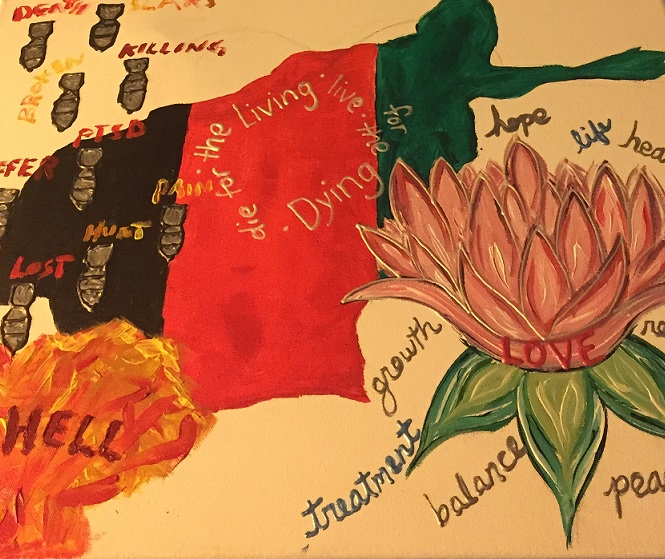
Veterans use the power of art to convey the struggles they have faced.

Positive Reflections: From Combat to Community, an art exhibit featuring work by veterans who served during World War II, the Korean War, the Vietnam War and the wars in Iraq and Afghanistan, will be opening on Feb. 5 at Gallery 625 in Woodland. The exhibit is a chance for former soldiers to present their battlefield experiences through art and is made possible by Veterans Initiative in the Arts (VIA), a pilot grant program of the California Arts Council.

A substantial number of former soldiers suffer from homelessness, including many who will be participating in this exhibit, and art is a way to draw attention to the issues veterans face.

Janice Purnell, the special projects manager at YoloArts, coordinated this exhibit and believes it is imperative for people to see a visual representation of the brutality of war.

“The artists each approach their struggle differently and use the art to discover ways of healing,” Purnell said. “Either they find through the process of art a way to access their emotions or they find an image that reflects the inner turmoil that they are to resolve.”

The show will also feature work by artists who did not serve in combat but have other connections to war, such as Nina Thi Strom. Strom’s mother was a refugee who fled from Vietnam during the Fall of Saigon.

“Our human experience and collective suffering as well as celebration, is vital to our survival,” Strom said. “This show is a way to acknowledge the bravery [of refugees].”

An astounding number of veterans face a multitude of hardships upon finishing their duties, such as high rates of post-traumatic stress disorder (PTSD) and unemployment. The exhibit hopes to bring these issues to light through the artists’ renditions.

Fourth-year statistics major Greg Griffin has an older brother who served in the Army and was stationed in Basra, Iraq. According to Griffin, his brother witnessed many of his fellow soldiers suffer from PTSD and struggle to readapt to civilian life.

“I think it’s really unfair how people volunteer to fight for their country and come back only to be neglected,” Griffin said. “This [exhibition] will be a good way for people to realize how terrible war is and how much attention veterans need once they come back.”

Positive Reflections: From Combat to Community will open with an artists reception held from 5:30 to 8:30 p.m. on Feb. 5 at Gallery 625 at 625 Court St. in Woodland.

The exhibition will also be traveling to Davis in March and West Sacramento in April. Dr. Andy Jones, a UC Davis professor and Davis poet laureate, will be reciting a poem at each of the exhibitions. For more information, please contact Janice Purnell at specialprojects@yoloarts.org.

WRITTEN BY: Krishan Mithal – arts@theaggie.org

Humor: Desperate professor wears flannel to class

0
ANGELICA DAYANDANTE / AGGIE

UC Davis professor Edward Heins has tried everything to stay relevant. He’s watched “Keeping Up with the Kardashians,” listened to Drake and even tried an açaí bowl, but nothing has worked. He still doesn’t understand what a woe is, or why North West is anything more than a compass direction.

“I just want to relate to the students more,” Heins said to me over a bowl of butternut squash soup that he brought for us to share.

The soup was cold, and I declined to take part because he had only brought one spoon.

“When I was in college I was the coolest! I used to wear five polo shirts layered one on top of the other! Five! My friends called me Ed McCool,” Heins said, slurping the yellow soup.

This desperation led to what Heins calls the most nerve-wracking experience of his life: the day he wore a flannel to class.

“It was a red flannel,” Heins said. “I once read a Buzzfeed article called 10 Man Buns That Will Drive You Wild and a guy was wearing one just like it. I bought it at K-Mart in the men’s section.”

That day the professor walked into class as he normally would, but desperately hoped one of his students would compliment him. He pulled out a mason jar containing a green smoothie, took what he thought was a casual sip and announced that night’s homework assignment would be available on twitter @$wAGGIEstud3nt.

“It went okay, I think,” Heins said. “I was a little distracted during class because I was thinking about the vegan leather shoes sitting in my Amazon cart the whole time, but other than that I think my flannel upped my cool-cat game significantly.”

Mallory Marks, one of Heins’s students, had a bit of a non-opinion on her professor’s fashion choices.

“Who’s Professor Heins?” she asked. “Oh. That’s his name? Like the ketchup? To be honest, I don’t pay attention in class. I was watching a video of a chicken running an agility course. It was really cute. You should check it out.”

Professor Heins would like us to tell you that you can “feel free to slide into [his] DMs any time.” To that we say proceed with caution: his Instagram is dedicated primarily to pictures of soup.

You can reach ALEX GUZMÁN at almguzman@ucdavis.edu and on Twitter @cactasss.

California school counseling ratio falls behind

0
JAY GELVEZON / AGGIE

California student to counselor ratio five times the national average; leaves high school, community college students at disadvantage seeking college admission.

In 2015, a report released by the U.S. Department of Education claimed that California ranks the lowest in terms of providing guidance counselors for students. The lack of counseling is most apparent, and often most detrimental, at the high school and community college levels, where students prepare for future college or career endeavors.

According to the American School Counselor Association, a recommended student-to-counselor ratio is 250:1. In reference to the most recent data from 2010 to 2011, the Association reported California’s estimated ratio as 1016:1. The disproportionate ratio is often described as a side-effect of Prop 13, an initiative passed in 1978 that lowered property taxes and altered schools’ reliance on state funding.

While the report does not reflect on the quality of academic or guidance counseling, it does show that an uneven ratio leaves many students unsupported. Specifically, students in underfunded schools often face the greatest consequences of this systematic failure, and must endure the college admissions process with little community support.

Jose Antonio V. Meneses, a first-year political science major, understands the depth of consequences which the scarcity of counseling may cause for many students, specifically first-generation college students.

“If you’re a first-generation college student, who are predominantly students of color, you are [most likely] attending a high school that lacks resources to aid students through the college application process,” Meneses said. “If you are ignorant of the college process and your parents only speak a foreign language and the student [to] counselor ratio at your school [is poor], then your chances of getting into college [are] probably going to be at a zero percent.”

Many students have to put in a greater effort than their counterparts at more affluent schools, who may have access to a larger pool of resources in the field of college preparedness. To make up for this disadvantage, various programs provide support to students of specific populations that may be subject to lack of resources at the high school level.

“I was a part of Occidental Upward Bound, and they primarily gave me guidance on the college application process,” Meneses said. “Upward Bound falls under TiO, which is a program that receives federal funding to aide predominantly students of color and low-income students to attend four year colleges.”

Upward Bound is just one of various programs designed to assist students of color and low-income students pursuing college. The lack of guidance counselors does not reflect on the integrity of the existing ones, who often do all that they can to help the students they support.

“I did have access to a guidance counselor in high school,” Meneses said. “For the most part, it was a positive experience. I at least know that my counselor assisted me to the best of her abilities.”

Since this ratio is not remedied after high school graduation, many students face difficulties receiving the help they need at the community college level as well. Marc Gessler, a third-year environmental policy analysis and planning major and transfer student, discussed some of the counseling difficulties he experienced at the community college level.

“The advising at my community college was inconsistent at best. It could be very difficult [to get to a counselor],” Gessler said in an email interview. “They held office hours where you could go for brief questions, but other than that it was by appointment only, and the wait could be up to two months.”

Due to the impacted appointment system, students are left without guidance during their attempt to transfer to four-year universities. In addition, information may be lost due to the irregular visiting schedule, leaving students unsure about what classes to take or which classes will transfer.

“Several courses that I have had to take here at Davis, I already took a comparable course at my community college,” Gessler said. “Another source of frustration was no one communicating to me at my community college level that I needed to get [Intersegmental General Education Transfer Curriculum] verified separately from having my transcripts sent. This doesn’t seem like a big deal, but it is a large inconvenience being that you have to verify it at your community college in person.”

Although students can face a variety of difficulties accessing advising at the high school and community college levels, UC Davis offers various Academic Counselors, Peer Advisers, Major Advisers and Community Counselors.

The access UC Davis students have to such a breadth of advising resources greatly contrasts the experience students have prior to admittance. Jennifer Flood, an Academic Counselor for the College of Biological Sciences (CBS), describes how the system of advising at the Biology Academic Success Center (BASC) includes various advising opportunities for students.

“[At UC Davis] we have several tiers of advising. We have peer advisers — we have eight of them here at the BASC. They are heavily trained, so they’re always here on a drop-in basis,” Flood said. “Then we have the staff advisers [and] we also have our faculty advisers. We have one to two in each of the different majors in the College of Biological Sciences, so students tend to go to them for career counseling or research counseling.”

In addition to providing CBS students academic advising, counselors also connect students to a variety of resources across the UC Davis campus.

“We as staff advisers act as support, counseling, academic advice, and we do a lot of referrals out. We also work really closely with Health Professions Advising which isn’t necessarily considered academic, it’s more career and pre-professional advising,” Flood said. “They’re right down the hall. They can help with applications, personal statements, where to apply [and] what are the requirements for applying to various different pre-health careers.”

Regardless of background, even freshmen with little guidance counseling at the high school level receive extensive resources once admitted to UC Davis. While this alone does not remedy the lack of advising they may have previously experienced, it helps to support their transition into a four-year university.

“We are heavily involved as academic advisers in Orientation, so we help [freshmen] get the guidance the need prior to coming here,” Flood said. “So they already come in with quite a bit of information, and there are very few students who don’t come to orientation.”

While freshmen have access to resources such as immersion into dorm life, transfer students coming from community colleges often have a much different experience.

“[Freshmen] get a ton of support in the dorms, they have the Academic Advising Centers there for peer-to-peer counseling as well as tutoring, and they go through the extensive freshman orientation,” Flood said. “With transfer students, if they come in with missing coursework, they’re way behind in their major — where that’s not necessarily the case with freshmen.”

Many students are excluded from admission as a result of their lack of knowledge toward the college admission process.

“It varies by school and by how affluent the school is, how affluent the student is with the family, and the support system they have,” Flood said. “If they’re first-generation college students, this could be a huge struggle for them […] The student-counselor ratio is a compounding factor, because many students are already entering academia with little support from their community.”

The difficulties of the student-to-counselor ratio do not weigh solely on the student alone, and academic counselors are often overwhelmed with responsibility. At the same time, students who face California’s dilemma have no choice but to pursue college admissions on their own time.

“I think it’s better for the actual high school counselors […] to be aware and do the best they can with the numbers they have, and the students to take note of how little time they actually have and to try and find resources elsewhere [when possible],” Flood said. “Nowadays you can be your own advocate and search online — search websites, call schools, contact undergraduate admissions.”

A mutual understanding between counselor and student of the lack of advising some may have faced prior to entry creates a collaborative environment to help each student reach their ultimate goal: graduation.

“It is helpful to be reminded of how little support students are getting in the high school setting, and in the community college setting we are made aware of that pretty regularly,” Flood said. “It’s not due to the actual counselors that are there, it’s just due to sheer numbers and lack of time. It’s a good reminder for us to be patient and remind ourselves that this might be the twenty-thousandth time we’ve given the information, but it’s the first time this student is hearing it.”

Written by Lindsay Billings — features@theaggie.org

Miyamo and ShopCuffs open stores in Downtown Davis

Store fronts of new Davis clothing shops, Miyamo (left) and ShopCuffs (right). (ANGELICA DAYANDANTE / AGGIE)

Your clothing funk is over: two new clothing stores open in Davis.

In December, the clothing boutique Miyamo opened its doors in its brand-new Davis location, followed by ShopCuffs, which opened its second store in January.

Miyamo, located on G St., is the second Miyamo store owned by Becky Anderson; her first is in Napa, which has been open for a little over 11 years.

“We just decided to finally take the plunge and open a second one,” Anderson said.

As a UC Davis managerial economics graduate, Anderson strives to keep prices low and often rotates inventory.

“Almost everything is retailed for under $100, at least half of the store for under $50, we have jewelry for $12,” Anderson said. “We really focus on trying to keep our price points low. We only get like six of anything of our clothes and everything is in two of a size.”

Anderson also brings in local artists for her store.

“As the store progresses, we’d love to have Davis artisans in here,” Anderson said.

ShopCuffs, another new clothing store in Davis located at 231 3rd St., also advertises clothing at an affordable price.

“I feel like most of the boutiques are pretty high end and I really felt there wasn’t something geared toward students,” said ShopCuffs owner Lacadia Johnson.

Johnson, who went to high school in Davis, moved to Sacramento after college and opened the first ShopCuffs store.

“Getting back to Davis now that we’ve been setting up the shop, I’m reminded of how awesome it is,” Johnson said.

Her Sacramento ShopCuffs location has been open for 10 years, but Johnson explains that she has wanted to come back to Davis for a long time, believing that more affordable shops are needed.

“Davis has some retail, it has got some shopping. I feel like most of the boutiques are pretty high end,” Johnson said. “[ShopCuffs’ style is] young contemporary but with more of an eclectic edge.”

ShopCuffs employee and second-year textiles and clothing major at UC Davis, Bridgett Medeiros, agreed that the change in retail is much needed in Davis.

“Everything in Davis is either overpriced or it’s just not that cute,” Medeiros said. “I was really excited [about the store] because this is the first time that I saw cute, affordable clothes.”
Written By: Samantha Solomon – city@theaggie.org

Increased minimum wage may still not support cost of living

KATE SNOWDON / AGGIE

Davis strives to find wage balance between employees, business owners.

As of January 2016, California has raised its minimum wage from $9 per hour to $10 per hour. Despite the increase, some Davis residents believe that the state’s minimum wage still does not keep up with the high cost of living.

Sean Raycraft, Davis resident and co-founder of Raise the Wage Davis (RWD), started the campaign after he and his friends were discussing politics and reflecting on their own life experiences with minimum wage.

RWD is an initiative that started in November 2013, which proposes to raise the minimum wage to $15 per hour in Davis, beginning Jan. 1, 2016.

Although RWD was not approved by the city council, Raycraft and other supporters of the initiative have continued to dedicate most of their time over the past two years to further the cause they strongly believe in.

“It’s something I see every day. I work at [a] grocery store at nights and the restaurant workers and fast food workers who get off late come in my line,” Raycraft said. “In the beginning of the month, they are able to buy healthy food because they have a little bit more money, and by the end of the month, they are eating ramen. It’s awful.”

Antonio Daniel Robles, a UC Davis neurobiology, physiology and behavior graduate, is a cook at Pluto’s restaurant in Davis, where he began as a starting wage worker earning $10.25 per hour. After five months, Robles worked his way up to $12 per hour.

“Sometimes I feel like a few more dollars would make [working] a lot easier. I’m pretty sure all of the employees feel the same way. If they get paid a little more, they’d be more motivated to work,” Robles said.

Even though he is getting paid more than the minimum wage, Robles explains that it still is not enough and he has to work three jobs to support himself. Robles also works at Sutter Hospital in Stockton as an emergency medical services worker, where he makes $19 an hour.

“If you want you to do just the bare necessities, and I’m talking about cup of noodles and sandwiches, you need more than one job,” Robles said. “One job that isn’t full time isn’t going to cut it. Especially with rent going up [in Davis], it’s expensive. If [minimum wage] goes up to $15, it will help out.”

Derar Zawaydeh, the owner of Burgers and Brew in Davis and Sacramento, does not support an increase in the minimum wage.  Zawaydeh believes that raising the minimum wage in Davis would not only hurt his business, but the residents of Davis as well.

“If you come to my place and eat a burger, assuming that Davis has surpassed the $15 minimum wage, I have to obviously respect that in the price,” said Zawaydeh. “The City of Davis will lose a lot of income, the businesses will lose money.”

Zawaydeh adds that, if Davis is the only city in the area raising the minimum wage, overall prices in the city would increase, deterring customers from frequenting local businesses.

“[The increase in minimum wage] cannot be limited to one town. A lot of people come from outside of Davis, but why should they come to Davis anymore? It [would be] too expensive,” Zawaydeh said.

The goal of Raise the Wage Davis is to find a wage balance that recognizes the needs of employees and goals of business owners.

“Ideally what we want is the city itself to come up with a living wage ordinance that’s going to be mindful of protecting our local businesses and at the same time addressing the fact that we have all of these working poor people who are basically invisible and really struggle to try and make things work in a town where a single bedroom apartment costs over $1,000 a month,” Raycraft said. “That’s basically the entirety of a worker’s income who makes minimum wage, which is ludicrous.”

Written By: SHIREEN AFKARI – city@theaggie.org

Replacing the gap left by Frank Ocean

0
CIERA PASTUREL / AGGIE

Ady Suleiman and Samm Henshaw conjure a musical mosaic of genres.

Nothing can quite fill the gaping hole Frank Ocean left in our playlists when he, well, left the music scene entirely. But nevertheless, I have shamelessly attempted to patch it together with the tracks of two soulful, genre-defying Brits. And with that, meet Ady Suleiman and Samm Henshaw.

Suleiman, a young musician currently residing in Liverpool, has mastered an integration of classic soulful melodies — so good they would make Stevie Wonder and Bill Withers proud — with a reggae that manages not to sound like a bad island beat. His adorably apparent British accent certainly isn’t a detriment, either.

As a relatively new artist in terms of released content, he has already made available two EPs, a Live in Manchester session and a collection of remixes for his single “What’s the Score.” Though Suleiman’s catchy beats in his EP What’s the Score are undeniably worthy of car sing-a-longs, it’s the two singles from his earlier released This Is My EP that truly showcase the R&B sound that makes him worthy of your attention.

The first, “So Lost,” has a message so genuine it’s impossible not to become immediately empathetic.  Feeling lost in your mind? Always; it’s midterm season. But how often are you told that “I must evolve or I will become incapable?”

The second standout track, “Need Somebody to Love,” is just about the only thing Suleiman needs to sing in order to successfully swoon any and all lady listeners. The nonchalance of his voice as he questions “Girl where are you?” paired with an acoustic guitar intro and the unexpectedly fantastic arrival of a smooth beat around 1:20 almost lets the desperation of the lyrics slide: “I’ve been waiting so long / to give some of my attention.”  Almost.

However, “Ain’t the Beep” might just eliminate this lovesick puppy image in a matter of minutes. This ability to slide across genres, however, is the truest portrayal of his talent.

Similarly, musician Samm Henshaw’s debut EP, The Sound Experiment, literally embodies its title, managing to conjure a musical mosaic of rhythms, genres and sentiments that can still stand as a collective work.  In fact, according to an interview with Quays News, his newest EP was produced with the intent of  “the theme is that there isn’t necessarily a theme.” And it does just that.

Although he only graduated from college last year, Henshaw has already proven his worth as an opening act for James Bay. Having only released one EP, the rising artist has his career (and my entire playlist) ahead of him.

The first track, “Temptation,” oozes with R&B rhythms and lyrics, followed by a catchy, pop-influenced track, “Autonomy (Slave).” The funky groove of  “Everything” and soulful sound in “Better” (a track that could be seamlessly added to John Legend’s 2004 album Get Lifted), provides evidence for not only Henshaw’s successful endeavor at a multi-faceted sound, but his diversified talent as well. There’s a reason his name ends in “Mm.”

The highlight track, “Only Wanna Be With You” has both an unplugged and fuller version, and though both have a meaningful take on a sweet love ballad, the unplugged version has a more intimate sound that encapsulates the sweet nature of “I know you’ve been hurt/ But I wanna make this work.”

I’m not suggesting these talented rising artists are Frank Ocean replacements, but I certainly won’t deny their successes as a temporary fixes, either.

WRITTEN BY: Ally Overbay – arts@theaggie.org