41.5 F
Davis

Davis, California

Saturday, December 27, 2025
Home Blog Page 530

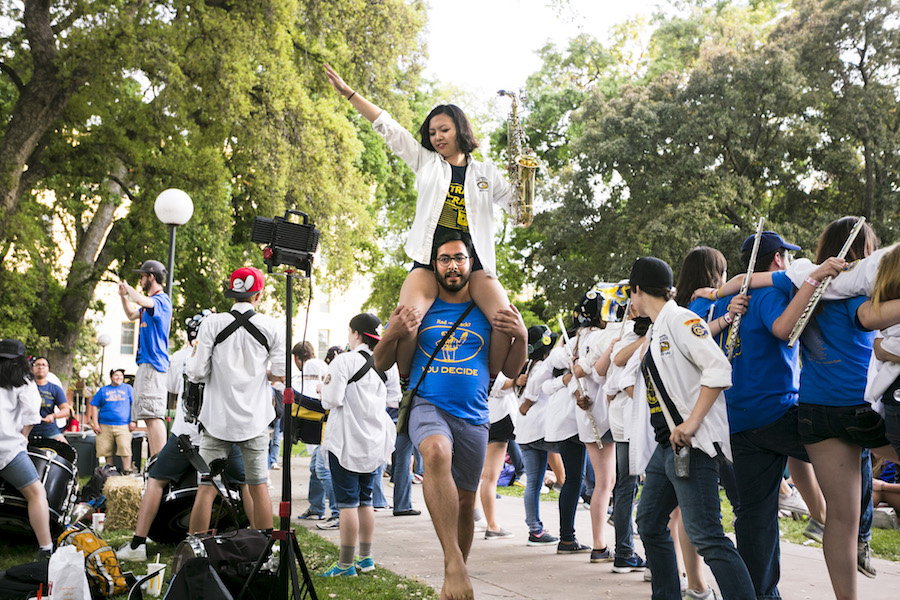
A day where the sun shines

DIANA LI / AGGIE FILE

Students shine light on 104 years leading up to this year’s Picnic Day celebration

April 21, 2018 marked the 104th year of UC Davis’ oldest tradition, Picnic Day. Picnic Day was kicked off by a cow’s pilgrimage from the UC Berkeley campus to the University Farm. Today, the University Farm is called UC Davis, and students and faculty showcase their interests and involvement at Picnic Day in various activities through performances and events. This year, the festivities consisted of over 200 events, including crowd favorites such as Doxie Derby, a chemistry magic show, Battle of the Bands, liquid nitrogen sorbet and the Davis Dance Revolution.

UC Davis was founded in 1908 as the University Farm, an agricultural extension of UC Berkeley. The following year, faculty members and students came together to celebrate and picnic at the campus Dairy Farm. In the subsequent years the university expanded, as have the number of events, exhibits and attendees.

Chelsea Falk, a second-year psychology major and the vice chair of Picnic Day, detailed the purpose and importance of Picnic Day to the Davis community.

“Picnic Day serves as our open house, but it is also a lot more than that,” Falk said. “We have over 200 events, and it’s a chance for our students and faculty to show off what they are most passionate about and what makes Davis special to both the students and the community.”

When the first Picnic Day was held in 1909, there were about 2,000 attendees. Since then the number has grown substantially, to over 75,000 people reported. As the university grew in size and more buildings and programs were added to the school, the students and faculty were able to exhibit their interests through new events.  

“It really started off as just a picnic, and there wasn’t a lot of events because the campus wasn’t as big as it is now,” Falk said. “In the following years, [Picnic Day] was showing off the new buildings and departments, and since then we have been adding more and more events to incorporate all the new aspects of the university.”

Nicole Deacon, a second-year applied statistics and psychology double major and the special events director, explained how Picnic Day remains such a unique aspect of the UC Davis experience.

It wasn’t until 1916 that Picnic Day became an entirely student-run event; today, it is the largest student-run event in the nation. It is supported by 16 directors, over 70 assistants and 200 volunteers. All of the events and exhibits are also organized and run by Davis students.

“I think what sets Picnic Day apart from other open houses is that it is completely student-run, unlike other open houses that are usually run by administration,” Deacon said. “We feature all the different departments, student organizations and athletic departments, and then there is a parade that goes downtown that not many other schools have. It’s really cool to see everyone come together and support Davis as a community.”

However, Picnic Day also has a wilder side and is commonly regarded as Davis’ largest party. The event has a history of rowdy behavior, causing city police to patrol the event.

“I think students definitely know that there is another side to Picnic Day that happens off campus and I feel like a lot of students don’t really know what is happening on campus, which is something we are trying to change,” Deacon said. “It’s unfortunate that some students have ruined its reputation a little bit, but the community continues to love Picnic Day because there are just so many cool things to see and experience.”

Despite student parties off campus, Picnic Day remains the community’s favorite family-friendly event. Aaron Garcia, a second-year psychology and communication double major and the publicity director of Picnic Day, shared his favorite part of the festivities.  

“I really like seeing UC Davis students come out to Picnic Day especially because it is a Saturday,” Garcia said. “Seeing so many people come and go to the different exhibits and enjoy what they are seeing as well as having all the family-friendly and community members come in really is the cherry on top.”

Grace Gaither, a fourth-year English major and the Picnic Day chair, revealed the evolution and traditions of Picnic Day.

“Picnic Day has changed a lot since 1909 and a lot of that has to do with safety reasons,” Gaither said. “We used to have mud pig-grabs where people would go in the mud and try to grab pigs and we also had bodybuilding competitions as well as food-eating competitions. We have always had fraternities and sororities involved in the parade but in recent years we have also had lots of clubs participate as well, which is really cool for potential Aggies to come and see.”

It wasn’t until 1916 that Picnic Day earned its name and simultaneously became a student-run event. Each year since 1923, the Picnic Day Board also bestows a theme that highlights something important to the directors regarding Picnic Day and to Davis as a whole. This year’s theme was “Where the Sun Shines.”

“Picnic Day is for everyone just like the sun and that is where our theme came from,” Gaither said. “The warmth and brightness that the students show is the coolest part of the event.”


Written by: Sneha Ramachandran — features@theaggie.org
Humor: Student to participate in school walkout whenever he gets bored

VENOOS MOSHAYEDI / AGGIE

One bold student stands up to lie in bed

Brace yourself, advocates — the social justice movement has found itself a new hero in  Bryce Daniels. Taking cues from important educational system protests of the past, Bryce is embarking on a crusade of his own against the evils of disinterest. Look out world, when Bryce Daniels feels the time is right he is unafraid to stand up — stand up, go home and play Fortnight, that is.

When The Aggie contacted Bryce, he was only available for comment over his Xbox headset. But when we found a matchmade Star Wars Battlefront game, he had this to say: “The East L.A. walkouts were a landmark in the protesting of low-quality education. If my teacher can’t make learning lists of o-chem reactions an experience I crave in the marrow of my bones, what is the quality of my education? I AM AN OPPRESSED MINORITY FROM EAST L.A. IN 1968 METAPHORICALLY!”

Too long has Bryce shouldered the burdens of memorization. Too long has he listened to corny jokes and participated in group exercises. The age of learning is over. The age of watching “Chopped” on Netflix is just beginning.  

“Yeah, I know Bryce,” said a member of Bryce’s linear algebra class. “I’ve only seen him a couple of times, but he seems really committed. He’s disciplined in leaving class between 15 and 20 minutes into lecture every single time.”

But Bryce’s protests aren’t just limited to walkouts. He protests in other ways, as well.  Classmates have reported that, whenever Bryce feels it’s time to take a stand, he’s unafraid to yawn loudly, put his headphones in or play World of Tanks on his phone.

Bryce told The Aggie that he wishes to be called a hero for his advocacy, and also for his two Battle Royale wins in three days.


Written by: Parker Nevin — phnevin@ucdavis.edu

(This article is humor and/or satire, and its content is purely fictional. The story and the names of “sources” are fictionalized.)


Mountain Made Life

JOSH MORRIS / COURTESY

Northern California art collective supports environment, nonprofits

Located in Marin, Mountain Made Life is more than a website that sells unique, nature-focused T-shirts. The art collective is an oasis for artistic expression of all forms that simultaneously supports the environment.

“When I first started Mountain Made Life, I was trying to develop a platform for my art, which then became a platform for others’ art,” said Josh Morris, the founder of Mountain Made Life. “The goal is to try and help people. It went from a place to sell prints to making shirts and giving back to the environment.”

Helping people comes in a variety of forms and destinations.The tees for sale on their website, for example, not only kickstarted the company but also stand for a level of craftsmanship and care by each designer.

“In today’s age, with fashion, it is about cheap products that you get rid of immediately,” said Leo Cooperband, a designer for Mountain Made Life. “This is more about making fashion a sustainable industry and also making connections with artists. It is us hand-printing our shirts with our own personal designs.”  

Mountain Made Life has expanded in the art that it hosts since its inception. Now, there is music through Tiny-Desk–esque videos filmed in scenic locations, adventure blogs and photography to tie it all together.

“Everyone I know is artistic in different ways, and I wanted to create something for everyone, not just me as a photographer and graphic designer,” Morris said.

The many mediums align in their dedication to the outdoors, its appreciation and its conservation.

“Through all the mediums that we use, it shows that nature is inspiration for any form of creation,” Cooperband said. “Nature can be such an inspiring starting point and getting people outside to express themselves creatively.”

For Mountain Made Life, nature is at the center of art and expression.

“I designed the pinecone T-shirt and the patches,” Cooperband said. “I take inspiration from a certain biome or environment. Whatever gave me inspiration, I try to give back to the nonprofit that directly helps that biome — it just feels right.”

Each tee purchased from Mountain Made Life donates 5 percent of the proceeds to an environmental nonprofit of the designer’s choosing — usually the environment the product is based off of.

“I wanted to be more diverse and have more choice in where the money we donate is going to,” Morris said.  “We wanted to see if we could give to another place and give people a reason to look at more shirts. If someone resonates with the desert, they could not only have a T-shirt with a desert scene but also give back to the desert.”

This environmental, philanthropic mindset of the company does not only fiscally support conservation, but also hopes to help others develop a similar love for the outdoors.

“I think for the most part [the nonprofits] are focused on the environment, not just environmental issues,” Cooperband said. “One of the nonprofits we support is the Outdoor Alliance for Kids. Their goal is to help get kids and families out in nature and get a sense of appreciation for it. That could help them get into some form of environmental protection, but it’s not the main goal. Our goal is to get people stoked on the outdoors, and I think we can use that to help protect the world.”

For Ricky Olivares, a photographer for Mountain Made Life, the larger purpose of the art collective is in the work he produces.

“If you can create images that pull people in, like the music and the clothing, those things can influence and give back,” Olivares said. “There is no better goal as a photographer [than] to make things better — to show things as they are but work toward making them better than they currently are.”

Mountain Made Life represents something greater, impacting not just those directly involved and those who buy and interact with the content. A community arises from the soul of the company.

“What makes Mountain Made Life different is that it’s not just photographing a person at a place,” Olivares said. “It’s a person you care about, or someone you just met and are having a good time with. It is different from the average adventure photography that is often detached and the photographer just witnessing what is happening. For me, when I am photographing for Mountain Made Life, I feel connected more, and that makes for more intimate imagery.”

With goals, interactions and products so genuine, the future of Mountain Made Life appears promising.

“In the future we hope we can still get people stoked on the outdoors and art,” Morris said. “We’re excited to tell more stories and to expand to what it means to do art — whether it is painting or forms of physical expression. We are going to start something called ‘Mountain Made Movement,’ which is how people relate their actual physical movement to artistic expression. We’re excited to keep expanding on things we want to represent.”

Mountain Made Life products and more information can be found on its website.


Written by: Caroline Rutten — arts@theaggie.org


Death in its title, death in its frames

ALLYSON KO / AGGIE

“The Death of Stalin” checks every box of a classic dark humor film

People always look to classify films. “The Godfather” is classified as a drama and “Star Wars” as science fiction. “The Death of Stalin,” released in the U.S. in March of this year, can be just as easily classified: dark comedy.

The significance of the film is just how expertly it achieves the requirements of a dark comedies. The humor in “The Death of Stalin,” boiled down, is analogous to that of “The Three Stooges”: it’s slapstick, and laughter arises from the misfortune of others. That being said, the slapstick nature of the film doesn’t arrive with Stalin bonking Khrushchev on the head like Moe to Curly, but resides in its treatment of everyone else. The fleet of Soviet officials (puppeted well by impressive actors like Steve Buscemi and characters like Khrushchev, Beria, Stalin and Zhukov) have complete disregard for any life other than themselves — and hence the dark “slapstick” arrives in its purest form. Properly employing these comedic ideals is what brings “The Death of Stalin” into the realm of good, if not great, films.

A scene early in the film follows Lavrentiy Beria, the chief of the secret police, through a torture facility. He passes a few rooms with people being beat, another few rooms ringing with executionary gunfire and finally past a staircase. Down the staircase rumbles the comedy — or, more literally, a man tied to a wooden log. No emotion crosses Beria’s face, not even a slight recognizing glance at the poor log-tied fellow. It’s a gruesome and morbid scene. Why, then, did the theater rumble with a low thunder of laughter? Why isn’t the audience turned away from the gore and insensitivity to death?

Films rely on its characters’ reactions for deeper meaning. Take “E.T.,” for example, when the space dweller goes home and taps the boy on the head: it’s sad. Specifically, it’s sad because the emotions related to loss are on the boy’s face, and audience members immediately empathize. Without the boy, there isn’t anything sad about E.T. boarding his spaceship. In regard to “The Death of Stalin,” the humor comes from a lack of that exact emotion. When Beria does nothing, he prompts the audience to do the same — not react at all. And somehow, in this lack of a reaction to death, the film kindles humor.

That is what makes “The Death of Stalin” a successful and funny film; the humor is not in its well-placed one-liners — which, to be clear, the film certainly showcases — but in its deadpan, emotionless delivery of countless deaths. The constant disregard for human life and emotion, not unlike traditional Vaudevillian humor, is inflated to obscene proportions to provide a masterful display of Iannucci’s hellish Soviet Union and the squabbling, childlike adults who run it.

“The Death of Stalin” provides a healthy sum of dark humor, and if one’s tastes abide to such a strict form, they will be left with teary eyes and stomachs of giggles.


Written by: Nicolas Rago — arts@theaggie.org


Analyzing the world through art

NICKI PADAR / AGGIE

Podcast by UC Davis graduates discusses importance of visual analysis

When was the last time you looked at the world around you critically? Have you ever stopped to wonder why our world looks the way it does? These are the questions confronted by art historians and students of art history on a daily basis.

In the academic sense, art history is defined as the academic study of art objects in the context of their historical and stylistic development. In a more general sense, however, art history is a tool that can be used by anyone to process the vast amounts of visual information presented to us every day.

“The Art History Babes” is a podcast available for free to those interested in improving their capacity for visual analysis by listening to four women — Corrie, Natalie, Jennifer and Ginny — drink wine while discussing the shared visual culture of human beings.

It started a fun side project to help express our love for art in a non-academic setting,” said art history babe Natalie De La Torre. “The response we got was overwhelmingly supportive and now it’s become our primary focus.”

Knowing the artist’s theory behind that eye-catching painting at the Manetti Shrem Museum goes beyond simply being able to impress your peers. The visual and iconographic analysis employed by art historians has real implications for making sense of the past, present and future of human beings.

“It’s really important to understand non-verbal modes of communicating,” said Caroline Riley, an art history lecturer at UC Davis. “So much of our world is visual and art history is a method we can employ to better understand why our world looks the way it does.”

Given the fact that UC Davis’ art history major has less than 100 enrolled students, it is important that those familiar with the field introduce the public at large to the more critical methods of viewing the world that art history offers.

Discussing subjects ranging from “Black Panther” to fabergé eggs, Andy Warhol to portraits of President Obama, the group of Davis graduates from “The Art History Babes” aims to do precisely that.

The podcast, which is available on iTunes, discusses a wide array of subjects, many of which bear surprising ties. Who knew that there might be a connection between Oprah, hangovers, ornamental hermits and tarot cards? It turns out that your local art historians may have some answers.

Art history isn’t isolated to what we study in the classroom. It encompasses all of the visual aspects of our lives — which is nearly everything,” said art history babe Jennifer Gutierrez. “We want to empower people to strengthen their visual literacy and make sense of the visual information that they are being bombarded by constantly.”

Tune in to the “Art History Babes” podcast for a entertaining, informative and critical look at the visual world around us.


Written by: Isaac Flores — arts@theaggie.org

New flights for old feathers

JAYDEN WESTBROOK / CRC

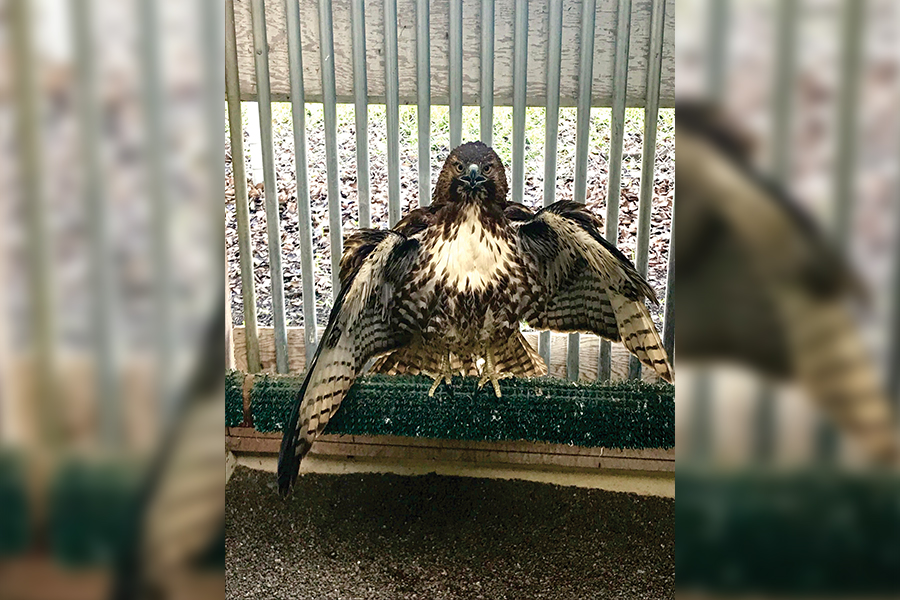
Raptor center cured, released red-tailed hawk whose feathers were broken

When a red-tailed hawk with six broken feathers was brought to the UC Davis-affiliated California Raptor Center, veterinarians knew they would need some old feathers and an old technique to heal the raptor. This method worked so well the hawk was able to be released back into the wild later that day.

Using old feathers that had been carefully stored and preserved, the center was able to imp the bird. Imping involves cutting away most of the broken feather on the bird, inserting a small wood rod in the hollow shaft of the feather, then attaching the preserved feather.

“Imping is actually a very old procedure, historically it dates back, some would say, hundreds, if not, potentially thousands of years along with the sport of falconry,” said Julie Cotton, the volunteer and outreach coordinator at the Raptor Center. “There are references to it in falconry manuals from the 1200s. So it’s a known procedure, it’s primarily associated with raptors, but in modern times it has been used in avian medicine with seabirds, parrots and other species as well.”

The materials for this procedure have changed over time, from wire and vinegar to wooden rods and epoxy. Although the idea behind the process sounds simple, the actual procedure is more difficult and very time-intensive.

“To prepare the feathers you must carve a small piece of bamboo that fits firmly into the shaft of the broken feather on the bird and also into the feather to be implanted on the bird’s broken feather,” said Bret Stedman, the operations supervisor. “This takes time to be sure it fits without splitting the feather shafts. When you have six feathers to prepare it does take a while to do it just right.

Stedman prepared the feathers himself. With the help of Michelle Hawkins, the director of the Raptor Center, Bill Ferrier, the former director, and veterinary residents, the feathers were attached to the raptor.

Even though birds molt their feathers, the imping procedure was deemed the best way to go. The rescuers wanted to get the raptor back into the wild as soon as possible and molting can take a long time, which meant the hawk might have had to stay in captivity from a few months to a year. Over time, the bird will replace all of its feathers, including the imped ones. This means that one day someone might find a red-tailed hawk feather on the ground that has been glued together.

“That’s exactly the idea behind the imping, that you’re giving the bird this temporary fix for the problem that should hold until it can naturally molt out the base of that old feather and grow in the new one,” Cotton said.

Since the hawk was able to fly well after the procedure, it was released on the same day. This is beneficial for the hawk as prolonged time in small spaces, such as carriers, increases the risk of the same feathers breaking again.

Imping is a known procedure, but not a very common one for the Raptor Center. Despite this, the Raptor Center holds onto feathers and stores them for the possibility of a future imping procedure.

“So we, at the Raptor Center, have a library of feathers from different raptors,” Cotton said. “And the feathers that are used in imping procedures very often come from […] carcasses maybe that people find or birds that have passed away. Because when you imp a bird you need to match not only the species of the bird correctly, but you have to match the age of the bird, get the right sized feathers, get the feathers from the correct wing or correct side of the tail. So it really does matter to have this library where everything is labeled, numbered and ordered.”

The Raptor Center rescues over 200 hawks each year. The goal of the volunteers is to be able to release the birds back into the wild after they have been healed. Birds that cannot be released often become a part of the center’s ambassador collection and are used to help teach others about raptors. Students can take advantage of this opportunity to learn more about raptors by visiting the Raptor Center. The center is open for most of the year and visitors can see other red-tailed hawks that are a part of its ambassador collection.

Birds that can be released are banded with an identification number and a phone number. This is so if the bird is found again, the success rates of the procedures the center has done on raptors can be tracked. Unfortunately, the data pool for this is small. According to Stedman, about four per 100 banded birds are ever found again.

With enough time, a pattern of success rates emerges. Stedman says he has a pretty good idea what works for the raptors the center rescues. Making sure the hawks live long lives after they are released again is crucial for they are a very important part of the natural order.

“Raptors are the birds that are highest on the food chain, and thus when their numbers decline it is very concerning that something quite devastating could be occurring in their environment to cause it,” Hawkins said. “They are environmental ambassadors in many ways, and by protecting them we protect the environment we all share. And they’re the world’s best rodent control.”


Written by: Rachel Paul — science@theaggie.org


Invisible Life of HIV Made Visible

CAITLYN SAMPLEY / AGGIE

UC Davis researchers discover how to disrupt HIV latency

By lying dormant, HIV can dodge the body’s immune system and hide from treatments. UC Davis researchers might have just found the way to bring HIV out of hiding once and for all.

“HIV latency is a unique state of HIV during its life cycle when the virus goes into hiding from the immune system,” said Guochun Jiang, a UC Davis associate project scientist. “Although the virus is present in the cells, it does not actively produce viral proteins or infectious viral particles.”

The researchers have been working on making the virus visible to the immune system so it can be targeted by immunotherapy.

“We were exploring the epigenetic mechanisms that could be exploited for disrupting HIV silence and target it for immune clearance,” said Satya Dandekar, a professor of microbiology and chair of the Department of Medical Microbiology and Immunology at UC Davis. “This led us to the identification of a new histone modification — histone crotonylation — by which HIV can be forced out of its latent state and out of hiding from the immune system. Histone crotonylation is a modification of the histone tails and occurs when  crotonyl coA gets added to lysine amino acid in histones.”

Histone modifications open up the DNA, enabling transcription factors to initiate gene expression. Histone crotonylation in particular leads to the active gene expression of HIV, making it more visible to the immune system.

The next step is to find out if reversal of HIV latency by histone crotonylation will help the immune system to eliminate infected cells,” said Dennis Hartigan-O’Connor, a UC Davis associate professor in the Department of Medical Microbiology and and Immunology and the co-investigator of this project. “We need to know if reversal of latency can have a meaningful impact on the amount of HIV in the body.”


Written by: Kriti Varghese — science@theaggie.org

Bridging the gap between Davis, Woodland

ALLYSON KO / AGGIE

New trees, landscaping to be installed

Tree Davis was founded in 1992, and has since worked with over 3,000 volunteers to plant over 9,000 new trees in and around the Davis area. The Woodland Tree Foundation was founded shortly after, motivated by the efforts of Tree Davis, and has since planted 4,607 trees around the city. The two groups have been in close communication since the inception of the latter and have worked closely, having joint tree-planting projects and working together to create a healthier environment. Tree Davis and the Woodland Tree Foundation have since taken it upon themselves to populate trees along Highway 113, working northward and southward, meeting at Road 29 in the middle.

“The tree-planting began a little after 1992 for us — for Tree Davis,” said David Robinson, the board president of Tree Davis. “As for today, both of us will grind on with the tree-planting. We will replace the ones that killed each year, get girdled by ground squirrels, get mowed over by CalTrans or die of drought. We plant them, we water them, we will get them filled in. But the interchange project will require landscaping, soil moving, soil amendment, maybe creation of birms. We’re drawing in Yolo County […] everyone will have to get involved.”

There have been several challenges the two groups have had to face since undertaking the project. In order to plant and grow trees around the highway, volunteers have had to apply for encroachment permits and pass collision and sight safety requirements to plant trees from CalTrans, as the trees need to comply with their regulations. Small wildlife, such as ground squirrels, often dig up and eat the acorns and seeds, and cars and trucks can cruise over seedlings and destroy growing trees.

The biggest issue, however, lies in the soil. During construction, foreign soil was compacted and imported, losing much of its nutrients. This depleted soil makes trying to grow so many native trees difficult.

“The goal is to determine — with the help of experts — what the soil problems are within the area, so that volunteers can plant everything,” said David Wilkinson, the president of Woodland Tree Foundation. “The vision is to really create something more beautiful, more ecological out there that I think will reflect well on the county. Hopefully, with both Tree Davis and Woodland Tree working together, we’ll be able to create a nice landscape out there.”

Robinson and Wilkinson have both reached out to the Yolo Resource Conservation District for assistance with the project and have since gotten in contact with Jeanette Wrysinski, its senior program manager. They hope that by bringing the YRCD, CalTrans and other related organizations into the conversation, they’ll be able to get more done with the soil issues and be able to refer to experts for more drained soil areas and more difficult plantings spots.

“I do think that having a complete tree corridor along Hwy 113 between Woodland and Davis is feasible and I don’t think there are any environmental risks,” Wrysinski said via email. “WTF addresses highway safety issues by coordinating with CalTrans for planting a safe distance from the roadway […] human encroachment since the mid-1800s has resulted in the removal of a vast number of oaks and other native trees.”

Leaders from the two tree-planting groups will meet with members of the Yolo Resource Conservation District on April 24 to discuss how to move forward with the project. Those looking to join or volunteer for Tree Davis or the Woodland Tree Foundation can visit their respective websites.


Written by: Ahash Francis — city@theaggie.org

Better broadband to come to Davis

JEREMY DANG / AGGIE

Broadband advisory task force researches new methods to bring better internet connections to community

The Davis City Council is currently looking into research to establish better broadband internet connections for the Davis community. The council has created a Broadband Advisory Task Force that will conduct research and propose different solutions to bring better broadband availability for the city.

Sarah Worley, the deputy innovation officer for the Broadband Advisory Task Force, explained this term in relation to how people can be better connected.   

“People use the term ‘broadband’ in different ways,” Worley said. “When we’re talking about broadband, we’re talking about high-speed, high-capacity fiber networks that will provide better connections to the internet.”

Worley explained that there can be crucial benefits that come with better broadband internet connections in a cyber- and technological-focused world.

“Maintaining access to high-capacity fiber broadband internet connections for the community is essential to receive benefits with universal access, including economic benefits, safety benefits, energy savings [and] climate preparedness,” Worley said. “[In addition,] there can be access to transportation and improvement to education and health to reduce the cost of medical services by using technology to bring communication.”

However, the task force only serves an advisory role.

“The task force would not be taking any formal actions,” Worley said. “They do research and make recommendations. Ultimately, the city council and the community can implement any major funding and approval of the projects.”

The task force has presented its research to the city council, outlining the possible changes and recommendations as a result of a broadband feasibility study.

“The city council accepted the report, approving the task force to continue their work and pursue the next steps recommended during the study,” Worley said. “It was an information exchange — the task force was given an assignment. These things need to be done so we can understand specifics better and decide if this is an undertaking the city wants to take.”

Currently, the goals are to expand and understand the attainability for a citywide network.

“Some of the next steps are to get a better understanding of how realistic and feasible it is for a citywide broadband network to actually have a sufficient number of the owners of multifamily units subscribed, since they vary in sizes and age with multiple property owners and managers,” Worley said.

Christopher Clements, the Broadband Advisory Task Force chair, outlined different areas in terms of the goals.

“There’s economic development — one of the problems today is the abilities for businesses to succeed, which depends on a for-profit need,” Clements said. “The other one would be education. In this day and age, there’s a dependency for rich content and capable internet, which is now a requirement. There is a significant portion of the environment where there is not adequate connection to the internet. Things like doing reports or projects becomes a problem for children who can’t connect to the internet at a decent speed.”

Furthermore, Clements notes that this can bridge any such inequalities through better broadband connections.

“If the municipality moves forward with this project, then every house has the same capability, regardless of economic diversity or fiscal geography — everyone will be equal in that regard,” Clements said. “More of a niche benefit will be telemedicine — the ability for people to go to a clinic to get treatment as they age gets difficult. Public transportation to appointments becomes a demand, and so one of the benefits here is that with the robust, reliable internet connection and secure device on the other end then people can have a virtual connection with doctors without the need to be on the road to be looked at.”

Steve McMahon, another member of the Broadband Advisory Task Force, also proposed equity within both homes and businesses with better broadband connection.

“The highest goal is to build competition ensuring that the town has some control,” McMahon said. “The more concrete goal is to build a fiber network to connect every home and business to the internet.”

Nevertheless, the council has not moved forward with changes yet. Robb Davis, the mayor of Davis, emphasized that they are still in the process of needing more research.

“We haven’t made a determination to go forward with community broadband yet,” Davis said. “We’re analyzing costs and structuring it as a business model. There are a lot of questions remaining about how we’re going to pay for it. We’re in the process of continuing analysis of the possibilities. We have made no decision to move forward on it yet.”

However, Davis suspects that change will come soon.

“The report that we received last week shows the potential and constraints,” Davis said. “We’re going to continue to analyze and provide greater coverage. We all have questions about other technological advances that we need to keep our eye on that use cellular technology for high-speed transmission of data. We’re still in learning mode, but I expect we will collaborate with the university and serve the needs of both citizens and companies that want to relocate here. Change is coming. I just don’t know quite the form of what that change is going to be.”

While changes are not effective yet, there will be steps that lead to better broadband for the community.

“This will be a large undertaking for the community,” Worley said. “There’s a lot of incremental steps along the way. Ultimately, the council representing will be making decisions going forward and also solicit support from the community.”


Written by: Stella Tran — city@theaggie.org

Growing income disparity in UC shown in recently released study

JAMIE CHEN / AGGIE

Percentage of black workers at UC declined from 19 percent in 1996 to 12 percent in 2015

A study commissioned by AFSCME 3299, the UC’s largest employee union, which used previously unreleased UC employment data, “reveals growing income inequality, persistent patterns of racial and gender hierarchy, and steep declines in African American employment within the university’s workforce.”

The study contended that the “the University of California must do more to combat inequality within its ranks” and that the state’s third largest employer needs to be doing more to bolster historically disadvantaged communities.

The study’s co-author Owen Li said in an AFSCME press release that “a taxpayer supported public university system is not the place where we should expect to see exploding wage gaps.” Li also said he sees the current UC employment model as an “opportunity ladder that seems to prize white males above all others.”

While preserving lowest-paid UC jobs as “ladders to the middle class for communities of color,” the UC still needs to focus on “career advancement and [stronger] protections against discrimination,” according to the study.

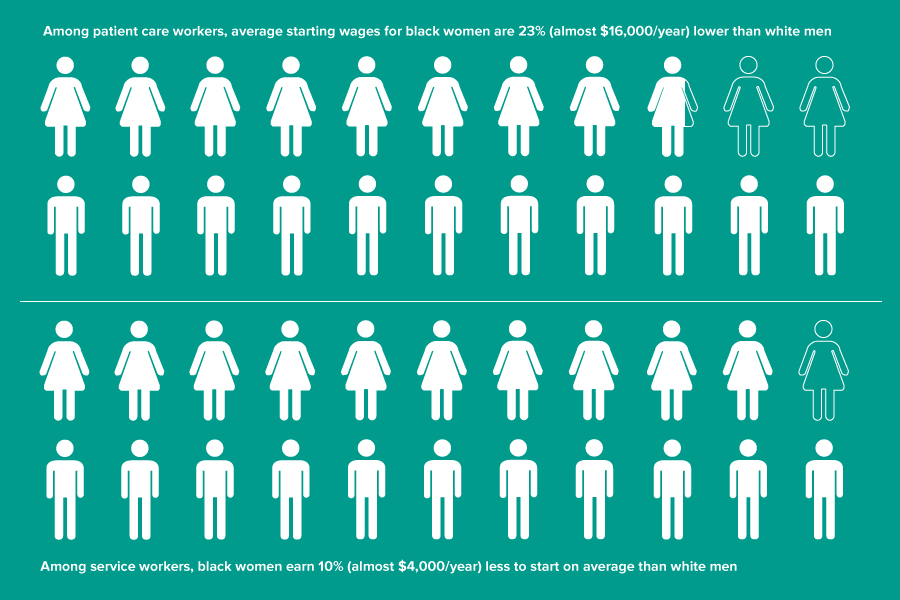
According to the analysis of UC’s employment data, contract or temporary workers need greater protections against “wide ranging inequities and abuses.” These inequities include an uneven platform of support and opportunity for people of color working for UC. In 1996, black workers comprised 19 percent of all UC service and patient care workers. In 2015, they comprised 12 percent.

The report states the UC utilized companies with a “history of labor abuse”
to supply contract workers.

According to UC spokesperson Stephanie Beechem, AFSCME’s findings are inconclusive because “we do not know how the union arrived at its information.”

“UC can confirm neither the accuracy of the figures nor the conclusions contained in AFSCME’s report,” Beechem said.

The figures in the report are based off of a review of UC’s published employment data.

We’ve provided full citations for our work in the report,” said AFSCME representative John de los Angeles. “I hope the sobering conclusions reached in the report trigger a period of self-reflection for UC. UC must be thoughtful about working with legislators, students, and workers to fight growing inequality and ensure that taxpayer dollars provide opportunities not just for students, but for workers as well.”

Beechem said that the UC is attentive to issues of inequality.

“We take issues of fairness and equitable treatment seriously, have mechanisms in place to respond to these types of issues, and follow appropriate Equal Employment Opportunity policies,” Beechem said via email. “We encourage any employee who believes he or she is being treated unfairly to bring their concerns to the attention of the proper UC office so that they may be addressed quickly.”


Written by: Aaron Liss — campus@theaggie.org

Stanley Cup Playoffs welcome new challengers, familiar foes

MICHAEL MILLER [CC BY-SA 4.0] / COMMONS
Hockey’s annual postseason tournament promises a wild ride through the spring

The 2018 NHL Stanley Cup playoffs got underway last Wednesday night, as a total of 16 teams will battle it out over the next two months to see who will hoist Lord Stanley in early June.

This year’s playing field is especially packed with bright young stars in their early 20s as well as the usual playoff stars fans have come to know over the years.

The Pittsburgh Penguins are vying for a third straight title, but face stiff competition to accomplish something that hasn’t been done in over 30 years.

No matter what happens, this year’s playoffs promise to be as intense and drama-filled as they always are every spring.


Eastern Conference


Columbus Blue Jackets (4) vs. Washington Capitals (1)


The Capitals are fresh off their third straight Metropolitan Division crown, but come into this year’s playoffs with significantly less pressure and expectations on them to win it all than in past years. Washington, a team that won the President’s Trophy in 2015-2016 and 2016-2017, has now made the playoffs four straight years and ten of its last 11 seasons. They were division champions in eight of those years. Despite all of these regular season accomplishments, the team has absolutely nothing to show for it in the postseason, failing to advance to the conference finals a single time in that span.

As usual, the Capitals will possess the most skilled player on the ice in the series in winger Alex Ovechkin, who once again captured the Maurice “Rocket” Richard Trophy this season by leading the NHL with 49 goals scored. Ovechkin has won the trophy seven times in his career, including five in the last six years. He will lead a potent scoring attack along with star center Nicklas Backstrom, who tallied 71 points this year. It’s fair to say that the Capitals are starting to inch closer to the end of this championship-caliber window, as both players are now in their early 30s and nearing the end of their respective contracts.

Defensively, Washington struggled early on in the season, but showed signs of improvement after some midseason trade acquisitions. John Carlson, who was the leader in points and assists amongst all NHL defensemen this season, will have a big impact on both ends of the ice. The Capitals have endured some instability in the net, as neither Braden Holtby nor Philipp Grubauer have solidified themself as the starting goalie heading into the playoffs. Both have enjoyed varying levels of success this season, but have failed to show much consistency.

The Blue Jackets are looking for their first playoff series win in franchise history, after advancing to the postseason for the second year in a row as a wild card team. Columbus is led by goalie Sergei Bobrovsky, who had another solid in the net with a 2.42 goals against average and five shutouts. He is capable of getting hot in a seven-game series, putting the team on his back, and leading it to victory.

The Blue Jackets have the edge on Washington defensively and also come into the series as the hottest scoring team in the league, with more goals than anyone else since the trade deadline in late February. Left winger Artemi Panarin led the team in both goals and assists, finishing with a total of 82 points on the season.

Nonetheless, Columbus still had the worst power play percentage, 17.2 percent, amongst all postseason teams. They also struggled mightily with a 76.2 percent penalty kill, which was fifth-worst in the NHL.


Philadelphia Flyers (3) vs. Pittsburgh Penguins (2)

The Penguins are looking to become the first team to win three consecutive Stanley Cups in 35 years, after advancing to the playoffs for the 12th straight season. Pittsburgh enters the series as the third-best scoring team in the NHL, thanks to Sidney Crosby, Phil Kessel and Evgeni Malkin, who all finished in the top 10 in points.

Goalie Matt Murray has had a very up-and-down campaign, but has the ability to completely take over a series like he’s done many times before. Murray was sensational in last year’s playoffs with a 1.95 goals against average. If he gets hot again, there’s no reason why this team can’t make another long run and capture their sixth Stanley Cup.

The Flyers finished third in the Metropolitan Division and are back in the playoffs following a one-year absence. Center Claude Giroux, a legitimate MVP candidate who was second in the league with 102 points, has been playing at another level lately with 19 goals in his previous 29 games. He is joined by fellow offensive weapons Jake Voracek and Sean Couturier.

20-year-old Ivan Provorov, the top goal scoring defenseman in the league, headlines a mediocre Philadelphia defense. There are some question marks surrounding goalie Brian Elliott, who has only played two games since a two-month absence late in the season due to an injury.


New Jersey Devils (4) vs. Tampa Bay Lightning (1)


The Lightning won the Atlantic Division for the first time since 2003-2004 and finished the season as the NHL’s top scoring team. They are led by the one-two punch of Steven Stamkos and Nikita Kucherov, who combined for 66 goals scored.

Victor Hedman is the team’s best defenseman and a strong candidate to win the Norris Trophy. He also contributed 63 points on the other end.

Tampa Bay goalie Andrei Vasilevskiy had a solid season overall, despite battling some fatigue in the final weeks. He should be rested up and ready to go for the playoffs, where he owns a .920 career save percentage in 12 games.

The Devils have enjoyed an incredible turnaround this season after finishing last year as the worst team in the Eastern Conference. They are returning to postseason play for the first time since 2012, when they fell to the Los Angeles Kings in the Stanley Cup Finals.

New Jersey is a very young team with minimal playoff experience. The team’s best overall player is left winger Taylor Hall, a 26-year-old who finished with 93 points on the season and scored 39 goals. To put things into perspective, Hall has 41 more points than the next best player on the roster.

The Devils are near the top of the league in both the power play and penalty kill.

Goaltender Keith Kinkaid took over the starting job in the middle of the season and has been playing at a very high level as of late, with a 7-0-1 mark and .931 save percentage in his last eight games.


Toronto Maple Leafs (3) vs. Boston Bruins (2)


It was a milestone season for the Maple Leafs, whose 49 wins and 105 points were both new franchise records. They are making just their third appearance in the Stanley Cup playoffs in the last 13 years, which included a first-round exit last year at the hands of the Capitals.

Toronto’s attack, the third best in the league, is centered around Auston Matthews, a 20-year old phenom who scored 34 goals in just 62 games. The team has an extensive amount of depth, including eight forwards that eclipsed 40 points on the season.

Goalie Frederik Andersen played a huge role in the Maple Leafs giving up the eleventh fewest goals, despite playing behind a defense that allowed an alarmingly large number of shots and chances.

The Bruins fell just one point short of capturing the Atlantic Division title this season, due to a critical loss in the final game on the schedule. Boston ripped off some outstanding stretches of play throughout the season, on the strength of a well-balanced roster of talented youngsters and impactful veterans. Overall, the team has a wealth of experience playing in high-pressure games, as evidenced by two appearances in the Stanley Cup Finals since 2010.

Boston boasts a lethal front line made up of Patrice Bergeron, David Pastrnak and Brad Marchand, all of whom scored over 30 goals.

The Bruins conceded the fourth least goals in the NHL this year, with a unit led by 6’9 defenseman and 41-year old veteran Zdeno Chara.

Goaltender Tuukka Rask endured a frustrating start to the season, but has since rebounded in a huge way. The Bruins are 31-6-3 in his last 40 starts, following the early-season slump.


Western Conference


Colorado Avalanche (4) vs. Nashville Predators (1)


After advancing all the way to the Stanley Cup Finals last season and falling short as a wild card team, the Predators came out this year and proved that the magical run was no fluke by winning the Presidents’ Trophy. The NHL’s top team had a massive +56 goal differential.

The Predators finished in the top 10 in scoring in the regular season, with players such as Filip Forsberg and Viktor Arvidsson.

They also boast the league’s second best defense and some of the top defenseman, such as P.K. Subban, Roman Josi and Ryan Ellis.

Behind that, goalie Pekka Rinne has emerged as one of the top players in the league at his position, standing near the top of every major statistical category this season.

The Avalanche managed to sneak into the playoffs by winning their final game of the regular season. Similar to the Devils, Colorado has shocked the hockey world with this run, just one year removed from holding the worst record in the NHL (by a significant margin).

Colorado has a top-heavy attack, with Nathan MacKinnon and Mikko Rantanen leading the top line and combining for over 180 points.

The team suffered a huge loss when starting goalkeeper Semyon Varlamov sustained a season-ending injury on March 31, and will have to turn to backup Jonathan Bernier as a result.

Colorado will also have to play without its top defenseman Erik Johnson, who suffered a season-ending knee injury.


Minnesota Wild (3) vs. Winnipeg Jets (2)


Winnipeg enters this series still searching for its first playoff game victory in franchise history, which extends back to 1999. The Jets finished second in the Central Division, earning them the home-ice advantage for at least the first round.

They’ve enjoyed their best season ever and were the runner up in both goals scored and total points. In addition, they have a top-10 power play and penalty kill.

Some notable players on their attack include Blake Wheeler, the league leader in assists, and 19-year-old sensation Patrik Laine, who scored 44 goals. Laine has more goals than any other player in the sport over the last two seasons.

The Jets were one of the most improved teams defensively and definitely have the goaltending advantage in the series, as no other goalie in the league had more wins than Connor Hellebuyck this season. With that being said, this is his first taste of playoff hockey, so inexperience could play a factor.

The Minnesota Wild are preparing for their sixth consecutive playoff run, having never advanced out of the second round during that stretch. They will hope to finally get over the hump this year and make a deep run late into the spring.

Eric Staal and Jason Zucker are the two names to know on Minnesota’s attack. Both had excellent seasons for the league’s eleventh-best scoring team.

Minnesota endured a huge loss when their top defenseman Ryan Suter sustained a season-ending ankle injury at the end of March. Suter had not missed a regular season game in three years before that.

The rest of the team will be forced to pick up the slack in front of 11-year veteran goaltender Devan Dubnyk.


Los Angeles Kings (4) vs. Vegas Golden Knights (1)

The Golden Knights have been the talk of the NHL for the entire season, ultimately setting the record for the most wins in a season (51) by an expansion team in its first year.

This series will be a battle of veteran goalkeepers, pitting Marc-Andre Fleury against Jonathan Quick. Both netminders have a tremendous amount of playoff experience and five Stanley Cups between them. Each has single-handedly carried their teams through a series on multiple occasions in the past.

The Kings were the top defensive team in the regular season, allowing the fewest number of goals and with the league’s best penalty kill.

Los Angeles clearly has the upper hand when it comes to experience, possessing a core of players that have won two Stanley Cups in the last seven years. Players like Anze Kopitar, Drew Doughty, Dustin Brown, Jeff Carter and Tyler Toffoli have been mainstays on the roster for many years and always seem to take their game to the next level in the spring.

Vegas, on the other hand, depends on its speed and depth as a top-five scoring team. Center William Karlsson burst onto the scene with a 43-goal campaign for the Knights. The team has a half dozen players that reached the 20-goal plateau this season.


San Jose Sharks (3) vs. Anaheim Ducks (2)


This battle of Northern California versus Southern California may very well be the most even match-up among the field in the opening round. San Jose ended the regular season on a troublesome 1-4-1 run, which cost them home ice for this series and opened the door for the Ducks to slide up to second place in the Pacific Division.

This was the first time in six seasons that Anaheim failed to win the division. They have lost in the conference finals twice in the last three years and are looking to get over the hump and win it all, like they did for the first time in 2007.

The Sharks worked through inconsistency in their attack early in the season, but really stepped it up a notch in the second half of the year. Since the calendar turned to 2018, the Sharks have scored the third most goals in the league. It’s no coincidence that forward Evander Kane was acquired around this time in a late-February trade from Buffalo. He has provided an unbelievable jolt to this team with 14 points in 17 games. This will be Kane’s first playoff appearance in 10-year career.

San Jose has gotten great contributions from its usual suspects, such as team captain Joe Pavelski, Logan Couture and Brent Burns.

Only two other teams in the league generated more points from their defensemen than San Jose. The Sharks enjoy the luxury of having a player like Burns, one of the top defenseman in the league and the team leader in points with 67. He is an incredibly dynamic player all over the ice.


Similarly, Anaheim benefitted from a midseason trade, picking up center Adam Henrique who scored 20 goals in 57 games. In addition, longtime veteran forward Ryan Getzlaf notched 50 assists in a mere 56 games to pace the attack.

Goalie John Gibson is a dependable presence between the pipes, but his health can be a concern at times with nagging injuries. He missed the last three games in the regular season.


Written by: Brendan Ogburn — sports@theaggie.org


More than tractor driving

JORDAN KNOWLES / AGGIE

ABT 49 instructors, students weigh in on Davis’ most popular class

Despite Jim Rumsey’s screams to put in the clutch, it was a little too late. With a tremendous splintering sound, the wooden barn doors to the shop were demolished as a tractor drove right on through, the student sitting on top in a state of panic. This was back in the 1980s, when Rumsey had recently resumed the position as the instructor of Davis’ classic tractor-driving course, ABT 49: Field Equipment Operation.

“In our safety talk, one of the first things we say [is], ‘if you panic, and you will, because there’s so much going on even though you’re going three miles an hour, if you want to stop, put the clutch in,’” Rumsey said. “So what I did, I took a big piece of plywood and I painted a bullseye on it, and that was my reminder, and their reminder.”

Field Equipment Operation first began in 1952. Over time, the official title of ABT 49 has transformed into the popular misnomer “the tractor driving class.” As Rumsey puts it, the class is sort of a rite of passage at UC Davis. It seems to represent the epitome of what an “ag school” should offer to its students, and to many it is also a lot of fun.

“I’ll tell you what, […] sometimes we have to tell the student ‘we are done today.’” said Mir Shafii, the current instructor of the class. “Really, we have to kick them out of there. That is how they are excited, especially for driving tractors. They want to continue for as long as possible.”

The pass/no pass class is extremely difficult to get into due to its high demand. It’s split into a lecture and lab, and even though over 100 students can take the lecture component, lab sections are typically limited with 16 students per each of the six sections. Although students in the class are learning a wide array of field equipment applications, as the nickname of the class suggests, students are the most enthusiastic about driving tractors.

“I am only on week two of the class but I have already learned how to drive eight different makes and models of tractors,” said Marly Anderson, a fourth-year design major, in an email interview. “I couldn’t believe we were out there driving them by ourselves in only our second field day and it was a blast.”

Despite the actual tractor-driving aspect of the class, ABT 49 students still have to learn complicated topics like calculating and calibrating different types of seed planters and broadcasting equipment, the basic systems of tractors such as power generation and hydraulics, and how to perform safety checks, basic services and maintenance operations on different types of tractors.

“Learning the actual mechanics and parts behind the tractors has definitely been challenging,” said Pele Gianotti, a fourth-year political science major, in an email interview. “The first couple of lectures I was a little stressed just because I knew absolutely nothing. It is pretty enlightening to realize that you’ve been driving a car for years and yet know nothing about how it runs and how to do maintenance on it. That was definitely the most eye-opening thing about this experience so far.”

As Rumsey’s early experience teaching the class illustrates, one of the biggest challenges for students who enroll in this class is none other than learning how to use the clutch. Even though the tractors roll along at roughly three miles per hour, driving a tractor is often a new way of operating a vehicle for students — especially for those who take the class and don’t have a driver’s licenses.

“[The biggest challenge for students is] using the clutch.” Shafii said. “All of the tractors now have clutch because clutch is a way of starting or right away stopping the tractor. That’s, using the clutch, what we call the ‘panic button.’ They really sometimes struggle with that one.”

Shafii pointed out that very rarely students will students try to fool around on the tractors, and whatever does happen mostly consists of them trying to race each other at three miles per hour. Ultimately, over the years students have been impressively conscientious of all things safety when it comes to operating the field equipment. Safety is nailed into the curriculum, including extensive videos, instructions, walkthroughs, on-site personnel in the form of TAs and a safety coordinator — everything the students need to maintain a safe environment.

“From day one we talk safety, and I always try to put the fear of God in them,” Rumsey said. “From a practical standpoint, day one, I say: ‘okay, everybody gets two warnings, and the warnings come if you’re screwing around.’ They want to go and hot rod my tractors and […] we’ll give you one warning. If we do it twice then you’re out.”

In the nearly 70 years it’s been taught, ABT 49 has a spotless record. Rumsey and Shafii hope it stays this way so that students can continue taking the class for years to come. Its uniqueness and popularity are likely influential factors in why students take the class so seriously, as they’re eager to learn but also keep it around for future students to enjoy as well.

“I would definitely recommend others taking the class,” Gianotti said via email. “I feel like no matter what level of knowledge you have everyone can have fun and learn new things. I love how new it is and think it is a great class to explore different areas of knowledge that you might not have experienced before. Overall it has been really fun and I am ready to learn more.”

Neither Anderson nor Gianotti are agricultural majors or engineers, which is actually pretty typical of students who take the class today. Although Rumsey says the conception of the class was for agricultural students to receive hands-on training in farm machinery, it has evolved immensely over the years, not only to accommodate the diversity of students who seek out the class, but to adapt to other kinds of changes, too.

“What we teach probably hasn’t evolved a whole lot, although technology-wise, it has,” Rumsey said. “Tractors now have auto steer, GPS. It’s pretty phenomenal, to climb on board of a brand-new tractor. The students that we tracked has evolved [too]. I noticed we started getting students who wanted to farm, but had absolutely no farming background at all. So their needs were different than somebody like myself or Dr. Shafii, who at least had some exposure [to farming growing up].”

This is something Rumsey appreciates about teaching this hands-on course. Not only will the practical applications of the class be unforgettable, but he can also tailor his teachings to the needs of the students. His intention is that each student leaves the class with a valuable new piece of knowledge. To both Rumsey and Shafii, the field of work as well as the profession of education are the main reasons they love being a part of ABT 49.

“For me it’s all about loving to be a teacher and also loving the people who teach,” Shafii said. “And also teaching, especially when you teach practical courses, your students love to listen to you. They know that if they listen to you then they’ll do better in the labs, [and] you will enjoy it because you see their eyes, you see the silence in the class. Doing hands-on skills, you never get tired of that. We love to use our hands.”


Written by: Marlys Jeane — features@theaggie.org

Annual OWN IT summit held at International Center

TAYLOR LAPOINT / AGGIE

Summit seeks to bridge gap between female leaders, students

The annual OWN It summit hosted by Davis Women in Business was held in the International Center on April 7.

OWN It is a women’s leadership and networking event featuring female leaders from various fields, including business, technology and entrepreneurship.  

“We wanted to create OWN It to bridge the gap between women who we want to see and become and young students like ourselves,” said Nicole Garcia, a fourth-year communication major and the president of Davis Women in Business.

According to pamphlets distributed at the event, Davis was one of the first schools on the West Coast to have an OWN It summit.

The Davis OWN It summit was made possible through the efforts of DWIB founder Disha Bahl, a fourth-year genetics and genomics major, and DWIB members.

“I think what makes our OWN It event especially unique to UC Davis is that it’s an event geared toward empowering women and letting them know that they can reach places that they want to reach,” Bahl said. “There’s this typical idea of a glass ceiling, or that women can’t be in certain fields, and this event is geared toward breaking those types of barriers that women have in their brains.”

The event started off with a presentation from Diane Bryant, the COO of Google Cloud.

Bryant spoke about her own experiences as well as the importance of sponsorship, confidence and inclusion, noting that men often have more active sponsorship in their lives than women. She distinguished between the role of a sponsor and a mentor.

“It makes a very, very huge difference in your career when someone is actively pulling for you and willing to put their reputation on the line,” Bryant said in her speech. “[Rather] than someone standing on the sidelines telling you to do this and do that.”

Subsequent panels featured women from Facebook. The speakers covered a wide range of topics including the importance of mentorship, self-care and finding one’s voice.

“Find where you feel you can help the world,” said Farhanna Mohammed, an operations manager at Facebook.

The last part of the summit consisted of breakout sessions where students had the opportunity to network with and ask questions to women from a variety of professions, including educational policy, consulting and tech.

“This conference brings together leading business women with college women who are at the beginnings of their professional careers,” said first-year managerial economics major Aakanksha Gupta. “Listening to their stories was very inspirational for me.”


Written by: Clara Zhao — campus@theaggie.org

A rush of blood to the mini-brain

DR. BEN WALDAU / UC DAVIS MEDICAL CENTER

Blood vessels connecting to whole-brain organoids can further develop study of brain, vessel diseases

Researchers at the Institute for Regenerative Cures at UC Davis may have solved one problem facing the future of stem cell brain models. A recent paper proved it was possible to introduce blood vessels into whole-brain organoids using endothelial stem cells, potentially unlocking new ways to study diseases the brain and its blood vessels.

Whole-brain organoids are models of brain and neural tissue created by scientists using induced pluripotent stem cells. The stem cells are given chemical signals, which coax them into developing as neural cells for scientists to study brain functions in an easily controlled environment.

One problem with the neural organoid process is that the tissue originally has no blood vessels within it. Since oxygen and nutrients cannot reach the organoid core through diffusion, the center of the cellular mass tends to die after reaching a certain size and being unable to meet its energy needs. But with blood vessels, made from endothelial stem cells, bringing nutrients into the cells and removing waste, a way of keeping organoids alive longer may be within reach. A UC Davis patient volunteered some of their cells for this project.

“The original cell type was a dura fibroblast that was isolated during shunt surgery from a UCD patient,” said Whitney Cary, the director of the UC Davis Stem Cell Core, in an email interview. “The patient had agreed to donate this tissue to our work as it would have been discarded normally during the surgery.”

The fibroblasts from the UCD patient’s brain lining were split into two groups. One group of stem cells were selected to form the whole-brain organoid, while the other group grew into endothelial cells. Even though both group of cells came from the same patient and the same fibroblast cell type, researchers were able to grow them into entirely different types of cells based on the cell culture media, protocols and environments involved.

“There are different medias out there, and finding the best one for your particular cell type takes some experimenting,” said Missy Pham, the first author of the study, in an email interview. “For the most part, companies have already figured this out for us, but even then, each company has their own unique formulation. For our iPSC culture, we are still testing new medias all the time and switching based on what our cells grow best in.”

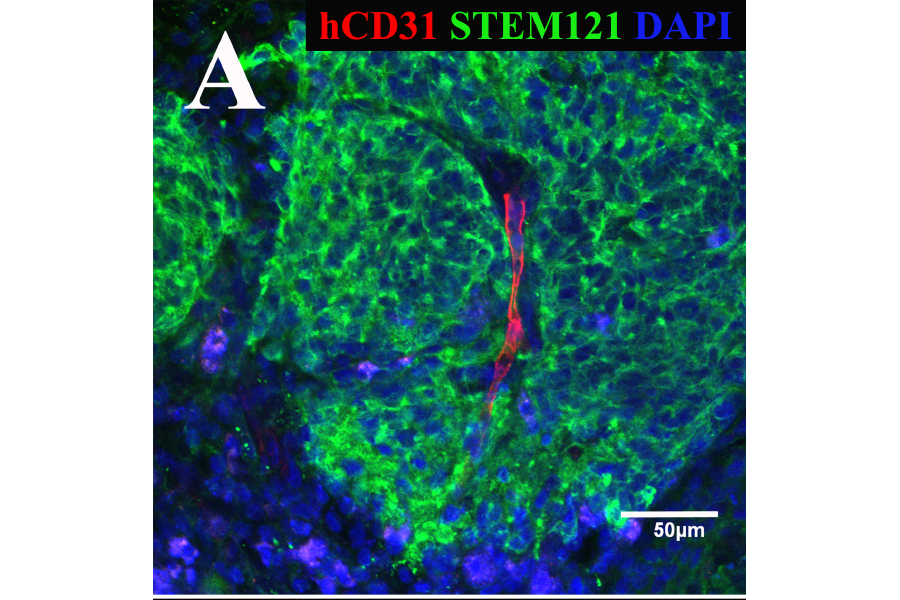
After coating the organoid with the endothelial cells, the endothelial cells immediately began to coalesce to form tubular structures and then capillaries. The cells grew separately for 34 days, 20 days with endothelial cells coating the whole-brain organoid, and finally two weeks surgically implanted in a mouse brain. The organoids were extracted on day 68 of the experiment and were shown, through fluorescent staining, to contain a protein known as CD31, which is only found in human blood vessels. Together, a vascularized whole-brain organoid was proved possible, created completely through the stem cells of one patient.

“But we haven’t shown these blood vessels are actually functional,” said Dr. Ben Waldau, an associate professor of clinical neurosurgery at UC Davis Medical Center and the project leader. “We haven’t shown that they have a functional blood brain barrier. We haven’t shown they are actually perfused with blood.”

Enabling blood to flow through a whole-brain organoid is the first of many steps needed to improve the model. With a steady blood supply, larger and more sophisticated organoids could possible be developed, allowing more complicated research and medical diagnostics to be practiced on brains in cell culture formats instead of live human patients.

“We are one of the first groups to show organoids can be vascularized with blood vessels,” Waldau said. “It looks like they are still healthy and their structural organization does not seem to be disturbed. The most exciting thing about the paper is this may open an avenue in the future to study the blood brain barrier in an organoid, which is huge. There are so many diseases where the blood brain barrier is disturbed and pharmacological testing would be important.”


Written by: George Ugartemendia — science@theaggie.org


Women’s tennis dismantles Sonoma State

MACLEAN HARTFORD / AGGIE

Aggies confident for upcoming Big West Championship tournament

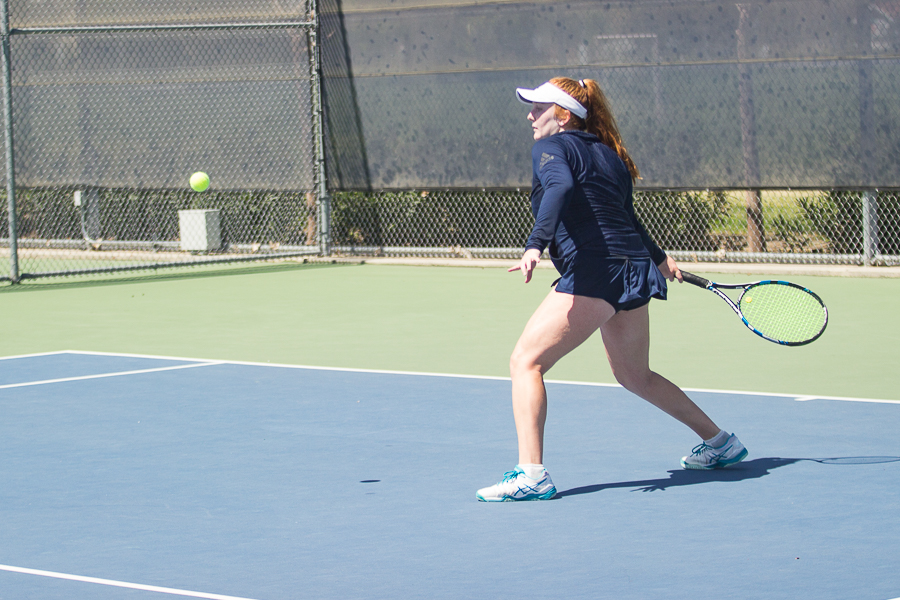
UC Davis women’s tennis steamrolled Sonoma State 7-0 at Marya Welch Tennis Center on April 14, the first match in a two-match weekend. This decisive win followed a 5-2 loss to San Jose State one week before on April 7 in which UC Davis was not at full strength due to injuries.

“It’s nice to get back in the winning column,” said head coach Bill Maze. “We feel like we are back now, we’re excited, we feel like this was a great match to get us ready for a big one at Long Beach State.”

The women started by winning all three doubles matches to grab the doubles point without much pushback from Sonoma State.

With momentum, the Aggies continued with the same energy into singles play without losing a single set to the Seawolves.

The official win for UC Davis was secured by junior Isabelle Von Ebbe’s nearly perfect performance, 6-0, 6-1. However, both teams agreed to play out the remainder of the matches. In total, the women only lost three games in singles play before locking in the win.

In the number one spot, senior Kristy Jorgensen got off to a quick start in the first set. After both players won a game a piece, Sonoma State’s Christina Colling lost two consecutive points, and then double faulted her way to 40-love. After a short rally, Jorgenson stepped into the court and stung a backhand down the line to break Colling’s serve, making it 2-1.

Jorgensen proceeded to secure the set with a forceful inside-out forehand, taking advantage of Colling’s second serve on a break-point to take the set 6-3.  

The second set was smooth sailing for Jorgensen, securing it 6-1.

“This win will help us out at [Long Beach], which will help us at Indian Wells,” Jorgensen said.

For the sophomore in the number two spot, Kristina Breisacher, the match was not as seamless. After exchanging top-spin heavy balls with her opponent, Jenna DeTurk, this match turned out to produce longer and safer rallies and was the longest match of the day. Each player waited for the other to commit the error rather than pushing forward to cut off the court to their opponent.

“Her opponent was playing pretty darn well,” Maze said. “Kristina wasn’t hitting the ball as well as she can.”

The tide turned at 5-5 in her first set when DeTurk lost two consecutive points on her serve and then double faulted to make it love-40 in favor of Breisacher. Breisacher broke her opponent’s serve to make it 6-5.

Breisacher’s first set did not come easily — DeTurk was on the verge on answering back and rallied to make the score 15-40 in favor of Sonoma State. Breisacher’s determination was apparent as she focused and carefully placed her shots, rallying her way to deuce.

On deuce, Breisacher and DeTurk traded heavy shots, each player waiting for the other to commit an error. Breisacher was a little quicker getting to the ball and DeTurk eventually missed wide on the backhand side, giving the set to UC Davis, 7-5.

This long set appeared to have broken DeTurk’s focus, and Breisacher easily won the next three games, and eventually the set, 6-2.

“I knew that Kristina would come through because she never says die,” Maze said.

Maze and the Aggies are excited for the rest of their regular season, and are staying focused for their remaining games.

“We also have a couple tough matches next weekend, it’s kind of nice to keep grinding away before the tournament so we don’t get into a lull,” said senior Lani-Rae Green. “We’re definitely working at it every single day. So we’re excited.”

In the Big West, UC Davis is currently number one at 6-2. UC Davis’ women’s tennis program has never won a championship, and for the past two years, UC Santa Barbara has won the year-ending tournament.

The women will travel to Reno to face University of Nevada, Reno on April 20 before coming back to face Sacramento State for their last home game. That will cap off regular season play, and the women will head into the Big West Conference championship tournament at Indian Wells starting April 26.

This year the team thinks they are in a good position to take a Big West title.

“We’ve had some good teams in the past years, but this is definitely the best team we played on, our best chance to win the conference at Indian Wells,” Jorgensen said. “We couldn’t be any more excited or amped up, we’re ready to go.”


Written by: Bobby John — sports@theaggie.org