53.5 F
Davis

Davis, California

Tuesday, December 23, 2025
Home Blog Page 592

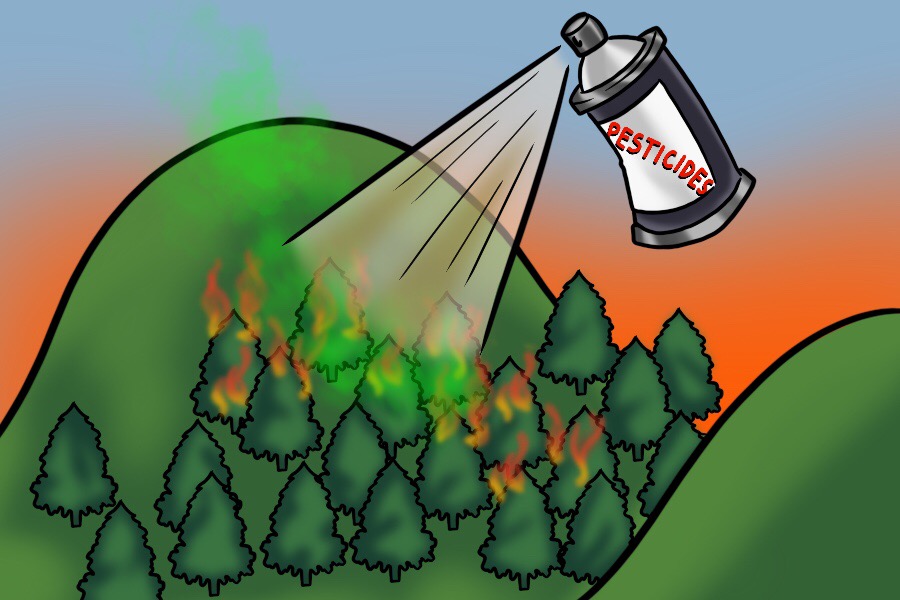
Pesticides and fire suppression chemicals in California wildfires

CAITLYN SAMPLEY / AGGIE

More toxicological and epidemiological studies are needed to understand human health risks

A review crafted by UC Davis graduate students reveals that research gaps remain in the science of human health toxicity of California wildfire smoke mixed with pesticides and fire suppression chemicals.

Millions of pounds of pesticides are applied to agricultural regions, especially in the Central Valley, to foster plant growth and combat pests. Firefighters use millions of gallons of fire suppression chemicals, such as gels and foams, to snuff out fires which threaten residential structures. Such chemicals can be broken down by the heat of wildfires and inhaled by humans living near urban interfaces, places where wilderness and urban areas meet.

“The literature out there on what these chemicals can do is very limited, especially these unique exposure situations,” said Michelle Kossack, a Ph.D. candidate in pharmacology and toxicology at UC Davis and one of the first authors of the paper. “You might be studying the effects of this chemical through direct exposure, but what happens when that chemical is transformed through heat of a wildfire?”

Wildfire smoke is known to cause health problems in eyes and airways exposed to the acrid air. Less is known about how burned pesticides and fire suppression chemicals can affect humans, animals, and the environment. When fires burn through agricultural areas, such as during the Napa, Sonoma and Solano County fires of October 2017, pesticides and fungicides can be involved in combustion.

“We wanted to learn more about wildfires and wildfire smoke because it’s a big problem in California,” said Cameron Flayer, a Ph.D. candidate in pharmacology and toxicology at UC Davis and another of the paper’s authors. “We have mega wildfires now, where a ton of smoke is polluting the atmosphere, and then we’re breathing it in. We were curious about the constituents of the smoke.”

The major components of wildfire smoke are particulate matter, which are the charred remains of trees and brush, and chemicals such as ozone and carbon dioxide. Although burned pesticides and fire suppression chemicals serve as minor components, they could pose serious health effects of their own to humans and animals.

“The particulate matter does cause a threat, but how is that compounded by other chemicals in the mixture?” Kossack said. “It’s no longer a virgin forest burning. Many of these forests have pesticides applied to them. Even national forests do it to control invasive populations of species.”

Toxicological and epidemiological studies often compare how individual substances can be harmful when exposed to animal models, often mice and rats. One of the research gaps identified in the review is the abundance of new chemicals created in the heat of a blaze, often structurally different from the parent compound they are derived from, which have not been extensively studied.

“It’s important to start looking at larger trends and patterns — classes of chemicals and groups of chemicals that can interact with each other,” said Sarah Carratt, a postdoctoral scholar at Oregon Health and Science University and one of the authors of the paper. Carratt previously worked as a Ph.D. candidate in pharmacology and toxicology at UC Davis before graduating in September 2017. “Even a few pilot studies to get a good idea of what we’re looking at in specific regions. If somebody were to look at emissions from the Napa Valley fires that are ongoing right now, they’d be able to figure out what’s in the air when these regions where they are growing agricultural crops burn.”

When researchers study smoke exposure and its health impacts, the tendency is to lump distinct types of wildfires together for simplicity and control, but forests burning in Yosemite National Park may have different chemical smoke mixtures than fires burning in the Central Valley or near Los Angeles.

“We were just trying to bring to light the fact that, when wildfires burn pesticide-treated land, or when we use these suppression chemicals to fight back against wildfires, there may be consequences for human health,” Flayer said.

One of the research gaps present is a lack of smoke mixtures to compare against one another. Collecting smoke from different sites can be a challenge to scientists in the field.

“We need a state agency or academic researchers who can respond to situations like the current wildfires here in Napa, Sonoma, and Mendocino Counties by setting up sampling equipment during the fire episodes with this specific goal in mind,” said Jerold Last, a distinguished professor in pulmonary, critical care and sleep medicine at UC Davis and the senior author of the paper.

As pesticides and fire suppression chemicals burn, the chemicals can break down into different compounds and structures, which may not be properly regulated by state and federal agencies.

“We really need to understand what the derivatives are of the parent compound and if they are found in the smoke, because all the regulations are just for the parent compound and not for any of the derivatives,” Flayer said.

The heat from wildfires can warp parent compounds of pesticides and fire suppression chemicals into new forms. While some remain close to the ground or soil, others can volatilize into the air and travel far from the flames.

“Once you have a very basic structure, and you expose it to heat, lots of things can adapt on to it,” Kossack said. “It can change very minorly, but that can have a huge effect on toxicity. One chemical can become hundreds. It is almost impossible to do all of these studies on each individual compound.”

Pesticides and fire suppression chemicals are not the only mixture public health officials need to be concerned about. Hundreds of structures have been incinerated by the North Bay fires in October 2017, creating smoke from construction materials which can be inhaled by fleeing residents, rescue workers and firefighters.

“It’s all the buildings that are burning, too,” Carratt said. “Think about all the chemicals that are added into the buildings. It’s not just fire suppression chemicals in terms of what they’re using to put out the fires. But most furniture and buildings have some kind of built-in fire retardant. Those burn as well, and those are other chemicals that you don’t think of being released into the atmosphere. But those things have the potential to transform when they are burned, as well.”

Studies considering not only multiple types of chemical mixtures but different routes of exposures can be challenging and expensive for researchers, but that could be one of the next steps to better understand more of the possible health effects of wildfire smoke.

“We would love to see other studies do more complex, more real-life relevant exposures, including what happens when pesticides burn or other chemicals,” Carratt said.

Firefighters battling the flames are the most vulnerable to harmful fumes. Migrant farmers who gather crops and tend to the land may also be vulnerable if they remain outside during smoky days. Children, the elderly, the immunocompromised, and those with existing respiratory challenges may also suffer disproportionately from effects of wildfire smoke.

“During wildfires, when the fire is burning, and it’s a high smoke day, where there’s a lot of particulate matter or ozone, EPA already recommends that you don’t go outside and participate in physical activity,” Flayer said.

While fires can occur in many places around the U.S., California faces unique challenges in managing the flames.

“Most of the western states have wildfires and relatively large usage of pesticides and fire suppression chemicals in agriculture and forest maintenance,” Last said. “What makes California unique is the size and scale of California agriculture and the proximity of wildfires in rural areas to large population centers — what we call the urban-rural interface. Think about the impact of fires in rural forests and brushy areas in Napa and Sonoma where large numbers of people live and farm grapes and other crops nearby.”

Wildfire smoke causes known health effects in humans, animals and the environment, but the flames can also introduce pesticide and fire suppression chemicals into the air far from their sources. More data is being collected to better understand the health impacts of these smoke constituents, since current evidence is lacking. Better study designs, improved collection techniques, and renewed funding streams can help protect some of the vulnerable populations in California.

“I think people are really interested in public health, especially in California, where everyone is very aware of how much smoke is in the air,” Kossack said.


Written by: George Ugartemendia — science@theaggie.org

UC Davis extends aid to wildfire victims

HANNAH LEE / AGGIE

Aggies prove that help comes in many forms

While the wildfires that caused 42 deaths and displaced thousands of Napa and Sonoma County residents are almost at complete containment, the physical and emotional losses remain. Those affected by the wildfires ravaging Northern California are faced with displacement and lost belongings. Some are also grappling with the devastating loss of their pets — the beloved animals they couldn’t save in the short time they were given to evacuate.

Among such harrowing tales of death and loss, the UC Davis School of Veterinary Medicine has been a ray of hope for Napa and Sonoma County residents with lost or injured pets. Davis’ Veterinary Emergency Response Team was deployed to the Sonoma County Fairgrounds, a central evacuation shelter in Santa Rosa, to treat animals with smoke and burn injuries. Many rescued animals still reside in the veterinary hospital and, as of Oct. 19, the hospital has treated one dog, two llamas, 10 horses, 19 cats and 33 koi fish. Hospital personnel are using social media in hopes of identifying the owners of these rescued animals.

But the UC Davis School of Veterinary Medicine isn’t the only campus organization to alleviate the suffering of Tubbs and Atlas fire victims. Six campus firefighters were deployed to Napa and Butte county fires with UC Davis’ wildland fire truck. The university’s Bodega Bay Marine Lab provided temporary housing for 31 people and has since partnered with Redwood Credit Union to offer a means of donating that guarantees 100 percent of proceeds reach fire victims directly. The UC Davis Campus Store has also initiated the “Aggies Helping Students” campaign, in which the proceeds of any donation amount are split 50-50 between wildfire and hurricane relief.

The outpouring of support from the Davis community has been incredible in both size and scope, and the Editorial Board commends fellow Aggies for initiating change in a time of such dire need. Even amid the university’s admirable provision of resources and campaigns, many students were proactive in finding ways to help.

UC Davis students proved that providing aid need not be formal or even monetary. Whether that includes the bucket inside the Memorial Union that reads “donation for fire victims” or the email sent by administration outlining the resources available to those affected — UC Davis faculty and students proved that help takes many forms.

We encourage fellow Aggies to continue such magnanimity, thoughtfulness and direct action. For those still unsure of how to help, we encourage students to reach out to those affected by the wildfires and, at the least, lend a listening ear.


Donations can be made to the following Davis-based organizations:

School of Veterinary Medicine’s Veterinary Catastrophic Need Fund

Bodega Bay Marine Lab’s partnership with Redwood Credit Union

Make a direct donation at the UC Davis Campus Store to donate to the “Aggies Helping Students” campaign.


Written By: The Editorial Board

Know your LGBTQIA resources

HANNAH LEE / AGGIE

LGBTQIA Resource Center establishes inclusive environment

National LGBT Center Awareness Day, held every year on Oct. 19, serves to commemorate the tireless work put in by community centers across the globe to secure a safer, more inclusive environment for lesbian, gay, bisexual, transgender, queer, intersex and asexual (LGBTQIA) individuals. On this day, the Editorial Board would like to recognize UC Davis’ LGBTQIA Resource Center for challenging widespread, systemic discrimination and bridging a diversity of identities and backgrounds to create unity and acceptance within the Davis community.

Our Resource Center actively strives to educate others about LGBTQIA identities by offering training on how to be an effective ally and championing an expansive, educational library with over 1,000 books. The staff is also dedicated to reaching out to high schools in Davis to broaden understanding, as well as creating visibility for lesser-known identities through programs like Intersex Awareness Week and Asexual Awareness Week. Progress is contingent on education and awareness, and we applaud the Center for taking these extra steps to establish a more equal environment for all people, regardless of their sexual or gender identities.

The LGBTQIA Resource Center is also committed to strengthening the mental, emotional and physical well-being of the community. A few of the resources offered include access to crisis hotlines and a community counselor, a wide range of support groups and free, anonymous HIV testing. These resources help people not only receive guidance from professionals, but also foster strong friendships and support systems within the community. By simply providing a physical space for LGBTQIA individuals to assemble and discuss their struggles, accomplishments and interests, the Center encourages and fortifies self-exploration in a place where students can feel safe, welcome and celebrated.

But the Resource Center does work beyond fostering self-acceptance and love. Most important to enacting true, lasting change, it’s also willing to engage in difficult conversations around how LGBTQIA identities intersect with other factors, such as race, socioeconomic status and religious or spiritual beliefs. This mission yields rich discussion and collaboration with other community centers at UC Davis, such as the AB540 and Undocumented Student Center, the Women’s Resources and Research Center and the Cross Cultural Center. As many of these identities are increasingly targeted by the current presidential administration, these partnerships ensure that each oppressed group stands strong in unity and solidarity with one another. The Editorial Board is proud to have such an active resource on campus that tackles multiple forms of oppression.

These three areas of concentration — education, communal support and intersectional discussion — come together to establish a foundation for LGBTQIA issues, both within the community and beyond.

The Editorial Board encourages students and other community members to get involved and utilize the vital resources available at the Center. Located on the first floor of the Student Community Center, the LGBTQIA Resource Center is open on Mondays from 10:00 a.m. to 4:30 p.m., Tuesdays and Thursdays from 10:00 a.m. to 6:00 p.m. and Fridays from 10:00 a.m. to 5:00 p.m.


Written By: The Editorial Board

Lessons from a killer clown: What “It” can teach the horror genre

JAMIE CHEN / AGGIE

“It” uses empathy and characterization to heighten the scare

Editor’s Note: This article contains spoilers for the film “It.”

Horror as entertainment is popular today. “It” recently debuted in theaters and proved just that. Masses flocked to theaters, helping the film gross over $100 million in its first weekend.

Where was the appeal of this movie? What made it different from other horror movies? What made it gross the most out of any horror movie in its opening weekend?

The movie made its money off its characters’ backs. And by “characters” I don’t mean the child-eating clown named Pennywise, but rather the cast of children, who were a unique aspect of “It” and a leading reason for its success.

The reason the Losers’ Club, as the kids are dubbed in the film, landed such success was its ability to traverse the large pitfall of horror movie casts: bad and stupid protagonists. Stupidity plagues modern horror films. In the 2013 remake of 1981’s “The Evil Dead,” one of the characters, Eric, finds himself in the basement of their strange eerie cabin in the woods. In the basement, Eric finds a book. To his surprise, he finds the book to be made of dried skin. Unnerved by the Frankenstein-like patchwork, the character opens the book and finds pages of pentagrams and scribbles about demons. On the pages, written in what could be blood, are the words, “Don’t say it, Don’t write it, Don’t hear it!” Eric, being the fool he is, reads the devilish words aloud, and in doing so releases a demon that kills a huge chunk of the cast.

Why did Eric do this? Wouldn’t a normal person be perturbed by the serious warnings scrawled on the pages? So why isn’t Eric disturbed? Because Eric is not a person; he’s a character — and a bad character at that.

The best characters evoke empathy, and the more the audience can relate to a character, the more popular that character will be. There is nothing relatable about Eric because few people are thick enough to peel back the pages of a human-skin-bound book and read aloud the explicitly marked demonic phrases. So, when Eric died, I didn’t care. I felt no empathy toward him. I connected with him on no level. When he was in danger, the outcome had no effect on the audience.

“It” does exactly the opposite: it presents likeable, non-idiotic characters. “It” allows for empathy. Ben Hanscom, one of the main characters in “It,” opens one of the film’s scenes by clumsily talking to the girl he has a crush on. That is a relatable aspect of Ben’s character. Many people have tripped up on their words when talking to their crush; it’s an incredibly human thing to do. Scenes like this, which involve small, but real, human interactions, fill the first half of the movie. Those scenes exist for one reason: empathy. The more empathy there is for a character, the more that character will be missed if lost.

Empathy for characters is the best thing a horror movie like “It” can do. Unlike Eric from “Evil Dead,” I cared when Ben Hanscom got gored up. I cared because the character Ben rang true to me as person. He did things a normal person would do. He didn’t summon demons and play with skin-bound books; he tripped up on his words when talking to the girl he loved. I connected with him, thanks to the cleverly placed empathy.

The film’s success is not found in its horrifying graphic visuals, but instead resides in the small things — the little actions that make you relate to a character and see them as your friend. Then, when they’re in danger, you worry and fear about their outcome because you care about them.


Written by: Nicolas Rago — arts@theaggie.org

Police Logs

What the egg?

Oct. 5

“Two subjects seen with flashlights looking inside a parked vehicle.”

“Vehicle versus skateboarder.”


Oct. 6

“Open line, possible phone in pocket.”


Oct. 7

“Loud chanting.”


Oct. 8

“Police department unit was in front of residence shining light on the roof, reporting party believes he heard someone on the roof.”


Oct. 9

“Enterprise moving truck struck reporting party’s vehicle and tore off the front bumper.”

“Loose dog without leash roaming the street, black/white, medium/large, similar to herding dog, appears friendly.”


Oct. 10

“Requested night extra patrol after resident was toilet papered and egged.”

“Suspicious suitcase outside business.”

“Several vehicles on street egged overnight.”


Humor: Awkward: CoHo to replace all coffee with La Croix

MEENA RUGH / AGGIE

Great content for your Insta feed

With each passing Fall Quarter, the CoHo seems to get more and more innovative. From taking mobile orders to offering açai bowls all day, this place practically had everything students could ever want. That is, until the CoHo remembered that what students really want is copious amounts of La Croix.

That’s right, you guessed it. The CoHo will be kicking off the school year by replacing all of its coffee with La Croix — and a lot of it. You might have a few questions. That’s natural.  

You might be thinking, “Isn’t coffee, like, the CoHo’s thing? Isn’t it named the Coffee House?”

The answer is, we’re not really sure. Sources can neither confirm nor deny these allegations, and with so much fake news out on the ‘net, there’s really no way to be certain.

Another great thought you might have: “Isn’t coffee a fall staple? Will my Instagram suffer?”

The answer to both questions is “probably,” but trends change, and there’s no reason that La Croix can’t be the centerpiece of your fall Insta feed.

As always, we anticipate the inevitable “Why is the CoHo replacing all of its coffee with La Croix?” question. Look, we’re just a newspaper, and we don’t have all the answers. If you wanted to hear a story from a valid news source, you could always listen to Fox. But if you want to open a can of La Croix with The Aggie this fall, you can come to the CoHo.


Written by: Lara Loptman — lrloptman@ucdavis.edu

(This article is humor and/or satire, and its content is purely fictional. The story and the names of “sources” are fictionalized.)

Guest: A Quiet Problem: Regulate bump stocks, not suppressors

Democrats should turn their attention away from the SHARE Act

In the wake of the Las Vegas massacre, we hear shouts and murmurs from both sides of the aisle. From the left: “We need gun regulations!” From the right: “This is not the time to talk about gun laws.” Amid all these cries, one issue in particular rose to the surface: the Sportsmen’s Heritage and Recreational Enhancement Act.

The SHARE Act does many things — chief among them, deregulating the use of suppressors, or “silencers.” Suppressors are legal to own in most of the 50 states, including Nevada. To buy one, a person must pay a special tax, fill out some official paperwork and submit fingerprints. The SHARE Act would eliminate many of these checkpoints needed to own a suppressor, making them “equal” with owning a gun. Democrats and interest groups across the country have turned their attention to this bill, urging the public to contact their local representatives to urge them to vote no.

This is the wrong solution.

A suppressor is “any device for silencing, muffling, or diminishing the report of a portable firearm.” Had Stephen Paddock, the Las Vegas gunman, owned a suppressor, the argument against suppressors goes, it would have made it more difficult for citizens and law enforcement to detect from where the gunfire was coming. While this is absolutely true, it’s irrelevant when you consider that Paddock obtained all of his guns and ammunition legally, and if he were so inclined, he could have purchased a suppressor as well. The same argument could be said of any mass shooting in recent history, indicating that suppressors are not the problem.

Specific provisions in the SHARE Act note that the purpose of deregulating suppressors is to protect the hearing of sportsmen, but suppressors are also helpful tools for home-defense weapons for the same reason. Imagine a scenario in which an armed burglar enters your home and you fire a shot. Unless you were so thoughtful as to put in earplugs first, you would no longer be able to hear where the perpetrator is coming from. Further, suppressors often aid accuracy by reducing the recoil of the gun. No, we don’t want this added bonus given to the likes of Stephen Paddock. But in the hands of law-abiding citizens, increased accuracy makes guns safer.

This begs the question then: If the SHARE Act isn’t the way to go, what can we do? The answer is to turn to “bump stocks.” Bump stocks are devices that can turn a gun into a rapid-fire weapon, shooting bullets at a rate comparable to a machine gun, and a device that Paddock took advantage of in Vegas. The National Rifle Association said in a recent statement that the federal bureau should revisit the issue posed by bump stocks and “immediately review whether these devices comply with federal law.”

“The NRA believes that devices designed to allow semi-automatic rifles to function like fully-automatic rifles should be subject to additional regulations,” the NRA said. One important thing to note in this statement is that the group is calling for regulations, not a ban. This is where Democrats need to push.

Famously, the Centers for Disease Control and Prevention has been blocked from conducting research that so much as peeks into gun violence. Republicans have, quite literally, stuck to their guns and stated over and over that gun violence cannot be regulated, that you “can’t regulate evil.” This has lead to Democrats pushing through every type of gun regulation politically feasible, regardless of whether or not such regulations actually make guns safer. This trend needs to end. Voting no on the SHARE Act is snatching the low-hanging fruit on the tree that is gun control and only plays into NRA rhetoric about regulation-happy Democrats. The NRA has already bent on the issue on bump stocks, so Democrats should turn their attention there as well to go for something both politically feasible and worthwhile. Michelle Obama said “When they go low, we go high” — and focusing on the correct issues despite party politics is exactly how we can do that.


Written by: Raelyn Torngren

Disclaimer: The views and opinions expressed by individual columnists belong to the columnists alone and do not necessarily indicate the views and opinions held by The California Aggie.

Humor: Archaeology professor introduces students to “The Bone Zone”

MARTIN MONROE [(CC BY-SA 2.0)] / FLICKR
The most interactive space to satisfy your boning needs

Professor Hume believed in creating a space where students could learn about dead animals while also having a lot of fun. A pet morgue? A museum? My backyard, full of the bodies of the cats and dogs I’ve had that all tragically died young? None of these things! Hume created an interactive space called “The Bone Zone.”

You’re probably thinking, “What?” — you lack creativity and humor. “Why would a serious professor create a space like this… and name it that?” What do you mean, name it that? You got a problem with the name? Well you can go  ahead and click the exit button, buddy, because I don’t have time for haters.

Oh right, I could see how that could be misconstrued. Well, you nasty weirdo, “The Bone Zone” is a wholesome space of fun and science, and we don’t need you and your sexual innuendos anywhere near it.

Anyway, “The Bone Zone” is a great place to go look at the bones of animals who existed long ago and whose very existence is likely fabricated by the publishing academic industrial complex that seeks to expand and absorb all world governments until we are under the rule of a massive corporate Machiavellian Leviathan that will require you to buy something every time you want to poop.

“The Bone Zone” opens on Oct. 31 — just in time for Halloween!


Written by: Aaron Levins — adlevins@ucdavis.edu

(This article is humor and/or satire, and its content is purely fictional. The story and the names of “sources” are fictionalized.)

Philz lovers rejoice

KENNEJIMA [(CC BY 2.0)] / FLICKR
Philz Coffee to arrive in Davis in January

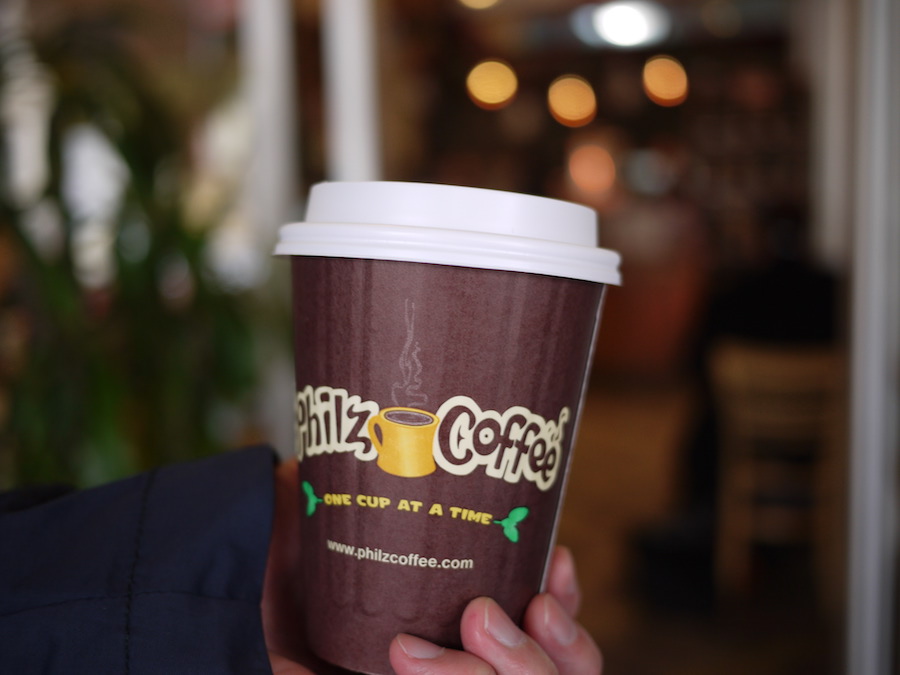
For those who have heard only whispers of the big news, let it be known that the rumor is true: Philz Coffee will officially arrive in Davis this coming January at the corner of Second and E streets.

Any coffee lovers who have yet to experience a Philz Coffee blend may be perplexed by the hype around this Bay Area-based company. To elucidate the reasoning behind this coffee frenzy, it should be noted that this once-small San Francisco coffee shop is now a rapidly expanding company with 41 locations across California and in Washington, D.C.

Over the past 25 years, Philz Coffee has become known for its highly customizable orders and superior coffee blends. Phil Jaber, the original owner of the San Francisco coffee shop, designed a coffee station that would allow his coffee to be made one cup at a time. This means that each “cup of love” is individualized for the customer and is made without pre-brew. Additionally, Philz offers over 20 blends sourced from international coffee growers. Some of the fan-favorite orders include the Philtered Soul, a hot medium blend; and the Mint Mojito, the Instagram-fave iced coffee.

Philz fans often testify that this coffee company is one of the best. Karen Chang, a fourth-year cell biology major and frequenter of the Philz Bay Area locations, is looking forward to enjoying a cup of Philz at the new Davis shop.

“The quality of the coffee is so much better than other chain coffee stores,” Chang said. “And the Philz vibe is really chill. I feel like it’s geared towards young adults and people my age. I love going there.”

Chang’s sentiment toward Philz Coffee’s ambiance echoes the intentions of the Philz Coffee team. Jaber hopes to make the Davis location a “perfect, central place for Davis students to study.” The large shop will house comfy seating, large tables, outlets and wifi, allowing for a simultaneously studious and social environment. Recognizing the ubiquitous bike culture in Davis, the company also plans to make the new shop as bike-friendly as possible.

Jolie Meschi, the store marketing director at Philz Coffee, expressed in a statement that, despite recent delays in construction, the company is “still really excited about the new location.” According to Meschi, “Phil Jaber picked out the location himself, seriously.”

Although the mention of a Philz opening in Davis may provoke raised eyebrows and wide eyes from many conditioned Philz lovers, the company’s success in Davis may depend upon the coffee fanatics who are already loyal to other local coffee shops. Philz Coffee will soon join the ranks of nearby Mishka’s, Peet’s, Starbucks, Temple Coffee Roasters and Cloud Forest Cafe, among many others.


Written by: Eliana Sisneros — city@theaggie.org

Local Music Venues in Davis

JEREMY DANG / AGGIE

A look into your go-to music events

A common misconception is that Davis is deprived of excitement. Students run out of things to do, and the town becomes too familiar. On the contrary, Davis is actually full of fun activities, which are particularly lively during the weekends. There’s never a boring moment if you dig deep.


Armadillo Music

The local record store provides live music across various genres and locations. Local bands and even bands from the Bay Area come to play at the store. Manager Paul Wilbur announces the events as they come, but it’s always a surprise.

“The events are usually on Thursday, Friday or Saturday nights, but they’re random. We don’t have regular, set events,” Wilbur said. “Being […] a music store in Davis, it’s super important to us that we have a music community — and a vibrant one. We had the Summer Cannibals play here, and they’re a band that got a lot of attention nationally. The bass player for that band is actually from Davis, and I think it would be cool to have her come back to play.”


Sudwerk Brewery

The brewery is well known for its Dock, where they host fundraisers, comedy shows, live music and anything that can support its community and interests. Sudwerk provides beer brewed in right here in California and a welcoming, cozy space for people to enjoy each other’s company.


John Natsoulas

The John Natsoulas Gallery in Davis is more than just an art gallery: it strives to explore art across different spectrums, whether it’s through poetry, painting or even music. The gallery hosts events that are collaborative with some great poets and jazz musicians, including artists in the community.

“We’re mainly a jazz venue, and we have been for 31 years,” Natsoulas said. “The history of the gallery is all about collaboration with great poets and musicians. We’re all about multimedia art. We really have a lyrical vision and [are] interested in spoken work and music with that.”


Woodstock’s Pizza

Everyone’s beloved pizza restaurant in downtown Davis actually hosts a variety of social events throughout the week. Woodstock’s hosts live music events every Saturday at 10 p.m., providing artists a space to perform, and allows people to have fun with friends and family.


Sophia’s Thai Kitchen

This thai restaurant is a favorite for nights out with friends. The restaurant/bar provides live shows seasonally, with their last event for the fall happening on Oct. 28. Shows will resume again in April.

Manager Kevin Wan brings touring bands to the venue for community members, continuing Davis’ long tradition of DIY house shows.

“We’ve been doing live music here for about 12 years, and we’re happy to bring it to Davis. Sometimes it’s a matter of just getting the word out,” Wan said. “With the increase in social media, we’re so used to discovering music via Spotify and algorithms, so I think the art of spreading music through word-of-mouth has dwindled.”


Written by: Becky Lee arts@theaggie.org

Associate Vice Chancellor Milton Lang resigns

MILTON LANG / COURTESY

Lang will move to California State University, Chico

UC Davis Associate Vice Chancellor Milton Lang has officially announced his resignation from the university staff.

“I informed the vice chancellor for student affairs last week that I would be accepting the vice president for student affairs position at California State University Chico,” Lang said.

Lang has been a member of the UC Davis community for over four years as associate vice chancellor for student life, campus community and retention services. He will be remembered most notably for his promotion of increased support for student community programs, creation of the First Year Aggie Connections Program and improvement of the Student Academic Success Center (SASC) services.

“Many of our students from various communities — African American, Chicano, Latino, Native American — didn’t feel […] a sense of community, a sense of belonging, a sense of empowerment to take full advantage of their higher education experience here at UC Davis,” Lang said. “So we created the Retention Centers: the African Diaspora Center, the Chicanx and Latinx Student Center and the Native American Student Center. To see that come to fruition and to see those centers […] packed with students […] who really appreciate that we’ve provided a place where they can again take full advantage of their educational environment and experience has been another highlight of mine.”

As an associate vice chancellor, Lang worked closely with the ASUCD student body, including with current ASUCD President Josh Dalavai and Vice President Adilla Jamaludin. Dalavai recalled his fondest memories of working with Lang during his time here.

“The conversations and work that we did surrounding Unitrans […] and seeking funding sources to stabilize their budget, I’d say, was our best moment,” Dalavai said. “[It] was a half a year process for us and we had to consult with a lot of different campus stakeholders. It was a long series of meetings [that] finally led up to a meeting with the chancellor, and all our prep was definitely worth it because we had a really productive meeting at that point.”
Though the pair had disagreements, Dalavai stated that Lang “holds no grudges,” remained professional throughout and allowed him to voice “concerns and hear them out.”

“No matter what, [he’d] make time for you,” Dalavai said. “He’s very accommodating with his time, and I really appreciate that. I’ll miss that a lot […] and I wish him the best.”

Lang described his new position at CSU Chico, his own alma mater, as “an opportunity to [not only] reach my goal […] of being a vice president, but also an opportunity to work […] and give back […] at an institution that has done so much for me.”

The position of interim associate vice chancellor will be determined by Vice Chancellor Adela de la Torre, who oversees UC Davis’ Division of Student Affairs.

“I’m putting together a succession plan for Vice Chancellor Adela de la Torre and she’s going to review that succession plan and then she will be making the decisions of how we move forward,” Lang said. “It is her ultimate goal to have somebody […] in this position by July, but her goal is to do a national search and […] let that help guide us to get three or four candidates on campus and interview them.”

Lang reminisced about his time spent at the university and spoke about what his experience has provided him.

“Davis has some very talented students — students who really care, not only about their academic achievements, but [also] about societal issues,” Lang said. “They’re very socially conscious and they really think about the role that their voice plays in enhancing and improving society as a whole. I will miss the passion that students bring to that.  I will never forget what UC Davis has given me, and that is an opportunity to work at a world-class institution with great faculty, staff and students.”


Written by: Priyanka Shreedar — campus@theaggie.org

Go-to guide for navigating Davis bar scene

NICOLE WASHINGTON / AGGIE FILE

Davis Bars offer special events, deals

If you just turned 21 or have no idea what’s going on in the Davis bar scene, fret no more. Here’s a guide for exactly what’s going on each night of the week, so that there’s no more wandering around town completely clueless.


Monday nights:

De Vere’s Irish Pub has trivia night every Monday from 7 to 9 p.m. Since it is also a restaurant, all ages are allowed. There are 30 questions on a variety of topics, so it’s recommended to come with friends who have a well-rounded knowledge of pop culture, science, history, current events and more. Happy hour goes until 7 p.m. on trivia nights. De Vere’s is located at 217 E St.

G Street Wunderbar also has a trivia night on Mondays from 9 to 11 p.m. However, it is 21+ and has a one-drink minimum. The Wunderbar is located at 228 G St.


Tuesday nights:

Sophia’s Thai Kitchen has one of the hardest trivia nights in Davis. This weekly 21+ event is from 9:30 to 11:30 p.m. and also has a one-drink minimum. However, most people say this is the best trivia night out of all of them and highly suggest going. Sophia’s is located at 129 E St., Suite E.

At G Street Wunderbar, there is open mic night on Tuesday nights from 9:30 p.m. to closing, according to its website. There is no charge for entry.

Tuesday, as of now, is better known as “Taco Tuesday.” In Davis, El Toro Bravo has one of the best deals. You can find most college students there enjoying the $1.50 tacos and pitchers of margaritas and beer.


Wednesday nights:

Red 88, located across the street from G Street Wunderbar, offers its drink special, the FML, for only $6. This combination is a great pregame to Funk Night.

Funk Night at G Street Wunderbar is the place to be on Wednesdays. At 11 p.m., you’re bound to run into some familiar faces.

If you are looking for a low-key night, there is open mic night at Sophia’s Thai Kitchen on Wednesdays from 8 to 11:30 p.m. De Vere’s also hosts Whiskey Wednesdays, when all whiskeys are half-price from 7 p.m. until closing.

At the University of Beer, there is trivia night on Wednesdays starting at 8 p.m. with a two-drink minimum. Each week there is a different theme that the bar announces on their Facebook page before the event.


Thursday nights:

Despite Thursdays being a popular night among UC Davis students for going out, there are not many deals or special events. However, there is Mojito Night at Bistro 33, which offers pitchers for $12.

If you’re dying for another trivia night, Woodstock’s offers yet again another opportunity. The all-ages event is held from 9 to 11 p.m. and conveniently located downtown.


Friday nights:

Froggy’s also hosts a karaoke night. Make sure to get there early, because it gets packed fast! Froggy’s is located at 726 2nd St.

G Street is typically busy on Fridays, so it makes for a fun night of dancing and drinking.


Written By: CaraJoy Kleinrock — arts@theaggie.org

Delving into the “diet soda effect” of buying a fuel-efficient vehicle

JAMIE CHEN / AGGIE

Households with a fuel-efficient vehicle often buy a more powerful second vehicle as well

If you thought that having a fuel-efficient vehicle is all it takes to make someone a trooper against the great climate change battle, you may want to reconsider that widely-held belief.

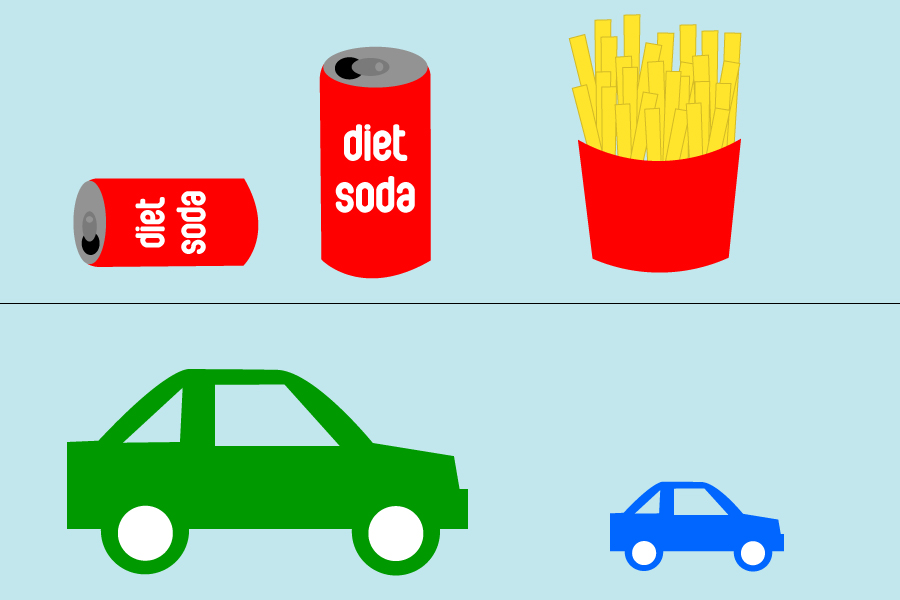
A recently published paper shows that buying a fuel-efficient car may not necessarily categorize a household as energy-efficient. The research shows that households that buy a fuel-efficient car also tend to buy a second car that’s more powerful, potentially negating most of the environmental benefits that come from having a fuel-efficient vehicle. Known as the “diet soda effect,” this is analogous to buying a diet soda with a helping of fries.

“If you think about putting households into a 10 percent more fuel-efficient vehicle today, if they don’t change any of their behavior, that’s going to reduce the amount of gasoline that household consumes by 10 percent because they’re not doing anything else,” said David Rapson, a UC Davis professor in the Department of Economics.” But we showed two margins on which they are going to adjust their behavior. They’re going to drive more but they’re also going to buy a more gas-guzzling car next.”

When you add up these effects, 6 percent of the 10 percent saved could disappear. But if eliminating large cars isn’t feasible, James Archsmith, a Ph.D. candidate in economics at UC Davis, suggests other methods of reducing greenhouse gases.

“If that is the goal, then putting a price on GHGs, either through a carbon tax or a cap-and-trade, is a much better way to achieve that reduction,” Archsmith said. “A price will nudge households to buy more fuel-efficient vehicles without the substitution effect we find in our analyses.”

But using an electric car can still reap huge rewards for those considering investing in one.

“In a highly polluted zone, there may be exceptionally high benefit from eliminating certain kinds of tailpipe emissions […] and usually when we think about electric vehicles, we typically think about climate change and its impact […] There’s no question that in some places, electric vehicles have enormous benefits and those benefits might have nothing to do with climate change,” said Alissa Kendall, an associate professor in the UC Davis Department of Civil and Environmental Engineering.

With the push for environmentally-friendly technology, it can complicate matters to focus on aspects where the technology may or may not be providing benefits. This further highlights the idea that research that tackles the various angles and social side effects of new technology should be regularly conducted after entering the world of consumerism.  Fuel-efficient vehicles are no exception. To use or not to use electric cars? Unfortunately, there’s no easy answer.


Written by: Kriti Varghese — science@theaggie.org

Interfaith event on Oct. 22 met with protest outside Islamic Center

BRIAN LANDRY / AGGIE

Local group Davis United Against Hate called for removal of Imam Ammar Shahin

Community members who attended the Oct. 22 event “Walking Our Faith and Sharing a Meal,” an interfaith potluck and walk, were met with protesters when they arrived at the Islamic Center of Davis. The event began at Congregation Bet Haverim, where Rabbi Greg Wolfe presented; participants then walked together to the Islamic Center of Davis to hear a presentation by Imam Ammar Shahin. The group Davis United Against Hate had pre-planned to assemble in front of the Center to protest for the removal of Shahin.

Shahin’s sermon in July of 2017 sparked outrage in the community and was covered nationally. Although Shahin claimed that part of his sermon was mistranslated, he says in English during the speech that “the time will come, the last hour will not take place until the Muslims fight the Jews.” Shahin has since apologized.

“To the Jewish community here in Davis and beyond, I say this deeply, I am deeply sorry for the pain I have caused,” Shahin said at a joint press conference in late July. “I let my emotions get the best of me and cloud my better judgement.”

Amr Zedan, the president of the Islamic Center of Davis, told The Aggie on Oct. 22 that the Imam’s sermon is “not a statement that we endorse here.”

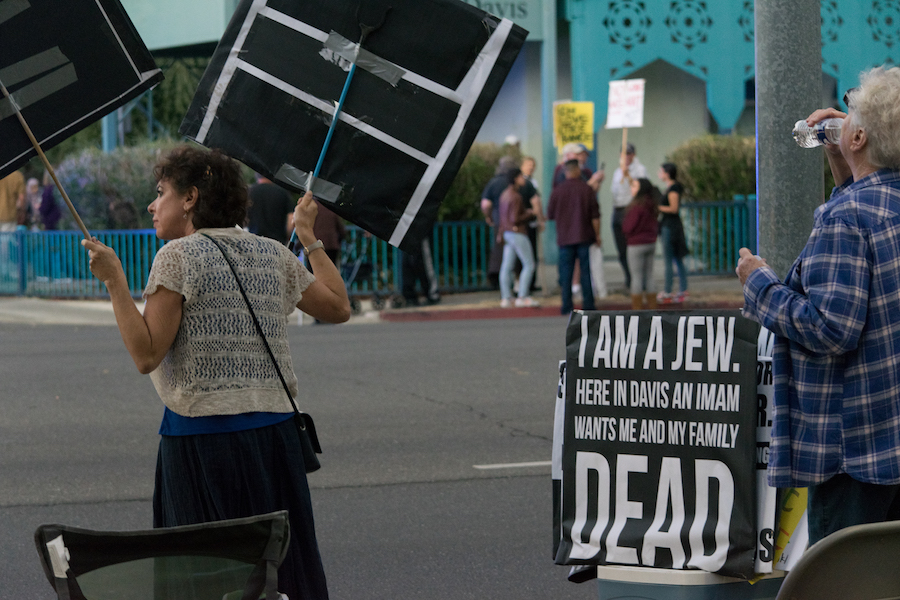
Ralph Libet, one of the protestors outside of the Islamic Center, held a sign in Arabic which he said, read “dear Imam, you are crazy, please leave here now.”

“I find it very disturbing, and to me it’s just ridiculous that we […accept] people talking about annihilating other people,” Libet said. “It just doesn’t fit in our society, it doesn’t fit in our city and it shouldn’t be happening across the University of California, either.”

About 20 people gathered to protest in front of the Islamic Center and across the adjacent streets. Gail Rubin, the organizer of Davis United Against Hate, said the group is a “loose affiliation of residents in the community.” Recently, Rubin’s guest opinion piece was published in The Davis Enterprise. In the opinion piece, she asked members of the community to join her group in the “peaceful interfaith vigil” they held on Oct. 22 from 4 to 6 p.m.

“UC Davis students who are Muslims, all they have to do is cross the street […] and hear those words now to become radicalized,” Rubin said. “We’re here to say, ‘He needs to go.’ We are here because the interfaith community is being cynically manipulated by this Imam to stand with them as a show of solidarity.”

Frohar Osmani, a third-year international relations major, said the Islamic Center of Davis is where she and others go to feel safe; “one person doesn’t represent Islam,” Osmani said.

Protesters held signs that read “I am a Jew. Here in Davis an Imam wants me and my family DEAD,” “Speak out no hate peace please,” “teach love practice tolerance,” “no hate in Davis words hurt” and “stop attending Mosque that preaches genocide of the Jews.”

Alexander Groth, a professor emeritus from UC Davis’ Department of Political Science as well as a survivor of the Holocaust from the Warsaw ghetto, was one of the protesters in attendance. Groth emphasized the need to stand up against hateful and anti-Semitic speech and likened Shahin’s speech to Hitler’s call for the “decimation of Jews” in World War II. He also expressed dismay that the Davis “city council has done nothing” in response to the July sermon.

A large group of around 60 or more were inside, around and behind the Islamic Center as part of the interfaith event — the group was a diverse mix of children and adults talking, eating snacks and passing around glow sticks. After the Imam spoke, the group prepared to continue the walk and end the night at the Davis United Methodist Church for a reflective discussion and potluck dinner.

Kate Snow was one community member at the interfaith event. Snow works as a school climate coordinator for the Davis Joint Unified School District and is involved in “restoring justice” as well as in how to “use conflict as a place to transform.”

“It’s so clear that this community, Davis as a whole, wants to transform and I think wants to be connected,” Snow said. “To me, [this event] is an opportunity to see another group of people […and] to build our learning, our education and to build our connection and then to think about what it is we can do ourselves to continue to build a community.”

When asked about her thoughts on the gathered protesters outside of the event, Snow reflected on what she had heard from Rabbi Wolfe and Imam Shahin earlier in the day.

“As the Imam said — and as Rabbi Wolf [said] — it’s important for us to listen,” Snow said. “My belief is that, as [the Imam] said, we make room for all and that […] includes people who say things you don’t like and […] includes people who scare you.”


Written by: Hannah Holzer and Elizabeth Mercado — campus@theaggie.org

Humor: When you should plan to get sick during the quarter system

VENOOS MOSHAYEDI

What to expect when you’re expecting

If you’re reading this, you’re probably planning on getting sick at some point in the quarter. You might not know it, but trust me, it’s coming. So I suggest you sit down, pop a vitamin C and whip out your schedule, because it’s meticulous planning time.

In the 10 weeks of the quarter system (including that cute little week 0 that nobody asked for) and maybe another week for finals (I’m not sure), there are endless possibilities for when you’re going to be taken down by a small cold that spirals out of control.

This might seem negative and obtuse. But in a system that requires you to stay three steps ahead while it constantly makes sure you’re five steps behind, planning when to get sick will at least relieve you of the stress and anxiety of not knowing.

Assuming it’s going to take about three weeks to fully recover (subtract time if you’re a responsible human being), I have broken up the quarter system into three parts — but please don’t let me stop you from mixing and matching.

  1. Weeks “0” to 4: Underestimating how much work you have and misusing your time. The most probable reason you’re getting sick in these first few weeks is that your immune system is going into overdrive after having spent the last month of summer in isolation. If you’re looking for a recovery period that sets you behind at the beginning of the quarter, the combination of your high susceptibility to illness mixed with your welcome week fun is your ticket to sickness. Pro: no real assignments or tests to get behind on. Con: You’re going to fall behind without even knowing it.
  2. Weeks 5 to 8: The perpetual cycle of midterms and contemplating whether to switch your major. If you want to get sick during this time of the quarter, my blessings. You’ll get major sympathy points but will also probably be socially quarantined by your friends, teachers and parents who all claim “I just can’t get sick right now.” The key to getting sick during this period of time requires almost no effort: just live your life the way you need to and do all the work you’re assigned and that should probably be enough to kick you into some type of common but serious sickness like mono or bronchitis. Pro: You’ll be prescribed whatever medicine your doctor thinks you should build up an immunity for. Cons: everything else.
  3. Weeks 8 to 11: Sporadic bouts of stress followed by one long endurance week. This is everyone’s favorite time to get sick. The end of the quarter is kind of similar to what I’ve heard running is like: After a certain amount of time you can’t feel your legs anymore, or something like that. If you choose to get sick during this time, just know the end is near and that, while your ailments may interfere with your final grade, there’s no need to worry. Pro: You worked hard all quarter, and having a week of tests on everything you ever learned isn’t going to take away from your hard work. Con: Oh wait, never mind. Good luck.


Written by: Rosie Schwarz — rschwarz@ucdavis.edu

(This article is humor and/or satire, and its content is purely fictional. The story and the names of “sources” are fictionalized.)