57.2 F
Davis

Davis, California

Monday, December 22, 2025
Home Blog Page 603

Jeff Flynn becomes new general manager for Unitrans

JEFFREY FLYNN / COURTESY

Flynn hopes to focus on student employees, expand collaboration with ASUCD, UC Davis, city of Davis

On June 26, Jeff Flynn became the new general manager of Unitrans, following the retirement of former general manager Anthony Palmere.

Unitrans was founded in 1968 as the University Transport System. Today, it provides public transportation services to the entire city of Davis — 18 routes and 48 buses see over 22,000 passengers on a typical day.

Flynn worked as a student employee at Unitrans for the majority of his undergraduate career, starting off as a driver and eventually becoming a student manager, overseeing planning, marketing and administration.

“Unitrans really defined my college experience and instilled in me a love and passion for transit that continues to today,” Flynn said. “I can’t explain my excitement to come back to Davis and Unitrans.”

Flynn’s passion for transit continued after graduation, as he went on to work for a transit planning consulting firm in San Francisco, serving as the planning and communications director for a small transit agency in the East Bay. Most recently, Flynn served as the chief transit officer for the San Francisco Municipal Transportation Agency, overseeing all bus, light rail and historic streetcar operations.

“I think Jeff is not only a great person but also well-equipped to lead Unitrans in a time where it will require an innovative solution-oriented approach to its contemporary problems,” said ASUCD President Josh Dalavai. “I’m very excited to work with him.”

As the new general manager, Flynn plans to focus on employee recruitment and retention, collaborating with ASUCD, the university itself and the city of Davis to ensure that Unitrans is on solid financial ground to meet customers’ current and future needs and ensuring that student employees get the most out of working at Unitrans.

“Unitrans wouldn’t exist in its current form without the support of the student body and the student employees,” Flynn said. “The passion and strength that our student employees bring to the job is what makes Unitrans so unique and such a great place to work.”

Students working at Unitrans have expressed excitement about Flynn’s designation as the new general manager.

“Jeffrey Flynn has appeared at the helm of Unitrans, and I am extremely excited to see what happens next,” said Emma Askea, a fourth-year English major and a student manager at Unitrans. “Heading into my final year with the company, I am thrilled to have such a young and passionate man of transit leading the charge into the new school year.”

Flynn believes that transportation is something everyone needs and that Unitrans plays a critical role in making sure people can safely and economically get to school, work and activities.

“I can’t imagine what the university or city would be like without this great student-supported system helping move people in an environmentally and economically-friendly way,” Flynn said.

Written by: Clara Zhao — campus@theaggie.org
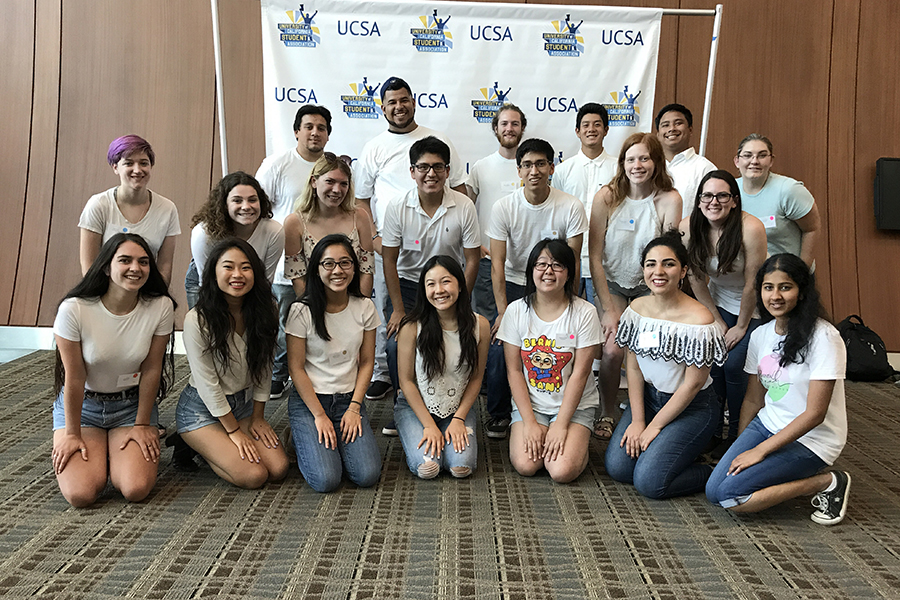
UC Davis students attend UCSA Student Organizing Summit

SAMANTHA CHIANG / COURTESY

OASR takes UCD’s largest delegation to the conference to date

From Aug. 3 to 6, 22 UC Davis students attended the UC Student Organizing Summit (UCSOS), an annual conference hosted by the University of California Student Association (UCSA) in Pomona, Calif. UCSA, the official organization of all students in the UC system, advocates for the accessibility, affordability and quality of the UC system. UCSA hosts three yearly conferences; the 2017 UCSOS conference is the 19th student conference of its kind.

Each university in the UC system has an external vice president (EVP) who reports to the UCSA board to represent their school in UC-wide action and efforts. Former ASUCD senator Daniel Nagey is the EVP of the Office of Advocacy and Representation (OASR), a unit of ASUCD. The office of the EVP is smaller at UC Davis due to budget constraints, but with the support of ASUCD, OASR is projected to expand in the coming years.

UC Davis has taken two previous delegations to the past two UCSOS conferences. Selection to attend is open to the general student body.

“This was the most diverse delegation we’ve taken in terms of representation from different student groups and affiliations,” said OASR Legislative Director Samantha Chiang. “Our commitment to advertising to the wider student body undoubtedly paid off, especially when students not traditionally involved in ASUCD spaces spearheaded WeAre3D, the student disability access campaign that was chosen by majority vote as the next two-year UC Student Association campaign.”

Students from all UC campuses attended a variety of panels, workshops, identity caucuses and campaign proposals to learn more about different social justice issues faced by students across the UC system. Issues discussed at the conference included racial equity, affordability, access and the security of basic student needs, among others.

There were four panels spread over the first two days of the conference; ReIGNITE, Undocumented Unafraid, Sustain our Students and Fund the UC. ReIGNITE (Re-Invest in Graduation, not Incarceration, Transform Education) was a racial justice campaign panel that discussed the school-to-prison pipeline and other problems formerly incarcerated people faced both before and after college. Undocumented and Unafraid was a panel that discussed the problems and processes of securing a Sanctuary UC and Sanctuary State.

Sustain our Students was a basic needs security campaign panel that discussed students’ food and housing insecurities. Fund the UC was a college affordability and access campaign panel that discusses combating rising costs of tuition and student fees.

Saturday’s keynote speakers were Jonathan Stein and Anthony Williams. According to the Master Program, Stein is a civil rights attorney whose work “focuses on voting access for immigrant, limited English-proficient and other historically disenfranchised voters.” Williams works with the Black Organizing Project, and his work studies the disproportionate inequalities –– of both race and class –– which affect people of color.

Students also had the opportunity to propose and vote on a campaign that UCSA will organize around for the next two years.

Fourth-year political science and Chicano/a studies double major Ryan Navarrete said he enjoyed the conference and liked seeing a different side of student government. Navarrete felt the first panel he attended was the most impactful.

“The very first panel, ReIGNITE, definitely hit home for me,” Navarrete said via email. “The panelist spoke on incarceration and how it has impacted them in both their life and education. As someone who is formerly incarcerated and a member of Beyond the Stats, what she was saying definitely brought a tear to my eye; especially when [panelist] Amber Rose answered my question on advising students who had to disclose being convicted of a crime to the school that they are applying will no longer be on any school application.”

Kevin Butt, a third-year political science major and transfer student, said he liked meeting members of the UC delegation who were passionate and welcoming.

“My biggest takeaway from this conference was, it’s okay to step outside of your comfort zone and take a risk on the unknown,” Butt said via email. “I went into the conference not knowing anyone or anything about UC [Davis’] OASR office or UCSA. Leaving the conference, I had [a] new understanding of other people’s perspectives and experiences. I also walked away with […] bonds that will make my transition into UC Davis [a] smooth one.”

Butt was one of the students who helped worked on the WeAre3D disability access campaign.

One event that was the most impactful for me was working with [our] Davis Delegation on a campaign to put forth to the UC and then collaborating with other [students] from the other UCs for one common goal,” Butt said. “It showed no matter where you come from teamwork makes the dream work.”

Scott Hwaynate, a third-year managerial economics major, was another first-time attendee.

“I enjoyed meeting the students from other UCs,” Hwaynate said. “In those short four days, I’ve gotten to know a good number of students all over California. A seven-hour drive really strengthens the bond between people who’ve never met. Take away the name tag and you could say we were all from the same school. I had no idea how many of us had so much in common. I saw the passion in each student that arrived and the campaigns presented revealed each UC’s dedication.”

Students also had some criticisms about the conference — mostly about food and food access.

The lunch boxes provided were unnecessarily expensive for everyone,” Hwaynate said. “I heard it cost $21 to make one box. I think students would prefer a crisp $20 bill than a dry sandwich and some chips.”

Navarrete and Butt also agreed that both the quality of meals provided at the conference and the number of meals that students had to pay for themselves could be improved.

“No one should have to share a loaf of bread nor use their food stamps in order to eat,” Navarrete said.

Chiang said she hopes that these issues can be resolved next year and that the conference will be accessible to more students.

“Next year, we’d love to bring more students, as this is one of the most welcoming and rudimentary conferences that UCSA holds,” Chiang said.

Written by: Jayashri Padmanabhan — campus@theaggie.org

Humor: Katehi reveals new memoir: Salt and Pepper Spray

CIERA PASTUREL / AGGIE FILE

Overjoyed readers gather, laud latest work as “Fire, Katehi”

This is it, folks. Linda Katehi is finally making good on her promise to students. And no, I’m not referring to the minor issue of the reneged $200,000 scholarship fund commitment.

Katehi is releasing a memoir. The subject matter is wide-ranging, including an exploration of Katehi’s humble beginnings in Greece, her budding interest in electrical engineering as a teenager and full technical instructions on “how to get you off the Google.”

Katehi will also discuss how she was inspired by the moon landing, how she became Davis’ first female chancellor and how DeVry can put you on the fast track to the career you deserve.

The former chancellor said that writing during her transitory sabbatical was difficult, but the $424,360 she was paid during this period helped her overcome the grief and complete her masterwork.

Katehi shared that her decision to release this book was, in part, to supplement her income, as the paltry $300,000 salary offered by the university to teach one to two classes per quarter was not covering her expenses.

The book will additionally feature an endorsement from interim chancellor and part-time mole-man Ralph J. Hexter: “Take it from an embezzler — Katehi really knows how to steal your heart.”

 Katehi is pleased to inform students that she has decided to print her new work through textbook publisher John Wiley & Sons, where she is a board member — and that this is completely coincidental. Students from ENL 2, 6, 7 and 109 though 206b will also be thrilled to learn that Katehi’s book is the newest addition to their required reading lists.

Written by: Parker Nevin — phnevin@udavis.edu

(This article is humor and/or satire, and its content is purely fictional. The story and the names of “sources” are fictionalized.)

First step to recognizing pain in horses

MAHEEN RASHID / COURTESY

Researchers aren’t horsing around with program to detect equine facial keypoints

As technology advances to make life more comfortable for humans, the need for developments in animal welfare also grows. While a computer with automated expression recognition for an animal’s face may seem far-fetched, a third-year computer science Ph.D. student at UC Davis has completed the first step to creating such a program.

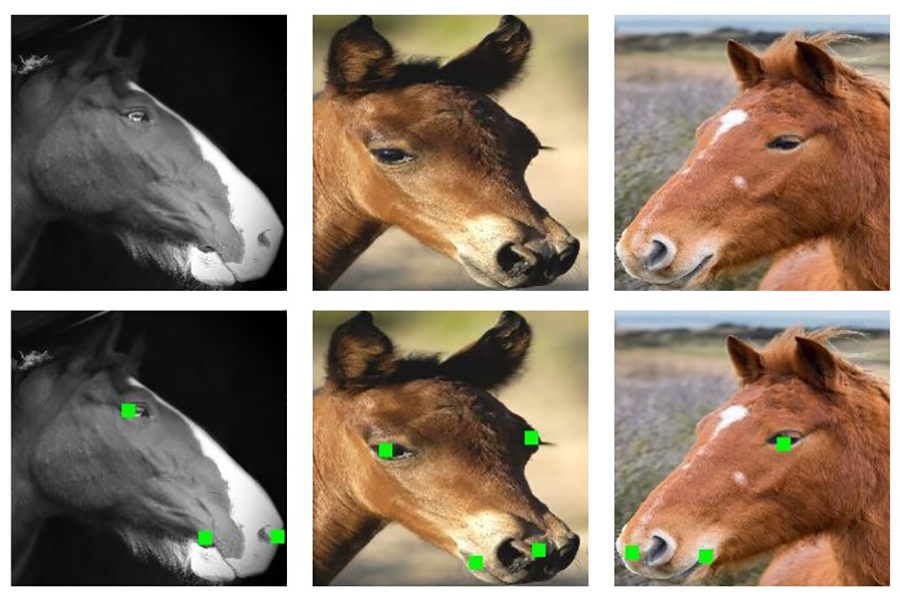
Maheen Rashid, along with her advisor Yong Jae Lee and intern Xiuye Gu, worked on a computer program that can identify “keypoints” on a horse’s face, which will assist her research in a program that can detect equine expressions of pain. These points determine aspects of an image that are of importance to the program.

“[Keypoints] identify points that have some kind of word or meaning attached to them, like the eyes or the nose or the mouth corners,” Rashid said. “They could also be points that don’t necessarily have any semantic meaning attached to them. For example, for humans, there can be 68 keypoints on a human face, and every one of those keypoints doesn’t have a name attached to it, but those keypoints can still be very important for telling if the eyes are open or shut or what type of smile the person has.”

Claudia Sonder, the director of equine outreach at the Center for Equine Health, oversees the projects using around 200 horses housed there for research due to their extensive medical records. She stated that minute changes in facial muscles are involuntary and are key to noticing a problem before other, more obvious traits are expressed. Horse owners and experienced veterinarians may still miss signs that a computer could catch.

“Facial recognition of pain is something that involves looking at the horses remotely to document the position of their ears, their eyelids, their nostrils and their mouth,” Sonder said. “In order to do that in any kind of high volume, you need a computer involved because a computer can measure those parameters more accurately and more quickly than the human eye. The initial goal of this team was to train the computer to recognize a horse’s face. Computers have, for quite some time, recognized a child’s face, for example, and a computer can detect subtle changes in facial expression in children that are not commonly detectable by the human eye.”

Some keypoints on a face, whether it is a horse, human, or otherwise, include the eyes, mouth corners and nostrils. However, it takes “training” for a program to automatically detect these points by “showing” the program many examples.

“If you’ve never seen any horses before in your life, and I want you to be able to identify what horses are, I can show you pictures of horses and say, ‘This is a picture of a horse,’” Rashid said. “Hopefully, after seeing a bunch of pictures of horses, you could identify a horse that you’ve never seen before. Training a program to perform a specific task ends up roughly meaning something similar to that, where you try to give the program a series of positive examples of something, and try to get it to extrapolate from those positive examples. In my case, it was being able to detect keypoints and the positive examples were images of animals with keypoints marked on them already.”

Since there were not enough images of horses with these keypoints marked, Rashid and her associates trained the program using human faces due to the large amount of data the program needed to learn to detect keypoints.

“When it is trying to adapt to horse faces, it’s a difficult job to do because horse faces look so different than human faces,” Rashid said. “We figured that we can make the job easier for the network by moving horse faces closer, in appearance, to the type of data that it’s used to seeing, which is human faces. When we ‘warp’ horse faces, we’re basically trying to make horse faces look more human-like, and we’re using these ‘warped’ faces to train the network and make it adapt to horse faces.”

Many researchers are involved in the project, including some from UC Berkeley and UC San Diego as well as some from Sweden and Denmark. Pia Haubro Andersen, a professor of large animal surgery at the Swedish University of Agricultural Sciences, was inspired by a paper she read in 2014. Sonder said she was contacted in 2015, while Rashid was brought on the project in 2016.

“Ten years ago, our research changed from looking at pain as a physiological response to pain as a behavioral response,” Andersen said. “At the same time, people started looking at the facial expressions in laboratory animals, and it was actually the nurses that saw a mouse with small eyes, its ears back, its little whiskers pointing and [could tell that] it was in pain.”

One of Andersen’s Ph.D. students at the time said that horses must have had this “pained face” as well and described small changes in the horse’s appearance. Though this may seem trivial, horses are known to be stoic animals who attempt to hide their pain from humans.

“What does a horse think of you, as an observer?” Andersen said. “Is it afraid of you, is it scared of you, or are you in good relations with the horse? If I’m the owner observing the horse, the horse trusts me. When you move the horse to a hospital, a lot of strange people are there and a lot of strange things are going on. For example, as a veterinarian, you look at the horse exactly where it hurts, and it scares the horse because it’s a prey animal. In a hospital, the horse believes that it is surrounded by hostiles.”

Even around its owner or other familiar humans, Sonder stated that horses still tend to withhold pain responses. Some uncontrolled tells include a horse’s ear position, the shape of their eyes and eyelids, whether the nostril is dilated, or the contour of its face.

“[Horses] are animals that evolved over millions of years to get away from predators, but also be strong,” Sonder said. “Many of us are not looking closely enough at them to detect these subtle changes. For example, a horse may walk up, and it has its ears forward. It may even take a treat from you, yet it’s experiencing pain. The horse will act cheerful and meet our thresholds for a normal exam. But if you look closely, the involuntary muscles in their face are telling us that there’s something wrong.”

This can be compared to some people’s tendencies to hide their pain from people and how others can detect subtle shifts in expression. However, veterinarians rely on these small changes for examinations, since humans cannot directly communicate with animals.

“If human observers are going to underestimate the pain that animals are in, then it means that animals are going to be in pain for longer until they’re diagnosed,” Rashid said. “It also means that there could be diseases that get really bad before they are diagnosed, so you end up spending a lot of money in order to cure an animal, and an animal may suffer for longer because you just didn’t know the animal was in pain.”

The next piece to this puzzle is getting Rashid’s keypoint detection program to notice these microexpressions.

“I think keypoint detection is a first in a series of projects, so I’m working on expression recognition now,” Rashid said. “Getting expression recognition to work on static images versus videos are two very different problems, so there more that I’m going to have to work on to get this to be actually usable.”

Both Andersen and Sonder have expressed their excitement to be able to use an expression recognition program to better the care for all animals. The implications of this project are not limited to improving animal welfare, but also touch upon aspects of academic and non-academic life.

“When we started with this, the automated recognition was just a tool for me,” Andersen said. “I wanted this tool because I wanted better pain management, and I wanted earlier diagnoses. And I still want that. But after [being] entered into this interdisciplinary collaboration with cognitive scientists and computer vision people, I think there are so many more applications that you could work on with animals. Sometimes, I say to my students, ‘Maybe computer vision is the closest we get to ‘talk’ to the animal, to understand what is it that animals ‘want’ or ‘don’t want’.’ We simply hadn’t been able to contain all the data and information, but suddenly we have computers to analyze them for us.”

Though this is only the beginning of this expression recognition project, there are already noticeable changes for those involved and high hopes for the future.

“It’s changed how I practice veterinary medicine,” Sonder said. “I feel that when I approach a patient, I have a much greater ability to detect pain, and it’s changed how I’ve made some of my decisions. But one thing that’s really important is that all of this research has to be validated, meaning, at some point, we’re going to have to prove that the equine pained face is relatively consistent for certain types of pain. That’s going to take time.”


Written by: Jack Carrillo Concordia — science@theaggie.org

UC Irvine to reinstate offers of admission to 290 of 499 incoming freshmen with rescinded admissions offers

BRIAN LANDRY / AGGIE

University stated that admissions decisions were reversed based on failure to meet deadlines, poor grades during senior year

In late July, UC Irvine rescinded offers of admission for around 500 students initially promised a spot at the university for the 2017-18 school year. Most of the nine UC schools, including UC Irvine, begin instruction for Fall Quarter in less than two months –– leaving several hundred students with severely limited time to find new plans.

After national media coverage and widespread controversy regarding the decision to rescind hundreds of admissions offers, UC Irvine has now decided to again offer admission to 290 of the 499 students. The 290 students now offered admission are those whose admissions were initially rescinded due to issues with their transcripts.

Thomas Parham, UC Irvine’s vice chancellor of student affairs, published a message regarding the 499 rescinded offers, stating that the number of applicants for the new school year was extremely high and that the number of applicants who accepted their offers for admission was much higher than anticipated. However, according to the statement, the decision to rescind applications was based upon whether or not students met all of the specified requirements.

“Acceptance into all University of California campuses is provisional, contingent on meeting the contractual terms and conditions that were clearly outlined in your original admissions offer,” Parham stated in the message. “This includes submitting all academic materials such as transcripts and test scores by the agreed-upon deadline, upholding strong academic performance throughout the senior year of high school that meets agreed upon thresholds, and having no discrepancies between the grades and courses you reported on your application and what we see once we review your official final transcript.”

The Los Angeles Times reported that the rescinded offers of 290 of the 499 –– the group now offered admission –– were due to complications with transcript requirements and submissions, while the rest had admissions rescinded due to unsatisfactory grades during their senior year of high school. The Times also reported that of the 31,103 freshmen students offered admission, 7,100 accepted their offers –– 850 more students than the university’s projected incoming freshmen class of 6,250.

A petition, with a goal of 2,500 signatures, circulated the UC Irvine Class of 2021 page.

The Associated Students of UC Irvine will be releasing a statement to stand in solidarity with students who have had their applications revoked, despite having completed all of the tasks that they were supposed to do,” the statement attached to the petition stated.

According to the Times, UCLA has rescinded seven offers of admission and UCSD has rescinded nine offers of admission. Although UC Davis does not appear to have rescinded any offers of admission for the coming school year at this time, the university has rescinded up to 150 acceptance offers for each of the previous two years.


Written by: Hannah Holzer — campus@theaggie.org

UC President, university leaders offer statements on Charlottesville

NADIA DORIS / AGGIE FILE

Leaders condemn recent actions of white supremacists, discuss current state of free speech on college campuses

In light of the chaos which occurred in Charlottesville, Virginia after a “Unite the Right” march led by white supremacists escalated into violent altercations between the marchers and counter-protesters that left at least one person dead, statements have been issued from administrators at both the UC and university level.

On Aug. 12, the day of the march, UC President Janet Napolitano issued a brief statement via Twitter.

“We abhor the violence & hate in Charlottesville that have tragically perverted Americans’ right to speak freely,” a Tweet credited to Napolitano from the University of California Twitter account stated.

A few minutes after the initial Tweet, Napolitano affirmed the UC system’s stance alongside the University of Virginia in “condeming this shameful display,” via the University of California Twitter account.

On Aug. 14, Napolitano sent a lengthier letter in response to the aftermath of the events from Aug. 12. Napolitano began the letter by condemning the actions of “white supremacists” and restating the UC system’s adamant support for “diversity and inclusion.”

Napolitano’s letter also addressed protections for free speech on college campuses. Marchers gathered at the University of Virginia, which has condemned the “hateful and violent activities” of late.

“University campuses in particular are meant to foster an exchange of ideas, and to teach students how to respectfully approach viewpoints different from their own — even when those viewpoints are offensive and hurtful,” Napolitano stated. “But the acts of domestic terrorism we saw in Charlottesville represented an assault on our cherished values of diversity, inclusiveness and tolerance. We must continue to speak and act against the shameful behavior we witnessed over the weekend and ensure that our colleges and universities, and our nation as a whole, remain safe and civil for all.”

Napolitano’s statement also offered “profound condolences” for the loss of Heather Heyer, who was killed when a car was driven into a group of counter-protesters, injuring 19 others.

UC Davis Chancellor Gary May issued a brief statement via Facebook.

We condemn the violence and hate on display in Charlottesville today,” the post stated. “Freedom of speech is not about provoking and inciting violence. Our thoughts are with our University of Virginia colleagues.”

ASUCD President Josh Dalavai issued a personal statement via Facebook.

“This movement can […] no longer be labeled anything other than white angst, supremacist and reactionary,” the post stated. “Chants of ‘we will not be replaced,’ ‘white lives matter,’ and ‘Jews will not replace us’ all prove that statement beyond a shadow of a doubt, if the Confederate and Swastika flags weren’t enough proof. This is no longer a game (it never was), and they are out here looking for blood.”

Dalavai credited the uprising of white supremacist ideology to the presidency of Donald Trump.

“To not be outrightly upset and ready for action is dangerous at this point,” Dalavai’s post stated. “Nazism and Fascism is growing in America and you can no longer disregard that notion as an overreaction. We are at a tipping point.”

In regards to the upcoming start of the 2017-18 school year, Napolitano’s letter stated that the UC system “remains committed” to creating and promoting a “safe, responsive and equitable environment” for all students, faculty and staff members.

We reject all forms of discrimination, commit to fostering an atmosphere of respect and inclusion and pledge to defend the right to free speech,” the letter stated. “This summer and fall, as UC students, faculty and staff return to their campuses, I ask that we all recommit to these enduring values of diversity, equity and inclusion and work to live up to these ideals in all that we do.”


Written by: Hannah Holzer — campus@theaggie.org

Linda Katehi returns to UC Davis as research professor, will earn $318,000 salary

BRIAN NGUYEN / AGGIE FILE

Katehi will teach one class per quarter in 2017-18 school year, conduct research

Following her 2016 resignation from the position of UC Davis chancellor, Linda Katehi will return to the university as a professor and researcher in the fall of 2017, earning $318,000 for the nine-month academic year. According to The Sacramento Bee, Katehi’s salary for the 2017-18 school year will be approximately equivalent to her previous 12-month chancellor salary of $424,000.

For the upcoming Fall Quarter, Katehi will teach Electrical and Computer Engineering 290 — a seminar in electrical and computer engineering, meeting on Fridays from 12:10 to 1 p.m. She will continue to teach at least one course in both Winter and Spring Quarter.

At a press meet-and-greet on Aug. 1, Chancellor Gary May defended Katehi’s salary, although he did not approve the number himself.

“Professor Katehi is a member of the National Academy of Engineering and is a world-renowned scholar in her field,” May said. “That salary is certainly consistent with others of that same [caliber]. As [a former] Engineering Dean, I’m familiar with those salaries and her salary is not in any way out of bounds.”

In addition to her expertise in the field of engineering, Katehi’s UC Davis biography also recognizes her as a distinguished professor of women’s and gender studies, although the classes she will teach in this department are currently pending.

ASUCD President Josh Dalavai emphasized his unhappiness with Katehi’s return to campus and the high salary she will earn.

“This is very unfortunate and goes to show that sometimes university decisions are made for the primary purpose of saving face as opposed to doing what’s best for students,” Dalavai said via email.

Napolitano asked Katehi to resign in the wake of multiple controversies –– including allegations of allowing campus police overreach and subsequent internet scrubbing following the 2011 pepper spray incident –– for which she took full responsibility –– as well as moonlighting for corporate boards. Katehi also faced accusations of nepotism at UC Davis in regard to her daughter-in-law’s promotion to the position of assistant vice chancellor.

Katehi officially resigned on Aug. 9 as part of a settlement, receiving her chancellor’s salary for the 2016-17 school year while on sabbatical and retaining the professorial position at UC Davis that she will soon return to.

Anna Lee, a parent of a UC Davis alumnus, stated her frustration with Katehi’s return to teaching, specifically in the Gender, Sexuality and Women’s Studies Department, via email.

“There has to be more qualified professionals, male or female, to teach Professor Katehi’s class,” Lee said. “[Especially] when she has not been teaching for a while. It is inappropriate for Professor Katehi to use the ‘woman’ card as added ‘experience’ when she herself was ineffective as a campus leader.”

In 2006, Katehi became an associate dean for academic affairs and graduate education at the College of Engineering at the University of Michigan, Ann Arbor –– a position she held until 2009. Prior to that, she was a professor of electrical and computer engineering at Purdue University, where she became the John A. Edwardson dean of engineering in 2002. Katehi has also served as provost and vice chancellor for academic affairs at the University of Illinois at Urbana-Champaign.

Lee said she predicts a possible fundraising backlash as well as a general lack of support for the university in light of Katehi’s return.

“Integrity should always be part of a good role model for incoming engineering classes,” Lee said. “Chancellor Gary May can lead by setting a good example that he can make tough decisions, instead of rubber-stamping the return of Professor Katehi. Although Chancellor May wants to move forward with his ambitious fundraising for Davis, he must remember that prudent financial management will give Davis [alumni] the confidence that their donation is being spent wisely. Chancellor May should know all campus funds are subject to public scrutiny, […] and everyone is watching.”

Dana Topousis, the interim strategic communications lead and executive director of news and media relations at UC Davis, stressed Katehi’s teaching experience and expertise. Topousis denied that Katehi’s salary was inconsistent or unmerited.

“Professor Linda Katehi is a […] remarkably distinguished professor of engineering,” Topousis said via email. “Her academic credentials and merits stand strongly on their own. Professor Katehi’s robust academic accomplishments fully merit her salary level, and it is consistent with similarly distinguished peers throughout the UC system, including those who are members of the National Academy of Engineering. Her workload for her first quarter is consistent with professors returning to their faculty posts. She will be conducting research and doing other work […] as part of her workload.”


Written by: Aaron Liss — campus@theaggie.org

Correction: an earlier version of this story incorrectly stated that Katehi’s daugher-in-law was promoted to the position of vice chancellor. She was promoted to the position of assistant vice chancellor. The Aggie regrets the error. 

Senator Daniel Nagey resigns to take on role of OASR External Vice President

DANIEL NAGEY / COURTESY

Nagey expresses excitement for his new position

At the last ASUCD meeting of the 2016-17 school year, Senator Daniel Nagey resigned from his position to take on the role of External Vice President (EVP) of the Office of Advocacy and Student Representation (OASR), a unit of ASUCD. Nagey’s resignation marked the third senator resignation for the 2016-17 school year — Anastasia Ruttkay and Samantha Chiang also resigned from their positions on the senate.

Nagey served as an ASUCD senator during the Winter and Spring quarters of the 2016-17 school year. During his term, Nagey focused on three specific platforms: mental health advocacy, food and housing security and fighting against tuition hikes and for increases in Pell Grants.

Nagey took on a number of notable projects during his term, including the Aggie Food Connection, which brought food resources both on and off campus to UC Davis students. The Housing Task Force Security gathered data from the UC Davis community to advocate for comprehensive solutions to the Davis housing crisis. And Taps for TAPS, a mobile application, allowed for students to report the location of bikes they believed to be abandoned and utilize other functions of the Transportation and Parking Services.

Chiang’s resignation was announced a few weeks before the end of the school year, while both Ruttkay and Nagey’s resignations came to light as the year ended.

“They — Nagey and Ruttkay — had incredible careers as senators,” said ASUCD President Josh Dalavai. “I’m sad to see them go but excited for what they’ll do in the future.”

Nagey said he hopes ASUCD continues its job of representing students and continues adding to their list of competency trainings.

“I think it’s important to know about the groups, especially the marginalized ones, that you are representing,” Nagey said.

According to Nagey, in his new position as EVP, he will represent the entire undergraduate student body in matters relating to UC-wide actions and lobbying efforts. Nagey said he “couldn’t be more excited and happy” to start his new role. However, Nagey noted that the office of the external vice president at UC Davis is substantially weaker than every other UC office, mostly due to budgetary constraints.

“As such, we need to work twice as hard,” Nagey said.

Written by: Clara Zhao — campus@theaggie.org
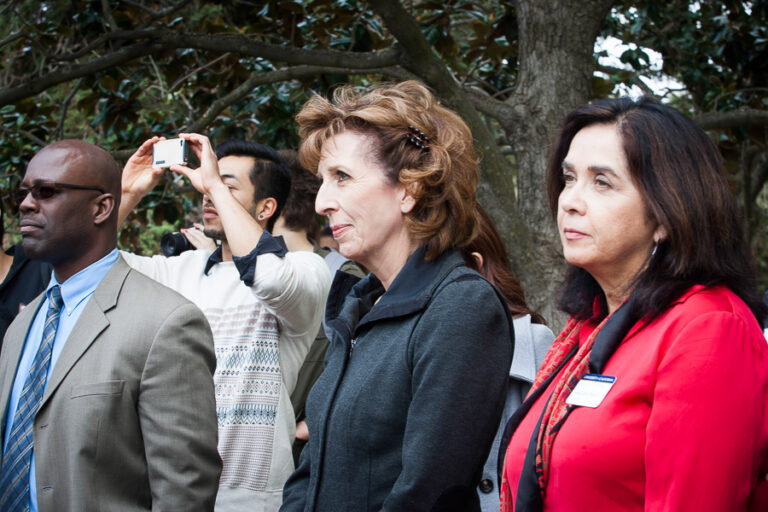
Local Habit Burger Grill closes down

CAT TAYLOR / AGGIE

Davis Commons loses another tenant

The Habit Burger Grill in downtown Davis has been serving its signature “charburgers” to hungry customers since 2007, when they first set up shop in the Davis Commons. But now, 10 years after the burger joint first popped up, The Habit has shut down its Davis location, barring Davis residents from indulging guilty habits with its delicious burgers.

“It was usually busy whenever I went there. It was a good choice when you didn’t want to wait in line for In-N-Out or pay more for Burgers and Brew. It came to town long before Krush Burger and beats out typical fast food Carl’s Jr and McDonald’s,” said Michele L., a Davis resident and alumna. “It really does fall somewhere between basic fast food and more upscale burger joints.”

The Habit had favorable reviews and was a frequent stop for many Davis students and locals alike. With all the traffic that seemed to be going through The Habit, the announcement that the restaurant would be closing had a lot of patrons confused.

“Every time a place closes down, each situation can be very unique. To me it seems like, for whatever reason, it’s difficult to do business at the Davis Commons,” said Chris Macias, a Davis resident. “With Whole Foods gone, your anchor tenant is gone, and there’s so much competition for other burgers in Davis. Redrum Burger is just on the other side of Richards [and] In-N-Out is across the street.”

The Davis Commons seems to have had a revolving door of restaurants and stores in the last decade, with Borders, Whole Foods, Pinkberry, Papyrus, Jamba Juice and several other establishments all cycling out of the shopping center in quick succession. No store has stepped in to replace Whole Foods as an anchor tenant, and The Habit’s former home is still up for grabs. While there are a number of likely reasons each of these shops has closed, the constant openings and closings at the Davis Commons raise questions about the shopping center.

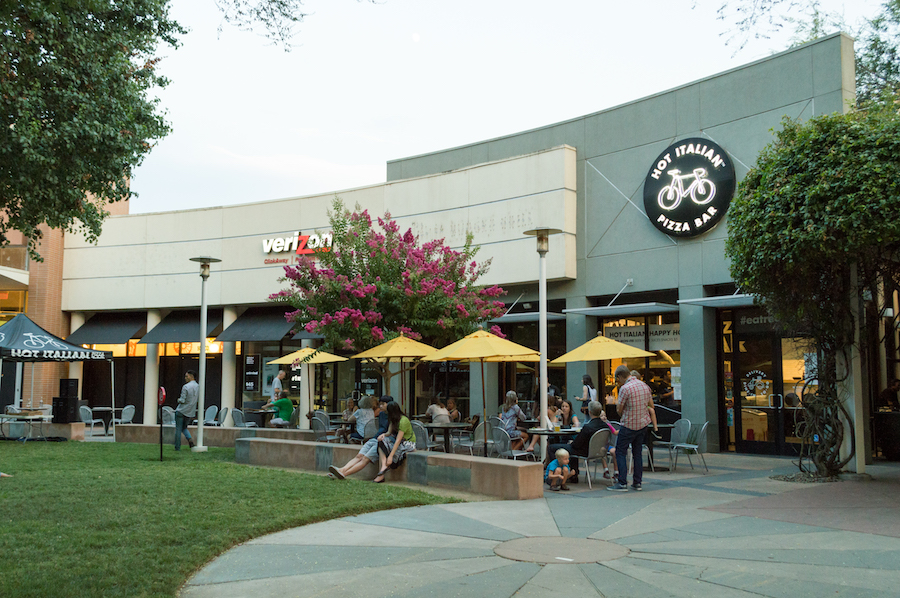
“I think businesses have to evaluate each location, regardless of the number of locations they have. Each [of the] locations have to stand on their own. I’m sure they have good business reasons; everything is relative,” said Andrea Lepore, the founder of Hot Italian, which neighbored The Habit in the Davis Commons.

It’s likely that this Habit location just wasn’t making enough compared to other locations the franchise owns and keeping this location open just wasn’t profitable. In-N-Out Burger, Redrum Burger and Burgers and Brew all provide competition, steering customers away from The Habit.

The Habit’s demise follows the closures of a few other Davis establishments. Krush Burger also closed down this month, and Hometown Chinese recently announced that Aug. 31 will be its final day. The Habit Burger Grill is a franchise, so there are other locations nearby in Vacaville and Sacramento. The lack of tenants in the shopping center could be a symptom of a larger problem with the Davis Commons location. Regardless, all of these closings serve as reminder to all of us patrons to support businesses and restaurants that we enjoy visiting if we want them stay open.


Written by: Ahash Francis — city@theaggie.org

Wonder Woman offers “I can” instead of “Can I?” to women and girls everywhere

SEBASTIAN VITAL [(CC BY 2.0)] / FLICKR
The first female superhero with a female director provides lessons for women of all ages

I’ll start off by stating this: I’m completely biased in favor of the success of the Wonder Woman franchise. When I was just four years old, I used to watch Wonder Woman in cartoon form every week with my dad. At that age, this character provided me with a lot of guidance, and the idea that girls could be heroes and warriors was firmly planted in my head. In my lifetime alone, I’ve sat through four Batman movies, three Iron Mans, three Supermans, a couple Captain Americas and, of course, several Thors. Not once was there a female superhero front and center on one of those posters at the movie theatre — and I grew to expect this from the industry. Men were the ones who got to have superpowers and their own movies. Women, such as Black Widow, were made to accessorize the bigger features. Even in written form, comic books have often failed women and created unrealistic body expectations for female characters, drawing them — more often than not — with more breast than muscle and costumes that are actually unequipped for battle when you really think about it.

Patty Jenkins’ Wonder Woman took all these standards created by the superhero industry and squashed them. There was a proper warrior costume, complex fight scenes and a whole lot of love between the main character and the world around her. The dialogue was powerful and filled with many inspiring lines from our leading lady. (My favorite: “What I do is not up to you.”) I’d been waiting for a Wonder Woman film for over 16 years, and I know many women had waited far longer than me. Jenkins allows these generations of women to see a version of this classic hero, who — for the first time in over 75 years — is portrayed with all the wonder she deserves.  

Themyscira, an island full of strong, muscular women training to fight, also showed female strength in a way that had never before been shown. It rivaled a lot of images of women that are portrayed in comic books that, as stated earlier, seem to theorize an unattainable physique with a pasta noodle for a spine. The fight scenes were choreographed to show the women’s strength and power instead of their vulnerability and grace, setting them apart from all other female characters in superhero films.

Jenkins also uses the romantic subplot of the film as something that drives Diana to fight harder, rather than something to distract her. The couple exchange thoughts on life and what makes them strive to keep fighting, as opposed to just standing in awe of each other’s awesomeness.

The movie never tells Diana that she can’t fight because she’s a woman, though it does address a lot of sexism that existed during the time period — and she certainly puts an end to those words right away. She never doubts herself and has confidence that she’s the greatest warrior the Amazons have ever produced.

To be quite frank, as a fan of superheroes, no film has ever made me feel stronger. There was no sense of weakness portrayed in Gal Gadot’s Wonder Woman. There was a radiating sense of power and confidence. The superhero industry ought to make more films like this so that girls of all ages can understand they can do anything — without the doubts and many questions that often occur before they realize their strength.


Written by: Olivia Luchini — ocluchini@ucdavis.edu

Disclaimer: The views and opinions expressed by individual columnists belong to the columnists alone and do not necessarily indicate the views and opinions held by The California Aggie.

Chancellor May attends meet-and-greets with students, faculty, members of the press on first day in new position

IAN JONES / AGGIE

At the press meet-and-greet, May responded to questions about student protest, Katehi’s salary, sexual assault prevention

To kick off his first day on the job, Chancellor Gary May attended several meet-and-greets in both Sacramento and Davis on August 1. The first event of the day, a breakfast from 7:30 to 8:30 a.m., was held at the UC Davis Health Education Building at the UC Davis Medical Center in downtown Sacramento.

From 10:30 to 11:30 a.m., a press meet-and-greet took place at the UC Davis Welcome Center. Around 30 members of the press were in attendance. May arrived with his wife, LeShelle, and gave a personal remark before welcoming questions.

IAN JONES / AGGIE

“It’s very nice to be with you this morning, on my first day on the job,” May said. “Although, actually, when the announcement was made in February, I […] started working for UC Davis then. I’m very pleased to be in a leadership role here, at one of the nation’s very best public research universities in the nation’s best university system. Everyone so far has been extremely warm and welcoming to me […] and I really appreciate that very much.”

When asked about his vision for the university, May said he hopes to improve the national and international reputation of UC Davis as well as create a holistic strategic plan.

“I’m very interested in raising the visibility of the campus and making UC Davis one of those handful of universities on the tip of your tongue when you think of the nation’s top research universities,” May said. “There’s a lot of different pieces [to that]. It will mean continued excellence in […] academic research. It’ll mean a continued emphasis on our well-deserved and well-earned reputation for affordability. Our continuing emphasis on community service, sustainability […] –– I’d like to bring all of these ideas together into a coherent strategic plan that will work for the university.”

May responded to several questions about former Chancellor Linda Katehi, who resigned after her questionable actions caused much controversy. A reporter from FOX40 stated that May follows an era of controversy –– “I hadn’t heard that,” he joked.

“My nature is to look forward,” May said. “I think I will be hopefully able to turn the page onto the new era. I understand that there were some challenges with the previous administration, I think that I’ve put those behind us.”

A recent Sacramento Bee article reported that Katehi will earn about the same salary she had previously made as chancellor. She will earn her $318,000 annual salary by conducting research and teaching a graduate engineering course each quarter. May said he did not personally sign off on Katehi’s salary, but did defend it when asked if he thought it was fair.

“Professor Katehi is a member of the National Academy of Engineering and is a world-renowned scholar in her field,” May said. “That salary is certainly consistent with others of that same [caliber]. As [a former] Engineering Dean, I’m familiar with those salaries and her salary is not in any way out of bounds.”

May also responded to questions about student advocacy. At the Pack the Patio event, May was the subject of student protests regarding his outside board positions.

“I’m a strong advocate of a student’s right to express themselves,” May said. “As an undergraduate student myself, I was involved in similar things. It was, in my case, the Apartheid demonstrations I was involved in. I think it’s an important part of development and the education process for our students. I may even participate in a protest if I feel they’re relevant and I agree with what the goal is. I’ve already been the target of protests, so I [have that] experience as well. I’m enthusiastic about [a] student’s right and ability to question […] authority.”

At the end of the 2016-17 school year, a Rally Against Rape Culture was held in response to an article published by The Aggie which stated that the university had not “investigated a student organization in connection with a sexual assault” in at least the past 25 years. At the federal level, Education Secretary Betsy DeVos has begun to reexamine the policies of former President Barack Obama, who expanded the means by which universities investigate sexual assaults.

Recently, in an interview with The Davis Enterprise, May said that his wife is interested in becoming involved with work involving sexual assaults. When asked what the university could do at a policy level if the federal government moves forward with dismantling Title IX protections, May responded, “Secede.”

“We’re going to follow that very carefully,” May said. “I think there’s enough resistance and debate even at the federal level to such actions that I’m optimistic that we won’t have to face that particular question. We have certainly a strong interest in protecting Title IX here, locally. One of the issues that myself and in fact my wife will be interested in tackling locally is sexual assault on campus and […having] some proactive measures to both prevent [it] from happening and also to come out and support a system for the victims of sexual assault.”

May was also asked to respond to Janet Napolitano’s pledge to protect undocumented students within the UC system.

“The president’s pledge is our pledge,” May said. “We’re part of the system and we will be complying with the system policies. I personally am dedicated to this issue as well, so I think we won’t have an issue there. I think it’s important for us to remain a place that welcomes people from all backgrounds, particularly folks from disadvantaged backgrounds such as the undocumented students.”
On a more local level, May was asked to respond to the City of Davis’ extremely low vacancy rate; he said that although there are no set plans to address expanding local housing for students, talks are underway.

“I had a very good meeting with the mayor of the city and the city manager over dinner […] a few weeks ago to talk about these issues,” May said. “I think part of the Sacramento initiative might have some impact there, we might be able to explore some housing opportunities. It might be a distance away, but it might relieve some of the stress here locally, in the city.”

May emphasized his hope to establish a mutually-beneficial partnership between the City of Sacramento and the university; he referenced the success of Technology Square, a partnership between Georgia Tech and the City of Atlanta which transformed a “fairly run-down, depressed area” of the city into a “highly vibrant live, learn, work, play environment.”

May answered questions from the press until approximately 10:47 a.m., at which point he met with reporters who had requested personal interviews.

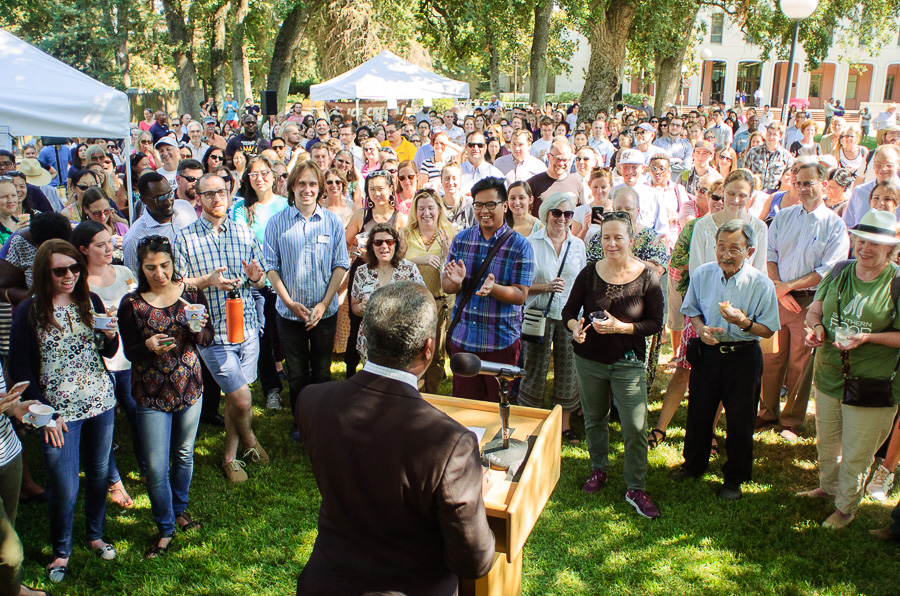
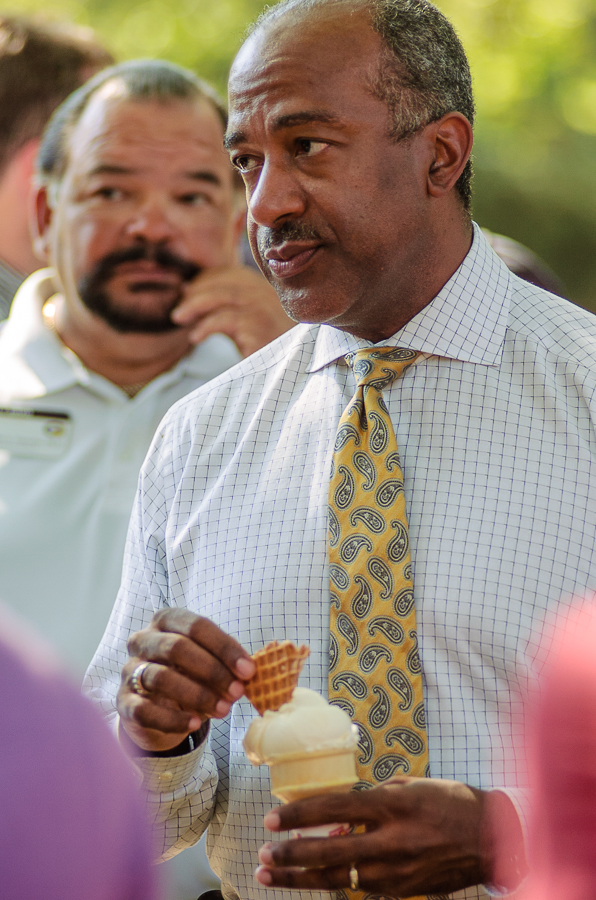
Later in the day, from 3:30 to 4:30 p.m., May attended an Ice Cream Social in Davis, which took place on the North Lawn of Mrak Hall. Around 1,000 people were in attendance.

Written by: Hannah Holzer — campus@theaggie.org

UC Davis hosts C-STEM GIRL Camp for middle school girls

C-STEM GIRL CAMPS / COURTESY

Camp designed to educate girls, motivate them to pursue STEM fields

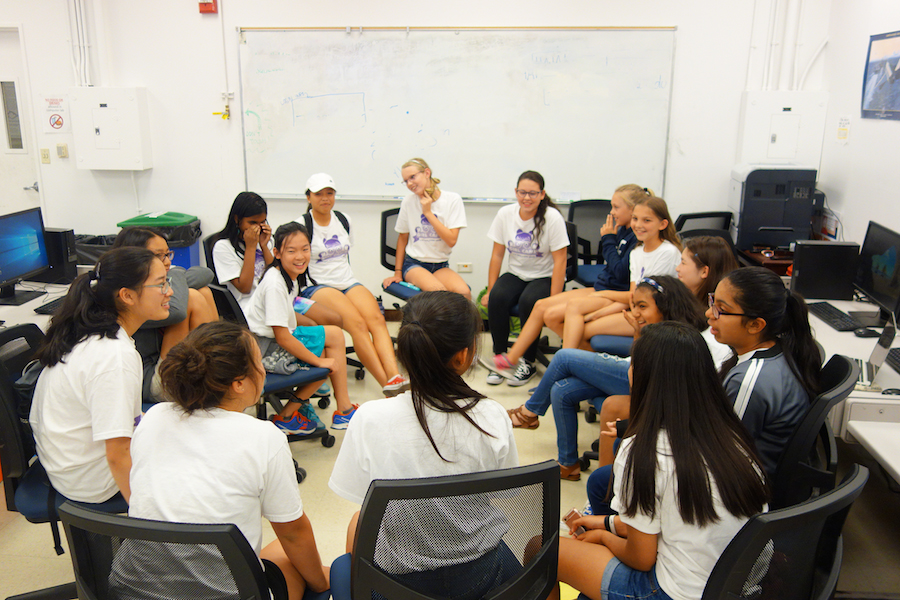
The UC Davis C-STEM Center recently hosted a Girls in Robotics Leadership (GIRL) Camp from July 10 to July 14. C-STEM GIRL Camps are focused on motivating girls in middle school to learn science, technology, engineering and math concepts through robotics, principles of engineering and computer programming.

The camps run in multiple locations through other GIRL Camp affiliates. The GIRL Camps took place in five locations this year, including one in Cincinnati, Ohio. This the fifth year that the camp was held at UC Davis.  

The students of the program are girls going into seventh and eighth grade who are peer-mentored by two high school students, two college students and one female teacher who serves as a mentor and coordinator.

Michaela Byrd, a third-year international relations major, was the coordinator of this year’s program alongside the C-STEM director. Byrd works with UC Davis’ C-STEM center year-round.

“Planning started last December since — especially with the other camps — we have a total of 140 campers,” Byrd said. “The curriculum is updated every year to maximize the value to students.”

Applicants are chosen first and foremost by their experience and progress in school. The program looks for students who have less experience and have an interest in robotics or coding but have not been given an opportunity to pursue that interest. Students can be accepted from all over Northern California.

“The camp is simply designed for girls with an interest in technology and leadership,” Byrd said. “We are trying to equip girls with an interest in technology with leadership skills.”

Students who attended the July 10 to 14 camp took several classes throughout the week on various topics while also working on a group project.

“The biggest project the girls work on during the week is [creating] videos — they need to identify a problem that they see in the world and propose a solution using robotics,” Byrd said. “They demonstrate their solutions in the videos.”

Elsie Luisetti, a seventh-grader from Nevada City, Calif., had a sister who attended the camp last year and wanted to come herself after seeing how much her sister enjoyed the experience. Luisetti attended a Girls Who Code camp locally and became interested in coding.

“I liked that we got to learn C++ — which I haven’t learned before — and I really enjoyed it,” Luisetti said. “I really like the project that we do at the end of the week. Ours is on firefighters. We’re having the robots go in instead of firefighters because a ton of firefighters risk their lives each year trying to put out fires.”

Naomi Baba, a seventh-grader from San Jose, became interested in programming robots after seeing her father code. Baba also attended camps about coding with Java and Python.

“My mom’s friend recommended this program to her,” Baba said. “I said, ‘Sure,’ because I wanted to try new things.”

Baba said her prior programming experience made the classes easier, although she had never used program codes for robots.

“I like the classes. They’re interesting, and they teach us a lot of stuff in one day [such as] coding [and] playing games to help our presentation skills,” Baba said. “Now I feel like I know so much about […] coding.”


Written by: Jayashri Padmanabhan — campus@theaggie.org

In the Footsteps of the Grand Tour

Aggie photographer Taylor Runnells documents a trip through London, Paris, the Alps and Rome

The Grand Tour was a journey embarked upon by young British aristocrats of the 18th and 19th centuries. They were usually people who had just finished university and travelled to the European continent in order to expand their minds — artistically, socially and culturally. Two hundred or so years later, a group of 28 UC students and one Australian followed in their footsteps with the same goals in mind. Our lodging was less elegant, but our travel was much more advanced. Before this trip, I had never left the United States. Now, I have experienced 10 cities in three countries in less than a month, all with a really amazing group of people. I saw landmarks and sculptures and art pieces with my own eyes that I’ve seen in textbooks since I was a child. I’ve walked the River Thames and climbed the Eiffel Tower, and I say, without a doubt, that every day was an experience I will not forget.

On our first day in London, we went on a hop-on, hop-off bus tour through Central London, and happened to hop off right as the changing of the guards was happening in front of Buckingham Palace. There were thousands upon thousands of people gathered at and around the gates, so for me to capture this photo without there being anyone in it was an extremely lucky feat.
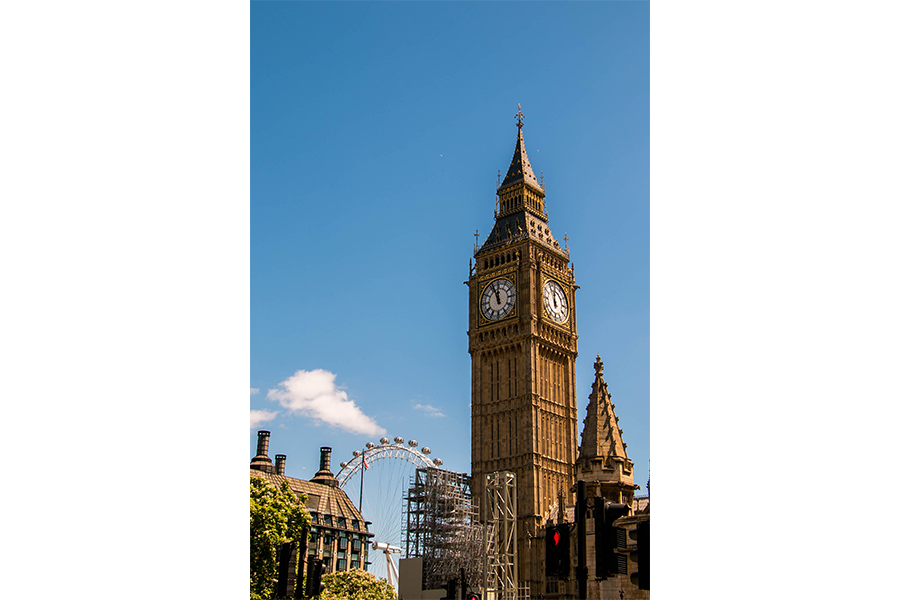
Obligatory photo of the Queen Elizabeth Tower with Big Ben inside. In the back you can see the London Eye peaking through the buildings.
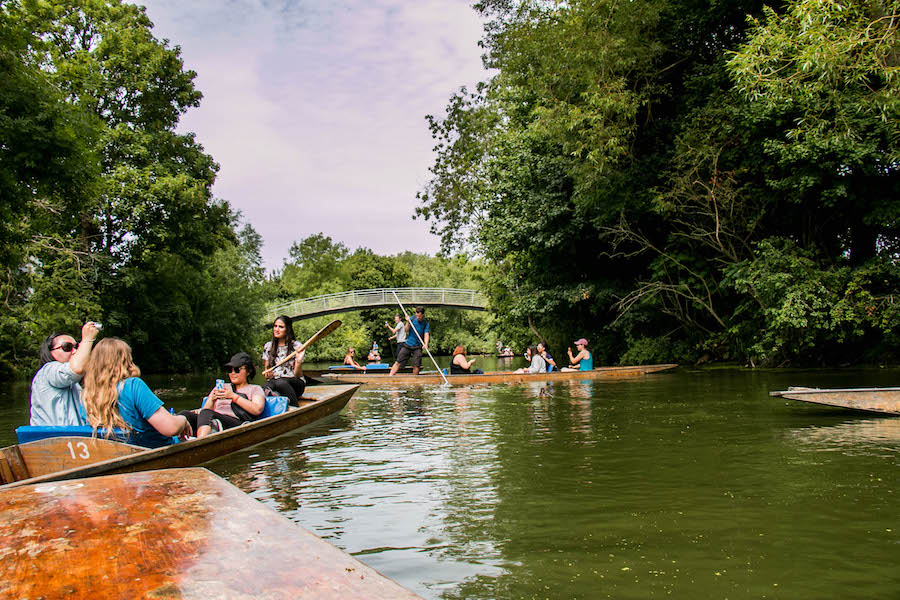
Most of the Grand Tourists had studied at Oxford or Cambridge, so on our fifth day of the program we took a bus to Oxford where our professor, who spent some time studying there for graduate school, gave us a tour of the college. Afterwards, we went punting down the Cherwell River, five people to each boat. The captain of our boat, Lim, had such good control of the boat that we started going in circles in the middle of the river so as to not get too far ahead of our classmates.
On our first free day, a group of five of us took a train from London to the old city of Salisbury, home to the tallest cathedral spire in all of the UK. It is also located only 8 miles from Stonehenge, pictured here. Walking around millennia-old rocks, brought to this spot for who knows what reason, you can almost feel the ancient magic in the shadows of the stones.
After a week in London, we moved onto the second leg of our trip: Paris. Thanks to high-speed rails, it only took us about two hours to get from London to Paris, and only a half hour to get through the English Channel. This is a photo of the view outside of my dorm room in Paris, located only about a 15 minute walk from the Notre Dame and only five minutes from Luxembourg Palace. I was lucky enough to have a balcony, where I spent most of my evenings journaling and drinking French wine.
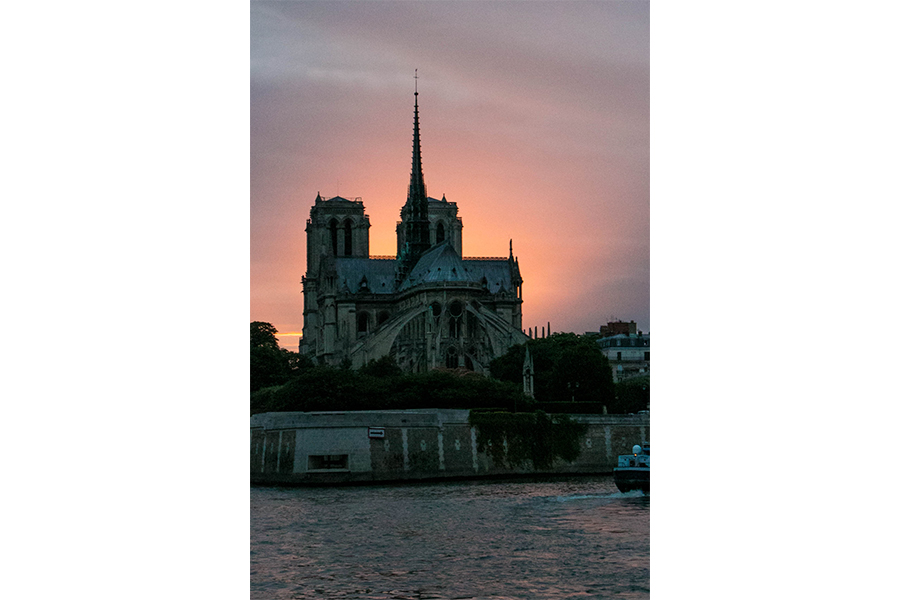
On our first full day in Paris, after climbing to the second deck of the Eiffel, we had a picnic on the River Seine as a class and then embarked on a river boat tour. We happened to pass by the Notre Dame cathedral right at sunset, and I got this amazing photo of the back of the cathedral silhouetted against the sky.
The day before Bastille Day, we journeyed to Château de Versailles, a palace so grand that there is absolutely no question why the French revolted against its residents, King Louis XVI and Marie Antoinette. This picture is of the Grand Trianon, which was basically Marie Antoinette’s escape palace, located about a 20 minute walk from the Château de Versailles. We also visited “Peasantville,” a name given to the peasant village created by Marie Antoinette when she wanted to further escape royal life and instead spend time spinning wool and pretending to be a milk maid.
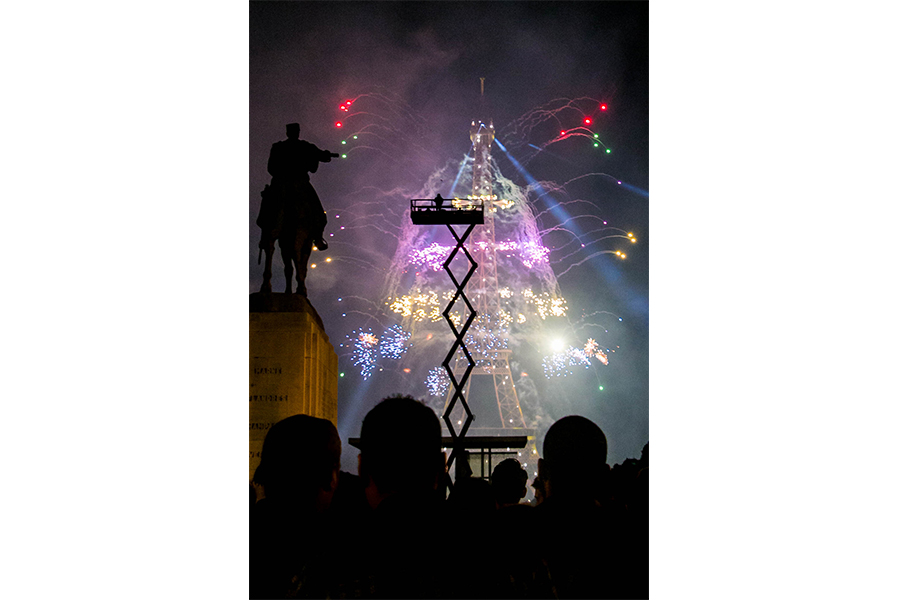
Taken on the Champs de Mars. We were extremely lucky to have gotten this spot, having arrived at around 9:30 p.m. in the busiest part of Paris on Bastille Day, only an hour and a half before the fireworks show began. It was nearly a perfect view, with the École Militaire behind us, the statue of Joffre silhouetted on the left, and a platform that wouldn’t stop ruining all my shots in the front. The fireworks show opened with the French national anthem, followed by music from the latest Star Wars trailer, and also included some Frank Sinatra and classical French orchestra.
Taking a break from urban life, we spent three days in the mountain town of Chamonix. On our first day there, we were able to go inside Montenvers, casually dubbed the “Frankenstein Glacier,” the spot where Victor Frankenstein and his monster reunite in Mary Shelley’s novel. Fitting, then, that I captured this photo of my friend Phil silhouetted against the outside light, looking fairly zombied-out.
After the ice cave, we hiked about 40 minutes uphill to Le Signal, a beautiful trip with vast vistas and friendly mountain goats. A group of us split off afterwards for another hike, where our professor led us to the Plan de l’Aiguille, seen in this photo as the little hut on the hill in the distance. It took us about two hours, with every twist and turn providing a beautiful aerial view of Chamonix down below.
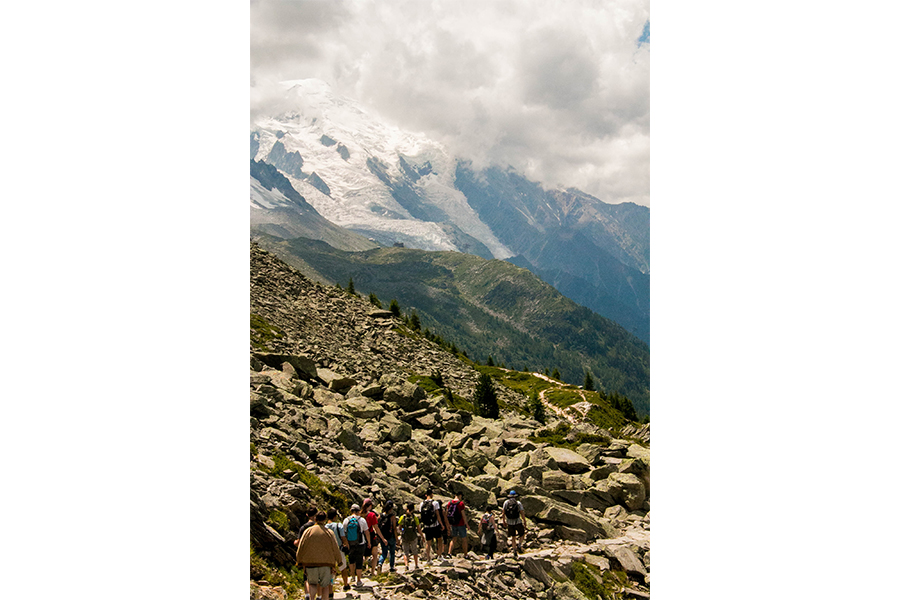
Our reward for the hike. From the hut, we took a telepherique up to Aiguille du Midi, an observation deck built into the side of the glacier at 12,600 feet. From here we saw Mont Blanc, the tallest mountain in Europe, pictured here in the center. It was breathtaking; I have never been so in awe of anything in my life.
On our second day in Chamonix, the majority of our group took a hike up to Lac Blanc. Though the hike sounded fun, three of us decided we wanted to go paragliding instead, so we booked online and met some instructors at the Le Brevent telepherique. After a ride up, we strapped in with our instructors and ran off a 6,000 foot cliff — just our parachute and the wind to guide us. We glided around the mountains, yelling at hikers when we got close enough for them to hear. After an extremely smooth twenty minutes, we landed safely at the bottom of the mountain. It was probably the craziest thing I have ever done, and I’d do it again in a heartbeat.
After Chamonix we took a 12 hour bus ride to Rome for our last leg of the trip. On our second day, we toured the Ancient City, walking through 2,000-year-old palaces and markets. This photo was taken from the palace of Caesar Augustus. The Colosseo is visible in the distance.
Being Grand Tourists, we obviously had to go inside the Colosseo, which was amazing. I’ve been inside countless sport stadiums and arenas, but nothing compares to these ruins.
On our last Monday abroad, we went to the Vatican and were chauffeured around by a lovely little Italian woman named Teresa — “not to be confused with the mother,” as she told us. She was hilarious and informative, combining history with modernity, including pointing out sculptures that looked like Bill Clinton and how certain boys had bigger bay leaves than other ones covering them, “for obvious reasons.” Once inside the Sistine Chapel, however, we had to depart, which was tragic. This is a photo of the ceiling of the Chapel, which I was totally forbidden to take but I did it anyway, because how can you not commemorate such a masterpiece?
Our last excursion as a class was to Pompeii and Naples. Pictured here is the main plaza in Pompeii with Mount Vesuvius looming in the distance, covered, thankfully, by clouds and not ash. After touring the ruins, we stopped off at the Naples Archaeological Museum, home to the more interesting mosaics and art pieces from Pompeii. Included in the museum is the “Secret Cabinet,” which is an exhibit that features ancient pornographic mosaics, used for communication between prostitutes and their customers, and thus are extremely graphic. Our group probably spent a little too much time giggling at ancient phallic statues, to the point that our tour guide was probably a little tired of us afterward.
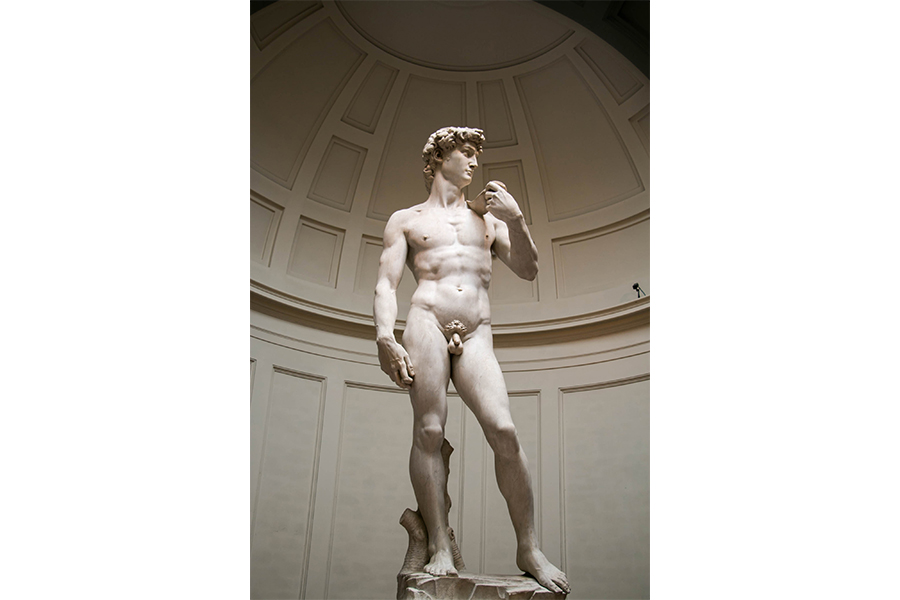
For our last free day, a group of six of us took a high speed rail to Florence. Our first stop was at the Galleria dell’Accademia, home to Michelangelo’s David, pictured here. No amount of warning can prepare you for the sheer size of the statue, or the stunning detail, from the arm veins to the look of fear in his eyes.
After a long day in Florence, traversing markets and gawking at architecture, we climbed up to the Piazzale Michelangelo at the height of the city. This is a picture of Il Duomo di Firenze, a cathedral that has stood since the 1400s. It is, without a doubt, one of the most stunning cathedrals I have seen, and we saw a lot on this trip, including St. Peter’s in Vatican City, and I still found this one more impressive.
The Piazzale Michelangelo is known best for its views, and thus it gets crowded at sunset, for obvious reasons. Here, the Arno River stretches out through Florence, reflecting the sun as it sets behind the mountains. I think Florence was definitely the prettiest city I have ever visited.


The end of the trip was bittersweet; I grew so attached to Europe, my classmates and being able to wander historic cities with people that I grew to care so much about. I was exhausted — physically, mentally, academically and emotionally — but I know there is still so much more to see, both in Europe and the rest of the world. The Grand Tour opened by eyes to different cultures, to history from a different perspective, to a world that is so much bigger than I thought, and I thank my instructor, John Stenzel, our on-site coordinator Dana Armstrong, and every single one of my fellow Grand Tourists for such an amazing experience.

Photos by: Taylor Runnells — photo@theaggie.org

The best of London food

MYAH DANIELS / COURTESY

From grocery stores to the finest restaurants, there’s something to eat for everyone — and every budget

There is a wide variety of food places to explore in London, to say the least. This summer I had the amazing opportunity to study gender and communication with a group of students from UC Davis and other UC campuses. With only a complimentary breakfast included, we were on our own to find food throughout the busy city. It can be incredibly overwhelming, not to mention expensive, to pick a restaurant along the streets. In fact, an average meal costs around £10, about the equivalent of $13. Buying meals of this price two to three times a day, in addition to coffee and alcohol, can add up very quickly. However, through lots of trial and error, I managed to find several ways to eat good food and not go (too) over budget. There are so many great places to eat in London, however, that I had to treat myself on occasion. And with that, here’s a list of great eateries in London for a variety of budgets.

Budget Food Places

  1. Grocery Stores: Stores such as Tesco, Sainsburry’s and Waitrose are located on almost every corner. Depending on your kitchen situation, I recommend preparing as many meals yourself as possible. There are also tons of pre-packaged foods that are perfect to take on the go or on your way to class. Plus, it’s super fun to try brands made outside the U.S. Tesco and Sainsbury’s also offer “meal deals” with their prepared foods, where four items cost only £10.
  2. Street/Market Food: You can find markets all throughout London. Some of my favorites include Borough, Brick Lane, Camden, Portobello and Exmouth markets. There are tons of options for everyone, including vegan, gluten-free and dairy-free options. I like to try a little of everything — from the seafood paella at Borough to the pork sandwiches at Brick Lane. Prices usually range from £5-£12 for a dish, depending on what you are looking for.
  3. Leon: This was one of my favorite places to pop in and get a quick, cheap meal. They have tons on healthy fast food options like salads, curries, smoothies, rice dishes, wraps and much more. Costs can vary, but are usually within the £5 to £8 range.


Mid-Priced Food Places

  1. Nando’s: I was told (many times) I had to get a “cheeky Nandos” while I was in London. Nando’s has great chicken and a variety of delicious sauces to put on top. There are also plenty of delicious side options like sweet potato fries, mint-pea salad and Portuguese rice. Dishes range from £10 to £15.
  2. Dishoom: While there is always about an hour wait, it is definitely worth it. Grab a friend and get in line to experience the ambiance and rich flavors of this modern Indian restaurant. This is a family-style restaurant, where there are no main entrees and instead you order several small dishes.
  3. The Real Greek: If you want great food accompanied by a great view, check this place out. Located on the River Thames, near Shakespeare’s Globe Theatre, this is another tasty, sharing-style restaurant. A friend and I split a tower filled with hummus, dolmades, chicken, tiropitakia and grilled octopus­­, costing us around £15 each.


Expensive Food Places

  1. The Princess of Whales: Accompanied by low lighting and a full bar, this place had a very cool, yet elegant, atmosphere, not to mention delicious food. If you are looking treat yourself to a nice dinner, this is the place to go. I ordered beef carpaccio, followed by lamb rump and dessert. This sort of meal will run around £30 to £50 per plate.
  2. Levant: Naturally, I saved the very best for last. Levant is the best food I’ve eaten in my life, so of course, it’s also the most expensive. Between belly dancers, an entire lamb with sparkling candles and copious amounts of food, it was a night to remember. The restaurant offers an array of shareable starters and main dishes. The entire class shared hummus, salads, vegetables, samosas, lamb, chicken, seafood,  rosewater-soaked fruit, Turkish desserts, tea and more. If you are going to shell out for one night, this is definitely the place to go.

London is an expensive city in general, and the food is certainly no exception. While it would be lovely to have dining commons in the traditional, all-you-can-eat style buffet, that’s not the reality for a study abroad trip. Plus, trying all sorts of different food in a foreign place is an experience worth the cost. Try to save a few extra dollars before you study abroad, but still try to savor all the delicious foods from across the sea.

Written by: Myah Daniels — arts@theaggie.org

The Internet Loves Rotten Tomatoes

CHRISTIE NEO / AGGIE

The rising influence of the Tomatometer holds filmmakers accountable

The art of film critique is not a recent development in the entertainment industry. Film critics everywhere — from big-shot news reporters to smaller movie bloggers — are constantly weighing in on what is great at the box office and what is not. Was it worth the hype? Does it deserve an Oscar? Does the audience love it or hate it?

Despite the fact that movie reviews have always been a contributing factor to a film’s success, ratings are more important in today’s society than ever before. The digital age has transformed the film world in more ways than one, but especially in regard to reviews and box office success. With the emergence of Rotten Tomatoes, an online review aggregator for film and television, people suddenly care about what the critics have to say — or more importantly, what the Tomatometer has to say.

Launched in 1998, Rotten Tomatoes has grown increasingly influential over the years. The website compiles published film and television reviews from various critics in the industry to create the Tomatometer rating, the percentage of positive professional reviews. A Tomatometer rating higher than 60 percent is considered “fresh,” while anything below is deemed “rotten.” Now under the ownership of Fandango, Rotten Tomatoes is quickly expanding in order to keep up with its increasing popularity.

“People don’t want to necessarily take the time to read a full review. They’d rather read the aggregate scores,” said 20th Century Fox executive Chris Aronson to The Los Angeles Times.

Nowadays, a good Rotten Tomatoes score can be a deciding factor of whether or not a movie does well at the box office. Kids, teens, families and adults alike all utilize this resource to find the opinion that matters. With Rotten Tomatoes, all it takes is a quick look at the compiled percentage rating for an immediate test of a movie’s worth.

“I definitely notice the Rotten Tomatoes score whenever I’m looking into a movie,” said second-year civil engineering major Jenny Callan. “It immediately comes up in Google, so it’s hard not to notice.”

Prior to the existence of a website like Rotten Tomatoes, marketing and advertising were the main determinants of a film’s success. Sure, a negative review in The New York Times could cause some damage, but a killer trailer, an eye-catching movie poster and a star-studded cast would be enough to lure in a plentiful audience. Whether or not the audience enjoyed the movie was still to be seen, but at least they made it to the box office. The growing importance of professional film reviews to consumers has changed the level of influence that marketing has typically held. Now, audience members will simply forego a movie entirely if the Rotten Tomatoes score isn’t up to par.

Is this new phenomenon a positive development? For us, as an audience, the answer is yes. Rather than wasting time on a seemingly horrible movie, we can instantly check its ratings to gauge the general public’s opinion. For filmmakers, the answer is, “well, kind of.”

A Rotten Tomatoes score can determine the life or death of a movie; ideally, good films are rewarded with a high rating, while lesser films suffer negative reviews. The solution? Perhaps production companies will have to release better content — things worthy of a fresh tomato.


Written by: Sydney Odman — arts@theaggie.org