54.1 F
Davis

Davis, California

Tuesday, December 23, 2025
Home Blog Page 610

ASUCD units in EcoHub face numerous problems

SAHAR FOROUZANFAR / AGGIE

Issues include rats, cockroaches, lack of adequate space

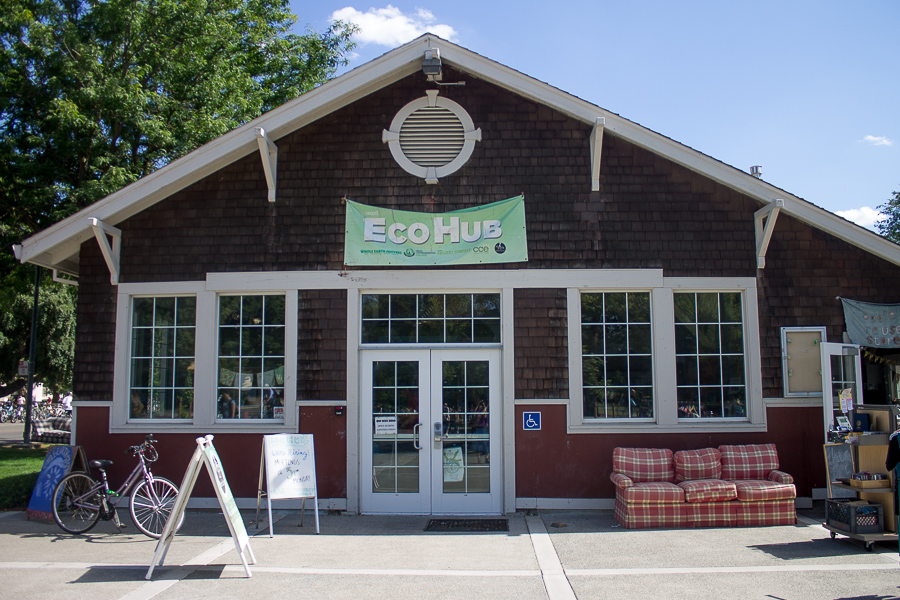
When six ASUCD units moved to the EcoHub three years ago, the unit directors were told that the move was only temporary. However, it now seems that the units, which include Whole Earth Festival (WEF), Experimental College, Aggie Reuse, Campus Center for the Environment (CCE) and Project Compost, will remain there indefinitely.

“The move was originally temporary, but it now appears to not be temporary,” said Amelia Evard, a fourth-year sociology and Spanish major and one of the WEF unit directors. “I don’t know of any plans to move any of us [the units] elsewhere.”

The units have dealt with numerous issues since moving into the EcoHub.

According to Nicole Garcia, a third-year communication major and the unit director for the Aggie Reuse Store, the units’ close proximity has been beneficial in some ways, but the units all need more space than what the EcoHub is currently providing.

It’s been a great experience for us to be able to work closely with the other unit directors, as we’ve been able to forge mutually beneficial relationships with them over time,” Garcia said via email. “But as a drawback, we are all sharing the same space; and as the units grow, particularly ours, we often need more and more space. For us, that’s space we’re using from CCE and WEF, being that the space given to us by ASUCD is incredibly lacking. Our unit in particular holds a variety of events throughout the year, ranging from small-scale to large-scale […] Additionally, as our team approaches sixty to seventy people for next year, the space concerns become even more alarming — that’s more than sixty people in our unit alone, using this space day in and day out.”

Evard and Jess Tierney, a fourth-year environmental science and management major and one of the WEF directors, said that the WEF unit has experienced many difficulties since moving into the building, including a lack of sufficient space.

“On the one hand, some units don’t have an office space, so we are obviously really happy that we do have the EcoHub and that we do have a space where our staff can meet but on the other hand we just got told this year that we’ve been in this room for three years with this furniture and all of a sudden we found out [from Student Affairs] that it’s a fire hazard,” Evard said. “[…] We know that as a unit we are fairly lucky with how much space we have, especially given that there’s a lot of things we need to store for the festival, but I think it also feels like we don’t have, us and I think the other EcoHub units, don’t have adequate space.”

While Student Affairs has told Evard and Tierney that it will provide them with the new furniture, Evard noted that the building itself is still a safety hazard, as it is made out of wood but has no sprinklers.

According to Evard and Tierney, there are also rats inside the building. When the building’s couches were moved outside for WEF, there were rat droppings inside one of them, and many of the outlets in the building no longer work because rats have chewed the wires. Tierney said that one afternoon, she saw a rat in the WEF office.

Currently, there are several rat traps throughout the building. Above one rat trap there is a sign that states “finger-shattering mouse trap nearby.”

Evard said that she and Tierney have emailed ASUCD Business Manager Janice Corbett, who has in turn sent requests to facilities, but the rat issue has remained about the same.

Evard said that there are also cockroaches in the building, and that earlier this year there was a gas leak in the front room, which Evard believes is now fixed.

Two former WEF directors, who wish to remain anonymous, said that during their time as directors they also saw numerous safety issues. In addition to the rats and cockroaches, they stated that there was a light structure hanging by a rope and nails on the ceilings as well as a lack of hot water in the kitchen.

Evard, Tierney and Garcia all wish that ASUCD made more of an effort to recognize the problems the units are dealing with regarding the EcoHub.

“I don’t really know if senators have even been in our office or know what it looks like,” Evard said. “And I just think that if you’re a senator you really should work more closely with the units […] I think it becomes difficult to make people understand the issues we are dealing with in our office when they don’t even necessarily know where the EcoHub is.”

Evard said that both of WEF’s current adopted senators, Jose Menses and Yajaira Ramirez Sigala, have been to the EcoHub, and that Menses has attended a WEF staff meeting. Menses and Ramirez Sigala did not respond to The Aggie’s request for comment.

“I think that ASUCD is trying but they’re not really […] they’re just moving people around to different places,” Tierney said. “You can solve one problem, but then you create a whole host of new problems.”

Garcia echoed similar sentiments.

We’ve mentioned it to ASUCD in the past, specifically several times with the various executive offices (I’ve been with the Store, working with ASUCD for 3 years now, seeing many exec officials in and out of office),” Garcia said via email. “Executive’s short answer is that although there are processes in place to handle these issues, such as URSAC (Unit Relocation and Space Allocation Committee), there are other units who have priority above us when it comes to space concerns.”

Additionally, Garcia said she has brought up these issues to ASUCD senators.

“We’ve also brought it up to Senate several times, especially last year, and they did not have any suggestions or ideas for solutions,” Garcia said via email.


Written by: Alyssa Vandenberg — campus@theaggie.org

Baboons use clues in their social neighborhoods to organize

ROB NELSON / UNTAMED SCIENCE

Simple social rules help predict where wild baboons will position in groups

New research on the spatial organization of baboons was recently published in the journal Proceedings of the Royal Society. UC Davis assistant professor and senior author Margaret Crofoot contributed to the data collection portion of this project.

Over eight days, 26 wild baboons in Kenya were affixed with collars which constantly monitored their locations. The collected data was analyzed to create a model of spatial organization for each baboon in the troop.

“We did this study where we collected simultaneous and continuous GPS data, so we were recording at really high resolutions, 1 GPS location per second,” Crofoot said. “We knew where everyone was all the time for a baboon troop over a relatively short period of time.”

The research team found results suggesting animals use cues from the local neighborhood of group mates to determine how to organize and place themselves. Some animals rely on a couple of close neighbors, while others used larger neighborhood networks to determine their placement.

“We were all surprised at how such a simple mechanism, which is to follow a smaller or larger number of neighbours, can robustly generate organisation that from the outside seems so complex,” said lead author Dr. Damien Farine in an email interview. “When you sit down and think about it, or think about the mathematics behind it, it’s pretty obvious, yet [no one] had really thought about this before.”

The science of how animals communicate and behave together in groups has fascinated researchers for centuries. Whether admiring birds flying together in mass migrations or witnessing massive schools of fish weaving and bending to steer clear of predators, complex behavioral activities have been an intense area of study for researchers.

“For food, for predators, where you are in your group is really important,” Crofoot said. “But, of course, where you are in your group is an emergent property. You don’t choose where you want to be independent of the choices of your group mates because it’s a dynamic system.”

The findings contribute observational evidence to scientists and researchers studying how animals organize themselves dynamically in social groups. Certain confounding factors were accounted for, but kinship ties were not considered in this study.

“We looked at the influence of age, sex and dominance, and found that there is relationship to all those things,” said co-author Dr. Ariana Strandburg-Peshkin. “There was also variation among the individuals. Even though, on average, the adults tended to be more on the periphery than the subadults, there were some adults who did tend to be more central. So it’s not just about your age and sex, it can also be about your individual identity.”

Theories regarding spatial organization of animals have been considered for decades, and confirmation of social cues such as neighborhood size helps researchers understand more about how animals group together and form complex webs of interactions.

“The strength of this project is that it integrates high-tech data collection, state-of-the-art analytical methods and new theory,” Farine said. “Most field studies suffer from a key weakness which is that the study is only observational — it is only by doing experiments that you can really test a hypothesis.”

New directions for this research include experimental studies of spatial organization and studying multiple large baboon troops simultaneously. Adjusting tracking methods to include kinship data among animals would strengthen future studies.


Written by: George Ugartemendia — science@theaggie.org

UC Davis alumnus Micah Grant advocates for equal education opportunities

NKI HERCHE / COURTESY

The role of school boards in helping disadvantaged students

As a first-year student about 10 years ago, Micah Grant sat in the front row of Kleiber Hall during his statistics class. His professor came in sick one day and asked the class if they needed to go over the lesson on rudimentary statistics. If the students felt they did not need to review the material, they could get up and leave. The lesson was from a ninth-grade level, but it was the first time Grant and other minority students had seen it. Everyone behind them walked out, and, as they were about to do the same, their professor stopped them and gave them their first lesson on rudimentary statistics. The material being new to the minority students in Grant’s class illustrates the differences in the type of education that students in the class received and speaks to larger disparities within schools across California.

“It’s reality, in this state: minorities are not graduating at the same rate and learning at the same rates,” said Grant, now an elected school board member for the Natomas School District. According to a 2015 report on Educational Attainment in the US, only 22.5 percent of African Americans and 15.5 percent of Latinos hold a bachelor’s degree, and only 0.7 percent of African Americans and 0.4 percent of Latinos hold a postgraduate degree.

Location can also be a factor in such disparities. Grant grew up in the inner city of Los Angeles and faced notable hardships. He remembers that his family could not afford after-school programs or babysitting, so he would go to work with his mom. He would also have to be careful going to school because of the gangs that surrounded his neighborhood. Despite these sources of suffering, Grant still managed to get into the Gifted and Talented Education (GATE) program. He recalls being misplaced, put in a regular classroom; he noticed the differences between that atmosphere and his usual GATE classrooms. The teacher, Grant said, was not as engaged, classrooms were overcrowded and the teaching was largely left to the students.

“The quality was different,” Grant said. “There was no interest from the teachers, no experience and low engagement from them.”

One report from the Public Policy Institute of California in 2000 found that one of the biggest factors associated with student achievement was the level of teacher experience. Disadvantaged areas, filled with minorities, had more teachers with less experience. Disadvantaged schools had “less educated and less highly experienced teachers,” which the study said led to “fewer advanced classes” offered in high school, which are often used to prepare students for college.

The same study emphasizes that inequality is based on different “level[s] of resources that California’s schools receive.” Again, causes of variation are teacher preparation, which is positively linked to experience, and curriculum, like college-ready courses. The study also shows how one of the biggest factors, socioeconomic status, comes into play in shaping the “levels of resources.” Such variations are key factors in educational disparities across schools in California.

Grant has done his part in education as the communications press secretary for the Board of Equalization, where he focuses on taxpayer education. He also serves as the vice-chair of California Black Media, a statewide information and education network that reaches over 1.5 million people. Additionally, Grant worked in the State Legislature consulting with the former vice-chair and current Senate Education Committee member Bob Huff, promoting policies and reforms that help ensure every child receives a stellar education, as illustrated by Grant’s website.

Grant is trying to address the problems of inequality he sees in the schools within the Natomas School District, including over eight elementary schools, three middle schools and three high schools. During his campaign for school board member of the Natomas School District, he knocked on over 8,000 doors, having realized that many people were unaware of the local governmental roles that regulate the schools. Grant says some parents don’t know what their rights are, what they have access to or who represents them.

According to Grant, parents have the right to petition, the right to complain and “the right in California to send their kids to the school that is going to help them receive the best education.” His first mission as a school board member is to advocate for and spread awareness about parental rights.

“Students should not be trapped in an environment based on their zip codes,” Grant added, as another example of parental rights. But even when there is a movement of students from one school to another, Grant also points to the problem of vouchers. According to Ballotpedia.org, critics contend that voucher programs divert funds from traditional public schools, thereby generating unequal outcomes for students. School choice programs improve educational outcomes by expanding opportunity and access for historically disadvantaged students, as well as by empowering parents.

Grant has not found vouchers to be a negative thing. Kids should not be subject to “a bad situation because [of being] afraid to send money somewhere else.” Students should have the right to go to any school they want, and “school by zip code” should not be a regulator. Grant says that vouchers and grants play a similar role, but the difference is the leniency that grants have in comparison to vouchers. Creating the same leniency for vouchers could increase opportunity for students and allow parents to have more freedom and choice when it comes to their children’s education.

Grants are available to students of every age, from preschool to college, one of which is the Cal Grant. Students can be given a $5,000 Cal Grant, and the state will not limit them to attending certain schools. The Cal Grant can be used for the school of the student’s choice, even with preschool grants. In terms of grants, there is a preschool program and a college program, but little in between. As a board member, Grant’s focus is “to make sure that there is equality of opportunity.”

In 2013, Governor Jerry Brown of California passed the Local Control Funding Formula (LCFF), a funding system which creates funding targets based on student characteristics and provides greater flexibility to use funds in order to improve student outcomes. The California Department of Education said that the LCFF replaced a 40-year-old finance system for K-12 schools. The legislation has fundamentally changed how local education agencies in the state of California are funded. According to Grant, the state is doing something right; the LCFF allows California to “send money to districts that are more impoverished, low-performing and need help.”

Although LCFF is a step forward, there still need to be more policy changes. Tenure, a form of job protection that keeps teachers from being fired for personal, political or experiential reasons, prevents more experienced teachers from being fired in favor of newer, less expensive teachers. But some parents and people like Grant argue that protective tenure also makes it harder to remove poorly performing teachers and “that it is granted too quickly, after two years.”

The most significant aspect which needs to change in order to minimize educational disparities, Grant said, is education policy. With Prop 98, California has a $1 billion budget, and spends 40 percent of the general fund on education.

“[California] spends the most on public education, and we get the least results,” Grant said. Disparities among minorities, teacher experience, college-ready courses and other policy problems all affect student performance.

Grant’s personal experience at UC Davis sheds light on the differences in students’ level of college preparation. Grant hopes to create equal opportunities for students in the Natomas School District but wants students to know a lesson he learned from his father: “Government cannot tell you what you are worth. [… You] have to assign value to yourself.”


Written by: Marisol Beas — mbeas@ucdavis.edu


Disclaimer: The views and opinions expressed by individual columnists belong to the columnists alone and do not necessarily indicate the views and opinions held by The California Aggie.

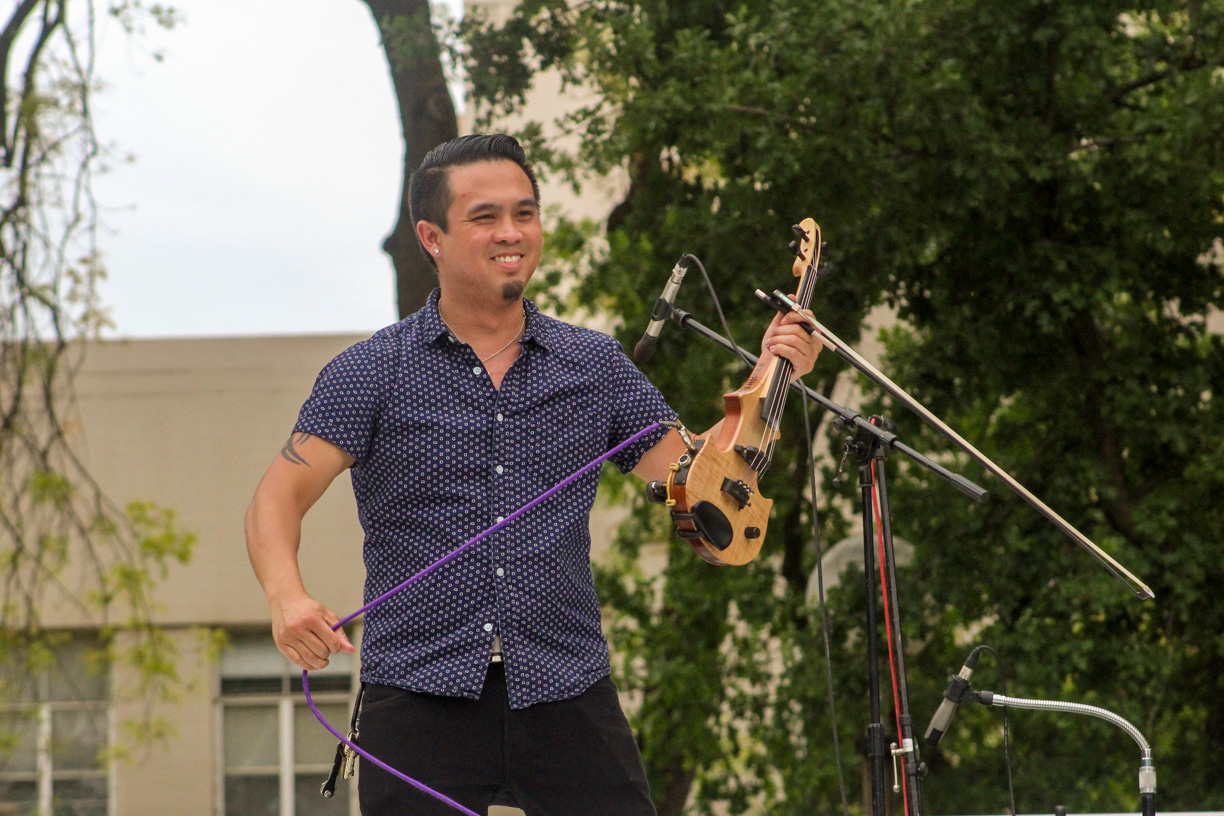
Student Sounds: CryWolffs Violin

RAUL MORALES / AGGIE

Graduate student talks violin, metalsmithing, musical sculpture

Corey Wolffs is an artist. Mediums, outlets, instruments — they do not confine or even define his craft. How could they? Wolffs is the inventor, the maker, the player, the adhesive that both literally and physically fastens his work together.

“For my undergraduate thesis project, I made musical sculpture — acoustic instruments with strings,” said Wolffs, a first-year student in Master of Fine Arts. “I worked with wood a lot, and metal and membranes and strings, which are musical instruments on their own. It wasn’t until then that I made that realization that a violin isn’t a magical thing; a violin and a guitar is a box with a string, and a little piece of wood that holds the string up.”

Working and experimenting with the physicality of instruments gave Wolffs new perspective on the social implications of music. Music is less about producing culture; rather, culture produces music.

“Every culture across the entire globe has a variation of violin, somehow,” Wolffs said. “They all sound different, and they all produce vastly different types of music, and they are all played predominantly the same way — and I find something very amazing about that. You can also take a violin, this magical thing, and put it in any culture, and every culture is gonna take that violin and use it almost how it was meant to be used, but use it in a completely different manner. So musical instruments are contextual and social objects, in a way.”

As a lifelong musician, Wolffs’ work with violin was both the catalyst and the product of his Bachelor of Fine Arts from California College of the Arts. Wolffs took a break from violin during the beginning of his undergraduate career, instead focusing his efforts to get a degree in metalsmithing and jewelry making. The years of consistent practice and playing were put on pause — but only temporarily.

“As a kid, I would have to go to violin lessons every Tuesday for lessons and every Friday (late at night) for group lessons, so I didn’t know what a Friday was like until I got to college,” Wolffs said. “For my first week at college as a freshman, I sat in my dorm and my roommate would ask, ‘hey, what do you want to do?’ And I’d be like, ‘I have no idea, I have never done this before.’ And I didn’t play music for about three years of college. I forgot everything, and I just focused on metalsmithing.”

Though Wolffs put down the strings, his hands never stopped moving. His work with musical sculpture — a seemingly impossible task for the intangibility of music — was a way for his music to find its way to the physical world.

“All crafts and all the creative work that we do — it’s kind of all the same,” Wolffs said. “You have a rough thing that you forge into a rougher, but almost finished thing, and then you polish that all out. The only difference between all of them is the skills that you have to use and the material. But the actual song, the actual drawing, jewelry making, painting, writing poetry — you start with something rough that’s from your brain, and you have to make that real somehow.”

Wolffs’s polished work takes many forms. With his musical project, CryWolffs Violin, his self-defined “urban” sound is a product of mastering many mediums: the physicality of his playing, the self-produced tracks that accompany his violin and the flexibility of his sound. However, Wolffs also attributes his music to situational factors.

“I graduated in 2010, which was probably the worst year to graduate with the recession,” Wolffs said. “And I had a few jobs here and there — not good jobs, nothing fulfilling or anything in particular — but they were all jobs I could do during the day, and just forget about after I left. So I had all this free time, and I started performing at open mics, and then I started helping out at the open mics and from those open mics people started asking me to play at their shows […] So after a period of time I was getting booked more, paid more, and it was kind of just something I almost accidentally fell into.”

Wolffs also draws inspiration from more unexpected sources. After working and performing at an open mic in Sunnyvale, California, Wolffs was inspired by his fellow performers. He explains, with genuine enthusiasm, that the vulnerability of performance is compelling — magnetic, even. It is what makes us human.

“What always inspired me to get up and play was watching other musicians get up and play,” Wolffs said. “The people who don’t necessarily do it for a living, or who are trying to do it for a living; there’s something very inspiring about seeing people take that step of performance, which most people are scared to do […] being able to step in front of other humans and materialize that thing in your head.”

Similarly, Wolffs’s “urban” sound is a product of his environment. As a classically trained musician — specifically, a student of the Suzuki method — Wolffs can easily cater his sound to that of his audience. And, because his beginnings in performance were as an open mic night performer and eventually as a privately hired violinist, his music edged into genres like hip-hop and pop.

“Performers have two avenues they can take: one, they can do what they do, and do everything in their style, or they can go with the route I chose, which is — you can do it in your style — but you have to tailor [your performance],” Wolffs said. “In festival work, you have to guess what the crowd wants, and obviously you never get it right all the time, but you can always bet that there’s one or two songs in a particular genre that they’ll like.”

To achieve such adaptability with his music and his performance, Wolffs is also a self-taught producer (with the exception of a friend that gave him a crash course in Ableton software). Wolffs explains that his violin is typically the melody line, but he can produce his tracks as a complement to his playing.

“Being able to create your own tracks, you have complete control over the sonic experience for both yourself and the audience,” Wolffs said. “So it’s not just for the audience, it’s having something you can follow along to, that you know you can create a musical conversation with […] As a producer, I have the ability to shape and perform the experience how I want it to be perceived.”

Moving forward, Wolffs is confident in the future of his music — not in its public success or his potential fame, but in its ability to satisfy a deeper, human desire to connect.

“I was always my own manager for CryWolffs Violin. I never got a manager or agent, so I kind of go wherever it goes. I never was trying to be a Bruno Mars. I was doing it because I like to get up on stage and perform, and that often manifests itself in other ways, whether that be a coffee shop or Quad stage […] Part of my humanity-ish thing is performing. And this satisfies that.”


Written by: Ally Overbay — arts@theaggie.org

Humor: Gary May in shock: “I’m the chancellor of what?”

JAY GELVEZON / AGGIE FILE

Gary May apparently did not understand that he’s the chancellor of UC Davis

Reporters from The Aggie interviewed Gary May, the current chancellor of UC Davis, about how he felt regarding the direction of the university under his guidance. We found Gary May in his office, constructing a Lego replica of the USS Enterprise from Star Trek that took up his whole desk. There was nothing else in his office except for boxes of Lego sets.

“Oh, hey guys. I wasn’t expecting you to come so soon,” May said as he shoved the Lego set off his desk. “What do ya need?”

We asked him his feelings on being the chancellor of a great university such as UC Davis, and how he felt regarding the pressures and responsibilities that were undoubtedly beginning to weigh on him. He was confused.

“What do you mean? What pressures? All I do is build Star Trek Lego sets all day long,” May said, obviously very confused.

We told him that we understood him to be the chancellor of UC Davis.

“I’m the president of what? I thought that I was just applying to be the president of a chess club! I guess that explains all the media coverage I’ve been getting lately. Huh. Well, I mean, I’ll still get to build my Legos right? I’m 53! I want to start to wind down my life a little bit. I’ve already done all that administration school stuff. I thought that life was behind me. But what are ya gonna do? I guess I have to take this responsibility and own it.”

We decided at this point it would be best to leave May to himself. It might take awhile for him to fully grasp the level of responsibility he has.

It’s not clear yet what will happen going forward. But whatever happens, we don’t have a doubt in our minds that Gary May will do a great job leading the university — once he’s done building the Lego sets.


Written by: Aaron Levins — adlevins@ucdavis.edu


(This article is humor and/or satire, and its content is purely fictional. The story and the names of “sources” are fictionalized.)

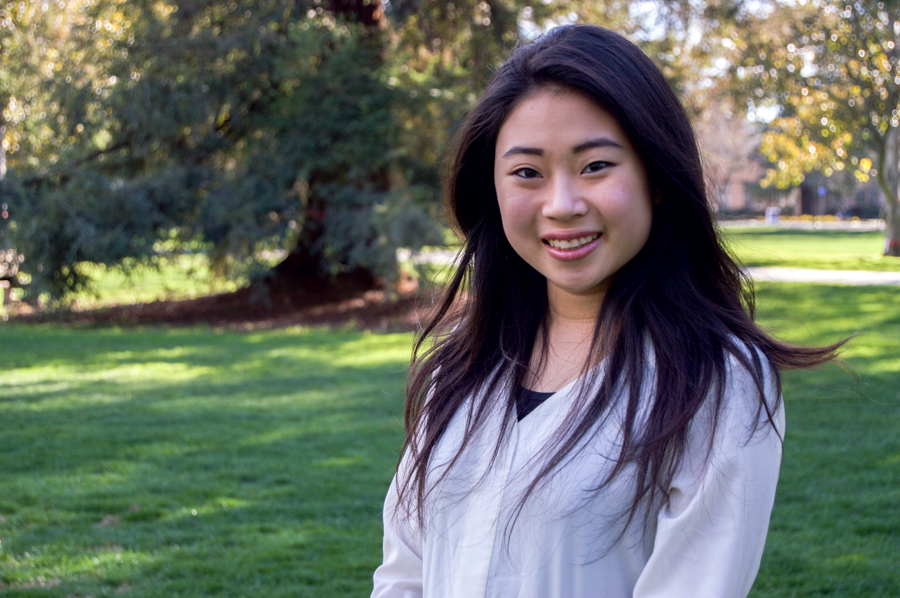
Samantha Chiang resigns as ASUCD senator

ARIEL ROBBINS / AGGIE FILE

Interim senator to be appointed

Samantha Chiang, a third-year English major, resigned from her position as an ASUCD senator on May 22 due to personal matters.

Chiang had served as a senator since Winter Quarter of 2016 and was recently reelected during Winter Quarter 2017. During her terms, Chiang advocated for improving the mental health resources available on campus; she worked to establish both the Mental Health Conference held in February and the recent Mental Health Awareness Month.

Chiang said the choice to resign would be best for her self care, but that she was appreciative of the platform ASUCD gave her to be a voice in the mental health community.

“I am infinitely grateful for my time in the association that has empowered me to make tangible change in the mental health community on campus, but the truth is that an institution can and will never love any individuals,” Chiang said via email. “ASUCD, as a structure, will always reinforce the hegemony, particularly gendered and racial power dynamics. I resigned because I do not need to be complicit in my own deteriorating mental health in order to advocate for my community. I’ve taken the resources and connections I need to continue to spearhead mental health advocacy effects and, rest assured, I fully intend to do so.”

According to the ASUCD Constitution, Chiang’s replacement will be appointed after the 2017 ASUCD Winter Quarter election votes are recounted excluding the votes she received. The candidate with the next highest number of votes will be offered the senator position. Should that individual decline the position, ASUCD President Josh Dalavai has authority to choose an interim candidate from a pool of applicants on vacancy.ucdavis.edu who would serve until the 2017 Fall Quarter election.


Written by: Lindsay Floyd –— campus@theaggie.org

Davis Pride: Responding to adversity in colorful stride

BRIANA NGO / AGGIE FILE

Month celebrates messages of strength, community, empathy

For many in Davis’ LGBTQIA community, feelings of safety and acceptance can be hard to come by. This May, UC Davis’ Pride Month and festivities in the city of Davis showcased the community’s vibrant resilience to the adversity it faces while recognizing folks’ unique identities. Pride events speak volumes to the strength and courage of a community that often lives in fear of others’ intolerance for their identities.

“I have a lot of friends who have experienced hate crimes just walking in Davis and there’s a lot of people that feel that other people don’t deserve to exist.” said Rosie Romick, a fourth-year plant biology major and co-president of Lambda Delta Lambda.

Pride in the City of Davis was born out of such violence committed upon a Davis resident. In 2013, Lawrence “Mikey” Partida’s neighbor brutally attacked him for his sexual orientation — to the extent that he could not walk. After the incident, Partida’s mother formed the Davis Phoenix Coalition to combat intolerance with programs and events such as the annual Davis Pride Festival and Run for Equality. No Pride events existed in Davis prior to the Davis Phoenix; the coalition united previously disjointed efforts of Davis’ different queer organizations.

“When I was staying here [in Davis], I was looking for some other queer establishments and I didn’t see much here,” said Johnathan Celestin, a recording artist headlining Davis Pride as the first stop in his world tour. “The fact that [Gloria Partida] was able to create [Davis Pride] amidst an absence of [queer establishments] — she filled a vacuum.”

Partida’s work has also focused on promoting the visibility of the LGBTQIA community so that individuals and their loved ones supporting them do not feel alone.

“We started this coalition because we wanted to work against bullying and try to promote an inclusive community,” Partida said. “When families find out that their child is gay or questioning, they often don’t know where to go or what groups are out there and that’s really hard, especially because they’re trying to do that quietly. It’s good to be very visible so that people can find you.”

UC Davis’ active LGBTQIA community has also made itself more apparent over the years via 16 queer-focused student organizations, a LGBTQIA resource center, queer dormitory housing in the Rainbow House, support groups and counseling.

“I went to a workshop yesterday actually and a couple people came up to me,” said Jade Lounds, a second-year environmental horticulture and urban forestry major and a resident advisor for Rainbow House. “They were like, ‘It’s really cool that you have this space because I didn’t know that there were other queer people out there.’ I think it’s great to just have that sense of community. I wish we could have more queer-focused events.”

Though students have noted the program has room for expansion, UC Davis has continually provided support to its LGBTQIA students through the LGBTQIA Resource Center, which is a hub for all of UC Davis’ queer-inclusive efforts. According to Bee Curiel, a fifth-year Chicano studies major and one of the Pride Month community coordinators, Pride Month and the community have grown concurrently since the center’s move to the Student Community Center. By 2015, the center had extended Pride at UC Davis from a week to an entire month.

“Different political events that have happened called for unification of the community here,” Curiel said. “[With] the theme for this year, ‘Rest and Resist,’ we wanted to highlight ways of resistance in the current political environment that we face and ways of healing.”

UC Davis’ Pride Month programming included Movie Mondays, Workshop Wednesdays, a pool party sponsored by the Recreation Pool, handing out snow cones on the Quad to support visibility and the grand opening of a gender-affirming clothing closet for trans and nonbinary individuals. These events are particularly important in the current political environment.

“It has gotten a little more hostile in different situations,” Curiel said. “As a transperson, I’ve been a little bit more scared to be open and vocal about my own needs […] because it’s been polarized now. It’s very clear what people think and it can be kind of scary.”

Spaces like the LGBTQIA resource center and Pride events can make queer students feel safe. For example, a wide variety of performances reflected the diversity of the identities at the Davis Pride Festival in Central Park on May 21. Drag queens, a cheer team, a choir, UC Davis’ alumni band, a fashion show and an international recording artist all made the stage for a multi-generational event only Davis could offer.

“It’s been a phenomenal thing,” said Sandre Nelson, the director of Davis Pride. “The community of Davis has really supported this idea that we had three years ago to make it go from this little, little pride to a great success.”

Nelson said the hometown event has grown from 500 attendees to an estimated 20,000 this year.

“The kiosks here, they’re all different businesses and they all have a different goal with somehow supporting marginalized voices,” Celestin said. “To see how people are trying to amplify marginalized voices in a unique way to Davis, I think that’s one of the things part of this experience that I just think is really cool.”

Davis Pride and UC Davis Pride Month events invite the general community to understand, recognize and uplift folks.

“The queer community at Davis is super active — especially the QTPOC [queer, trans people of color] community,” Lounds said. “It’s a lot of emotional and physical work to be an activist and when you’re constantly fighting, you can […] feel really worn out. I think that that is where the allies can step up. You can’t just call yourself an ally […] without actually actively fighting for the rest of all people. [But] if they’re not personally invested in it, then they don’t show up.”

For many, Pride events provide a start to building bridges of empathy.

“I’ve traveled around the world and it’s so funny [because] people think that they are so different but when you go to a lot of these prides, you see that people have so much more […] in common,” Celestin said. “If people just take the time to experience the commonalities that we have, you see that life is a lot more beautiful and less complicated than we like to make of it.”


Written by: Kristen Leung — features@theaggie.org

A second wind for desert tortoises

GENESIA TING / AGGIE

Design of wind energy facilities impacts predators, prey

Although habitat disturbance is hardly ever viewed as favorable for wildlife, the presence of wind turbines can lead to unique opportunities and advantages for some species, such as desert tortoises. According to a recent study published in The Journal of Wildlife Management led by researchers at the University of California, Davis and the U.S. Geological Survey (USGS), the design of wind energy facilities creates special patterns of behavior in both predators and prey.  

Scientists surrounded the entrances of 46 active desert tortoise burrows with motion-activated cameras in a wind energy facility near Palm Springs, Calif. The results from the video recordings show that visits to burrows by predators such as bobcats, gray foxes, coyotes, black bears and western spotted skunks decreased in proximity to wind turbines and increased closer to dirt roads.

“These results suggest that infrastructure associated with large-scale wind energy facilities, such as dirt roads, may act as movement corridors for terrestrial wildlife,” said Mickey Agha, the study’s lead author and a UC Davis graduate student in ecology. “Alternatively, lack of mesocarnivore sightings closer to wind turbines could suggest avoidance by terrestrial animals.”

Dr. Jeffrey Lovich, USGS scientist and a co-author of the study, added that the sound and vibrations from wind turbines may cause the mammals to avoid areas closer to turbines.

Wind energy facilities can fragment habitats and thereby diminish populations of large carnivores, but small carnivores such as foxes and coyotes are often able to adapt to the modified environment.

Additionally, the discovery that dirts roads can lead to species success in desert tortoises is beneficial to consider when designing the layout of wind energy facilities.  

“Minimizing the amount and extent of roads that are built to service wind turbines may benefit desert tortoises by eliminating a popular corridor for predators,” said Dr. Brian Todd, the study’s other co-author and a UC Davis professor of ecology.

This study shows the immense impact that the infrastructure of wind energy facilities can have on wildlife behavior.  

By understanding wildlife’s response to changes in the wind energy landscape through studies like this one, scientists hope to implement better designs for wind energy facilities while also considering the effects of human actions on species occupying a given habitat.


Written by: Harnoor Gill — science@theaggie.org

Undergraduate seniors in Design Department to showcase a variety of work

ZOË REINHARDT / AGGIE

Pieces range from apps to furniture to fashion

The Department of Design will present its first-ever undergraduate senior showcase from May 22 to June 18. For anyone confused as to what the subject of design entails, fear not — the exhibit’s preparer, Chris Jones, has clarified what it means to showcase design.

“The short answer to that is that it’s a lot of different things, and maybe the basic principle is that everything that we interact with as people is designed in some way,” Jones said. “So this show is nice in that you do see how these things kind of permeate throughout our culture from everything from apps to more straightforward image design or layout or typography or textiles. It’s kind of neat to see how some design principles are overarching across many kinds of disciplines and ways of making things.”

Design is certainly varied in its medium, preparation and context, ranging from textiles and digital media to product design and beyond. The exhibit includes some independent projects, such as a bus that was theoretically designed to transport disabled and elderly people, as well as product-design projects, like a new design for packaging mooncakes.

Brontë Blanco, a third-year design major and assistant exhibition designer, found it rewarding to work on the exhibit, as she was able to collaborate with various on-campus clubs and artists, whose work will also be showcased. For the months leading up to the exhibit, she worked on exhibition design, curation of the materials and organizing submissions from design clubs and students. Blanco said that the showcase is meant to celebrate the works and accomplishments of individuals from the Design Department but also to give the public a better understanding of the variety of design coming from the department.

“I think it’s exciting to know that this is the first of many to come, and the point is that this exhibition is supposed to be reflective of the senior student body, so the seniors are supposed to work alongside whoever is designing the exhibition to put their own feel on the exhibition,” Blanco said.

She also noted that the exhibit may be completely different years from now, but will still be representative of graduating seniors’ hard work.

Marissa Meier, a fourth-year design major, has two pieces being showcased in the exhibition. One is a small wooden chair made of vinyl sheeting and bucket straps, which she created in her furniture design class. The idea is that the chair can be taken apart and carried, since it doesn’t have any hardware. Another is an interlocking seating installation group project that was featured in the Chicago SOFA (Structure Objects, Functional Art and Design). Only five schools are accepted, and UC Davis is the only one from California to be included almost every year. Meier and her peers “tried to being something that’s uniquely UC Davis,” according to Meier.

In terms of the undergraduate senior showcase, Meier noted that it personally motivates her to see what other students are working on throughout the school year.

“A lot of people in the Design Department take different multidisciplinary approaches on the projects that we do,” Meier said.

The showcase coincides with the design commencement on June 17, so many of the seniors will be there to discuss their pieces and answer any questions, including the professors who teach the classes from which the projects were inspired. All pieces include wall tags that note which class the piece was made in for those who may be seeking some inspiration when it comes to signing up for a design class.

The exhibit is open Monday through Friday, 12 to 4 p.m. and on Sunday from 2 to 4 p.m., from now until June 18 in Cruess Hall.


Written by: Pari Sagafi — arts@theaggie.org

Davis Community Advising Network reaches out to a diverse student body

HANNAH WODRICH / AGGIE FILE

The need for cultural competency in counseling

At times, students may find it hard to relate to others at UC Davis. Many come from diverse backgrounds such as being first-generation college students, having economic hardships or growing up with a different culture. Oftentimes these students have no one to turn to. It’s because of this diversity that cultural competence is needed, and it’s also why the SHCS Community Advising Network (CAN) was created.

In 2009, UC Davis created the only program of its kind in California: CAN, which consists of six ethnically-diverse counselors trained in multicultural competence. These counselors have crucial understandings of diverse backgrounds in relation to the ethnicity, race, gender and culture of students. Counselors trained in multicultural counseling have a better understanding of dissimilarities in religion and spirituality, sexual orientation, gender, age, maturity, socioeconomic class, family history and cultural background.

CAN counselors are able to go beyond the Western style of counseling and use a more culturally-sensitive approach. The CAN counselor’s goal is to help everyone, including professors and faculty — underrepresented or otherwise — achieve their goals, as well as address any hurdles that may be affecting their academic success.

They are diverse individuals who provide a range of services, including individual counseling, group counseling and career counseling. CAN counselors can help students with issues like time management, academic difficulties, depression, addiction issues, family expectations, relationship issues, balancing activism and academics, questioning sexuality and coming out, cultural adjustment, immigration concerns and stress management.

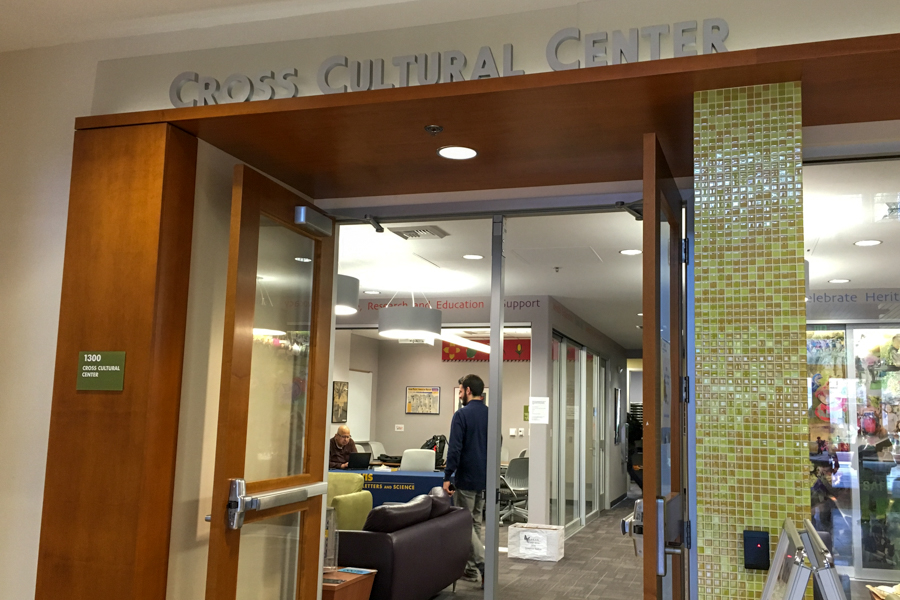
CAN’s six community counselors are partnered with 12 departments and programs at UC Davis, including the Cross Cultural Center, the Educational Opportunity Program, the Women’s Resource and Research Center and many more. With these partnerings, the CAN team hopes to increase access to mental health services for students from marginalized and underserved communities.

The CAN team increases access through visibility with various locations and partners. Paul Kim, the director of Multicultural Services, said in an email that the CAN team concentrates on developing relationships and “being part of the communities that they work with.” He added that, “for many students, it is more culturally congruent to speak to someone in their community about challenges that they are experiencing.”

With this approach, Kim said, the CAN team can help decrease the stigma that students face when they seek mental health services. The CAN program is a great way to serve these students because they do not have to go through paperwork, and there is no formal intake process. Counselors have open office hours throughout the week, and students can also be seen anonymously for consultations. Kim stated that, with this approach, “barriers are decreased and access to support is more readily available” — a benefit for all students.


Written by: Marisol Beas — mbeas@ucdavis.edu


Disclaimer: The views and opinions expressed by individual columnists belong to the columnists alone and do not necessarily indicate the views and opinions held by The California Aggie.

Davis Chamber Choir Spring Concert

CHAMBER CHOIR / COURTESY

A fusion of classical and pop

The Davis Chamber Choir (DCC) Spring Concert will be the choir’s third major concert this year. They will sing both a cappella and to musical accompaniment as both a full group and in smaller group combinations. Their music ranges from classical and choral works to arrangements of pop and jazz songs.

Bailey Cooke, a second-year music major and the choir’s musical director, is responsible for teaching music, leading rehearsals and performances, organizing concerts and conducting the choir.

“The planning process is usually similar in each concert,” Cooke said. “The repertoire is selected about two weeks before the quarter starts and we rehearse twice a week for two hours each.”

According to Cooke, some of the highlights of the concert include “A Boy and a Girl” by Eric Whitacre, “Alleluia” by Jake Runestad, “The Heart’s Reflection” by Daniel Elder and Chanticleer’s “Cells Planets.”

There are 29 singers in the choir this quarter, and their board consists of six singers elected by the ensemble. Positions include the treasurer, administrative director and music coordinator.

Lisa Bell, a fourth-year exercise biology major, is a current member of the choir and former administrative director and treasurer.

“There are a variety of pieces. They have this shimmer effect because they have chords built on top of each other with 8 part harmonies,” Bell said.  “We finally have everything memorized for this concert.”

Nicole Daghighian, a third-year global disease biology major, is an alto in the choir.

“It’s a fun mix of songs and we are a pretty big group and we have a few really great soloists and good small groups that are fun because they sing pop songs,” Daghighian said.

The choir performs a variety of songs that fuse choir and pop, and audience members can look forward to hearing such arrangements at their spring concert.

DCC has grown a lot each quarter, so at each performance there is a larger concert and audience. The group really focuses on musicality and methods of sight-reading, setting it apart from other choirs.

The show will be held on Saturday, June 3 from 8 to 9:30 p.m. at the Davis Community Church at 412 C St. There is no entry fee, but a $5 donation is suggested.


Written By: CaraJoy Kleinrock — arts@theaggie.org

Petition for continued employment of NPB lecturer Dr. Lauren Liets

HANNAH LEE / AGGIE

Over 1,000 students sign petition

A petition was created on change.org at the beginning of May to support the continued employment of Dr. Lauren Liets, lecturer in the Department of Neurobiology, Physiology and Behavior (NPB), beyond Spring Quarter 2018. In 2014, Dr. Liets was given a “pink slip,” meaning her job could be revoked at anytime during the year. It was decided that her time as a lecturer would end after Spring Quarter 2018. UC Davis students Noreen Mansuri, a third-year NPB major; Colin Wang, a third-year NPB major; and Hiba Hummadi, a fourth-year NPB major, created the petition so that Liets could retain her job. As of May 28, 1,172 people had signed the petition.

“We, the students of UC Davis, would like to express our love and support for Dr. Lauren Liets,” the petition reads. “Her passion, extensive knowledge, and ability to engage with students have made her one of the most beloved and sought out professors [sic] in the NPB department.” The petition also states that “her departure from the university would be a great disservice to all students and the NPB department.”

Many comments were left by the petition’s supporters. Ekaterina Gurzh, a fourth-year NPB major, said Liets is one of the best lecturers she has ever had.

I’m currently in Dr. Liets’ NPB 168 class and I can safely say she is one of the best professors [sic] I have ever had,” Gurzh commented on the petition. “Her class has been extremely eye opening and informative and I firmly believe that she is an irreplaceable asset to the NPB department. I hope students can continue taking her class for years.

Mansuri supports Liets because she believes the lecturer is an irreplaceable part of the NPB department.

“I support this petition because Dr. Liets is one of the best professors [sic] on campus and as a student, I want to have the opportunity to take more classes with her in the future and ensure that incoming students have this opportunity as well,” Mansuri said via email. “Dr. Liets is able to engage students in a way that I have not seen any other professor [sic] do. She is humorous, incredibly knowledgeable and compassionate. Our campus and NPB department would not be the same without her.”

Liets is the reason why Mansuri decided to switch her major to NPB.

“I have now had two classes with Dr. Liets, NPB 101 and NPB 168,” Mansuri said via email. “Her NPB 101 class prompted me to switch my major to NPB. I absolutely fell in love with the material and Dr. Leits made it so exciting to learn. I spent a great deal of time in the office hours for both of these courses, attending almost every one. I was able to see Dr. Liets’ approachability and dedication to students.”

Mansuri, Wang and Hummadi arranged a meeting with Dr. John Harada on May 12 to encourage dialogue between students and the NPB department.

“The meeting went well, as they will look into extending her professorship [sic] for at least another quarter, so that she could at least qualify for her 20 year retirement benefits,” Wang said via email. “However, as with the nature of her position as lecturer, she has to have her contract renewed yearly, without any long-term guarantee-which is why we encourage students to continue to utilize their voices as part of a sustained effort.”

The next step will be to contact the vice chair of teaching for the NPB department, according to students in support of the petition. The goal is to express support for Liets and inquire about ensuring Liets’ contract will extend beyond 20 years.


Written by: Yvonne Leong — campus@theaggie.org
 

Correction: The version of this article that ran in The Aggie’s June 1 print issue incorrectly referred to Dr. Liets as a professor. Dr. Liets is a lecturer.

UC Davis Net Impact chapter on the rise

NET IMPACT / COURTESY

Nonprofit group seeks to improve community

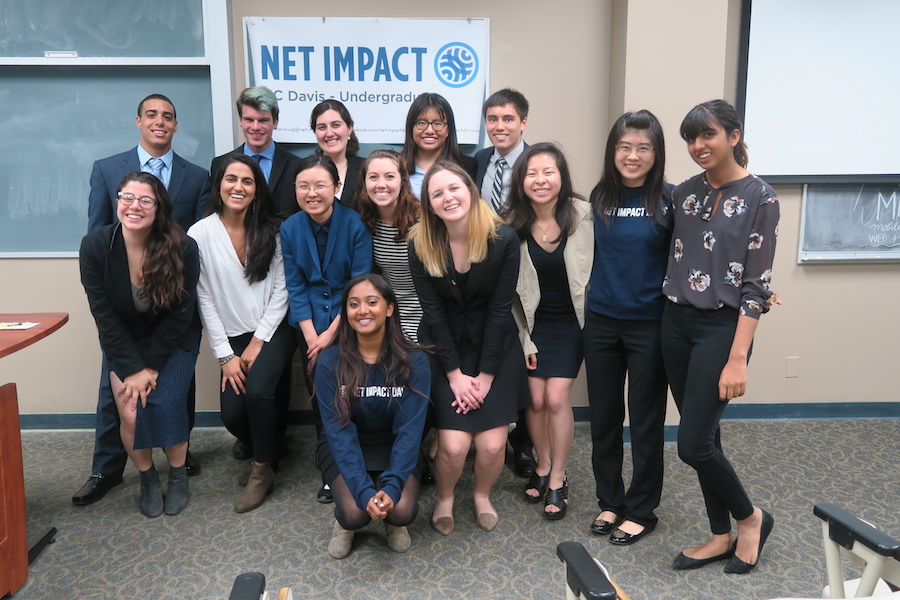
There is no shortage of UC Davis clubs and organizations dedicated to benefitting the community and making positive changes in the world. One such club is Net Impact, a nonprofit social and environmental entrepreneurship organization. Net Impact is an international organization with chapters in numerous universities around the world, but the UC Davis chapter was started just this year by Nivi Achanta, a fourth-year managerial economics and statistics double major. Achanta, who serves as the club’s president, wanted to focus the efforts of the Davis chapter on an area particularly pertinent to the Davis community.

“We wanted to do something with respect to sustainability on a very targetable and local scale,” Achanta said. “Once we recruited enough people in Fall Quarter that’s when we were really able to figure out our mission.”

The club is split into three interdisciplinary teams, each focused on a specific project. The teams develop their project in three phases, each of which last one quarter. During Fall Quarter the project is designed, Winter Quarter focuses on strategy and research and in Spring Quarter the project is implemented.

The teams also have to work on getting their projects funded — an integral part of any nonprofit organization. Although some funding is provided by ASUCD and the Innovation Institute for Food and Health, much of it depends on the Net Impact members themselves.

“We have an annual pitchfest to a panel of potential investors,” Achanta said. “These people decide how valuable and doable our projects are and then they give each of us either full or partial funding.”

The three projects are each headed by project managers, who are responsible for overseeing the projects and ensuring that their team fulfills all of its objectives.

One of these managers is Brooke Garcher, a third-year environmental design major and the leader of the waste management team. Garcher, also the club’s director of outreach, had her team focus on expanding compost on campus, both in terms of adding more compost bins and educating people on waste sorting.

“We knew that where composting existed, like at the CoHo or Silo, it was very successful,” Garcher said. “But they’re only at food places. So when you take your coffee cup to go, you throw it in the trash which ends up piling a lot. A lot of the waste in landfills could be compostable.”

Garcher, who aims to implement compost bins on a building-to- building basis, began contacting on-campus buildings such as Shields Library to conduct trial runs.

“During week 10 and finals week we’re going to have several compost bins at the library,” Garcher said. “We’re gonna be monitoring the data and hopefully we can make the bins a permanent mainstay.”

Another project manager is Maria Arteaga, a third-year managerial economics major. Arteaga, who will take over for Achanta as club president next year, heads the education project. Arteaga acknowledged the fact that the current divisive political climate has made education and understanding other cultures as important as ever. Arteaga and her team created a program that connects UC Davis students to students abroad through sister schools and schools that UC Davis has already partnered with.

“What we’re trying to do is create a seminar, where a pilot group of 10 students can come in and log on to the country’s most used chat and video platforms and start talking about themselves and get to know each other,” Arteaga said. “They would then lead into their education and how living in their community has impacted their lives. Eventually they would identify a problem in their community and using everything they learned about each other to create a solution.”

Artega stated that her team’s main goal was to give students a chance to work together on an international scale.

“We feel like collaboration is key, and we want to provide that opportunity for that international experience due to money or government policies,” Arteaga said.

Achanta, who started the club at the beginning of Fall Quarter, stated that the opportunity to collaborate with a diverse range of people was one of the main driving forces behind founding the club.

“I wanted to work with people from different backgrounds, and I never had the opportunity to collaborate with people from different majors,” Achanta said. “Our entire founding board is a different major and I think that’s one of the reasons we’ve been so successful.”

Net Impact has attracted numerous students with the same mindset as Achanta, also looking to make a legitimate difference in their community and the world at large.

“[Net Impact] is very driven by the club members,” Arteaga said. “We’ve got a lot of members who have really great ideas to make really feasible projects.”

One of Achanta’s main objectives is to spread awareness of the club and continue to add on to the team, as Net Impact’s ability to make a difference increases with each student that joins the club.

“Outreach is something that’s always been very important to us,” Achanta said. “We’re constantly reaching reaching out to people to try to recruit the best talent.”

Although Net Impact is still a relatively new club, it is quickly growing both in popularity and impact. Students from around campus who want to help other people and make a difference are joining the club, and due to this, Achanta and her team have high aspirations for Net Impact.


Written by: Eddy Zhu — campus@theaggie.org

Significant snapshots

Aggie photographers share some of their most cherished photographs.

I will always consider Hong Kong to be home, but even then I never felt connected to the city. This shot was taken on my film camera in Mong Kok, an older district of the city. To me, photographing these scenes of antiquity is how I connect to my city. (NICHOLAS CHAN)


This was my first DSLR photo taken in my backyard in San Diego. (FARAH FARJOOD)


I’m so thankful to have the opportunity to travel and visit so many places at such a young age. Exploring the worlds will always be a passion of mine. (ALEXA FONTANILLA)


I took this photo on my trip to Italy over the summer with my first DSLR camera. This trip was special to me because having the opportunity to travel and see so many scenic places truly influenced me to learn more about photography to be better able to capture photos of future explorations. (SAHAR FOROUZANFAR)


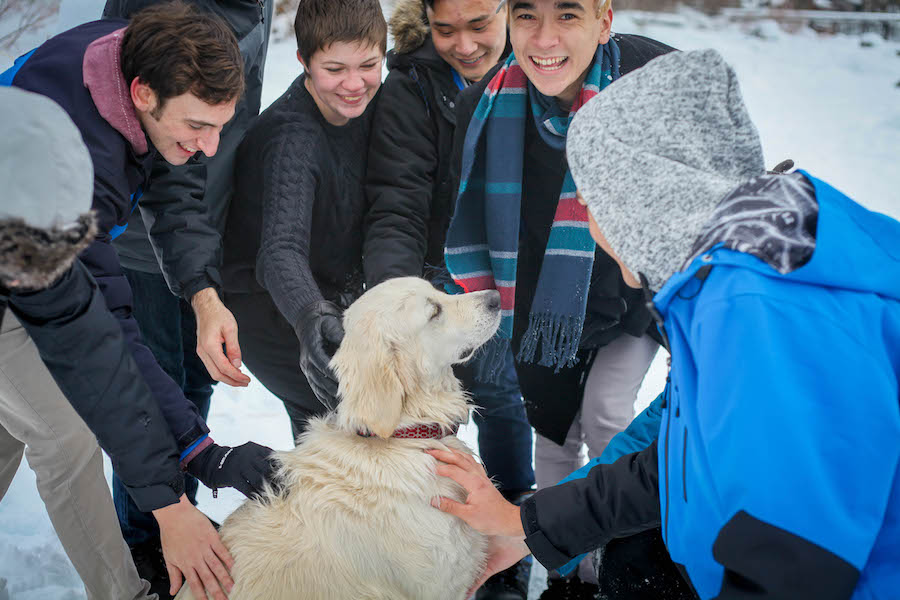
Not only does this photo unite people with the wonderful creatures that are dogs, it captures pure happiness. I wasn’t feeling like my best self during this time but I was fortunate enough to escape to Lake Tahoe after being away from these friends for awhile. The moment after I took this photo I lit up and everything felt a little bit better and brighter. The smiles from my friends and the dog’s loving gaze are all so genuine and so was that moment. There is nothing quite like capturing a moment of pure joy especially when a dog is involved. (KELSEY GREGGE)


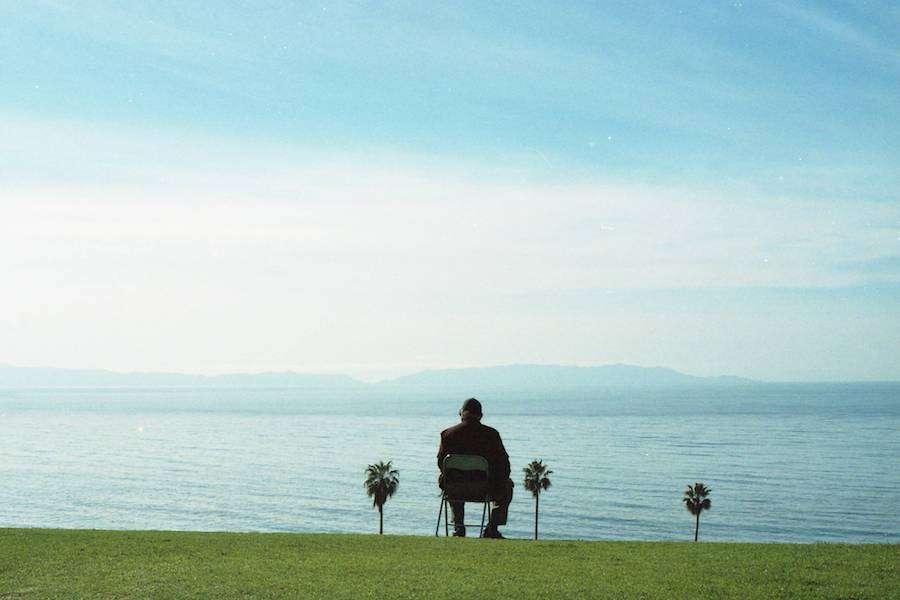
I shot this on 35mm film back home this past winter break in Los Angeles. Sitting on the bluffs of San Pedro was a man who brought with him his own chair and solitude; walking behind him, I was able to frame this shot as he looked out over the Pacific ocean, and continued to do so for another hour. (IAN JONES)


This is a photo I took at the Women’s March in January. It was incredible event where I saw so many people come together to stand against something they felt was wrong, and I’ll never forget the experience. In this photo, a young marcher holds up a sign that reads “Future Madame President.” Even though you can’t see, the girl in the photo was showing another young girl her sign and they shared a really special moment that I think encapsulates what was so amazing about the movement. It was about bringing people together and inspiring each other to look toward the future to get through difficult times. (BRIAN LANDRY)


During my semester abroad in Singapore, I visited the iconic Rochor Centre, a residential estate built in 1977. It was once a lively hub full of shops, family gatherings, and freestyle soccer hobbyists. It was also slated for demolition by 2017. A number of residents and shops had already relocated to nearby towns, leaving behind dilapidated furniture and lingering memories of their old home. While standing on the deck, which was quiet beneath the hum of traffic and cooing pigeons, I was reminded of the finite amount of time I had to explore this new country. I may be back home in California, but the memories I made in Singapore are ones I will continue to cherish. (DIANA LI)


This is one of the first pictures I have taken of my sweet dog. Whenever I think of pictures that show improvements in my photography skills, I always think of photos like this one. Even though there are some things in this picture that could be improved, it just shows that there is always room to grow. My dog lifts my mood whenever I don’t feel like myself and will always be an inspiration to take pictures of. Since pictures are memories, I will always treasure them. (LAURA LONG)


This was taken in front of a wall at the death star. I tried to portray this idea of loneliness, but at the same time contrast that with all the colors in the background. That practically sums up my first year in college.In some ways it was lonely and confusing at times, but through friends (such as Sedona right here), family, and exploring myself I learned a lot about who I am. That’s another reason the colors are there and part of the reason why the yellow and light tone of green is on the right and darker green on the left; Although loneliness can leave us in a box, being able to be positive and go through this journey of being lonely can lead to a realization of our true colors and who we are as individuals, moving from a dark space (left side) where loneliness and fear can rise to a lighter and brighter side (the right) where you find who you are and through that journey you find love (red/pink) and sadness (blue). Her face just sums up all this. The sun had hit her face and she couldn’t see for a sec and it’s kind of like how college hits us right in the face and we make this face of like agony and confusion because that’s how it feels for a second, being out here away from family and our homes. Overall, even though the sun (college) can be blinding, that can never stop us. That’s what it feels like; getting smacked in the face with this totally different experience and through this comes being lonely and fear, but at the end of it all we are able to find love for ourselves, find our true colors, and portray ourselves through what we love. I mean, that’s college, right? (RAUL MORALES)


It’s scary to think how fast four years here can fly by. I remember visiting campus as a 12-year-old with my parents (both UC Davis alumni), somehow knowing instinctively that this is where I wanted to go to college. 10 years later, I am graduating from UC Davis. Thank you, UC Davis, for all of the memories, learning experiences and opportunities. (CIERA PASTUREL)


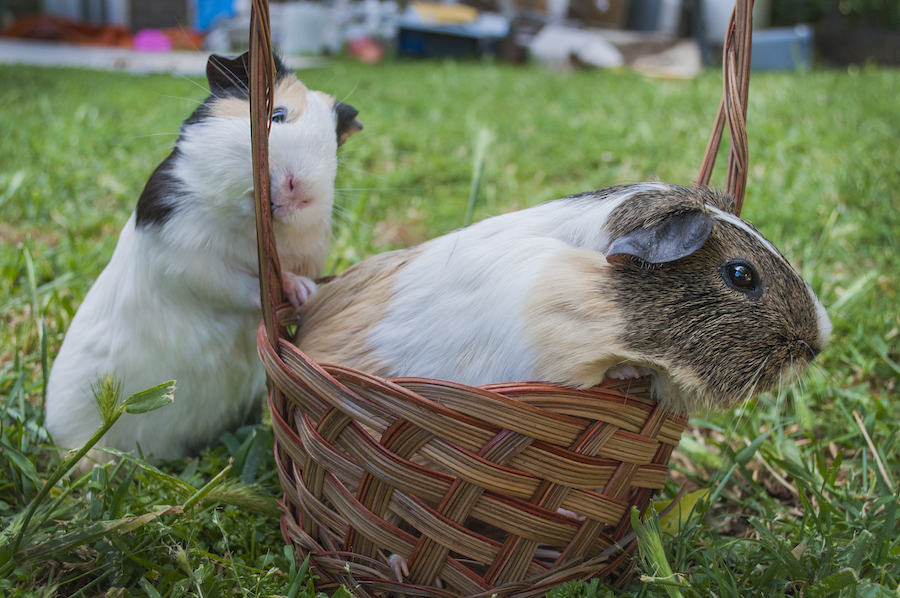
Bëë (right) passed away list last week. This photoshoot was taken the day prior to her passing. I had never had guinea pigs prior. She rubbed off on me in a big way and I grew very close to her. Her personality was one of a kind and she will be missed. (JORDAN KNOWLES)


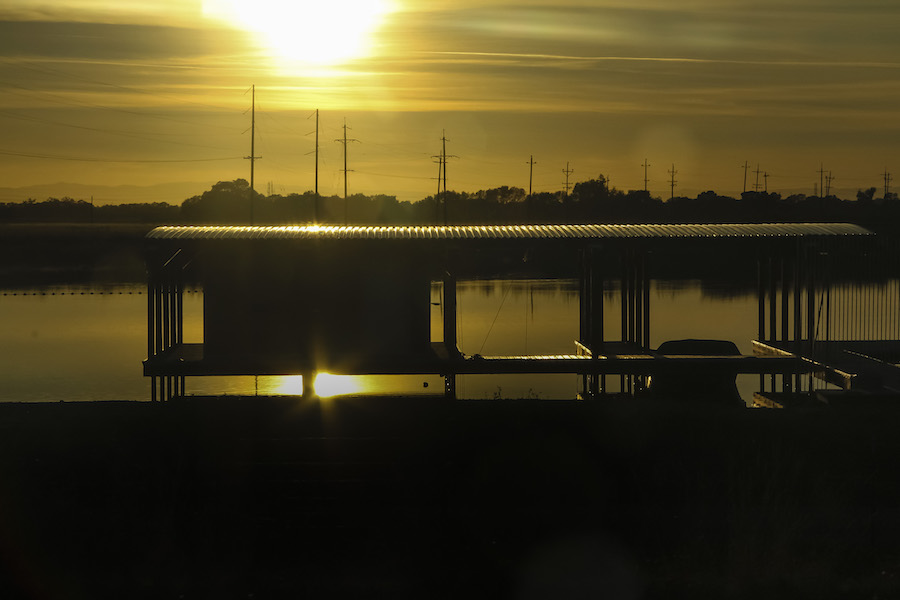
This is a photo taken several years ago, I was coming back from a family road trip and saw this interesting looking shed as I sat in the passenger seat. I snapped a few shots, and since I was sitting in a moving car I really didn’t think it would amount to much, but when I looked back at it I’m still amazed at my sheer luck. I wouldn’t have been able to compose it any better even if I was standing in front of the shed. It’s ultimately one of the photos that continue to inspire my photography. (JERO REAL)


This was one of the first photographs I took. I’ve always wished I would run into the surfer so I can give him copies of the photos I took of him. (ZOË REINHARDT)


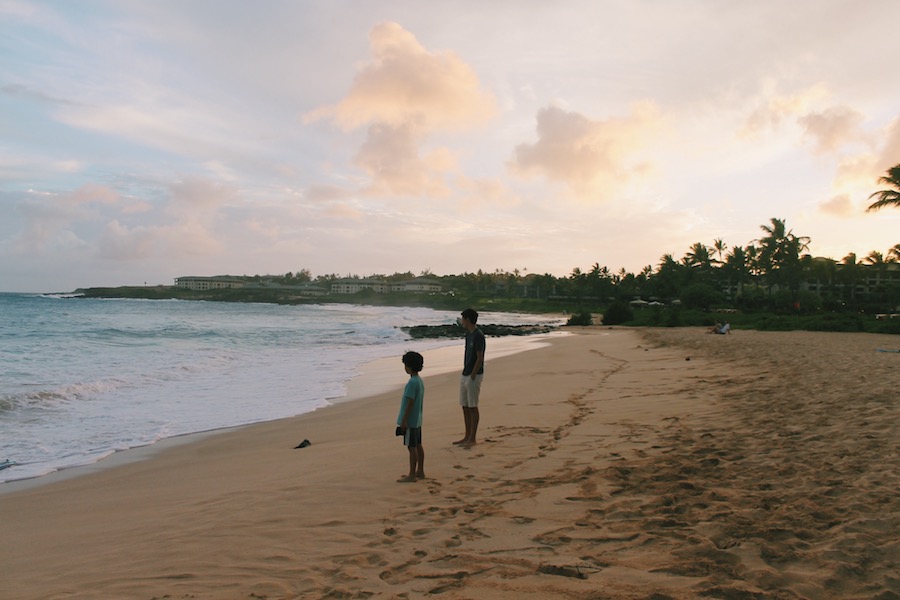
My younger brother (the taller one) and I didn’t have the best relationship growing up. This photo was taken during a family trip to Hawaii last summer when we finally started to get along and grow closer despite our history. This photo means a lot to me because it reminds me of the importance of family. (MEENA RUGH)


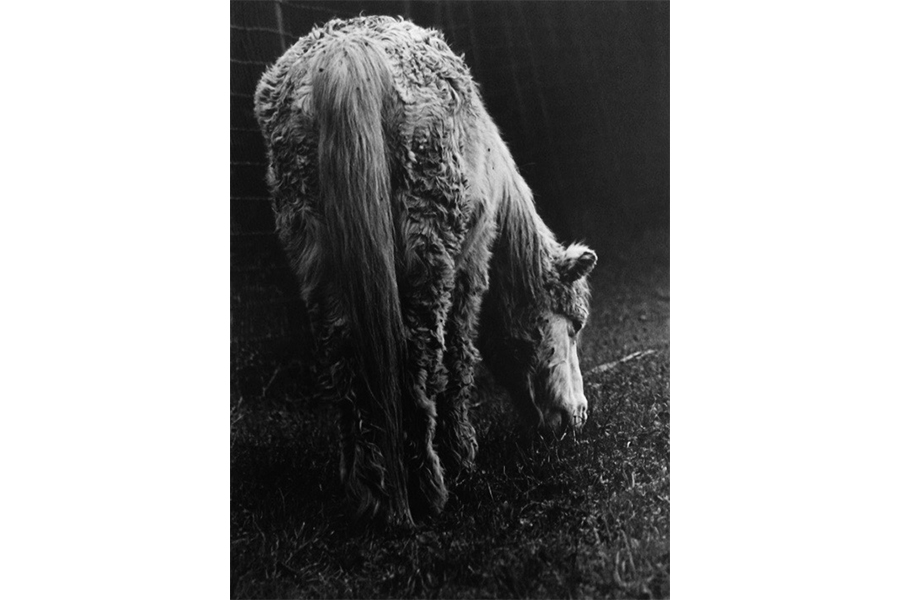
This was the first print I made in the darkroom. Rookie to proper image exposure times, contrast filters, the methods of dodging and burning, I can’t number how many test prints didn’t meet my satisfaction. Ultimately, it’s a pretty humble image, but so began my love for film photography. The laborious act of manually developing, cropping, editing, and enlarging is tactile and personal. The involvement of film photo removes the passivity of just taking a fast picture, and has made photography meaningful for me. (CAT TAYLOR)


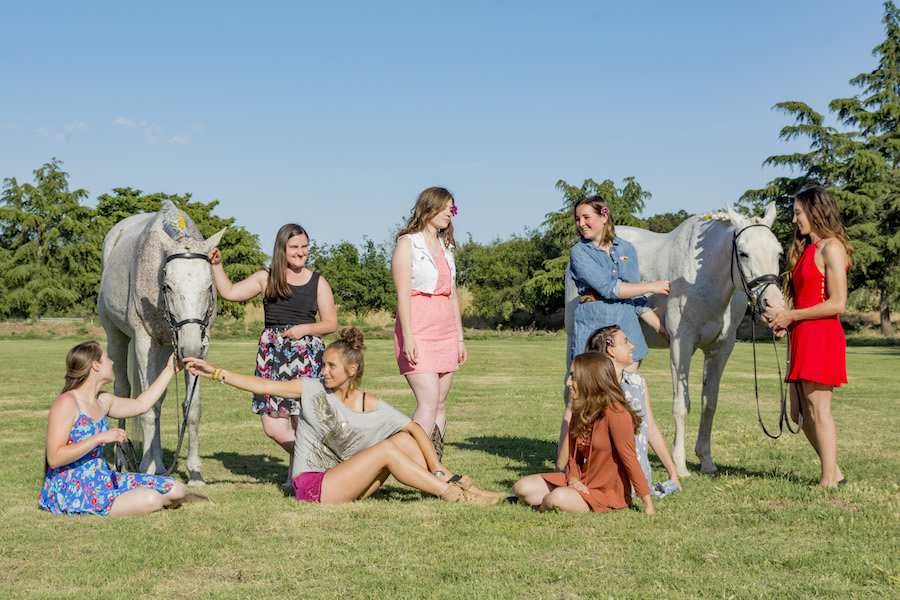
This photograph represents my two greatest passions: photography and riding. Some of my favorite memories are with the UC Davis dressage team. I love that I got to share my passion and I hope I get to continue sharing it after I graduate. (NICOLE WASHINGTON)


Compiled by: The California Aggie Photo Desk — photo@theaggie.org



California salmon threatened by changing climates

CRAIG BALLENGER / COURTESY

Population diversity key to salmon resiliency

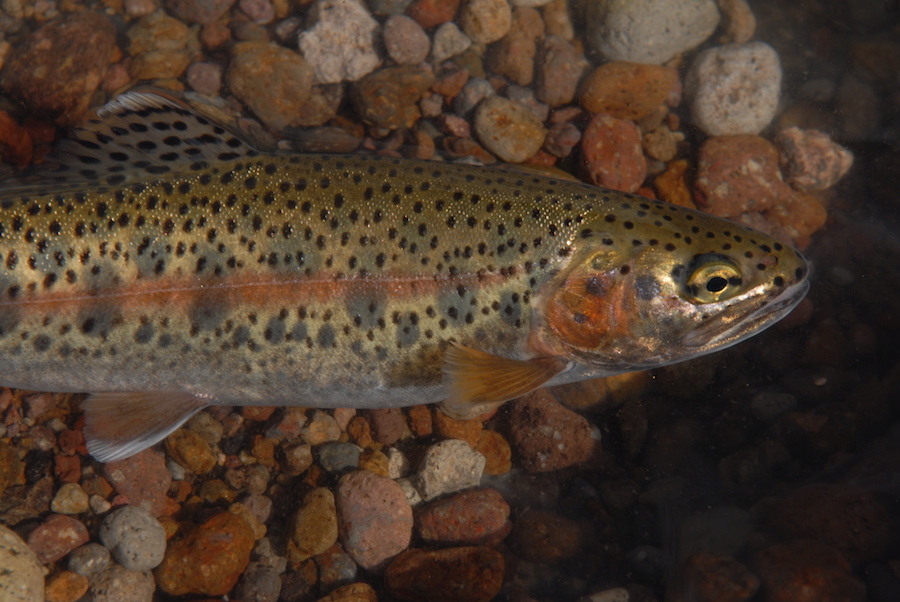
A recent report commissioned by California Trout — a San Francisco-based nonprofit — and completed by UC Davis reviewed the state of the 32 types of native California salmon, steelhead, trout and whitefish. The report, entitled State of the Salmonids II: Fish in Hot Water, was a follow-up to a similar report completed in 2008. The newest findings indicate that nearly half of these fish populations are in danger of going extinct within 50 years. The bull trout, one of the 32 species native to California, has been extinct since 1975.

“The big overarching threat, and the one we found threatened 84 percent of the species, is climate change,” said Dr. Robert Lusardi, a joint California Trout and UC Davis Wild and Coldwater Fish researcher and one of the authors of the paper. “The reason for that is climate change will affect and is affecting the magnitude and  timing of the flow, so it’s changing what these fish are evolved to. But it also affects food web dynamics, how their food interacts, abundance [and] diversity. It can also alter species interactions.”

Salmon are coldwater fish and struggle to survive in warm waters. Certain types of salmon are anadromous, or migratory, and travel from the frigid Pacific Ocean to California rivers for development and breeding. These species are most vulnerable to dams, which can cut off their traditional migration routes and spawning grounds.

Other types of salmon stay in small watersheds higher up in the hills and mountains, where the water runs quick and chilly. Even slight warming of these sensitive waters could jeopardize entire species of inland fishes. In recent years, more precipitation has been reaching California peaks as rain instead of snow. Salmon rely on large snowpacks to slowly melt during the summer, providing the perfect coldwater brew for growth and maturation.

According to Patrick Samuel, the Conservation Program coordinator for California Trout and one of the authors of the paper, everybody plays a role in revitalizing California’s native salmon.

“Something we advocate for is trying to restore the logical function of our highly altered landscapes,” Samuel said. “We can protect our source waters, our springs, our natural reservoirs on the landscapes to help store water and keep it cold and then slowly release it during the warm summer months when the fish really need it.”

The report is hopeful in regards to potential partnerships between competing water interests in California. An ongoing observational experiment involves agricultural entities and fisheries sharing seasons of land and water use.

“We’re working with rice farmers,” Samuel said. “They flood their fields in the wintertime when they don’t need to grow rice. Juvenile salmon and steelhead have historically used those floodplain habitats to fatten up before migrating to the Pacific Ocean.”

According to Lusardi, salmon are also indicators of watershed health. When coldwater fish are unable to thrive in their traditional waters, signs point to important links in the local ecosystem weakening. A sustainable California will strive to have high-quality water, and actions can be taken to improve the health of California’s native salmonids. The goal of these interventions will be “to help them return to abundance,” Samuel said.

Climate change is the largest overarching threat to 84 percent of California’s native salmonids, but it is not the only danger facing these fish. Estuary alteration, major dams and agricultural water demands impact anadromous species, while invasive fish species, severe fires and hatcheries imperil inland species.

Certain existing dams could be removed to recreate lost floodplains for fish to develop and thrive. Future construction projects that will permanently affect waterways should be mindful of the needs of watershed to keep ecosystems healthy.

The proposed Bay Delta Conservation Plan reroutes water from above the San Joaquin Delta to huge pumps for agricultural usage and human drinking water. Scientists and wildlife experts are divided on how fish will be impacted by the construction project, which will lower the resting flow volume of the San Joaquin Delta.

Dr. Peter Moyle, associate director of the Center for Watershed Sciences at UC Davis and lead author of the paper, has mixed feelings about the project.

“If the tunnels are operated as as planned with no more water exported than is done now, the remaining water will be able to flow through the Delta in a more natural fashion, reducing the likelihood of salmon being sent to unfavorable habitats in the Delta,” Moyle said in an email interview. “In the long run, properly operated tunnels should benefit salmon, or at least not make them worse off, but I would not take any bets on it.”


Written by: George Ugartemendia — friend@theaggie.org