55.7 F
Davis

Davis, California

Monday, December 22, 2025
Home Blog Page 608

Call to action: widespread toxic exposures contribute to developmental disorders

BRIAN LANDRY / AGGIE FILE

Scientific, medical experts come together to advocate for action, policy change

Significant scientific evidence links exposure to toxic environmental chemicals to neurodevelopmental disorders such as autism, attention deficits, hyperactivity and other learning and intellectual disabilities.

Project TENDR: Targeting Environmental Neurodevelopmental Risks, co-founded by Irva Hertz-Picciotto, the director of the UC Davis Environmental Health Sciences Core Center, issued a nationwide call to action to reduce exposures to chemicals and pollutants that contribute to neurodevelopmental disorders in children.

“By working with experts in research we can evaluate the science and work with health professional experts (like pediatricians, nurses, OBGYNs), advocates and community groups to make policy recommendations,” said Jacqueline Barkoski, a Ph.D. candidate in epidemiology at UC Davis, in an email interview.

The overall goal of the project is to increase general awareness about harmful chemicals and the lack of protective regulation. Many of the toxic chemicals can be found in our food, household cleaning and personal care products as well as in the air and water.

[The way in which chemicals are regulated is] that the public has to prove harm rather than those who put the chemicals out there having to prove safety,” Hertz-Picciotto said in an email interview.

Many chemicals and pollutants contribute to children’s learning, intellectual and behavioral impairment. They include organophosphates (OP) found in pesticides, polybrominated diphenyl ethers (PBDE) found in flame retardants, combustion-related air pollutants like nitrogen dioxide, lead and mercury.

Specifically, PBDEs pose a threat to children’s brain capacities that are critical for thinking and success in school.

Although these chemicals are banned in some states due to health concerns, North America still has some of the highest detected levels in the world.

In the 1970s, these chemicals were found in manufactured furniture, TVs and other electronics. The risk of exposure comes from the fact that they are not chemically bound to the plastics and foam so they come out of these products into the air and dust of the household environment.

Replacing old couches or mattresses with products that are PBDE-free is one step toward reducing exposure of the flame retardants.

“Another way to prevent exposures is through cleaning up house dust because chemicals such as PBDEs, pesticides and lead can be found in house dust,” Barkoski said. “This will also help reduce exposures to young children who crawl on the floor and have a lot of hand to mouth actions.”

This unique project brings together stakeholders to address the issue of harmful environmental toxins affecting child neurodevelopment.

The Consensus Statement of the project, published in the Environmental Health Perspectives, describes the scientific approach to validating recommendations related to harmful chemicals and calls for policy change to reduce the high prevalence of neurological disorders developing in children.

Project TENDR has numerous organizations endorsing the Consensus Statement, including the American College of Obstetricians and Gynecologists, American Nurses Association, Child Neurology Society, National Hispanic Medical Association and Physicians for Social Responsibility.

We are also in contact with several other large organizations who are considering endorsing either our original Consensus Statement or joining onto some of our upcoming recommendations related to specific chemicals,” Hertz-Picciotto said.

Recent progress includes the American Medical Association (AMA) passing a resolution to adopt Project TENDR recommendations on lead. No level of lead exposure is safe for a developing fetus or child and is known to cause harmful brain development.

Currently more than half a million children aged 1 to 5 years have a concentration greater than 5 μg/dL.

By utilizing the most current scientific literature on the topic, scientists hope to ensure that, by 2021, no child has a blood lead level greater than 5 μg/dL and, by 2030, no child has a blood lead level greater than 1 μg /dL.

Project TENDR members advocate for better policy regulations that governments, corporations and health care institutions should adopt to lower children’s risk of developing neurological disorders.

“This project is unique because it reflects the consensus of public health professionals. It allows experts to review science carefully and also go beyond the science to policy in order to reduce exposure and protect health,” said Asa Bradman, an associate professor of environmental health sciences at UC Berkeley.

Methods to reduce exposure to harmful chemicals can be utilized in the home and work environment. Choosing fruits and vegetables that have lower level of pesticides are safer choices of produce.

In addition, choosing personal care products with absence of phthalates and lead acetates can reduce exposure. Phthalates are often found in many fragrances and lead acetates are common in many hair dye kits.

Students interested in Project TENDR and children’s environmental health can obtain further information from the Environmental Health Sciences Center at UC Davis.

“We recently started a twitter account (@ProjectTENDR) and we post updates and materials we have developed and possibly in the future there will be more direct opportunities for UCD students to get involved with Project TENDR,” Barkoski said via email.

More information about how individuals and families can reduce exposure to harmful chemicals that impact brain development can be found on the Project TENDR website.

“We still have a long way to go, but I do have the sense that the tide is turning, with editorials appearing in medical journals and voicing similar ideas as those of Project TENDR,” Hertz-Picciotto said.


Written by: Shivani Kamal — science@theaggie.org

Renovations coming to the ARC

KELSEY GREGGE / AGGIE

Boxing area, weight room, outdoor training area, Peet’s Coffee to be added

Along with the conversion of Starbucks to Peet’s Coffee, other renovations coming to the Activities and Recreation (ARC) over the next two years, including new training areas, will allow students to better utilize the existing space.

With UC Davis’ food distributor contract with Sodexo coming to an end on June 15, UC Davis is taking over management of many food operations around campus. One of these changes includes switching the Starbucks locations at the Silo and the ARC to two Peet’s Coffee shops.

Students can expect other major changes in the ARC over the next two years. Many of the changes aim to reorient existing aspects of the ARC to make it easier for students to use and enjoy. One of the changes involves the accessibility of the ARC’s martial arts rooms. Instead of entering through the main ARC entrance to get to the martial arts rooms, students will enter through the ARC Pavilion entrance.

Additionally, students will lose access to two basketball courts in favor of creating a space designated for weightlifting.

Fourth-year economics and communication double major Nicole Lin Ho has played on UC Davis’ club basketball team during her time at Davis. Although Ho is graduating this spring, she is confident that the upcoming renovations will not hinder her team’s ability to practice in the future.

“We have amazing Sports Club advisors behind us that do what they can to accommodate everyone,” Ho said.

Many students using the current weight room at the ARC are looking forward to these changes. Third-year linguistics and Spanish double major Katya Piscitelli is an aspiring power lifter and can often be found at the ARC lifting weights and perfecting her form.

“The current weight room is well-equipped but always overpacked,” Piscitelli said. “I’m hoping that the new weight room will be more spacious and include more racks and benches.”

Piscitelli also mentioned that she is keeping her fingers crossed that new deadlifting platforms will be added to the weight room.

In addition to a weight room, a specific area for boxing will also be worked into the ARC renovations. Michael D. Dominguez, the Sports Club coordinator, is looking forward to the new space for student boxers to enjoy.

“We’ve had female boxers win a National Championship for the past three years, so it would be nice for them to have a better practice space,” Dominguez said via email.

In addition, an area outside will be converted into an outdoor training area that will give students a fresh change of scenery during their workouts. New cardio equipment will also be added to cater to UC Davis’ growing student population and demand for more equipment.

Deb Johnson, the director of recreation for UC Davis Campus Recreation and Unions, declined to provide a specific comment because many details remain unconfirmed.

“The [bids for contractors] are in process of being reviewed and the outcome will give us the details we need for the article,” Johnson said via email. “I would feel more comfortable submitting a story once the University has accepted a BID [sic] and we have formalized plans. We know conceptually what will be included but until we have a price tag we do not know what the final project will include.”


Written by: Ally Russell — campus@theaggie.org


Hard lessons from Aggie opinion

Opinion Editor Eli Flesch on four life-changing years of college journalism

It took me a long time to figure out exactly what Joan Didion meant in Slouching Towards Bethlehem when she wrote that “writers are always selling somebody out.” After four years of working on The Aggie’s opinion desk — two as its editor — I think I understand a little better.

To be an effective writer you need to betray some sense of loyalty — to your subjects, your editors, even to your friends and family. Otherwise it’s impossible to write candidly and honestly.

But most people, I would guess, enjoy many of their subjects and editors, and even love their friends and family. I certainly do. These last four years have been the best of my life for that reason.

So what gives? Are writers just back-stabbers? Is that Didion’s game?

Probably not. Because there’s a higher loyalty in being honest, especially when it means talking about uncomfortable truths. And if you’re an opinion writer, that loyalty comes when you tell your truth — the one you’ve come to after a life of unique experiences and lessons. It’s been a distinct privilege of mine to have been exposed to so many wonderful individuals through The Aggie.

I’ve always made a point of editing and writing for Aggie readers first. When I hired columnists, I made sure to hire liberals and conservatives alike. My goal was to facilitate dialogue. College newspapers should not be safe spaces. Editors and reporters disrespect their readers when they sanitize or refuse to publish material with the potential to offend. I’ve seen this self-censorship play out at The Aggie, and I often resisted out of a sense of obligation to the readers.

The vigorous pursuit of alternative opinions is the moral responsibility of every writer and reader. Ideas that go untested, no matter their strength, are simply not credible. So we better get as much writing as we can out there — to create those oppositional forces that improve our society.

Having felt those oppositional forces against my own work has made me a better person.

I’ve written dozens of columns and stories for The Aggie — the overwhelming majority of which would normally be considered liberal or progressive — and yet it was perhaps one, maybe two, that effectively cemented my reputation in some circles on this campus as a white supremacist, deserving, as one person notified me at a bar one night, of being beat up.

And while threats of violence I can never justify, I’ve always welcomed and encouraged criticism that compels me to reevaluate my own biases and preconceived notions. Publishing letters and interacting with the community has been one of the most rewarding aspects of this job.

But I would still advise against the tendency, regrettably common today among the left, to demand moral purity. The idea that a person can be free of deep contradictions and flaws needlessly creates enemies out of potential allies — dangerous at a political moment requiring unity.

In some of my proudest moments at this paper I’ve defended teachers unions, criticized private schooling and searched for ways universities can best serve low-income communities.

(I’m also so proud to have defended Milo Yiannopoulos’ right to speak on this campus.)

But I’ve never been perfect in my efforts. And any claim I may have to certainty now will surely be blunted by age. So I’ve learned to be as careful as possible with what I say, how I say it and where I say it (tragically, you’ll never see me stoop down to argue on Facebook or Twitter).

The saving power of journalism still exists, even in this age of “fake news” and “alternative facts.” The best writing gifts readers the ability to pause — to have a moment of skepticism in which judgement and self-righteousness give way to consideration and openness. In that moment, violence is impossible. Ego vanishes. This is to say, writing makes life immeasurably rich.

I think by writing. I find it difficult to speak to other people. I’m often inarticulate. My mind runs with stopgaps and pauses and loops that are impossibly frustrating. Those vanish when I write. Or at the very least I can work through them to the point where they don’t appear on the page. It’s for this reason that writing has been the great love of my life. It’s why I’m so invested in the impossible task of getting it right, and it’s why I lapse into self-loathing when I don’t.  

People have helped along the way. They’ve humbled me with their hard work and humor, and in the process they’ve made that self-loathing feel a little bit more common. I must conclude my Aggie career by acknowledging a few of these people, for whom I feel nothing but gratitude.

I need to thank Scott Dresser for not only employing me and defending my work, but being a friend. Stephen Magagnini deserves recognition for showing me the kind of mettle it takes to be a capable reporter. Taryn DeOilers, my successor, for leaving me absolutely confident in the continued success of the opinion desk. Ethan Victor for helping to bring some humor to this thing. Zach Moore, my rock. And the rest of my lovely columnists and humorists, who somehow trusted a person who never uses semicolons to be a strong judge of their work. Thank you. Thank you.


Written by: Eli Flesch — ekflesch@ucdavis.edu


Disclaimer: The views and opinions expressed by individual columnists belong to the columnists alone and do not necessarily indicate the views and opinions held by The California Aggie.

Home remodel leads to mummy discovery

CHRISTIE NEO / AGGIE

Home remodeling project in San Francisco leads to study of a mummified child

In a strange twist of events, a seemingly normal home remodeling project turned into an archaeological excavation led by archaeologist and UC Davis anthropology professor Jelmer Eerkens when the mummified daughter of an elite historical San Francisco family was uncovered. The California Aggie dug deeper to learn more about the findings.

The mummy, later identified as Edith Howard Cook, from the affluent Cook family, was exhumed almost 150 years post-mortem and offered UC Davis researchers and their teams a source of archaeological analysis.

Angela Evoy, an archaeometry lab technician, was especially excited about the news that a mummy had been found.

I was very excited because it’s not something that you come across very often,” Evoy said. “And you know, you hear about mummies, you think of Egypt. So [to] find out that there was a mummy in San Francisco, it’s pretty amazing, it’s pretty phenomenal that it was preserved.”

The research team submitted the mummy’s hair samples for various lab analyses, including carbon, sulfur, nitrogen and hydrogen testing.

Hair is nice because it grows over time,” Eerkens said. “We have about one year’s worth of hair growth […] Based on dental corruption patterns, we estimated [the girl] was about 2.5 years old — we had information about the girl that was preserved in her hair from about 1.5 to about 2.5 years before she died. Given new analytical techniques, we can use really small pieces of hair […] we cut it into small sections and we do analyses on each of those different sections. It gives us sort of a picture of what the girl was eating and where she was during the last year of her life.“

During analysis, the research team found that the nitrogen isotopes that would normally come from one’s diet started being sourced from her own body, indicating starvation. This led to the belief that the girl most likely died from malnourishment, possibly brought on by an infectious disease. However, the sulfur isotopes, normally used to indicate the presence of medicine in the body, showed no signs of any medication given to the child before she died.

The process of submitting the samples for analysis was the most tedious step in the process, as the team had to submit around 630 samples for analysis.

“There are always roadblocks when it comes to dealing with samples that are that tiny,” said Bryna Hull, an archaeology Ph.D. student and former archaeometry lab technician. “So even with the [hair], we occasionally had issues with static. Not only do we have to worry about getting it out of the vial, but sometimes when you go to remove it, it will start climbing around in the vial due to static electricity.”  

With the process being so frustrating, it was no wonder that there was a large number of team members working on it.

People are involved in it together,” Evoy said. “We got to do some really cool stuff here, but there’s a lot of other people who put in a lot of work to make it happen. It’s a huge project. The people in San Francisco who originally initiated this project and the people who are doing the DNA analysis […] and also the people at the stable isotope facility get left out of a lot because they’re sort of more in the background, but they run all of our samples for us through their inductively coupled plasma mass spectrometer (ICP-MS), which gives us their data. Without them, we wouldn’t have anything.”

The most unexpected result from the research was actually being able to find the child’s identity. Evoy said that it made her take a step back and think about the person behind the skeleton.

“It’s really exciting because sometimes when you’re working with archaeological collections, you can tend to forget that it’s a human being,” Evoy said. “You’re working with a person, somebody’s loved one, somebody really cared about this. You’re so hyper-focused on just getting your sample to cooperate or get some data [that when] they give you a name, and then you have a picture, and then you see family members, you realize that this is a person and that people actually care […] It sort of brings it all home and in this way, doing a sort of historical project, you get to find out a little bit more than you probably would within an archaeological collection that’s really old where there are no living descendants.”


Written by: Kriti Varghese — science@theaggie.org

Davis city council adopts cannabis policies for commercial businesses

MORGAN TIEU / AGGIE

City should expect local cannabis businesses to apply, open for business later this year

During its meeting on May 23, the Davis City Council voted to adopt a zoning ordinance permitting commercial cannabis businesses in the city. The ordinance outlines the cannabis business regulations involved in manufacturing, research and development, testing and distribution. These businesses will soon be allowed to apply for permits and open doors in Davis in the second half of this calendar year.

With the passage of the ordinance, the council has allowed for the use of volatile and nonvolatile solvents for manufacturing processes, the distribution of cannabis from the cultivators and/or manufacturers to dispensaries, the testing of marijuana and its products in laboratories and research and development purposes within city limits. Existing ordinances already regulate indoor cultivation for medical use as well as outdoor cultivation for medical and personal use.

“We voted unanimously to move forward with permitting zoning ordinances that would allow for three or four different types of commercial businesses to be established in the city,” said Mayor Robb Davis. “We feel that the businesses fit within [current zoning regulations] — we don’t necessarily have to create any new businesses-type zones.”

This could open up the production of marijuana products, such as edibles, topicals and oils, in Davis, while also opening doors for different ways of regulating the once-illegal drug. However, marijuana is still federally illegal, preventing research within UC limits due to the University’s federal funding.

The council has yet to establish retail regulations for cannabis use but expects to dial down on those policies next. City officials note that the community seems to have very few, if any, instances of controversy in regards to commercial regulation. Most citizens have general concerns with this part of the process, but community involvement and opinion is expected to pick up once the council beings to tackle cannabis retail policy.

“The public comment at that meeting was definitely in favor of the ordinance that was brought forward,” said Ashley Feeney, the assistant director of the Davis Community Development and Sustainability Department, a multi-departmental team that is leading the City of  Davis’ efforts to bring forward cannabis regulations for council considerations. “There wasn’t any public comment that I can recall that was dissenting.”

The cannabis industry is likely to create more jobs and is therefore expected to positively impact the Davis economy.

“Specifically for the manufacturing ordinance that was adopted, those type of businesses are not too dissimilar to other manufacturing businesses that operate in the manufacturing spaces,” Feeney said. “The difference would be the product –– the input that is put in for the product they manufacture. Those types of businesses would typically have professionally trained chemists, engineers and a multi-line staff at those businesses, so certainly it would make a positive contribution to job creation within the manufacturing field.”

Moreover, taxing cannabis and cannabis-related businesses is a question for the city council and a concern for citizens. Measure C allows the city to tax these businesses up to an additional 10 percent on top of existing state and sales taxes. Some citizens are concerned about the taxation of medical marijuana in particular, as the lack of federal regulation of the drug by the U.S. Food and Drug Administration makes the process seem a little unclear.

“Please make sure that medical marijuana is not taxed,” said Davis resident Donna Russell, according to The Davis Enterprise. “You tax liquor, tax candy; you don’t tax medicines.”

The city council is accounting for these concerns when creating new cannabis policies to ensure that vulnerable populations and those who use cannabis for medical purposes are included in the conversation.


Written By: Bianca Antunez — city@theaggie.org


Revolution of Responsibility: Youth leadership and agricultural advocacy

ANH-TRAM BUI / AGGIE FILE

The future of agriculture is in arts and humanities

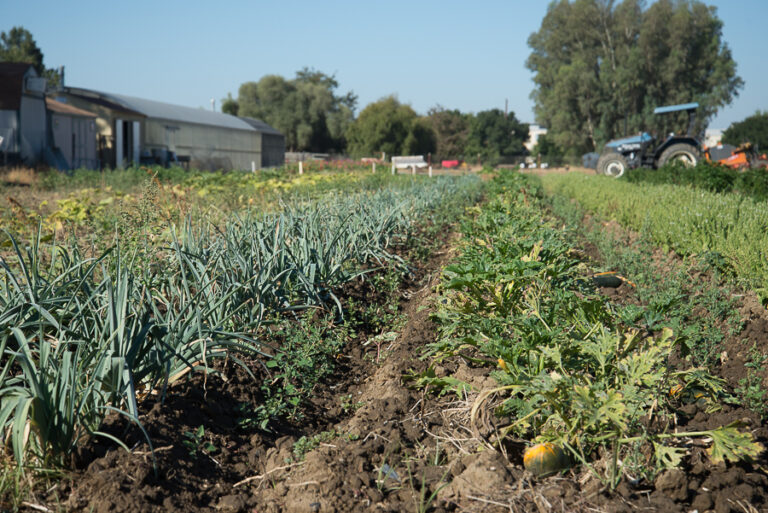
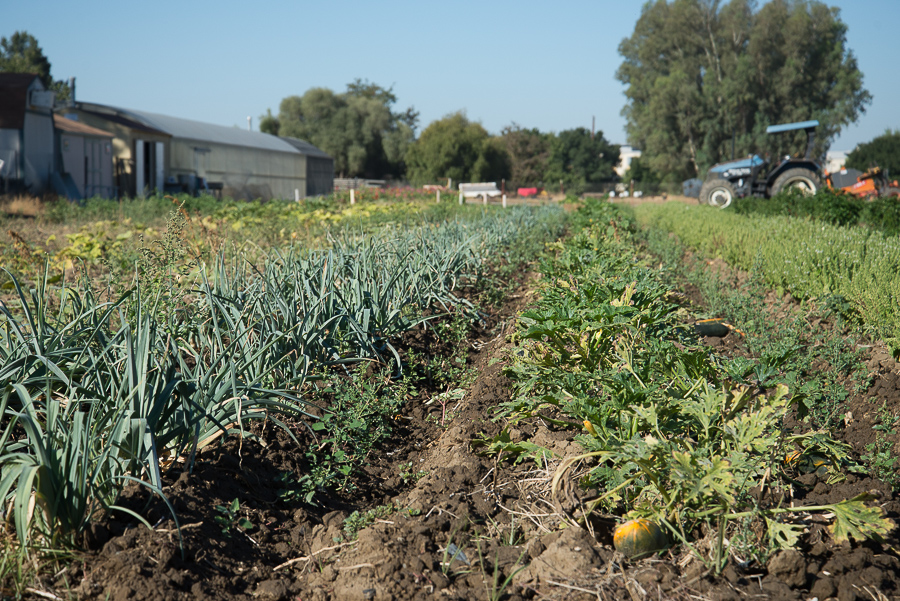
A recent KQED Radio forum on the topic of the graying, demographically homogenous agricultural industry discusses possible ways to rejuvenate the $37 billion industry employing 800,000 Californians. The general consensus among featured guests, who are all farmers, is that in order to save the industry from operational problems, pursuing a fruitful future means looking to the next generation. Investing in the youth is not a novel idea, but rather a tried and true ideology that still holds as a fundamental building block of our society’s functionality: looking for novelty in the innovation of young, curious minds always seeking the best solution.

The way today’s youth is revolutionizing the parameters of agriculture is complex. As the American landscape continuously progresses toward industrial urbanization, the challenge for farmers is thinking about agriculture in a metropolitan context. What does agriculture look like in populous cities and towns, and how are the youth in these areas engaging with agriculture? One historically ag-centered youth organization, 4-H, has begun to contemplate this idea and implement ways in which the general public can get involved in the “revolution for responsibility” in terms of how our food, fiber and pharmaceuticals are produced.

One way California 4-H traditionally upholds its youth engagement and education is through its annual State Field Day. This day-long event features the work that members from various county 4-H chapters across the state have accomplished throughout the year. There’s a lot of emphasis on advocacy among these young agriculturists and on the power of finding new ways to inform people about agricultural issues.

Communication, to my pleasant surprise, was a recurring theme throughout the day. Communication about agriculture and its science is just as important as conventional farming — if not more so — for industry innovation and implementation in society. It’s present in the principles of the 4-H motto to prepare kids for success through leadership development and communication skills. This was subtly noticeable in the way presentations were run and more explicitly seen when youth and adult volunteers were asked to be more involved in marketing and communications in their local communities. Susan Garcia, the secretary of the California 4-H management board, noted that communication between the clubs is one of the most important elements of 4-H clubs’ success statewide. This is also an aspect that the management board is working hard to improve.

What intrigued me the most about this event was its emphasis on the marriage between agriculture and creative outlets. The future of agriculture is in the arts and humanities, as reflected in the day’s festivities: a fashion show, a film festival, presentations incorporating literature and public speaking and competitions in photography, entomology and plant identification. I overheard a girl no more than 10 years old ask one of the judges to explain what she could have done to earn a higher ranking in a photo competition, and the judge taught her on the spot about composition.

The photography contest was founded by John Trammell and was inspired by his time on the educational technology advisory committee. The committee was discussing ways to envision the future of their educational technology programs, figuring out the best ways to merge agriculture and science technology. In addition to the film festival, which teaches kids how to communicate about their projects through a creative medium, the committee decided to hold a photography contest to provide another venue for kids to showcase their skills, exemplifying 4-H’s history of adapting its programs to broader audiences, involving more and more youth as their environments and interests evolve.

Children in agriculture-related youth organizations will not necessarily pursue future careers in ag, but their careers will nevertheless be informed by the experiences they gained. Famous 4-H alumni include Carla Hall from The Chew, Julia Roberts and David Letterman, all of whom credit their 4-H membership as the pivotal foundation of their creativity and leadership skills, which they use in their careers. Having a worldview grounded in ag issues will aid these kids in their futures because they can adapt it to any career they choose. What will the future of agriculture look like? From what I’ve observed, it will look like public relations and information technology, reflecting our increasingly digital society.


Written by: Camille Chargois — cachargois@ucdavis.edu


Disclaimer: The views and opinions expressed by individual columnists belong to the columnists alone and do not necessarily indicate the views and opinions held by The California Aggie.

Police Logs

NICKI PADAR / AGGIE

Week 10 vibes

May 28

“Residents above pounding intentionally on the floor. RP has already asked them to quiet down and believes that they are retaliating.”

“Male on a bike peeking into driveways.”


May 31

“Male was punching a parked vehicle.”


June 2

“Driver under the influence of marijuana — circling neighborhood in white Ford Explorer.”


June 3

“RP requesting advice for legality of selling old swords online.”

“3 juvenile females just urinated on the lamppost.”


Written by: Sam Solomon — city@theaggie.org

Synestia: more than a “hot space donut”

New planetary object rocks canonical Earth-moon theory


The giant-impact hypothesis is the most popular in explaining the moon’s origins and  matches up with the prominent theories of the solar system’s formation. But there are still many mysteries that have yet to be solved — and the research team of a Harvard graduate student and a UC Davis professor may have figured out part of the mystery.

Simon Lock, a graduate student at Harvard University, has suggested a piece of the puzzle in his article about the discovery of a new planetary object: the synestia.

The term “synestia” is derived from the prefix “syn-”, meaning “together”, and “Hestia”, the Greek goddess of the hearth and architecture. After the initial press release, the internet dubbed this object a “hot vaporized space donut”.

However, Sarah T. Stewart, an earth and planetary sciences professor at UC Davis and the co-author of Lock’s paper, doesn’t think that the description of “space donut” is entirely accurate. Stewart was a professor at Harvard for 11 years and continued to work with Lock even after her move to Davis in 2014.

A synestia is a biconcave disk, comparable to the shape of a red blood cell, and is mainly vaporized rock. When two planet-sized rotating objects collide with high enough temperature and angular momentum to pass the corotational limit, a synestia is formed.

The corotational limit refers to the point when the disk’s energy and mass can still be taken back into the planet and rotate as a single body. However, beyond this limit, the planet physically cannot be a normal spheroidal planet.

“Collisions between planets are incredibly energetic,” Lock said. “Two planet-sized bodies are coming together and colliding at tens of kilometers per second. So, many times the speed of sound. That dumps a lot of energy into both impacting bodies. Impacts in near-Earth mass bodies tend to vaporize a few to 10 percent of the body and melt the rest.”

A rotating object is explained easiest with the analogy of an ice skater moving their arms in or out to change the rate of spin, while conserving angular momentum.

Another example is an amusement park swing ride. As the rider is lifted into the air and accelerates, the rider spins at an angle, and they are pushed out at a larger radius than when the ride is stopped. If there was no chain to limit the angle, the rider would “expand” farther.

This is how a synestia works: its mass expands to its outer edges by moving slowly outward, creating the disk-like shape.

“These bodies were rotating faster than the corotational limit, so, even if you tried, you could not squish all of their mass and angular momentum into one body,” Lock said. “You have to have some part of the body in what’s called the disk-like region.”

After the object’s mass spreads out into this biconcave shape, it cannot be compacted into a “normal” planet’s shape until it slows or cools down.

“Eventually, what happens is you lose enough energy from the synestia that you fall below the corotational limit, and the whole thing can collapse down to a single body,” Lock said. “That process for the Earth itself takes around 100 years or so. It cools, in geological terms, reasonably fast, down to a more corotating object. Other objects may last longer than that.”

The formation of the Earth and the moon is highly debated because of its irregularity. According to Stewart, the moon is expected to be chemically different than the Earth based on physics models, but it’s not. Their isotopes, or “chemical fingerprints,” are basically identical, which is not clearly explained by any hypothesis thus far.

“[Lock and Stewart’s work] allows a lot more mixing between the material which will eventually make up the moon and the earth, and could explain why they’re so similar,” said Jay Melosh, an earth, atmospheric, and planetary sciences professor at Purdue University. “Ideally, and this is surely what Lock and Stewart hope, this will be regarded as the solution to the formation of the moon.”

Lock and Stewart’s work is built upon years of investigation and research from other sources as well as their own observations. Both stated the synestia resulted from a completely different perspective of looking at planet formation, one which has not been thought about before.

“These synestias are objects that are always moving,” Stewart said. “That’s different from the way we think about planetary objects. We don’t think about their mass changing, or in this case, losing this mass to what would then become moons. That was our eureka moment. It was almost three years ago.”

That “eureka moment” led Stewart and Lock to play around with calculations, working to find out what the structure was and why no one had seen it before. According to Lock, Stewart was looking at the data from her models and thought it didn’t look right alongside the canonical model. In hindsight, Lock said that the canonical model and preconceptions of what a post-impact planet is supposed to look like limited them, as well as other researchers.

“It was that moment, from changing our world view and having to reform our opinions and having to rethink all of the things we thought we knew, which was a really exciting thing,” Lock said. “Stewart likes to call it the eureka moment, and I like to agree.”

The current moon formation model dates back to the ‘70s and continues to be a highly-debated topic as technological advances are made.

“10 years ago, we thought we had [the moon’s formation] nailed,” Melosh said. “And then the geochemists got better at measuring isotopes and it turned out that the isotopic composition of elements on the moon is, essentially, identical to the earth, and that did not agree with most of the scenarios of impact that we could think of.”

Both Lock and Stewart have expressed their excitement about the discovery of a new object and the implications it has for hypotheses on the moon formation.

“I expect it will take some number of years to shake it all out and define the new normal,” Stewart said. “We’re hoping we’ve found the right path to the new textbook answer because we think the current textbook answer is not quite right. How long it takes until we call it a consensus answer is yet to be seen.”

Among Stewart’s future research plans are the evolution of the Earth’s surface and the magma ocean. Lock wants to take the synestia and learn if non-terrestrial planets, like a super-Earth or a Jupiter-sized planet, could form one in their lifetime.

“There are still things about our universe that we don’t understand,” Lock said. “There’s just infinite fascination in our universe. We’re in the 21st century, and still there are whole new concepts that have never been thought about. There’s an endless possibility to the things we can see in our universe and have yet to be discovered.”

Lock and Stewart’s next paper is currently in review and will cover their explanation of the moon’s formation using the research on the synestia.

More information about the synestia and moon formation can be found on Professor Stewart’s website and Simon Lock’s website.


Written by: Jack Carrillo Concordia — science@theaggie.org

Reacting to inflammatory speech

NICKI PADAR / AGGIE

Students, faculty discuss thoughts on effective responses to charged messages

While at the Silo, Pete Srivarom overheard a group of people vocalizing inflammatory and discriminatory messages. One of the preachers began to personally attack Srivarom on the basis of his ethnicity and sexual orientation.

“He asked me if I was gay and I said yes,” said Srivarom, a first-year environmental science and management major. “He said, ‘Oh, were you a child prostitute living in poverty and some young American gay molested you?’ What kind of person does that?”

Michelle Occhipinti, a first-year communication and managerial economics double major, decided to post in the Freshman Class of 2020 Facebook Group and share her thoughts on how best to react to these potentially harmful messages. Her post received over 157 comments and 165 reactions.

“Many people were personally targeted and that is not okay, but attacking them back doesn’t help,” Occhipinti said. “They’re not going to change their mind if you call them mean names or if you insult them the same way they insult you. Do something to spread a positive message to counter it.”

Occhipinti’s Facebook post resulted in a slew of separate discussions, some more contentious than others. Srivarom was one of the individuals who voiced their disagreement with Occhipinti’s opinions.

“She was saying that we should give respect to him, but he’s not giving respect to us,” Srivarom said. “Saying we should take the high road and attack the idea not the person, but why doesn’t that apply to him?”

UC Davis is one of many colleges nationwide grappling with how to find the proper response to speech on campus that many find repugnant. Responses by UC Davis students and faculty to the controversial Breitbart editor Milo Yiannopoulos’ scheduled speech earlier this year included reserving tickets to the event, protesting outside of the reserved building and writing a letter demanding a cancellation. Dr. Jeffrey Weiner wrote an op-ed about reactions to the event, which was ultimately shut down due to safety concerns.

“Now we’ve gotten to the point where we have the regressive left that controls not just this university but every university [and] they don’t allow people they disagree with vehemently to come,” Weiner said. “That’s a real problem, because it teaches students that the response to things that are distasteful is to shut it out. [Instead], you may go to Milo Yiannopoulos’ event, […] walk out and say, ‘What a jerk, but at least I listened.’”

Weiner said he advocates for open dialogue in the face of offensive speech. The UC-wide “Principles Against Intolerance,” which was adopted by the Board of Regents in 2016, promotes fighting “abhorrent” speech with “more speech.” Daniel LaBolle, a first-year wildlife, fish and conservation biology major, also supports open discussion.

“Even if other people’s views are possibly factually wrong, to hear them and understand why they’re understanding the things they’re saying is essential,” LaBolle said. “If you’re going to convince someone and actually really change their mind, you have to first hear their view and then respond to it.”

However, fourth-year history major Elly Oltersdorf said that there is a time for open discussion, but not in response to hate speech.

“When it comes to someone who holds completely open white supremacist views, transphobic views or Islamophobic views, to engage in a dialogue with that is just to validate something that is, at its base, completely irrational and not defensible,” Oltersdorf said. “When people hold views that invalidate the existence of somebody else, then it’s not appropriate to engage in a dialogue with them. Even by stepping into a dialogue with [that] opinion, you are giving it a sense of platform and legitimacy.”

In the case of suppressed speech, both Occhipinti and Weiner warned of potentially dire consequences.

“When people can’t express their opinions, when they can’t express their ideas, that’s when a lot of conflict comes,” Occhipinti said. “It’s very limiting. That’s not the kind of campus that we should be, it’s very hypocritical.”

Oltersdorf was one of the students who was able to infiltrate the interior of the building Milo Yiannopoulos was planned to speak inside of and risk arrest in an effort to help shut down the event. Oltersdorf said they make a personal distinction between what reaction is appropriate in response to individuals informally making inflammatory comments and individuals who are given a platform to make such comments.

“In the case of Milo Yiannopoulos, I am actually of the opinion that the school shouldn’t have allowed him to speak, specifically because he had targeted students,” Oltersdorf said. “There were rumors of him giving out lists of undocumented students. You’re pretty much directly inciting violence against those individuals and putting them up for target. I think the school should have stepped in and I was really proud of our ability to shut him down.”

In the face of deciding how to respond to the presence of such pointed and upsetting speech on campus, Adriel Ramos, a first-year undeclared student in the College of Letters and Science, said that he believes the university should be doing more to ensure students make informed choices.

“We need people to tell the students […], ‘Let’s take action, but let’s do it in a proper way,’” Ramos said. “We need more knowledge, more education on this situation. A little more push from our faculty. Maybe UC Davis can have students volunteer [to hold] a discussion about it.”

Additionally, Weiner has been pushing for the establishment of more first-year seminars centered around contentious topics which he said would provide a place for students with different mindsets to openly discuss without fear of backlash.

“Making these kinds of talks part of the university curriculum is important,” Weiner said. “There is an opportunity for the faculty to talk to students […about] how is it that you engage with somebody who you feel is antithetical to who you are. You’re 18-22, you don’t even know yet what your political positions are […] so it’s foolish to react in such a strong, emotional way.”

At UC Davis, a three-part discussion series open to students was held to discuss the legality of protected speech on campus. The title of the third installment in the series — “Hate Speech, Free Speech, More Speech or Less Speech: The Quad as Free Expression Zone or Safe Space?” — poses an important question.

“Free expression and safe spaces can definitely exist in tandem,” Oltersdorf said. “So many spaces that I’ve been a part of at university where people are trying to be mindful of larger, oppressive systems are full of disagreements […] and yet people find a way to express themselves [in a way] that’s not condemning someone for their existence. Ideally, a university should be a place where we strive to challenge each other but we’re real about the commitment to inclusiveness.”


Written by: Hannah Holzer — features@theaggie.org


2017 commencement ceremonies headlined by graduation speakers

HANNAH LEE / AGGIE

Students, alumni set to speak at graduation

With the end of Spring Quarter fast approaching, seniors and staff alike are preparing for the annual graduation festivities. This year there will be 10 commencement ceremonies in total, one for each college. Three colleges — the School of Medicine, the School of Law and the School of Veterinary Medicine — already held their commencement ceremonies in May, leaving seven commencements to be conducted between Wednesday, June 14, and Sunday, June 19. All the ceremonies will take place at the Activities and Recreation Pavilion, except for the Graduate School of Management ceremony, which will be held at the Mondavi Center. Two colleges, the College of Letters and Sciences and the College of Agricultural & Environmental Sciences, will have multiple ceremonies due to the extensive amount of people in these colleges.

Each commencement will have a student graduation speaker. All graduating seniors were eligible to apply. Speakers must be enrolled and in good academic standing, have a minimum of 160 units completed by the end of Winter Quarter 2017 and have registered to participate in the commencement. The students chosen as speakers will be seated on the stage during their respective ceremonies and will receive an introduction from the dean. The speech itself will last three to five minutes. In addition to the student speakers, the ceremonies will also include guest speakers consisting of notable UC Davis alumni. Among them are Grace Bransford, the owner of Ross Valley Veterinary Hospital, who spoke at the Veterinary Medicine commencement; Ed Manansala, a school superintendent who will speak at the education commencement; Prem Jain, the CEO of Santa Clara startup Pensando Systems, who will speak at the Graduate Studies commencement and Kat Taylor, the co-founder of Beneficial State Bank, who will speak at the Graduate School of Management commencement.


Written by: Eddy Zhu — campus@theaggie.org


Kierra Davis earns Big West Women’s Freshman of the Year

UC DAVIS ATHLETICS / COURTESY

Track and Field sprinter Kierra Davis has a standout year, earns multiple honors

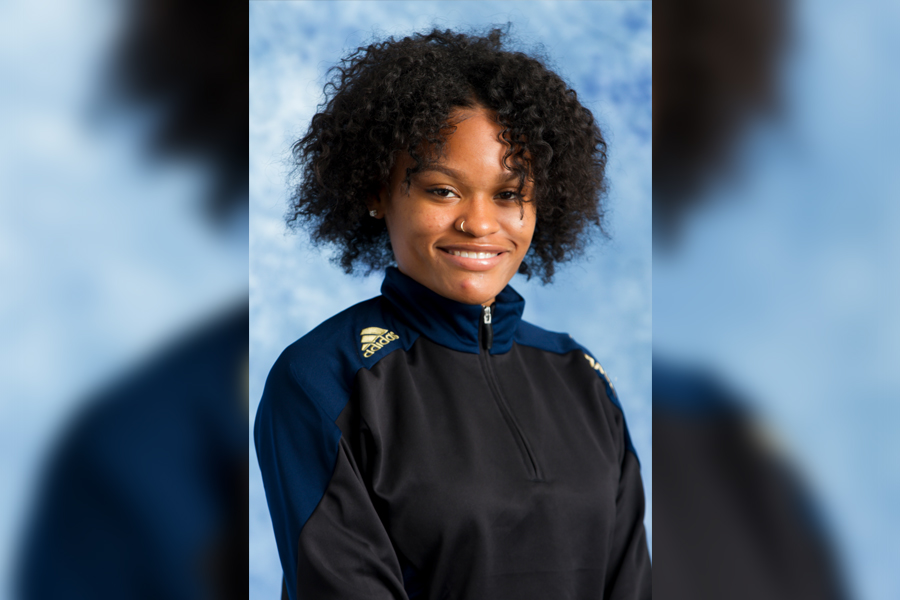
In an overall impressive year from the UC Davis track and field team, earning second place at the Big West Championships, one sprinter in particular has caught the eye of many. Track and field sprinter Kierra Davis earned Big West Women’s Freshman of the Year, the first Aggie to earn this award since 2014. Davis also took home the Female Newcomer of the Year Award at the Gunrock Gala, an awards banquet put on by UC Davis to recognize and award student athletes for their amazing performances.

Davis finished fourth in the 200-meter dash and seventh in the 100-meter sprint at the Big West Championships. Her 100 meter preliminary heat time of 11.70 seconds ranks fourth in UC Davis outdoor history, and her 23.84 time at the University of Nevada Las Vegas Invitational earned her third in the school record books. She joined the No. 2 relays that helped win the Big West Conference title. She was named Big West Women’s Track Athlete of the Week on March 21, an honor which was attributed to her personal record of 11.86 in the 100-meter and 24.46 in the 200-meter sprint. At New Mexico’s Don Kirby Invitational, she ran a 24.46 in the 200, which now ranks second in UC Davis annuals.

The California Aggie had the chance to sit down with Kierra Davis to talk about her success on the track.


How long have you been running track and field, specifically sprints? What got you into the sport?

I started really running track my freshman year of high school. I always was kind of fast, but I always told myself that I was going to run track in high school. My dad really pushed me to try and do track, so that is what really got me to do it. Freshman year is when I started, but sophomore year is when I started to really get serious.


How does it feel when you were given the Big West Women’s Freshman of the Year Award?

It is honestly surreal. I have been going through the motions and everything, but if you step back and see that this is real, it is a great experience and I am just very grateful for it. It is an honor because everybody is talented, but for this to actually happen, I am just really grateful.


How did the team react to you winning this award?

They have been really supportive. Our sprint squad specifically is a big family, so they have been very supportive and at the Gunrock Gala they were yelling and voting for me, so I really appreciate all of that.


What is the ultimate goal for you to achieve athletically at UC Davis during your next few years?

I want to make it to Nationals. I already know our relay team can make it in the next few years, but I really want to do it individually. I told myself that after college I was going to be done, but it would be the Olympic year [2020], so we will see what happens. I am not saying anything for sure, but whatever happens, I am just going to go with the flow.


Director of Cross Country and Track and Field and sprints coach Rahn Sheffield, the coach of numerous Olympic track and field athletes, added comments about Davis and where he sees her future in the track and field world.


Did anything stand out about Kierra that you don’t normally see in other athletes?

Her strength to deal with adversity. We are talking about a lot of pressure. She delivers in that environment, which is hard to do, especially for a freshman. Usually, you see a freshman have a bad day or a bad year, but she doesn’t have that. She can deal with all the nerves and the pressure of not just her family, but the invisible weight of UC Davis that you cannot see, and go out and deliver.


Why do you feel that Kierra was chosen to receive this award?

There are people that wait for greatness and there are others that go for greatness, strive for greatness, and Kierra is one of those athletes. Whatever is going to be, she is a strong enough athlete and knows that she is in charge of her own destiny, and if it comes with the awards then so be it.


As the coach, what do you feel needs to be implemented in order for Kierra to continue to have the success she has been having?

I believe that she needs to continue to listen, and be a student of her sport, and she will continue to get better and better. I don’t feel that the Olympic Games are far off for this young lady. To represent the United States of America, you represent all nationalities. You may not know their names, but they will be shouting yours, and I believe that she is headed in the right direction. I also believe that she is the best recruit we have had in the last 10 years.  


Written by: Ryan Bugsch — sports@theaggie.org

A year in songs

The arts desk reflects on the academic year


Oftentimes, listening to a song can take you back to a very specific moment — you can remember how the right song captured just exactly how you felt when you were cramming for a midterm, when you were out dancing with friends, when you were preparing to walk across a stage and receive a diploma. Here, the arts desk shares the songs that defined our year.


Ally Overbay — “Suede” by NxWorries, Anderson.Paak

I hold no lyrical connection to this song. It’s loud, crude, too explicit to be quoted from — almost reckless in its composition. But choosing something melodic would simply be inaccurate; encapsulating my year with tracks like Shakey Graves’ “Tomorrow” or Bon Iver’s “9 #Strafford APTS” would simplify my experiences — and my junior year was anything but casual chord progressions or haunting harmonies.

Funky basslines, jazzy rhythms, Anderson.Paak’s raspy vocals — these are my experience. “Suede” is an anthem for chaos; for waking up at 6 a.m. to finish a paper due at 9 a.m.; for napping in a car, Blaze pizza box as a pillow. This song is silliness and thrills, grinning and dancing, fully intended for staring fear and discomfort straight in the eyes and crooning, “Yes, lawd!”


Myah Daniels — “Humble” by Kendrick Lamar

Not only is this politically-driven track a banger, but it also reminds listeners to take a step back and look at the greater social picture. Oftentimes, students get caught up in the spectacle of parties, midterms and internships. However, Lamar reminds his audience to keep one’s family, culture and self-identity at the forefront of their thoughts, not losing sight of who they are among a crowd. Sometimes, we college students need to do exactly what the chorus says: “sit down, be humble.”


CaraJoy Kleinrock — “Trees” by Twenty One Pilots

When choosing a song that defined my year, I knew I had to pick a Twenty One Pilots song. Ever since I went to their concert on assignment for The Aggie — which was the best live performance I have ever seen — I have been obsessed with the band. Their music doesn’t fit into any genre, but somehow all their songs make me feel calm. The song “Trees,” specifically, helps me put all my worries at ease and ends up putting a smile on my face. This was a song that I needed this year to help me deal with the stress of junior year, and knowing that these lyrics come from someone’s own experiences only give it a deeper meaning.


Akaylah Ellison — “River” by Leon Bridges

          The beginning of the school year was surrounded with doubt, anxiety and, more importantly, fear. This year, Davis was overwhelmingly wet, so it seems fitting that the song that sums up this academic year encompasses the water and what water means. Water has a purifying aspect: it is redemptive, forgiving and transparent. The school year started with the guilt of all past failures, and I worked through the rain, which cleansed me and gave me hope — it gave me a future.


Sydney Odman — “Brand New” by Ben Rector

          I discovered this song the summer going into freshman year. It was upbeat, fun and full of all promises and expectations for the coming months. My first year of college has undoubtedly been one of my best yet, and it’s all due to the wonderful people I’ve met along the way. I feel as if this song perfectly encapsulates the excitement and positivity I’ve experienced this year, and listening it to it fosters a bittersweet feeling.


Caroline Rutten — “A Change is Gonna Come” by Sam Cooke

         I am indeed a sucker for any older song; call me an old soul if you please. But in all actuality — and I say this with the least intention to sound cliched — starting my freshman year here at UC Davis has inevitably been a change in my routine and setting, sparking a correlating change in myself and my interests. Moreover, the most poignant of changes have been the most unexpected, achieved with an enchanting wonder along with a grit and determination. I have found an interest in human rights, have solidified my intention to change social and racial dynamics in the future. So as much as this song can merely describe the change I have witnessed in myself, it is also the song I listen to as I plan to foster equality in my community and abroad. That initial belting note gives me the chills every time.


Becky Lee — “Entropy” by Bleachers ft. Grimes

“Entropy” describes the common loss of joy in pursuing a passion for success, which is essentially what school felt like many of these days. Through immense stress and hard efforts, I’d oftentimes question my abilities and the quality of my work. However, these moments of doubt were actually reminders of my strengths and accomplishments in the end. It’s ironic that the singer seems to question the originality of their music while being immersed in the industry, while the song itself is deviant from mainstream sound. “Entropy” has a cool tune but also describes my inner monologues flawlessly.


Abigail Wang — “I Try” by Macy Gray

This song is special to me because my mentor Claire introduced it to me, and it reminds me of our amazing friendship that developed over the year. I also resonate with it a lot because I wear my heart on my sleeve, and the person in the song is not good at hiding their emotions either. It is a great song to sing or yell along to and get your frustrations out. It’s a classic and a song I will always remember my first year by, and the wonderful people I had the opportunity to meet in that time.


Pari Sagafi — “Another Day of Sun” from La La Land

This song perfectly sums up the school year for me: filled with anxious excitement to leave one place for another, hoping that although there may be some inevitable post-graduation disappointments, there’ll always be “another day of sun” and great things to look forward to. Unbelievably cheesy, yes, but the film’s opening number is so catchy and fun that I’ve been replaying it nonstop since its release.


Amanda Ong — “This Year” by The Mountain Goats

It seems almost too obvious and straightforward, picking a song titled “This Year” to sum up this year. But after a year that was anything but easy, a song with the line “I’m going to make it through this year if it kills me” felt like the best way to sum things up. This song comes from the album The Sunset Tree, which revolves around lead singer John Darnielle’s experience growing up in Southern California and dealing with his abusive stepfather. The lyrics are sometimes dark, sometimes full of youthful spirit and ultimately hopeful — something much needed this year.


Written by: The California Aggie Arts Desk — arts@theaggie.org


Double Take: Chocolate chip or oatmeal raisin?

NICKI PADAR / AGGIE

CHOCOLATE CHIP — Noah Pflueger-Peters

I think Eli is a good guy, but I never knew he could be so wrong about cookies. Allow me to right his wrongs.

I’d like to preface this by saying that I’m not arguing that oatmeal raisin cookies are bad, simply that they are and forever will be inferior to chocolate chip cookies.

Raisin cookies’ main offense is that they pretend to be something they’re not. They’re fakes, posers and frauds whose only purpose is to deceive and to disappoint. How many times have you seen cookies in the distance with little dark dots and gotten excited for a beautiful chocolate chip encounter, only to realize that they’re actually oatmeal raisin, causing you to walk away disappointed, having that craving unfulfilled and your time wasted?

Oatmeal raisin must always be defined in relation to chocolate chip. If the chocolate chip cookie didn’t exist or the raisin cookie didn’t pretend it was chocolate chip, I could see myself eating oatmeal raisin cookies from time to time. Sadly, this just isn’t a reality.

The Aztecs and Mayas considered chocolate “The Food of the Gods.” It was considered the utmost delicacy and was a centerpiece of religious rituals for centuries in Mesoamerica. Would you rather have a dried, wrinkly, weirdly squishy fruit all up in your cookie, or a substance that’s so good it has literally been deemed fit for gods and kings?

The experience of eating a raisin cookie simply can’t compete with that of a chocolate chip one. When you eat a fresh chocolate chip cookie, the chocolate blends with the warm dough and melts in your mouth, creating a symphony of deliciousness. But raisins don’t melt. At this point, what’s the difference between a fresh-baked oatmeal raisin cookie and a day-old one that’s been warmed in the microwave?

I’ll give the heathens one concession: chocolate chip cookies contain slightly more calories per ounce. Oatmeal raisin cookies also contain half the fat and cholesterol. However, you’re ignoring the real killers: sodium and carbohydrates.

Oatmeal raisin cookies contain a whopping 56 more milligrams of sodium than the average chocolate chip cookie. If you ate one oatmeal raisin every day in place of a chocolate chip you’d consume an alarming 20,440 more milligrams of sodium per year. Excess levels of sodium lead to high blood pressure and an increased risk of stroke, heart failure and kidney disease. Oatmeal cookies also contain 3 more grams of carbohydrates, which are linked to obesity and an increased risk of heart disease and diabetes. If you choose oatmeal raisin over chocolate chip, you’re signing your own death warrant.

The world is depressing enough as is. The last thing we all need is a deceitful, disappointing and dangerous dessert haunting us on top of all of life’s other grim realities. Is not even dessert sacred? The oatmeal raisin cookie grabs you by the neck, looks you dead in the eye and screams, “NO!”


Written by: Noah Pflueger-Peters — napfluegerpeters@ucdavis.edu


OATMEAL RAISIN — Eli Flesch

Why oatmeal raisin good (better than choco-chip): First, everybody knows “oatmeal raisin” rhymes with “amazin’.” Chocolate chip only rhymes with “fava bean dip,” also known as “the dip of fools.”

Also: I ate a choco-chip once. No good. Too much “chocolate.” Which means, sweetness was bit much. Overwhelming. And chocolate kills dogs. Not oatmeal, nor the mighty raisin. So would you rather kill a dog, or eat cookie with fruit and oats — two big-league health things, I think?

Yes, healthy. So healthy. The healthiest. Which is why Mr. Pflueger-Peters is wrong. Gwyneth Paltrow once said: “I know healthy. I am a former head of lettuce” (healthy) “so I know green. And when I see Mr. Pflueger-Peters say Mr. Flesch is wrong, I think: No. Eli right. Oatmeal raisin good.” Okay. Even if quote wrong, it is “essential truth.” “Fictive truth.” Like War and Peace, or Lolita or Freddy Got Fingered. So to Mr. Pflueger-Peters I say: No, it is you who is wrong.

More reasons why oatmeal raisin good:

  1. “Meal” in name. As in the things that keep us alive, please the bellies. Chocolate chip has “late” in name. Tardiness bad habit. Also has “hip.” But not “cool hip.” The hip bone. Gross.
  2. The crustiness factor. Oatmeal stays moist. Longer than choco-chip. Helps me on long road trips to “SoCal” — Southern Cal — where I have family, dog that I want alive.
  3. Taste.
  4. Fun to pluck out raisins, make little raisin men, give little raisin men names (like: Mr. Raisin, Raisin III, Big Raisin Jr., Daniel) and have little raisin men discuss Important Things such as meaning of life, meaning of society, meaning of meaning, etc.

Riddle:

Man found dead. Autopsy reveal suffocation. But no marks. What happen?

Answer:

Man choke on one choco-chip (dumb). Dies (dumber). Choco-chip melt, leave no evidence (clever). Family bury man, kids cry (sad). Wife launch herself on coffin — “Take me with him!” (sad).

This is the “Riddle of The Choco-Chip.” Has moral. Moral: eat oatmeal raisin cookies. Better.


Written by: Eli Flesch — ekflesch@ucdavis.edu


Disclaimer: The views and opinions expressed by individual columnists belong to the columnists alone and do not necessarily indicate the views and opinions held by The California Aggie.

5 Films to Watch This Summer

WALT DISNEY MEDIA

Movies that everyone can enjoy, from thrillers to rom-coms to documentaries  

Terrified of not having enough summer movie options and being forced to watch the dreaded Emoji Movie? No need to fear — here’s a short list of films to provide you with a well-rounded movie-going experience this summer.


The Beguiled — Psychological Thriller (June 23)

A wounded Union soldier in the Civil War (Colin Farrell) takes shelter at an all-girls boarding school in the South and inevitably shifts the dynamic between the women as rivalry, lust, anger and seduction suddenly come into play. Yet, the women — led by the stellar trio of Nicole Kidman, Kirsten Dunst and Elle Fanning — become aware of this foreign disruption of harmony and attempt to restore order by any means necessary.

Director Sofia Coppola sticks to her typical aesthetic when it comes to the film’s cinematography, creating a dreamlike atmosphere of hazy hues and soft pastels. As usual, it works well with the externally beautiful surroundings, which serve as a stark contrast to the film’s subject matter. This ominous Southern Gothic thriller has already garnered Coppola a Best Director win at the Cannes Film Festival and is sure to be a sizzling psychodrama for the summer.


The Big Sick — Romantic Comedy (June 23)

Here we have a typical love story: Pakistani boy meets white girl, boy decides he cannot see a future with white girl due to societal and familial pressures, couple breaks up, girl falls into a coma, but, eventually, a relationship develops. Through extended hospital visits, the cultural gap is bridged, and a great love results.

So maybe the plot isn’t so typical. Based on the real life love story of Silicon Valley’s Kumail Nanjiani and his wife, Emily V. Gordon, this movie is one to watch. The romcom navigates tricky multicultural differences and romantic expectations in an endearing, funny and ultimately touching way.


It Comes At Night — Horror (June 9)

This summer’s cabin-in-the-woods zombie thriller may have you rethinking your camping trip. It has everything you could need from this specific genre of film: claustrophobia-inducing tight quarters and the palpable tension of knowing that the characters can turn on each other at any moment — all illuminated by flashlight.

The film has been so far well-reviewed and applauded for being “not over the top,” with all of its terrors and characters being somewhat realistic, therefore creating an even more terrifying movie experience. Hollywood Reporter reviewer Sheri Linden made important observations that the film inspired: What does it mean to protect your family at all costs, and when does survival become meaningless?


Whose Streets? — Documentary (August 11)

             When unarmed 18-year-old Michael Brown was shot and killed by police in the suburb of Ferguson, Missouri, it marked the breaking point for a community. Driven by deep sadness, anger and a demand for change, residents took to the streets to protest. This activism ushered in the phrase “Black Lives Matter,” which ultimately became a national movement.

Directed by Sabaah Folayan and Damon Davis, this documentary chronicles the beginnings and progress of the Black Lives Matter movement and the profound impact of that fateful 2014 event. It may have been three years since Brown was killed, but he has certainly not been forgotten, and neither have the black deaths at the hands of police that have happened since. The directors noted that they made this film “as a tribute to our people — our deeply complex, courageous, flawed, powerful, and ever hopeful people — who dare to dream of brighter days.”


Beatriz at Dinner — Comedy/Drama (June 9)

Called “The First Great Film of the Trump Era,” director Miguel Arteta’s Beatriz at Dinner invites audiences to experience what may be the most cringe-worthy dinner party to ever be captured on film. Salma Hayek plays a holistic medicine practitioner who ends up attending a wealthy client’s dinner party when suddenly her car breaks down, and she meets a rich, loudmouthed hotel owner named Doug.

Their first encounter is awkward, to say the least: he asks her if he can “get another Bourbon, hun,” assuming that she’s the help instead of a guest. It only goes downhill from there. With Doug interrupting her, disrespecting her and asking her if she is in the country legally, the film addresses topics that are relevant now more than ever, but in an entertaining and funny way.


Written by: Pari Sagafi — arts@theaggie.org

Humor: Confused Gary May leaves school in May: “I thought we were a semester school”

JAY GELVEZON / AGGIE FILE

New chancellor confused with layout of quarter system, attempts to leave while school is still in session

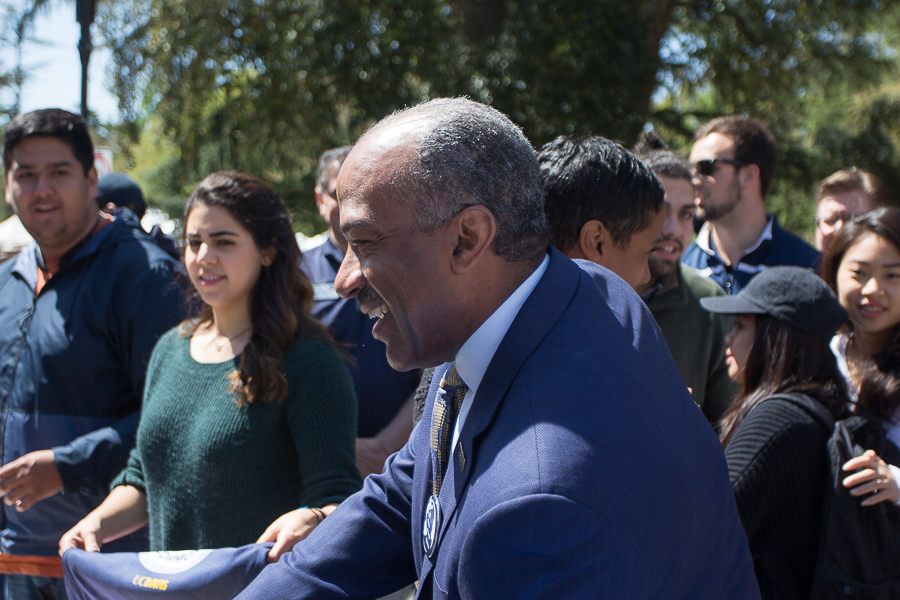
Gary May, the former dean of Georgia Tech’s College of Engineering, has spent a significant amount of time in Davis after being named the school’s new chancellor. May has worked closely with Interim Chancellor Ralph Hexter to learn the ropes of his new school’s administration.

May, however, seems to have not been informed that UC Davis is a quarter school, unlike Georgia Tech. With school starting in late September and ending in the middle of June, the quarter system can confuse students — and clearly the chancellor as well. Gary May fell into that familiar trap and has attempted to leave to spend the summer with his friends.

“Honestly, I goofed,” May said. “I thought we were a semester school. Quarter schools are pretty rare. Berkeley is a semester school — I figured all of the UCs were the same.”

May has admitted to his mistake, but the damage has been done. May has unfortunately proven that he has yet to learn how the Davis system works. Questions surrounding May’s dedication to the school have been raised as a result of his premature vacation.

May was also seen sporting a Vegas gold jacket, which is a UC Davis color but also a Georgia Tech color. The breast pocket had Georgia Tech’s logo of a yellowjacket. UC Davis students have noticed these small mistakes.

“Whatever, he’s new,” said third-year international relations major Bronson Pew. “Given the other scandals that we’ve had over the past few years, I don’t mind that he wore the wrong jacket or tried to book it too early. These things happen.”

Other students, however, are concerned about May’s many early mix-ups.

“I don’t know how this is going to play out in the long run,” said fourth-year biology major Tim May, who has no relation to Gary May. “If May can’t figure out when we end school, what’s going to happen when there’s another incident that requires quick thought? We can’t have silly mistakes like wearing the heinous Vegas gold and accidentally representing the wrong school.”

These concerns are valid, but Gary May is stepping into a large role with a fair amount of experience. The transition to the West Coast might take longer than some had  hoped, but he has proven with his extensive resume that he is fit for the job. Small gaffes happen. He’s under the microscope after issues with the prior administration have led to distrust among students and the powers-that-be. May will do his job effectively and continue this school’s upward trend.


Written by: Ethan Victor — ejvictor@ucdavis.edu


(This article is humor and/or satire, and its content is purely fictional. The story and the names of “sources” are fictionalized.)