54.1 F
Davis

Davis, California

Tuesday, December 23, 2025
Home Blog Page 730

Zenith Fashion Show to be held on Picnic Day

0
HUAN YU / UC DAVIS
HUAN YU / UC DAVIS

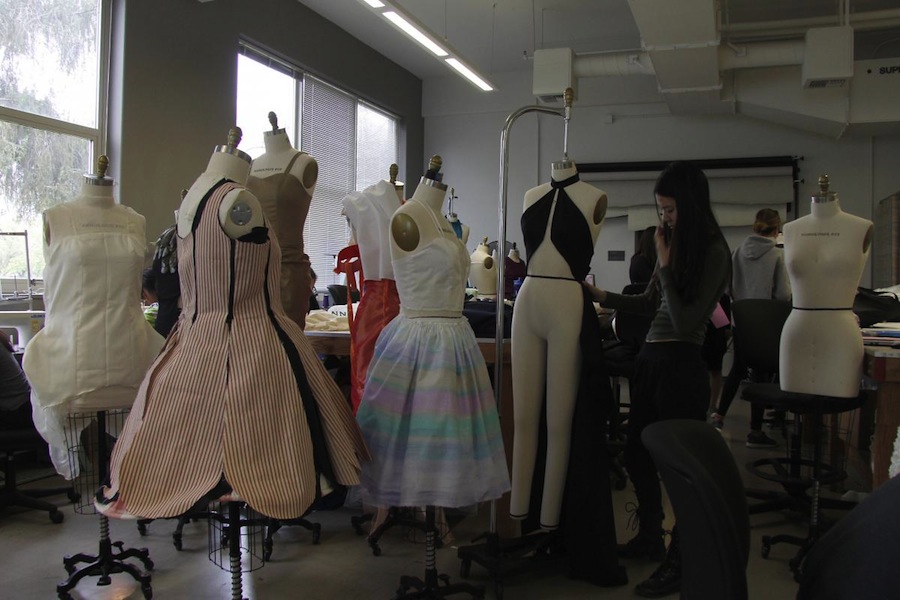
Students from the Signature Collections class excited to reveal their designs

This Picnic Day, on Saturday, April 16, the Fashion and Design Society and the Signature Collections class are debuting their 2016 pieces during their annual fashion show. The Fashion and Design Society (FADS) has been planning the show since Winter Quarter.

Jason Lin, an officer for FADS and fourth-year design and psychology major, titled this year’s fashion show “Zenith,” which means the highest point reached. They found this to be representative of all the work they put into their class and designs. Lin describes Zenith as a culmination of everything they have learned over the last four years; in other words, some of their very best work.

“I wanted my art and fashion to have a purpose and speak some sort of meaningful message, and the first thing I thought of was gender identity […] My collection is this kind of avant-garde play on gender roles,” Lin said.

Lin discussed how his collection reflects the idea of people evolving to the point where no matter what they wear, no one judges them and gender roles become obsolete. He is excited to finally reveal his collection after putting so much work into his designs, which incorporate a wide range of mediums.

Katherine Ta, a third-year design major with an emphasis in fashion, has been working tirelessly to complete her collection. Her collection theme was inspired by various types of circuses and incorporates different color and pattern elements.

“My favorite part of designing was simply completing an outfit. Once you put it on a dress form or a model, you can see all the hard work that you put into it,” Ta said. “There’s that feeling of satisfaction and a weight off of your shoulders. Having a sense of relief helps me get through the endless days of sewing.”

        The fashion show will showcase many different designs, themes and models. Lisa Romero, a fourth-year design major, came to UC Davis specifically for the design program. Her collection is Alice in Wonderland-inspired.

“My collection has simple silhouettes, but the use of unique fabrics, including some textiles that I hand-dyed, really elevates it to that ethereal feeling associated with the story. I’m a huge fairytale/Disney fan so it was no surprise I decided to go with inspiration that related to those themes,” Romero said.

Zenith will be held Saturday at the ARC Ballroom. Doors open at 10:30 a.m. and the show begins at 11 a.m. The presale fee is $5, and tickets at the doors are $7 for students and $10 for non-students. Please visit the Facebook event for more details.

WRITTEN BY: Sami Bass – arts@theaggie.org

The fight for 15

0
HANNAH LEE / AGGIE
HANNAH LEE / AGGIE

California workers to benefit from new minimum wage

California took a large step toward improving the lives of its lowest earning workers last week by signing into law a $15 minimum wage that will be phased in by 2022. The move, which came on the same day New York passed its own similar bill, promises to provide millions of Californians with a much-needed pay raise.

Before signing the law, Gov. Jerry Brown adopted the right tone of economic skepticism and moral imperative that should accompany any sweeping change like the one enacted Monday. While acknowledging that, “minimum wages may not make sense,” he also praised them for their social and political benefits.

It’s true that in a large state like California, with vastly diverse economies, one base wage might pose problems. Workers in San Diego may benefit more than workers in the Central Valley, where the cost of living is significantly lower and an increasing minimum wage could restrict employment opportunities.

Thankfully, the law signed on Monday provides a sensible mechanism by which wage increases can be paused in the event of a recession. And the six year timeline — four years longer than New York’s — suggests that potential problems can be studied and dealt with as they arise. California also gives small businesses, defined as those with fewer than 26 employees, another year to meet the base wage.

Slow timelines like these have provided huge benefits. As Seattle instituted its own $15 minimum wage, its restaurant industry boomed, despite the usual apocalyptic language labor opponents used to paint the proposal.

And California’s law, fitfully passed by the legislature on César Chávez Day, affirms the struggles of labor like no other proposal.

The Service Employees International Union (SEIU), which represents approximately two million workers, sponsored one of two competing ballot initiatives that would have increased the minimum wage to $15 by 2021, one year earlier than the current law. By possibly leaving the wage question to the voter, the SEIU effectively pressured Sacramento to pass its own, better law with a much-needed sense of urgency.

The actions of the SEIU underscore the importance of organized labor in fighting a decades-long stagnation of wages. However, labor leaders must show good faith. In Los Angeles, where a $15 minimum wage was passed last summer, some union heads argued that a worker’s right to collectively bargain should allow them to take a subminimum wage in exchange for other benefits, like better working conditions.

If organized labor were to use this line of hypocritical argument, it would undermine the whole point of a minimum wage — namely that it should be a minimum. As the partisan vote to pass California’s law showed, the minimum wage has enough opponents without the extra headache of labor.

Indeed, the vote itself, seemingly thrown together in a matter of days, calls to question whether lawmakers fully appreciated the magnitude of their actions. Though it’s refreshing to see legislators actually legislate in a timely manner, not much consideration was given to how the minimum wage might affect, say, retirees who live on fixed incomes ever sensitive to increasing inflation.

Still, the wage increases passed in California and New York are cause for celebration. Now that the two of the most populous states in the nation have resoundingly affirmed the working class’ right to live comfortably, Congress should take it upon itself to enact a higher federal minimum wage.

Humor: Tour group stands idly by as tour guide walks backwards off flat Earth

0
BARK / FLICKR
BARK / FLICKR

UC Davis mourns the loss of one of its students while learning about the true shape of the planet

On Decision Day earlier this month, a group of prospective Ags were walking through the Arboretum on what they thought would be a normal day, when tragedy struck.

“I’ll be walking backwards, so let me know if I’m going to run into anything,” fourth-year geology major and campus tour guide Rosie Schwarz told a group of high school seniors. And run into something she did. As she was explaining some strongly-worded protest chalkings to the curious crowd, everything that Rosie had learned about the Earth in her geology classes was disproven. What she thought was just the edge of the Arboretum was actually the point at which the flat Earth fell into the vast, dark depths of outer space.

In the same style as good ol’ Sandra Bullock in Gravity, Rosie began spinning uncontrollably and flying toward the sun with no end in sight. Rest in peace.

The crowd that Rosie had been leading watched on in horror. Now how were they going to get a tour of the campus?

“It’s really disappointing that tour guides here feel the need to fall off of the planet instead of telling me about all the different types of bland foods served at the CoHo,” prospective Aggie dad Richard Thomas said.

The geology department put out a heart-wrenching statement in which they mourned the loss of Schwarz, one of only five students who had declared a geology major.

“She wasn’t even interested in it for the dinosaurs,” department officials said. “She really had a passion for plate tectonics. She wanted to save lives.”

An important lesson can be learned from this tragic event that occurred on our own campus. We need to listen to more crazed “celebrities” when they tweet about the state of our planet. Like when B.o.B. tweeted, “A lot of people are turned off by the phrase ‘flat earth’…but there’s no way u can see all the evidence and not know…grow up.” It’s time we prioritize B-list celebrities over these “scientists” who are obviously just government sheep designed to conceal the truth of #FlatEarth.

Follow @FlatEarthToday on Twitter for more truth.


You can reach BRIAN LANDRY at bjlandry@ucdavis.edu.

Technology takeover

0
ROSA LEE SCHWARZ / AGGIE

Increasing number of classes switch to hybrid and online course format.

As class sizes grow, so do the number of online and hybrid courses offered on college campuses.

Some of these classes include PSC 100Y, BIT 100Y, BIM 110B, BIM 110C, LIN 001 and many more. Currently, several new hybrid and online courses are being developed by UC Davis faculty.

Steve Luck, UC Davis professor of psychology, created PSC 100Y — Intro to Cognitive Psychology — two years ago, after 15 years of teaching it in the traditional format.

“Over time, my classes got bigger and bigger and it just seemed that the quality of the education was going down,” Luck said. “So I thought maybe by using technology and doing this hybrid style, I’d be able to give the students a better educational experience where they could learn more and enjoy more without changing ultimately how much time I spend in the classroom.”

Luck created the course through the Provost Hybrid Course Award (PHCA), a grant program that gives faculty members $12,500 to create and design a hybrid course. He was one of six faculty members awarded the grant in 2013. In order to receive the award, Luck also had to attend a 10-week seminar on hybrid classes put on by the Center for Excellence in Teaching and Learning.

“[The award] was matched by the dean of social science’s office and that gave me $25,000 total,” Luck said. “That provided funding to pay graduate students to help me with creating course material, buy[ing] the equipment I needed to shoot the videos and pay[ing] for undergraduates to help with all of the production and editing, [which] turned out to be really important.”

The course is divided into both in-person and online components. Lectures are scripted, pre-taped and given through online videos, and after every five minutes of lecture, students are asked a quiz question. After every half an hour of lecture, students are quizzed again with another five questions.

“It turns out that there’s a ton of evidence for something called ‘the testing effect’ which is that if you’re tested on something shortly after you learn it then you remember it better later,” Luck said. “Really the quiz questions do two things – one is retrieval practice. The other thing is that they focus the students on what [it was] that I wanted the student to learn from that [lecture].”

Discussion sections are in-person, and a class of about 200 students is broken down into eight discussion sections with about 25 students each. The teaching assistant (TA) and the professor take turns leading discussion sections. Fifth-year graduate student in the department of psychology Branden Kolarik has worked as a TA for Luck’s class four times.

“[In a traditional class] the only interaction I would ever have with a student is if they came to my office hours to talk to me about something, whereas with the hybrid course, I was spending 50 minutes a week with four different classes,” Kolarik said. “We had one-on-one time where they could ask questions about concepts and we were able to do group activities, which is just not feasible at all in a big lecture class.”

Although some question the effectiveness of online education, Luck found that students scored better in his hybrid class than in his standard class.

“It doubled the number of test scores in the A range and cut the number of D’s and F’s in half,” Luck said.

The hours of time and energy spent to create the course proved effective for Luck.

“The amount of time it takes to put together a class like this is truly insane,” Luck said. “For that class, I estimate that every hour of video I produced probably took me about 20 hours to make. It’s a crazy amount of work but that work then pays off for many years. It’s worth it in my mind to do it, but I do it because I love it.”

Dr. Liz Applegate, professor in the department of nutrition, has taught NUT 010 (Discoveries and Concepts in Nutrition) at UC Davis for 31 years, and transformed it into a Hyflex course in 2012. In a Hyflex course, students have the first week to choose the option of taking it entirely in-person or virtually, with in-person exams.

The Hyflex format allows for higher enrollment numbers; Applegate currently has 1,150 students in her Spring Quarter NUT 010 course. She works with her teaching staff, eight TAs and 30 test graders, to manage the course.

“It’s a ton of work on our side — it’s similar to running two courses,” Applegate said. “We have to be very precise and make sure that we cover things in the time frame, that we’re consistent, that we have messages that go out to students by email in a concise way — everything has to be comparable in the two groups and we go to great lengths to make it that way.”

As opposed to Luck’s online format, Applegate records her in-class lectures for online viewing. According to Applegate, virtual students are performing “equally well, if not just a tad better.”

This quarter is Applegate’s last quarter teaching NUT 010. In the future, she will be working on developing an entirely online NUT 010 course for all UC campuses.

“Why I didn’t [create a 100 percent online course] right off the bat is that I didn’t feel, at the time, we had a good handle on how these students learn best in a fully online course,” Applegate said. “In the past four to five years I’ve been learning that and I think we’re ready to take this to this large level, so it’ll be exciting to see how this pans out.”

Written by: Fatima Siddiqui – features@theaggie.org

Sacramento heats up for chili cook-off

0
ZHEN LU / AGGIE
ZHEN LU / AGGIE

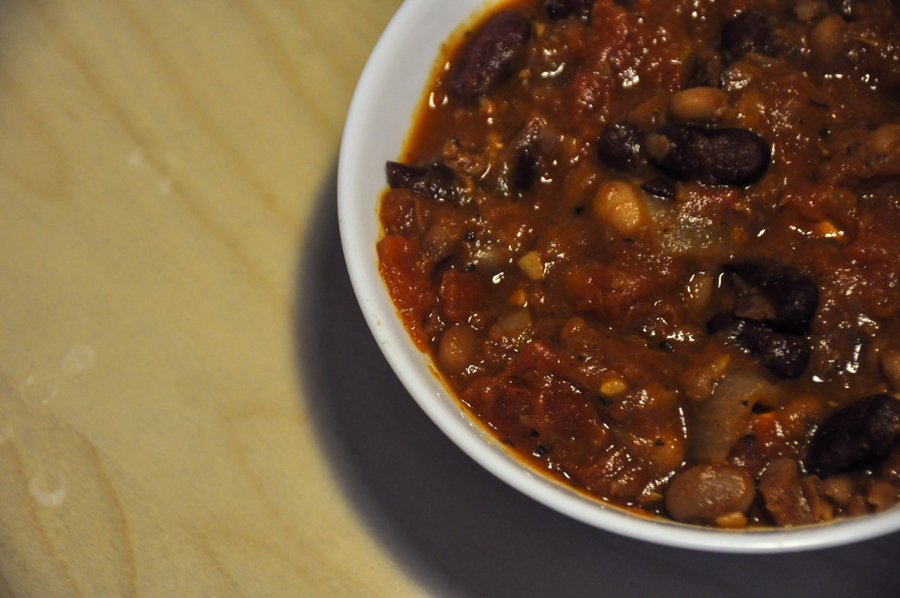
On Saturday April 16, Sacramento will host its annual Beer and Chili Festival at Roosevelt Park, located at 1615 9th St. The event, which has been running every year since 2011, will include a chili cook-off competition and a variety of beer tastings from over 15 local vendors.

The festival is run by the Sacramento Artists Council (SAC), a local non-profit which gives out grants to help keep art programs in schools. The festival is one of the SAC’s biggest fundraising events of the year.

Susan Rabinovitz, founder and executive director of the SAC, says that she started the event as a fun way to fundraise, as opposed to simply asking for donations. She chose a chili competition because she noticed that nobody else in the area held one.

It has grown tremendously. I think in the first year we had maybe a few hundred guests and this year we’re looking at about 1,500. We only had eight chili contestants the first year and this year I believe we have around 20 or 22 contestants,” Rabinovitz said.

Apart from successfully raising money for SAC, Rabinovitz added that, in past years, they have also raised enough funds to support the Aging a Miracle program, a youth summer camp for children from homeless families.

One of the groups participating in the chili cook-off is Chalk it Up, a Sacramento-based nonprofit which gives out grants for youth art projects.

Linda Perry, board president of Chalk it Up, said that one of the reasons the organization decided to participate in the festival was to support a fellow art grant nonprofit.

We’re just […] two art programs supporting each other […] I felt like [the competition] was a good way for us to be involved and just sort of have fun with it. We wanted to do it last year and then I chickened out […] we’ve been practicing and our whole team is geared up and ready to go this year,” Perry said.

While slightly nervous about serving food to so many visitors, Perry is also excited about the prospect and is confident in her team’s chili recipe.

“It’s a little intimidating to think that […] potentially hundreds of people are going to taste your food […] It’s been a recipe since back in the Cattle Club days,” Perry said.

One of the other competitors at the event is Dad’s Kitchen, a Sacramento-based restaurant owned by Rabinovitz’s husband, Julio Peix. Peix is the beer consultant for the festival and has helped run the event since its inception. He highlighted that the festival’s main goal is to let people have fun in a welcoming atmosphere.

“I like giving value […] We have bands, we have food […] we really control it, we want people to have fun and enjoy the day, not just come and get pie-eyed,” Peix said.

Peix is also excited that Dad’s Kitchen will be participating in the chili cook-off for the first time and emphasizes that the cook-off is a jovial yet serious event for the participants.

“[For the winner] it’s pretty good bragging rights […] We want people to participate, it gets very competitive too, people go at it, they try to kick each other’s asses, it’s pretty funny […] We get judges from different fields,” Peix said.

The Sacramento Beer and Chili Festival takes place on April 16, at Roosevelt Park in Sacramento. Tickets are $35 and VIP tickets are $55, prices will increase for tickets bought at the door. Tickets can be purchased online at http://sacramentobeerandchilifestival.com/ as well as at the door.

Written By: JUNO BHARDWAJ-SHAH – city@theaggie.org

Correction (4/18/2016): The article originally stated that Susan Rabinovitz was the wife of Julio Peix, but this is not true. The article has been updated to reflect this change.

UC accused of favoring out-of-state applicants over in-state students according to state audit

LUCY KNOWLES / AGGIE

Audit claims percentage of admitted out-of-state students has increased over the years, causing in-state students to be turned away from their schools of choice

In late March, the new state audit released a 126-page report accusing the University of California (UC) of admitting too many out-of-state applicants to its campuses and turning away local students.

The audit revealed that the UC favors out-of-state students, and found that while out-of-state applicants benefited from lowered admission standards, California students were increasingly turned away from their campuses of choice.

The audit was requested more than a year ago by California Assemblyman Mike Gipson, who witnessed the enrollment of students from other states and countries grow to 15.5 percent of UC’s total undergraduate enrollment, which is up from about 5 percent eight years ago.

UC President Janet Napolitano claimed the audit was “disappointingly pre-baked” and “unfair and unwarranted.” She stated that higher-paying out-of-state students contribute $728 million to UC coffers which allows the 10-campus system to accept more Californians amongst the massive budget cuts imposed since the 2008 recession.

“Our commitment to California and California students has never wavered, even through the worst financial downturn since the Great Depression,” Napolitano said in a press release on the University of California website.

UC officials also insist that the nearly $25,000 in additional tuition that nonresidents pay each year has allowed the UC system to enroll thousands more California students than the system could otherwise afford. Tuition and fees for out-of-state students totaled $38,108 this academic year, compared with $13,400 for in-state students.

“Without the extra money from out-of-state students, Californians could have faced an additional $2,500 in tuition — a roughly 20 percent boost,” Napolitano said in a statement for the Los Angeles Times.

On April 4, the University of California posted a press release on its website stating that in 2016, the system admitted significantly more California residents. According to the press release, California resident freshmen admitted to a UC for fall 2016 increased by 8,488 students for a total of 66,123 admissions offers. This is a 14.7 percent increase over 2015.

The press release also states that the preliminary fall 2016 admission rate for nonresident students fell from 54.6 percent to 53.7 percent.

However, state auditor Elaine Howle said that UC officials did not provide evidence for their key claims, as they had not shown how they used the $728 million in nonresident tuition for more California students.

“They never called into question any of the facts […] They just don’t like our conclusions,” Howle said in a statement for the Los Angeles Times. “But our conclusions are based on the facts.”

Hans Johnson, a senior fellow at the nonpartisan Public Policy Institute of California, believes that with fewer nonresident students, more Californians could go to their top campus choices. Many students who are turned away from their favored campuses are offered a seat at UC Merced, even if they did not apply there.

Kara Sonh, a third-year transfer biology major, echoes Napolitano’s sentiment on the audit’s claims.

“I never thought getting into an out-of-state school would be easier,” Sonh said. “In fact, no one really tries even leaving Texas and going to a place like a UC because it is difficult, plus really expensive. My friends who go here and are from California had benefits like even being guaranteed a UC for being in the top of their class.”

Mason Hall, a third-year anthropology major from California, believes out-of-state transfer students pay a high price for attending a UC.

“I have a friend leaving Davis this year because they can no longer afford the tuition,” Hall said. “She pays a substantially greater amount than me and I’m shocked they even ask that much from transfers.”

The audit recommends a biennial cost study and a review of how to reduce the $13 billion spent on staff salaries in 2014-15. UC officials said they have worked on reducing costs and will continue to seek new ways to do so.

The audit also recommended stricter entrance requirements for nonresident students, a cap on their enrollment and an increased focus on recruiting Californians — particularly African Americans, Latinos and other underrepresented minorities.

Written by: Demi Caceres – campus@theaggie.org

UC Davis ranks no. 1 college for women in STEM

AMY HOANG / AGGIE
AMY HOANG / AGGIE

University recognized for ADVANCE Program and CAMPOS Initiative

On March 29, Forbes named UC Davis the number-one college for women in STEM.

Using Forbes’ 2016 Best Value colleges ranking, the magazine assessed schools with a strong emphasis on science, technology, engineering and mathematics and found the rate of attendance by women. Forbes states that UC Davis has a 56 percent female enrollment with 29 percent of the total student body declared as STEM majors.

Forbes went on to highlight UC Davis’ ADVANCE Program and CAMPOS Initiative as examples of key support systems.

Started in September 2012, UC Davis ADVANCE is a mentoring program with both faculty and student members which aims to support the participation and advancement of women in science and engineering fields. The university branch is supported by the National Science Foundation’s ADVANCE Program.

CAMPOS, a sister program under ADVANCE, strives to support a diverse and inclusive environment for women in STEM through prioritizing Latina STEM scholars.

Many other programs under these initiatives help to support women in STEM. For example, LAUNCH, another sister program under ADVANCE, provides mentorship for new faculty by supporting their early professional integration and development of their careers at UC Davis.

Mary de Leon Siantz, UC Davis ADVANCE CAMPOS Initiative founding director, speaks to the importance of balancing work and life for women.

AMY HOANG / AGGIE
AMY HOANG / AGGIE

“One of the things here we’re looking closely is to foster and support life-work balance and that’s really important to women,” Siantz said, “We’ve had a number of these scholars come in either pregnant, getting pregnant, or have babies [while] trying to navigate their careers here.”

Siantz cites the Partner Opportunity Program as an example of the university supporting women balancing work and life. The program helps already employed female faculty find employment for their husbands as well.

Forbes points out the secret to helping women succeed in STEM is support systems.

“I agree 200 percent with [Forbes]. We’ve been working very hard with the Chancellor’s initiative on an institutional transformation that is being supported by the National Science Foundation,” Siantz said, “I came from the University of Pennsylvania and I’ve worked in other places, I’ve never seen a thing like this.”

Chancellor Linda P.B. Katehi credits UC Davis’ recognition to the faculty.

“A primary reason for our success has been the outstanding faculty we recruit and the work they spearhead to increase female and underrepresented minority representation in STEM,” Katehi said in a press release.

Andy Fell, associate director of news and media relations at UC Davis, said that UC Davis differentiates itself from other universities in terms of diversity because of the large number of female STEM faculty.  

“The departments of Earth and Planetary Sciences and Chemistry are two STEM departments with a high proportion of female faculty compared to similar departments at other universities,” Fell said.

Siantz emphasizes the significance of UC Davis’ institutional transformative initiative to support women in STEM.

“The National Science Foundation has supported [UC Davis] ADVANCE to promote science for women all over the nation. UC has been [the foundation’s] focus [to] not only recruit women, but [also] diverse women,” Siantz said. “This [program] is going be very important for future scientists. The girls from California are going benefit a lot from this [program] and [so is] the nation.”

Written by: Yvonne Leong – campus@theaggie.org

UC Davis launches bike helmet promotion campaign

DIANA LI / AGGIE
DIANA LI / AGGIE

University to offer affordable bike helmets and 5 dollar CoHo gift cards to helmet-wearing students

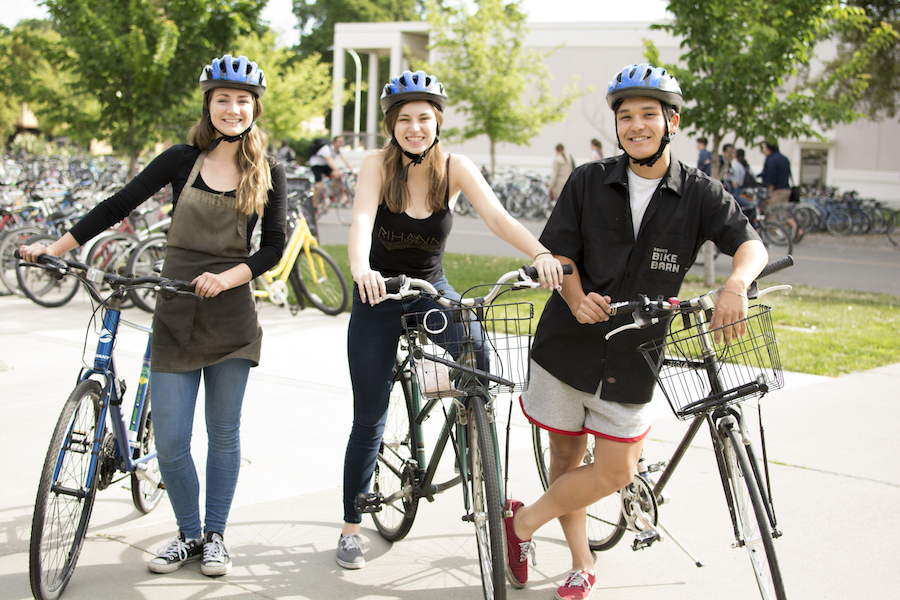
The Student Health and Wellness Center (SHWC) has partnered with various members of the UC Davis community to launch “Helmet Hair Don’t Care,” a new bike helmet promotion campaign. This initiative will provide students with inexpensive helmet options along with incentives, such as ASUCD Coffee House gift cards, to encourage more of the student body to wear helmets when biking.

According to a 2014 American Community Survey, Davis has the highest population of bicyclists in the U.S., with 23.2 percent of the city’s population commuting via bicycle,

According to data collected by the National College Health Assessment in spring 2016, less than 8 percent of undergraduate students wear helmets, which is far below the national average of 32 percent.

“We saw [the statistic] as a pretty big indicator that we need to step up our game on that level,” SHWC student assistant Steven Kracke said.

“Helmet Hair Don’t Care” combines resources from the Bike Barn, CoHo, SHWC, Transportation and Parking Services and the UC Davis Police Department to create a campaign that appeals to the student body.

DIANA LI / AGGIE
DIANA LI / AGGIE

As part of the campaign, the Bike Barn will sell helmets for $13 each and accept coupons for 13 percent off any helmet in order to provide students with affordable helmet options.

“The point isn’t to make money. The point is to get people to wear helmets and be safe,” said Robert St. Cyr, Bike Barn general manager.

Starting the week of April 10, if a campus police officer sees a student wearing a helmet while biking, the student will be rewarded with a $5 gift card to the CoHo.

“We will be handing out 300 gift cards throughout the quarter,” said Shantille Connolly, a wellness health educator. “We’re hoping to also obtain funding for an additional quarter and make it more of a sustainable model.”

Focus groups organized by Kracke revealed that appearance, convenience and affordability were the top reasons why students don’t wear helmets. To combat this, Connolly and Kracke launched the “Helmet Hair Don’t Care” campaign.

“One of the biggest barriers that students indicated was appearance,” Connolly said. “They also said that by providing affordable helmets and by having their peers use helmets, they’d be more likely to use helmets.”

Connolly and Kracke view the launch of “Helmet Hair Don’t Care” as just the beginning of the initiative.

“We’re hoping that this coming Fall Quarter will have a much larger role with orientation and welcome week. When students get here, they get the message,” Connolly said.

Posters around campus and future helmet-related activities are meant to gain momentum around “Helmet Hair Don’t Care” and raise awareness of helmet use within the UC Davis student community.

“We want to get people thinking about it, as opposed to just accepting the norm of not having helmets,” Kracke said.

Written by: Lindsay Floyd – campus@theaggie.org

Student Sounds: Introducing Cardinal

LINDSAY BRIBIESCAS / COURTESY

Duo boasts rich acoustics, hypnotizing harmonies and a lyricism that presents the mundane as poetic

In 1936, Lee Falk created the first popular superhero, The Phantom. Originally debuting in the comic strip section of the newspaper, The Phantom eventually made the transition to comic book serialization in the 1940s under the publisher Ace Comics. Ace Comics later titled the comic book series The Phantom, which suggests one reason many Western comics take their title from their superhero. To this day it remains a very popular and widely-circulated book in over 40 countries and 15 languages.

Just as today’s politicians argue on the floor of the Senate, the House and screens of televised Republican and Democratic debates, some comic book fans argue over the better of the two dominant publishing houses: Marvel and Detective Comics (DC). The political comparison is apt. Comic books actually have a long and interesting history with politics given their initial effect on America.

Cardinal’s most striking feature, however, is not their contagious energy, but their fluency; though proficient in English and air guitar, they best communicate through something more profound and permeable: making good music.

WRITTEN BY: Ally Overbay – arts@theaggie.org

D’Angelo Russell and the Case against the One-and-Done’

0
HANNAH LEE / AGGIE
HANNAH LEE / AGGIE

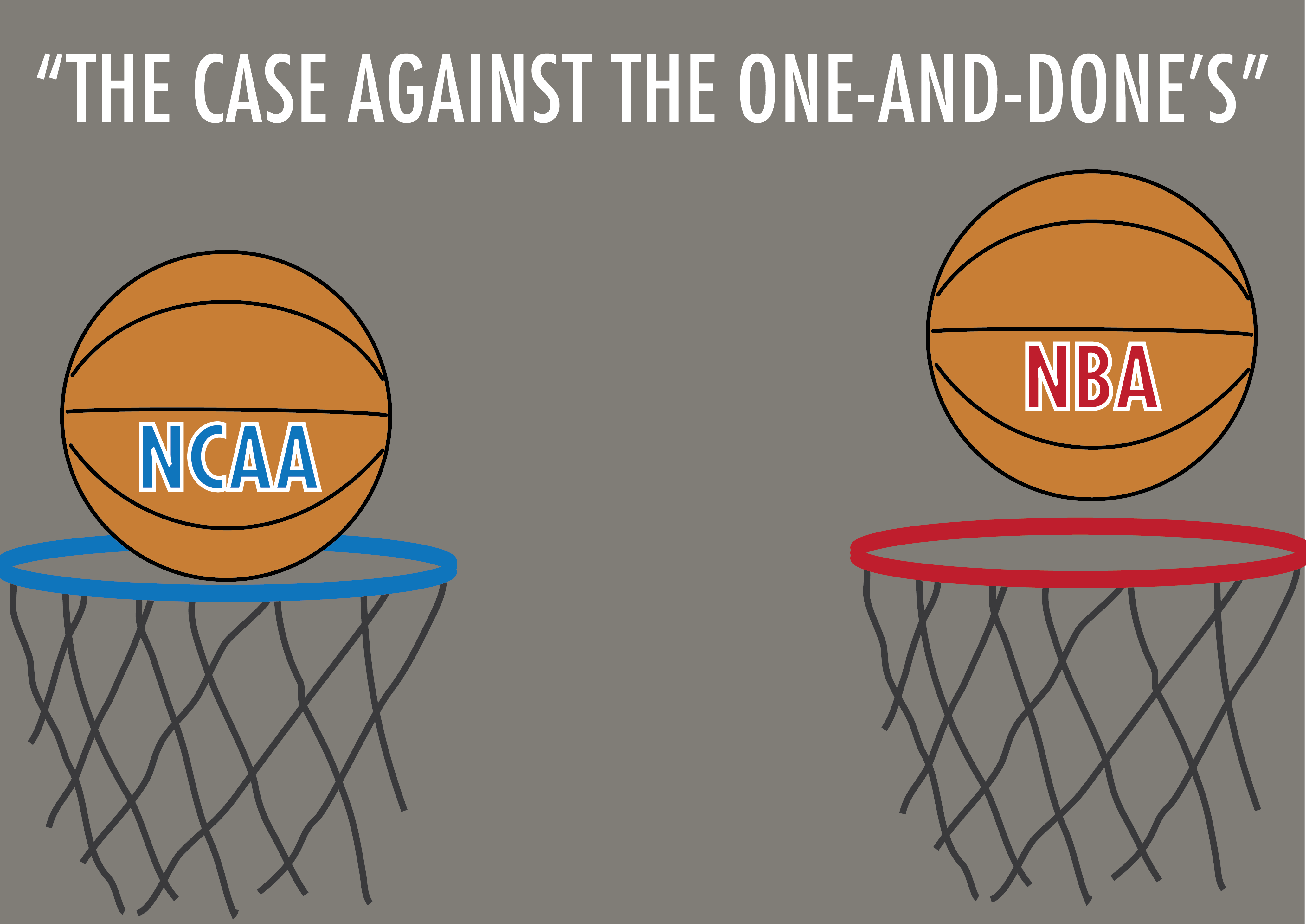
Kevin Durant. Anthony Davis. Carmelo Anthony. Three bona fide NBA superstars who took their talents to the next level after a single year in college, and exemplify the standard for one-and-done college basketball players. What should we come to expect from one-and-done college basketball players in today’s NBA landscape?

A couple weeks ago, Los Angeles Lakers’ highly-prized rookie D’Angelo Russell came under fire for allegedly snapchatting a conversation between himself and teammate Nick Young, discussing Young’s infidelity against fiancée and hip-hop artist Iggy Azalea. It remains unclear how the Snapchat was released to the public, but regardless, it has unleashed a nightmarish situation inside the Laker locker room, which seems to fit the current narrative of a tumultuous season for the Purple and Gold, who remain on track to have their worst record in franchise history. Russell, 20, had reportedly been completely isolated by his teammates who were livid at his lack of maturity and inability to properly justify the recording in the first place. While Nick Young, appallingly and surprisingly, has survived this fiasco relatively unscathed, reporters quickly jumped on Russell, implying that he is now the catalyst for a toxic environment which will have lasting implications in Los Angeles as the prospect of a strong free agency now appears increasingly grim for the 16-time World Champs.

Russell is the newest addition to a list of one-and-done NBA basketball players who have blemished their reputations with questionable teammate-related behavior or off-the-court transgressions in the early days of their playing careers. The list of one-and-done athletes that have committed these kinds of blunders goes on endlessly and displays a clear assumption of risk in the immediate transition to the professional level. Lance Stephenson is another example of this developing trend. His breakout season in 2013-2014 was offset by his inability to maintain healthy relationships with his Indiana Pacer teammates, and he has bounced around to three other teams in the previous two seasons. Michael Beasley, the second overall pick by the Miami Heat in the 2008 NBA draft, has also harmed his own potential through multiple encounters with the police related to marijuana possession.

Yes, the Russell-Young fiasco was probably another example of media sensationalism, and while the verdict is still out on whether or not this will actually have lasting consequences for Russell or the franchise, one thing is for certain — Russell’s maturity should rightfully be called into question. This is not an attack on Russell or his character, because 20-year-old kids make mistakes. This is someone who just two years ago was a high school senior. Maybe though, we should examine the current relationship between the NCAA and NBA that allows players to make this sudden leap.

Maturation is a core element of life in college, and this is not something to take for granted. While these athletes may feel it necessary to make this immediate leap for financial reasons, time spent in college is essential in shaping the identity of the individual. NBA scouting heavily favors the physical development of these players, and they do not emphasize the mental aspect as much. There is a pretty explicit disinclination to draft the juniors or seniors of the class at the very top, but I bet that a few teams are now hitting themselves on the head for passing up on guys like Steph Curry, Damian Lillard and C.J. McCollum. These four years (maybe three, maybe five…sometimes six) are invaluable, and every mistake made now is a learning experience. While it’s hard to condone the actions of D’Angelo Russell or the others who have done something comparable, it’s difficult to imagine being thrust into the spotlight of the national media at such a young age. A college environment could have helped to prep these kids for the limelight, fostering an environment where the budding stars could have learned to deal with adult team dynamics. Maybe the NBA and NCAA can alleviate this potential conflict by reexamining their dynamic.


Written by Michael Wexler – sports@theaggie.org

The Aggies sweep Stanislaus State

0
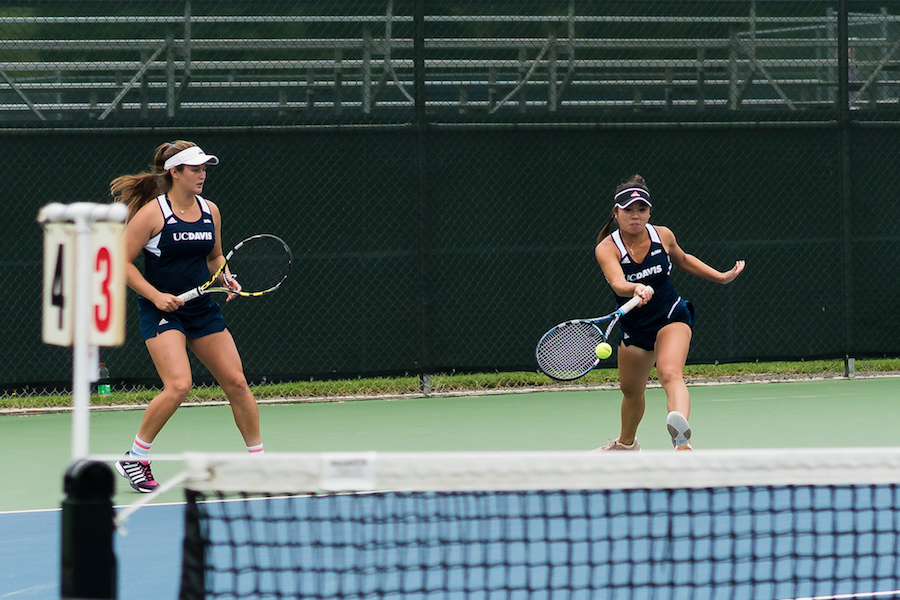
Sophomores Kristy Jorgensen and Jessie Lee helped the Aggies sweep Stanislaus State by winning their tiebreaker 8-6. (NICHOLAS YOON / AGGIE)

UC Davis women’s tennis defeats the Warriors 7-0

NICHOLAS YOON / AGGIE

On Saturday, UC Davis faced off against Stanislaus State in a non-conference match at the Marya Welch Tennis Center. The Aggies swept the Warriors 7-0, winning all the doubles and singles matches and clocking in their third win in a row. This improved their record to 9-9.

All four doubles matches were won by the Aggies, including a 6-1 win by sophomore Lani-Rae Green and junior Kamila Kecki. Following them were juniors Alex Huie and Samantha Martino, who defeated their opponents 6-2. Sophomores Kristy Jorgensen and Jessie Lee battled through a tiebreaker to win their match with a score of 8-6.

NICHOLAS YOON / AGGIE

The singles players were equally successful in their matches, with Green defeating her opponent 6-3, 6-3 and Jorgensen posting 6-3, 6-4. Kecki dropped only one game in the second set, winning 6-2, 6-1, while Lee gained

another point for the Aggies with a 6-0, 6-2 win. Freshman Isabella von Ebbe and Martino capped off the day by each posting shutout victories, with a score of 6-3, 6-3 for von Ebbe and a score of 6-1, 6-0 for Martino.

The Aggies will take on Nevada on Friday, April 15 at home.


Written by: Julia Wu – sports@theaggie.org

Student Sounds: Introducing Cardinal

0
LINDSAY BRIBIESCAS / COURTESY

Duo boasts rich acoustics, hypnotizing harmonies and a lyricism that presents the mundane as poetic

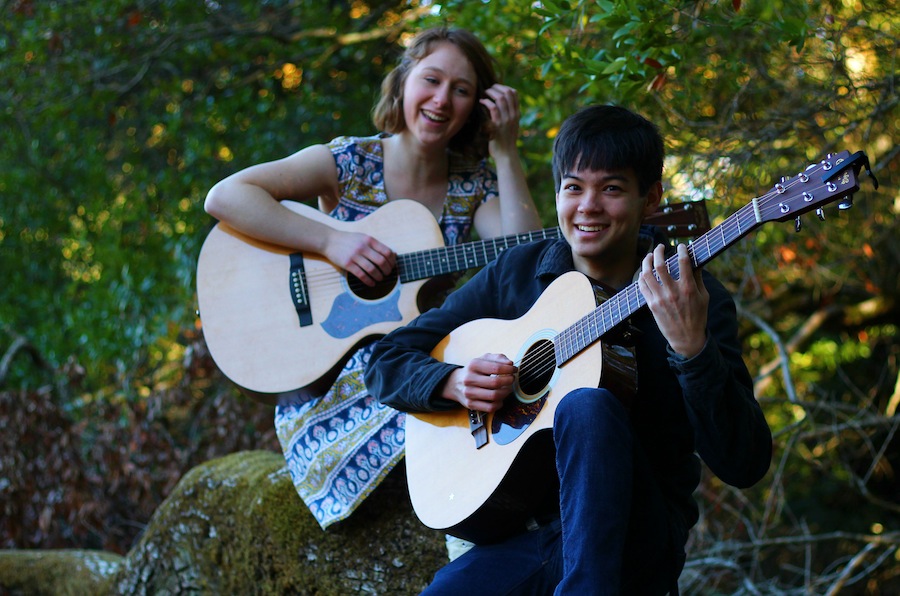
“You know, that one song with the weird chord,” says Ashley West, first-year music and sociology major at UC Davis. With intricacy — and what appears to be a legitimate imitation of a “weird chord” — she strums an air-guitar toward her good friend and bandmate Nathen Gong. At first he faces me and laughs (now imitating her strumming), until his eyes light up, responding with “Oh yeah, that one with the weird chord,” in both English and air guitar.

But they communicate by more than just imaginary fretting, of course; with West studying at UC Davis and Gong residing in Santa Rosa (their shared hometown), efficient communication is a necessity for their indie folk band, Cardinal. And, with Gong attending Cal Arts in the fall, this skill will not be squandered. The two have mastered other ways of keeping their musical long distance relationship alive, often finding themselves jotting down chords and lyrics on their shared Google Doc until they can bring them to life at their next meeting.

Giving life to the ordinary, however, has never been an issue for this duo. Their lyrics, with a melancholic depth I could only resolve by the consistent replay of their 5-track EP, are not indicative of their upbeat and bubbly personalities. Within the first five minutes of our meeting, I was in no way surprised to discover that fate only played a minor role in their introduction. Rather, high school physics and Gong’s “Donut Hole Thursday” ritual chanced their meeting.

Having attended Santa Rosa High School and participated in its renowned Art Quest program, it wasn’t long before the two began jamming after school with fellow classmates. But both picked up music and art at a much earlier age.

West found music in many outlets — family, friends and church — and admitted through laughter that she basically “grew up jamming with old people.” She explored other facets as well, dabbling in piano, ukulele and later, guitar. Though her current studies lie in music, she remained a part of the Art Quest dance program throughout her high school career. Also a member of her high school choral program, her time at Davis has also been spent with the Davis Chamber Choir.

Gong entered their project with a different background; playing drums since the fifth grade, he didn’t begin singing outside of the casual family car ride until pairing with West within the past year. The quality of his voice, especially on their track “Spin,” is best described as a pleasant surprise. Their harmonies, sounding more like a performance by The Head and The Heart than a group who met only a few years ago, merely adds to their deserved recognition. Though West picks up guitar in some tracks, Gong is in charge of most guitar responsibilities.

Their array of talents, synthesized by a mutual contribution to Cardinal’s sound, has carried them through the successes of small, local performances and even an Open Mic night at the CoHo. The most tangible sign of their hard work, however, was the official release of their EP, “Crossed Wires” (available for both listening and purchase here) this past December. Having designed and organized the project themselves, West notes that “self-producing is not for the faint of heart.”

Their hearts prove anything but faint. The first songs on their EP are brimming with emotion and catchy melodies, only enhanced by West’s simple, beautiful vocals. Their stripped-down acoustics, paired with simple harmonies, are reminiscent of musicians like Hozier, Iron and Wine and even Fleet Foxes. The EP concludes on a strong note, with their track “Hold My Heart” beginning with West’s soft, haunting vocals. It only takes a few seconds for Gong’s flavorful chords to infuse the track with charm and personality, increasing curiosity such that you can’t untangle the left ear bud from the right one quite fast enough.

Cardinal’s most striking feature, however, is not their contagious energy, but their fluency; though proficient in English and air guitar, they best communicate through something more profound and permeable: making good music.

WRITTEN BY: Ally Overbay – arts@theaggie.org

The Superhero in Society

0
LORE SJOBERG / FLICKR

In 1936, Lee Falk created the first popular superhero, The Phantom. Originally debuting in the comic strip section of the newspaper, The Phantom eventually made the transition to comic book serialization in the 1940s under the publisher Ace Comics. Ace Comics later titled the comic book series The Phantom, which suggests one reason many Western comics take their title from their superhero. To this day it remains a very popular and widely-circulated book in over 40 countries and 15 languages.

Just as today’s politicians argue on the floor of the Senate, the House and screens of televised Republican and Democratic debates, some comic book fans argue over the better of the two dominant publishing houses: Marvel and Detective Comics (DC). The political comparison is apt. Comic books actually have a long and interesting history with politics given their initial effect on America.

Falk’s comic book hero The Phantom drew upon the classic archetypes of honor, chivalry and masked-vigilante-ness that centered and created the base and foundation for the morals of many superheroes today. One reason for this could be the time and era in which comics became popular. The 1940s in America were very unstable because of the war in Europe. And, as my AP Economics and AP United States History classes taught me in high school, wars often lead to a strong surge in nationalism as the country tries to rally together against a common foe. The Phantom, Superman and Batman served as just a few of the earlier examples of superheroes that were created to rally and foster American nationalism and pride. Within the comics, many superheroes often fight larger-than-life enemies that threaten to destroy the American people and their ways of life.

Take Superman.

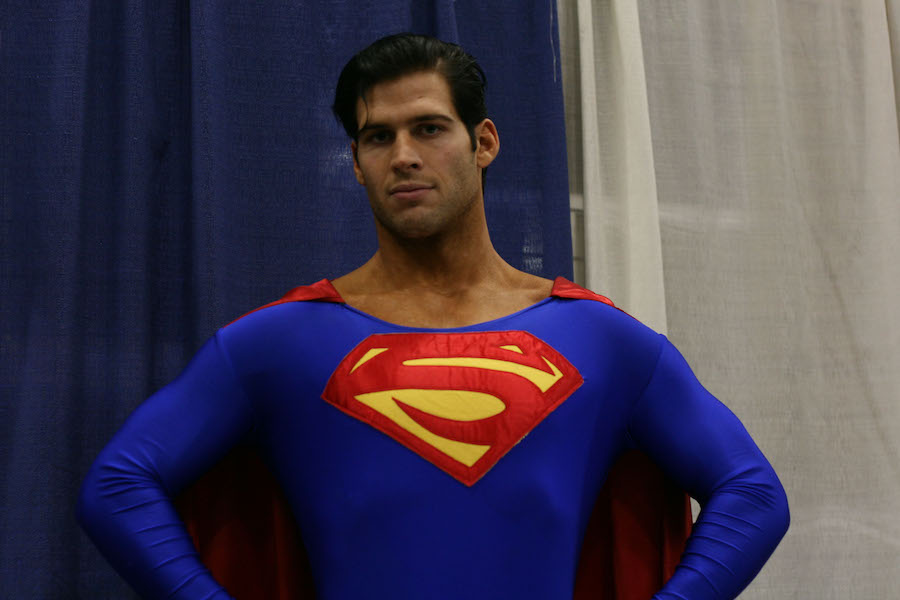
His common, everyday alias goes by the name of Clark Kent — an unassuming newspaper reporter for The Daily Planet. Yet, when he actually zooms around as Superman saving the city of Metropolis, he represents a larger idea and concept than just the classic triumph over evil in a fictional world. Superman’s common job serves as means to relate to the average, middle-class desk worker in America. Along with the job, Superman also displays the power of the everyday working man’s ability to be a hero. This sentiment of anyone’s potential to be a hero is something that rang true during times of war and can potentially explain why many of these heroes have endured to today.

But does that feeling of relatability in the middle of the 20th century translate to today? Absolutely. The presence of comic books and superheroes in today’s world results in the multiple superhero movies released every year without fail, the constant ability to find superhero shirts and various other merchandise at Kohl’s and the existence of Comic-Cons. DC and Marvel enjoy a constant market for their multi-million dollar budget (and grossing) films. I say absolutely because I’m never able to find a good seat at the theatrical premiere of one of these superhero films. I’m never able to find a shirt that fits me and, for four consecutive years, I have never been successful in acquiring a ticket to Comic-Con. But I think that there exists something innate, wonderfully relatable and hopeful about superheroes that causes their films to be made, remade and then remade again. They won’t be going anywhere any time soon either.

Written by: Michael Clogston – opinion@theaggie.org

DEA investigates recent increase in Sacramento drug overdoses

0
MONICA CHAN / AGGIE
MONICA CHAN / AGGIE

At least 10 deaths, 48 overdoses attributed to fentanyl-contaminated street drugs in Sacramento

A recent spike in drug overdoses in the Sacramento area is likely due to street-purchased painkillers contaminated with fentanyl, according to the Sacramento County Department of Health and Human Services. As of April 8, 10 people have died and an additional 48 have been treated for overdoses.

Jerome Butler, a father of three, is among those that have died as a result of overdosing on the fentanyl-contaminated drugs. Butler remained in a coma for several days before being taken off of life support. His mother and grandmother warned of the dangers of street drugs in light of his overdose.

The San Francisco-based Drug Enforcement Agency (DEA) is handling the investigation into the source of the spike in overdoses.  

“We can’t discuss the details of any ongoing investigations but this case is a priority for us,” said DEA agent Casey Rettig. “We have added additional resources to work this investigation. We are currently taking information from the established tip line in the public and actively following up on leads, working around the clock.”

The Sacramento Department of Health and Human Services published information on its website detailing the signs of overdose and warning residents that opioid painkillers — including Vicodin, Norco and Lorcet — bought on the street are often counterfeit and contaminated (or “cut”) with other drugs.

“Our department has done a great deal of outreach to the public, warning people about this issue and advising them to not take any prescription drugs that have not been prescribed by their doctor,” said Laura McCasland, media and communication officer for the Sacramento Department of Health and Human Services.

While serving as inpatient neurologists last week, the UC Davis Health System Department of Neurology team was asked to consult on a nearly-fatal fentanyl overdose at the UC Davis Medical Center.

The department has more than 60 faculty and staff members who conduct neurological research and provide clinical services. Dr. Fredric Gorin, chairman of the department, holds both an M.D. and Ph.D. As a graduate student, his dissertation included the use of computers to design drug neuropeptides that bind to the brain’s endogenous opioid receptors.

“Currently, there is an epidemic in the Sacramento area of acute narcotic overdose from fentanyl being sold on the street as Norco. More than a dozen people have either died or come close to death. Luckily, the person I saw survived and will probably be able to recover without major neurological complications,” Gorin said.

Gorin explained that the patient was with his girlfriend when symptoms of overdose began to occur and she was able to seek help.

“Fentanyl is a narcotic usually given intravenously or slowly released by transdermal patch,” Gorin said. “Fentanyl is at least 20 times more potent than the narcotic in Norco, which is hydrocodine. Fentanyl is absorbed into the bloodstream very rapidly. It acts on opiate receptors in the brainstem, controlling respiration, and can cause a person to stop breathing when absorbed quickly in sufficient amounts.”

Gorin added that addiction often results when people inadvertently become addicted to prescription painkillers and continue using after their prescription ends. He explains that overdoses are a fairly common phenomenon seen in emergency rooms and usually occur when users attempt to buy drugs off the street. These substitutes are often more potent or faster acting than the user expects.

“The truth is that the people who are selling any bioactive drug on the streets don’t care about you. They don’t care if it’s good or harmful or could injure or kill you.  Sometimes they want to make [the drugs] more harmful so they are more addictive,” Gorin said. “Doctors have access to medications that help people slowly withdraw from narcotics without harming themselves.”

Written By: CAROLINE STAUDENRAUS – city@theaggie.org    

UC Davis sciences, humanities faculty speak out on Katehi controversy

AMY HOANG / AGGIE
AMY HOANG / AGGIE

Chancellor receives some support, some opposition from faculty

The battle over the future of UC Davis Chancellor Linda P.B. Katehi is heating up as members of the sciences faculty and the humanities faculty are at odds over their feelings on Katehi’s involvement with DeVry University, King Abdulaziz University and John Wiley & Sons textbook company.

On March 23, 33 UC Davis faculty, mostly comprised of members from the science departments, wrote a column explaining why they supported Katehi and were against calling for her resignation. Sixty-seven faculty members signed this letter, most of them from scientific fields — only seven were from other departments.

The column’s authors believe Katehi is a fit chancellor for the university. They wrote that there is selective outrage over Katehi’s entanglement in these organizations and argued that many other university officials also hold positions on similar boards.

“Much real and substantive progress has occurred at UC Davis under Chancellor Katehi’s leadership; and we see an alarming trend of ‘piling on’ in a negative campaign against a strong female chancellor who has worked hard to serve the campus,” wrote the faculty members in the column. “Over the past seven years, we have seen the chancellor argue passionately about student welfare and effectively advocate for UCD with the UC president.”

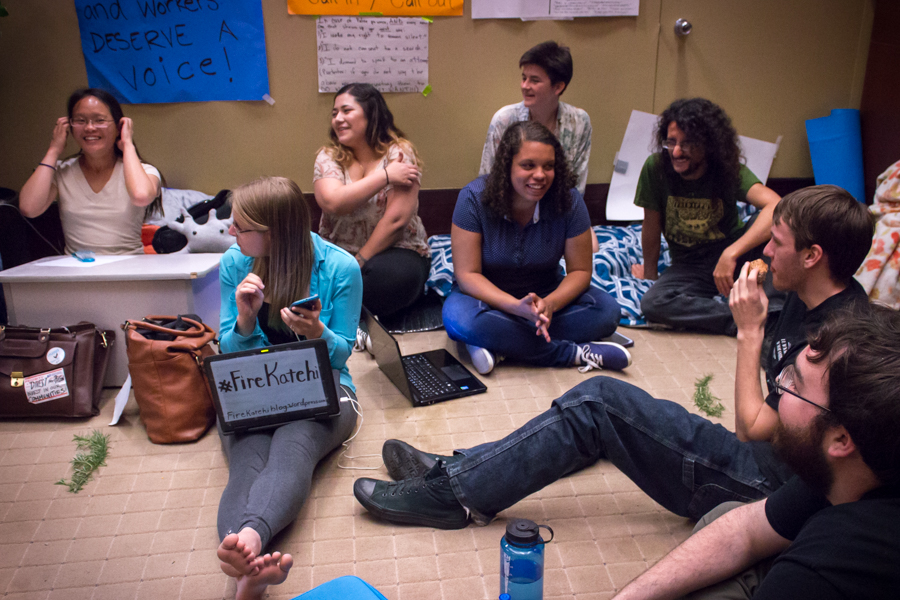
However, this sentiment was refuted by several humanities faculty members a week later on March 30 in a column for the Davis Enterprise. The column was written by over 30 humanities faculty members on campus, who argued that standing with Katehi would mean standing against the students. The members vowed that they were going to stand for and with the students who are occupying Mrak Hall.

“[Katehi] has enriched herself professionally and personally at the expense of the reputation of UC Davis, and multiple legislators have now called for her resignation,” the column read. “At a time when our students are facing ever-increasing fees, class sizes and exorbitantly priced textbooks, the chancellor’s actions demonstrate poor judgment and weak ethical standards that have eroded our confidence in her leadership.”

However, there is some disagreement as to whether there is any real schism between the science faculty and the humanities faculty at all.

Natalia Deeb Sossa, an associate professor in the Chicano/a studies department and one of the faculty members calling for Katehi’s resignation, said that she believed that there were faculty members on both sides who support Katehi.

“I am not sure that divide exists,” Sossa said. “Even within humanities faculty, there are many who argue she should not resign, while others argue that she should.”

Many students, particularly the ones protesting in Mrak, are even less convinced that there is any real divide. A few of the protesters even argue that many faculty members are fearful of losing their jobs, which is why they continue to support Katehi despite her transgressions.

Bernadette Fox, a second-year transfer student and international relations major, said that she read both of the letters and believes that the letter supporting Katehi was inconsequential and does not speak to the larger issues at hand with regard to Katehi’s ethical violations.

“I don’t think that one article can speak to any sort of separation between the departments,” Fox said. “A lot of people are speaking to her personality or how they have personally benefited [from Katehi’s tenure]. I don’t think that’s what we’re here to talk about. We’re talking about larger issues and all of UC Davis and not just a small few. There are things that UC Davis has accomplished [over the past few years] that we don’t think should be attributed to the chancellor.”

University representatives did not wish to comment on the columns.

Written by: Sangeetha Ramamurthy – campus@theaggie.org