58.4 F
Davis

Davis, California

Tuesday, December 23, 2025
Home Blog Page 506

Hooper’s big bat propels Aggies past Anteaters

KAILA MATTERA / AGGIE FILE

UC Davis men’s baseball defeats UC Irvine 4-2 in final season game

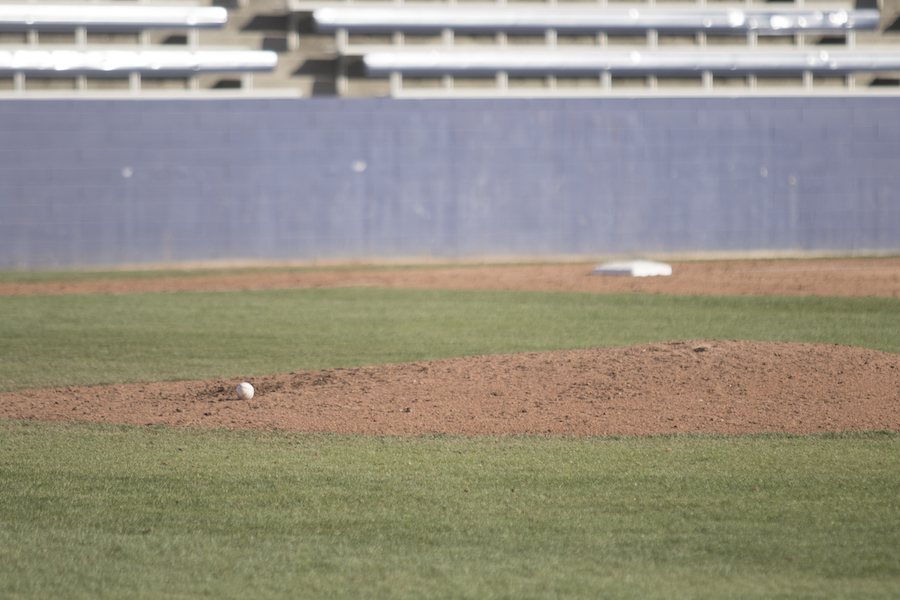
Earning a 4-1 win the day before and with the weekend series tied at 1-1, the UC Davis Aggies men’s baseball team wanted to send its seven graduating seniors out with a final win at Phil Swimley Field on May 26.

It was a rough start for the Aggies when the Anteaters hit a deep, “no doubt about it” home run to left field early in the top of the second to earn the 1-0 lead. UC Davis pitcher Chris Brown did not let the home run discourage his already troubling earned run average (5.14), finishing the inning with two groundouts and a flyout to keep the deficit low.

In the bottom of the fourth, senior right fielder Ryan Hooper stepped up to the plate. Leading the team with six home runs in the season, fans cheered on the senior to make something happen. Going against a tough Irvine pitcher with an ERA just above 2.00, Hooper cracked a ball curving to the left field wall, just barely getting over the fence to give the Aggies the 2-1 lead.

“I kind of had a good idea [about the home run],” Hooper said. “I am kind of always scared to think it’s a home run so I ran pretty hard in case it didn’t go out. I hit it pretty hard and it had a shot and went over.”

UC Davis continued to produce offensively, as freshman shortstop Tanner Murray drove in a run to right center field in the bottom of the fifth to increase the Aggie lead to 3-1.

In the top of the seventh, the Anteaters drove in a run to cut the UC Davis lead to one. With runners on second and third and two outs in the bag, freshman reliever Tim Wieser came to the mound to try and end the inning. On a bouncing ball through the left infield that looked as though the Aggies game was done, a hustling Murray scooped the ball, making a jumping throw mid-stride to get the runner out a first and end the inning. Murray’s impressive performance this season (.333 BA, 27 runs, 22 RBI) earned him Big West freshman field player of the year earlier last week, the first Aggie ever to earn this award.

“If we have footage of that and can get it to SportsCenter, they will put it on [TV],” head coach Matt Vaughn said regarding Murray’s defensive play. “The kid is unbelievable. When you have a guy like that to build around, it’s gonna be a lot of fun [moving to next year]. I think the future looks good here but we have to keep getting better and win those close games.”

The Aggies were able to drive home one more run in the bottom of the eighth on a fielder’s choice play at third base. Senior star reliever Connor Loar pitched the last three innings for UC Davis, only giving up one hit to bring his career ERA to an overall 1.62 to end his pitching career as an Aggie.

UC Davis finished the season with an 18-35 overall record and a 9-15 conference record, but Vaughn is impressed with the team’s constant hard work and chemistry playing together.

“We were out of it two weeks ago,” Vaughn said. “It’s been tough for these guys to come out everyday and keep giving it but they just kept doing it. One thing we have done all year long is be in these close games, now we just need to find ways to win these close games, and today we did that.”

After the game, UC Davis’ seven seniors celebrated the win by snapping photos next to their numbers painted in the grass. It was a perfect way to end all the work put in to UC Davis baseball, according to Hooper.

“It’s kind of surreal,” Hooper said. “Definitely happiness and trying to hold back some tears. Obviously we didn’t have the season we wanted but this is the closest team of 35 that I have been on since I have been here. I am going to keep playing baseball but not with these guys [anymore] but I am just enjoying it.”


Written by: Ryan Bugsch — sports@theaggie.org
Davis remembers those who served

Memorial Day ceremony brings remembrance, understanding

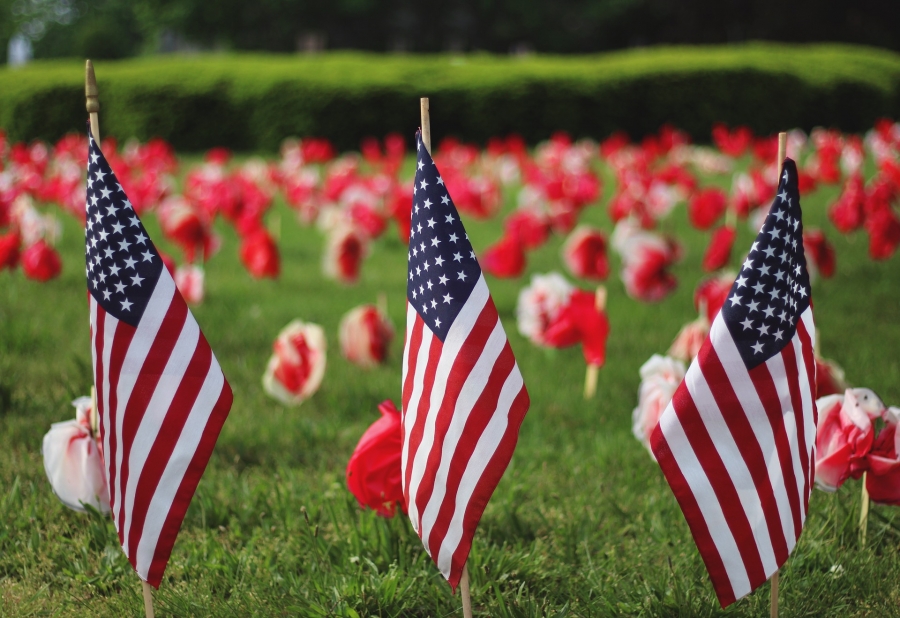
Flags, 20 feet apart from one another, stood all along the road cutting through the Davis Cemetery on May 28. On a rather hot Memorial Day Sunday, at least 300 attendees gathered at Davis Cemetery to recognize veterans who have served and those who continue to serve. A veteran from World War II, Francis Resta, was in attendance along with other veterans.

Davis Veterans of Foreign Wars Post 6949 and Davis Cemetery District worked in conjunction to host the event. The Davis Brass Ensemble, the Davis Children’s Choir and the Davis High School Madrigal Choir delivered the musical selections. The event started early at 10 a.m., with people scrambling for shade and a good chair to sit on. Many chose to just sit down on a blanket atop the grass.

During the opening remarks, Jay Brookman, the commander of VFW 6949, reminded everyone that this was a ceremony to pay respects to those who paid the ultimate sacrifice. Brett Lee, Davis’ mayor pro tempore, thanked everyone for coming to recognize those who served and appreciated all those who took the time to come to the event.

This year’s keynote speaker, Jerry Coker, dedicated his speech to sharing his experiences in combat and how saddening it is to lose a friend.

“Combat is like a car accident,” Coker said. “If you weren’t hit, it’s almost as if you weren’t there.”

Through writing books and speaking up for veterans at events like this one, Coker offers the experiences of people who have witnessed it first-hand. Coker reminded everyone that life is brief and is often ended too early, especially for many who serve in the armed forces.

“This is for the men and women who came home in boxes — that capped their terrestrial dreams forever,” Coker said.

Coker ended by asking everyone to remember those who willingly walk in harm’s way because their country asked for it. Lee liked Coker’s anecdote, especially since it shared a connection between those who died serving and those that are still alive today. Lee’s grandfather served in World War II, and his two step-uncles also were in the military.

“Today was very thought provoking,” Lee said. “It helps you think about the world a little differently.”

Mayor Robb Davis also attended the event, choosing to stand up as the Davis Madrigals sung the Navy song as part of the Armed Forces Medley.

“My dad was marked for life in World War II,” Davis said.

Davis thought that this event was very special, as it brought a lot of people together to honor those that have served.

Brookman also thought that Coker successfully articulated the experience of combat to those that have never served. He also highlighted the importance of VFW, as it brings awareness to the community about veterans and their contributions. VFW is also working with the city of Davis on a tiny home community to provide housing for homeless Davis veterans.

“[VFW has been doing] anything we can do to help people remember that a lot of sacrifices were made,” Brookman said.

To honor and remember veterans, Mel Russell, a volunteer at the Yolo County Archives, pitched a tent at the ceremony for the project “Lest We Forget.” This project aims to tell the story of the almost 1,000 veterans in Yolo County who served during World War I. Russell is also working to record the experiences of many veterans in the county.

“We need to document the service of current vets,” Russell said.

One part of the project is to take veterans’ photographs. Russell also aims to get as much information from veterans as possible so that it can be stored in the county’s official archives. The program is currently on hiatus until August.

Kristi Dvorak, the community outreach director for the Davis Cemetery District, got there at 6:30 a.m. to place flags, chairs and tents. Two weeks of preparation had gone into making sure the event went well.

“Memorial Day is an opportunity to celebrate our culture and civic history,” Dvorak said. “It is important for [our] community to honor those veterans we have lost and those still with us today.”


Written by: Justin Chau — city@theaggie.org

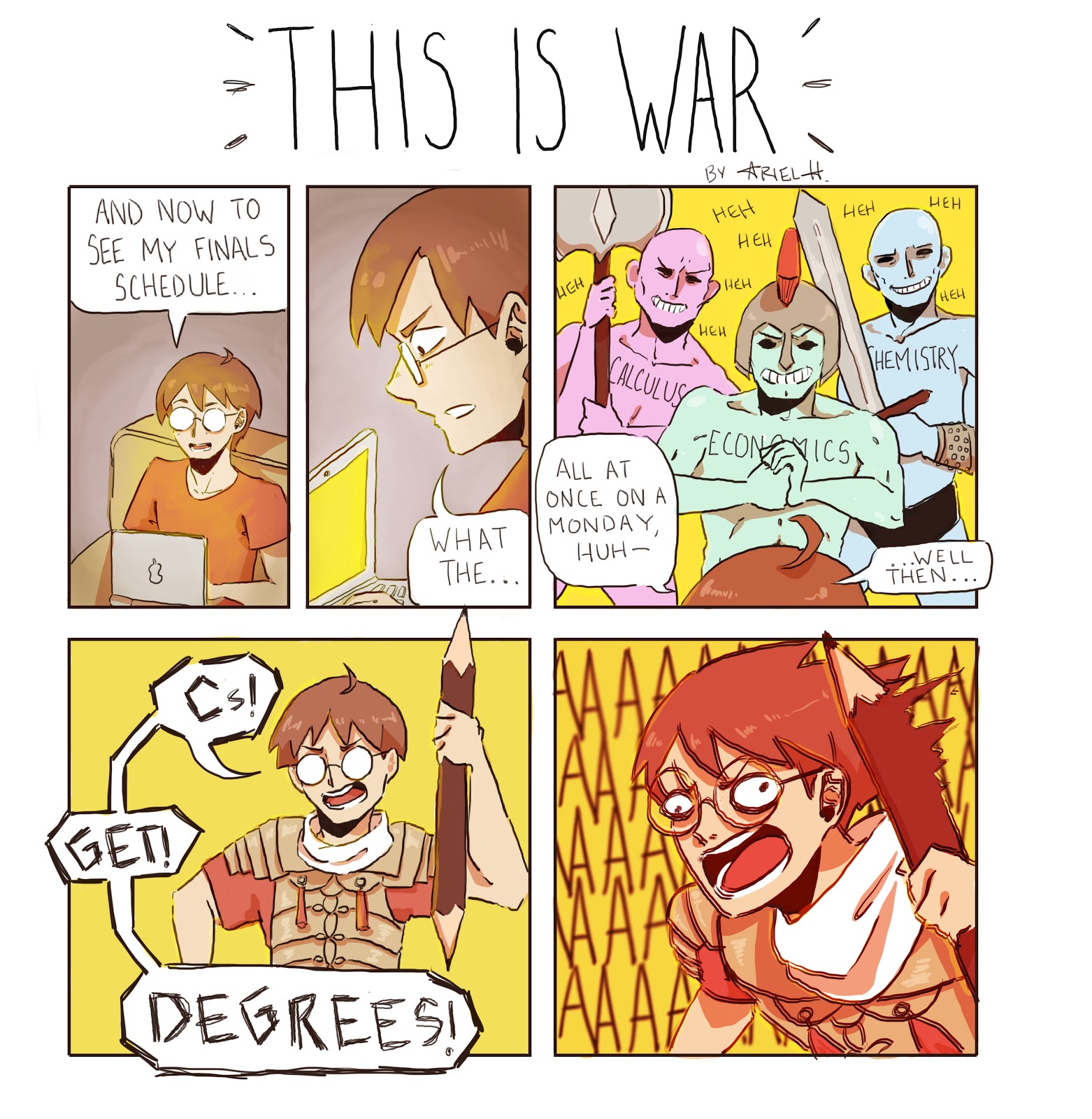
Cartoon: This is War

By: Ariel Hilomen — abhilomen@ucdavis.edu


Disclaimer: The views and opinions expressed by individual cartoonists belong to the cartoonists alone and do not necessarily indicate the views and opinions held by The California Aggie.

Humor: One bold cow to run for ASUCD president

MICHELLE GORE / AGGIE

The leader we deserve steps up to the plate

In the current political climate, many people are standing up for what they believe in and kicking down the door to have their voices heard by both student and federal governments. Yet it’s not just people who are perusing the scene to find their spot and make a difference. Our four-legged chums from across the street have big Hollywood dreams too. That’s right kids: One bold cow is about to run for ASUCD president.

This was all announced during a real glitzy press-conference at the dairy facility on Thursday. They pulled out all the stops. There were cows, grass, some manure… it was basically the same old dairy facility, but now there was a flag there. Cows are red-green colorblind, so it all turned out a bit funky. With gusto, Wares DaBeef took to the mountain of manure that had been assigned the role of “podium.”

“Heif-hers, heif-hims and heif-thems, it is my honor to announce that I will be running for ASUCD president,” DaBeef said into a microphone made of hay. Cheers (well, moos) and applause (well, hooves pounding on the ground) erupted across the facility. “I know that you have concerns. For one, I am not a student, so I probably cannot run.”

The crowd of cows all let out moans of disbelief and began walking back to their respective corners to screw with some first-years who were trying to get that good cow selfie for the ‘gram.

“Or so you think,” DaBeef said into the mic. The crowd shuffled back quickly, leaving three first-years looking hecking lame.

“Though you see me as a simple cow, I have actually been obtaining a degree from UC Davis in theatre and dance,” DaBeef said.

“Well, I did notice that his jazz squares had suddenly become impeccably clean,” said Dairy Fisher, a close friend of DaBeef’s.

Because of this, DaBeef was an eligible candidate for the presidency. He announced that he would be running on two platforms. The first was a promise of respect toward all students and the immediate addressing of concerns about resources offered by our campus. The second platform was to dethrone Gunrock and make our girl, Hamburger Patty, the official mascot of UC Davis.

“Hamburger Patty only gets to come out on Picnic Day and that’s a damn sham,” DaBeef said as tears welled up in his eyes. “She has been around since 1926, has a dang song about her and she has to sit passenger seat to a buff, blue horse? It’s an outrage!”

A cow rushed up and handed DaBeef a tissue. He composed himself for the cameras.

“I hope that you all can vote for me to be your ASUCD president,” DaBeef finished. “I promise to come to meetings and validate all these kids who use us as photobooth props, because they need us. They need a cow in office, not a pig.”

In the distance, one angry pig flipped him off.

“How rude,” Peter Porker said.


Written by: Olivia Luchini — ocluchini@ucdavis.edu

(This article is humor and/or satire, and its content is purely fictional. The story and the names of “sources” are fictionalized.)

Behind Backstage: Concert production, women and mops

A look at the obstacles women face when attempting to break into concert industry

There’s something magical in attending a concert; working one, however, brings you back to reality.



Sitting in front of the Activities and Recreation Center at 7:30 a.m. one bright April morning, I had trouble thinking because my mind was still foggy with sleep. The sun had yet to warm the ground, and wearing shorts left me chilled in the early spring weather. But since my boss had yet to appear, I remained in the sunlight on the cold seat hoping my choice of clothing wouldn’t come back to bite me later.

Instead, I bounced my legs and tried to distract myself, watching the early-morning stragglers creep toward the gym.

Gradually, a strange occurrence came to my attention: a slow wave of nearly-silent people — all men, all dressed head-to-toe in black — migrated from the parking lot to The Pavilion. It was odd, since those who frequent the gym so early are usually the workout buffs and athletic types.

In contrast, these men these men appeared to have walked off the Pirates of the Caribbean set only moments before. Some men had beards, some were clean-shaven; some sported longer locks than anyone I’ve ever met or encountered, some were bald. Most were heavily tattooed, pierced, dead-eyed with exhaustion, or some mixture of all three.

Of the 40 or so men working, we were the only women helping to unload. There’s a reason most concert tech and sound work remains a male-dominated occupation: setup and takedown of music shows requires enough strength to lift hundreds of pounds of equipment for hours on end. It’s considered “blue-collar” grunt work.

But in the wake of a new wave of modern feminist organization — like the #MeToo movement that has led to the indictment and ousting of several icons in many industries (but especially the American film industry) — it was still shocking to see such a vast gender discrepancy as there was in the set up for the recent alt-J concert in Davis. Among that swell of men oozing in the direction of The Pavillion, I had yet to see one woman.

A burst of laughter echoed from somewhere out of my sight, breaking the still morning air and rebounding off of the cement walls of the ARC.

I’d never been more intimidated — maybe it was their camaraderie, maybe it was purely their choice of dress. Either way, they were a club I was not a part of, and here I sat, waiting to get started with no one in the group saying so much as a “Hello” to me.

Suddenly, I spotted my co-worker arriving with our boss, who gestured for us to follow the group around the building. On the other side, near the loading zone for the ARC Pavilion, two massive tractor-trailer trucks were in the process of being unpacked. This must have been where the laughter came from, as these workers spoke familiarly with one another, laughing and teasing like soldiers on the frontlines. Their voices mixed cacophonously with the sharp cracks of metal equipment against wooden carts.

The three of us, outsiders, shared a glance.

Yet this doesn’t come as a surprise to women familiar with the industry. It is nearly an unspoken prerequisite for being a Productions Director in the ASUCD Entertainment Council (EC) — a position responsible for helping put on shows for artists like Chance the Rapper, alt-J, BØRNS and Khalid. Kurtie Kellner, a third-year managerial economics major, oversees sound and set up for all EC-led events. And she’s nothing if not familiar with the treatment of women backstage in the music industry.

When asked about her experiences, she grinned, understanding immediately.

“A lot of times you just kind of get brushed off and dismissed,” Kellner said. “It’s like, ‘No, this is kind of heavy, we can do it!’”

Kellner was quick to remind me that this doesn’t happen at every concert or with every company. At a recent EDM concert — where she shadowed under the man running the lighting for the show — Kellner made it clear that she was treated respectfully.

She followed this up, however, with a slightly ironic sentiment: “Adam [the man running the show] had made all of the guys sign sexual harassment and sexual assault waivers right before they got to the venue.”

Despite the few silver lining cases like Another Planet Entertainment — which recently made headlines for being the only entertainment company to be headed by women — much of the industry still needs to play catch-up.

As for me, I couldn’t help but agree. Especially thinking back to when, an hour after working ambiance, a man came up to me, took the equipment I held in my arms and left me adrift and jobless without so much as a backward glance:


It was early afternoon — approximately six hours until the doors opened — so The Pavillion was fairly empty. Only a few workers milled about, carrying fencing, and discussing placement of the remaining equipment or cleaning up fallen debris during load-in. Confetti leftover from the Chance the Rapper concert in October 2016 sat in heaps on some of the constructed barricades, and the entire floor was covered in a layer of dust; off to one side of The Pavilion stood a mop.

Weighing in at 162 pounds, each barricade required at least two people to maneuver into place in front of the stage — they were then bolted into place with two bolts spanning the length of a hand to prevent collapse mid-concert. Assembling barricades could take anywhere from an hour to three hours, depending on availability of help.

So imagine our surprise when six of us, all EC staff members and all women, arrived to help out only to find barricades already in place.

We stood motionless, momentarily dumbstruck and debating our purpose until Liz O’Neill, EC’s director and a third-year double major in psychology and managerial economics, took the initiative and approached one of the men presumed to be in charge. In his mid-30s with a few graying hairs and eyes hardened from years on the job, the assumption seemed promising — the majority of other men in The Pavillion looked to be in their late 20s, grinning and messing around with each other when not currently occupied.

If anybody could get the man to take her seriously, it would be O’Neill.

“For the most part, people know I’m in charge and won’t talk to someone else,” O’Neill explained later. And that’s entirely plausible when she walked toward the man unperturbed, clipboard in hand, frown on her face.

The highest of positions in the industry, O’Neill told me later, remain run by men. If she were to reach out to a promoter, for example, she would likely speak with a man. On the other hand, advertisement and marketing remain women-driven fields.

Take it from Kellner, who had already experienced the culture of dismissal time and again over the course of two years in her position.

“As a girl, you have to make a point of putting your foot down, and being like, ‘Yes, hi, how can I help you?’” Kellner said once. “You have to go out and ask for a task. They won’t immediately assume you’re in charge. You have to go out and say, ‘Hi, yes, I’m in charge.’”

Despite O’Neill’s leader expertise and authority, we ultimately expected dismissal until later that evening  — our job had been done already, so there was nothing left for us to contribute.

What we got, instead, were a bucket of bolts, the aforementioned mop and a few dismissive glances. So we took what we could get, dragging the bolts and mop to the barricades, and fell upon our duties resignedly. We were disappointed but not surprised by this treatment.

It was, however, a blow to my self-confidence, being in a situation that was so clearly tight-knit and not necessarily unwelcoming, but still exclusive. We’d had experience — UC Davis had hosted countless concerts in the past — and yet time and time again, we’d been sidelined for the sole purpose of us being women. Looking at my coworkers, I could easily read the frustration and indignancy written on their faces.

Unfortunately, it’s one aspect of concerts that few understand until they find themselves working one: the gut-punch and sharp anger when a man — usually a foot taller and a hundred pounds heavier — approaches you, plucking your job right out of your hands with nothing more than a condescending “Thanks for volunteering, ladies.” Or, my personal favorite: delegating you menial tasks like mopping and sweeping, both of which hold the unspoken association with women and femininity.

Katie Lewis, another third-year on the team, a genetics major and the assistant director of EC, was just as confused as the rest of the EC staff when she was given charge over mopping up the confetti on the barricades. And while we attached the remaining bolts, over our shoulders stood Lewis stooping over the dirty metal, wiping back and forth until deemed clean enough. Which, apparently, it wasn’t, as another male ARC employee went over the same barricades with the same mop, afterwards.

Looking back, Lewis is still slightly uncomfortable by that job and who was doing it.

“We were assigned barricades — so I got there assuming that I would be doing lifting,” Lewis remembered. “And [the men in charge of barricade set up] were, like, “Ah no… you guys, you are such great volunteers!” and left us with cleaning up after [putting] up the barricades together already.”

In no way was this incident malicious — the backstage workers couldn’t simply take the barricades down for us to put them back up. Regardless, the situation was definitely an uncomfortable one, like we had encroached on a territory we didn’t belong in. For all that was unspoken, the whole event might as well have read “BOYS ONLY. No girls allowed.” As if we were all five years old again, and boys were afraid of girls on account of their cooties.

“They didn’t realize that this is what we do and just assumed that, since it was a group of like five girls, we were just there to just clean up or whatever,” Lewis agreed.

In the first moments after a concert ends — when the lights snap on, the band leaves the stage and the crowd grows quiet — the world pauses, and silence seems to fall over the room. The audience remains standing, as if in shock that the pounding music and flashing lights have cut out, with their jaws on the floor and not a sound to be heard throughout the venue.

Finally, when reality sinks in, the crowd unfreezes and surges toward the exit doors in the back of The Pavillion, an eruption of chatter exploding from the massive group. Soon, all that’s left are some discarded pieces of confetti, forgotten empty water bottles and crumpled tickets.

That’s when the real work begins for us. And by “real work,” I have come to learn that this means sitting and waiting before I could clean up after the artists.

After the Alt-J and BØRNS concert, once the remaining few EC workers gathered, the ambiance manager brought us to a deserted room backstage to wait out the post-concert party most artists enjoy for a few hours before boarding their buses. By this time — after waking up early, setting up and attending the entire two-hour show — I was completely exhausted.

The four other girls from EC and I crammed onto a couch while we awaited the call to action, each of us taking turns to dip our hands into a bag containing nothing but pillow mints — the only food available for us to eat.

An hour later — around midnight — the supervisor arrived, giving us the green light to enter the first room, which happened to be BØRNS’ and his band’s. Fame often makes us forget that celebrities are human too. I was struck immediately with that realization when, upon entrance to this backstage room, we had to pause to take in the scene. To our left was a table piled with empty pizza boxes and bags of chips; to our right, a cluster of couches sat upon a rug covered by chip fragments, popcorn and discarded drink bottles. Behind, tucked away in a far corner was an empty Converse All-Star shoe box. The ambiance was dim and softened the edges of the room as well as the debris thrown across the floor.

It was an odd sort of humanizing moment, when the glamor of an artists stage performance wears off and all that remains is the knowledge that most artists cannot clean up after themselves. And who had to sift through the garbage, pick up the used towels, the burnt cigarettes and empty beer bottles? Who helped unload and dismantled the green rooms and the barricades, the couches and the rugs? It certainly wasn’t mostly the men.

We are not mothers. We do our jobs out of love, not for the artists themselves, but for the music they have created. It was laughable that this translated into us cleaning up their messes.

Yet the entire time, when I stepped on a chip or packed away towel soaked with who-knows-what, I realized that the music industry, like any other, has a ways to go until equality is reached.

And maybe it will never be reached fully — maybe productions won’t ever be a women-dominated field like advertisement or nursing. But the next time you attend a music show or festival, I’ll bet you the women working behind the scenes deserve more work than clean-up duty and more recognition than “Ladies, thanks for helping!”


Written by: Erin Hamilton — elhamilton@ucdavis.edu

Disclaimer: The views and opinions expressed by individual columnists belong to the columnists alone and do not necessarily indicate the views and opinions held by The California Aggie.

2017-18 Goodbye Editorial

CAITLYN SAMPLEY / AGGIE

HAGS

Bryan Sykes, Editor in Chief

By Ally Overbay

Including myself, this year’s editorial board was entirely comprised of new editors — that is, except for Bryan. For the first few weeks of editorial board, when we struggled to pitch ideas or run meetings, our confusion was always redirected toward Bryan: “He’s been here before. Surely he knows what we should be doing?” And he always did.

But even when Bryan brought some much-needed guidance to our flurry of questions, he did so with grace and without condescension. He let us think for ourselves — and, often, fail by ourselves — before gracing us with his editorial wisdom. Bryan was supportive of every idea we had, and I will forever remember him as the editor-in-chief that let us run the California Chronicles and produce two Couch Concert videos (and as the guy who let me include this shameless promotion of arts desk content).

More importantly, I’d like to apologize to the incoming editors who will never get the chance to work with the patient and intelligent Bryan Sykes — our bold and fearless leader.


Emily Stack, Managing Editor

By Veronica Vargo

We picked names out of a hat and the last name I wanted to pick was Emily’s. The irony came when I pulled a slim piece of what used to be an intact pink post-it out of my very own hat — it bore the name “Emily.”

In many ways this piece of paper reminded me of you. Slim and usually bearing a tint of pink, its original purpose to remind yourself of something, just as you constantly remind me to be humble. Despite its size, it holds great power — just like you, future editor-in-chief. Its ability to carry words that are written in a hurry, or as a note, mirror how you always have something to say.

The truth is, Emily, over the course of my time on managing staff, you have left many sticky notes in my book of life. Many of them consisting of the recent findings of Inside Higher Ed and what “gay twitter” is up to. But the best of them consist of the little yet crucial perspective you have given me.

I swore many times that you were my archnemesis of sorts; sometimes the thought still crosses my mind, but the reality is that there is no one I admire more on this staff than you. Your commitment to excellent journalism, keen sense of integrity and dedication to this paper are what will make you a great editor-in-chief, and what makes you a great person overall.

So, as I stick this piece of paper into my pocket and walk out of the office, I carry with it all the memories and lessons and look forward to the many more to come.


Hannah Holzer, Campus News Editor

By Emily Stack

I consider working with Hannah one of the great honors and pleasures of my life. She’s a crackerjack journalist, as gifted at researching, interviewing and gathering a story as she is at writing clear, lucid, sparkling prose. Her work consistently goes above and beyond even my highest expectations — her series on mental health care in the UC system is one of the crowning jewels of The Aggie’s coverage, combining an investigator’s eagle eye for detail and tenacious pursuit of information with a public servant’s sensitivity and dedication to getting the story right. The writers under her tutelage grow by leaps and bounds in an incredibly short amount of time, a credit to her skill as an editor, a teacher and a mentor. She has a disarming sweetness and genuine warmth that makes sources open up to her — both the disenfranchised who trust her to do right by their stories and the powerful who should rightfully be quaking in their boots when she calls. Journalistic credentials aside, Hannah is a ray of sunshine in our cold basement office — due in no small part to the candy dish on her desk — and always wears a smile on even the most stressful of deadline days. I’d wager good money that The Aggie has a future Pulitzer Prize winner in Hannah Holzer, and I’m thrilled to keep working with her next year.


Kaelyn Tuermer-Lee, City News Editor

By Hannah Holzer

Kaelyn and I may be the two second-year babies of the Aggie managing staff, but I like to think we’re also pretty badass. Our two desks are responsible for covering all news about the university, UC system and city of Davis, and Kaelyn manages her writers and breaks news with immense ease, grace and care. She is unbelievably kind and one of the most genuinely friendly people I have ever met, but she can also ask a whopper of a question to any interview source — even the mayor of Davis — with a stone-cold expression. She’s truly an all-in-one woman extraordinaire: super scientist, soccer star, decisive reporter and dedicated friend. I am excited and honored to cover news with her again next year, this time a year older and a bit wiser.


Taryn DeOilers, Opinion Editor

By Gillian Allen

Every Monday through Thursday, the editorial board meets to decide what headline or scandal we feel strongly enough about to write a piece on. With nine different creative minds all pitching ideas and expressing opinions on each, it can be challenging to form a cohesive view on a controversial topic, and it would not be possible without Taryn. Taryn is patient, caring and well-versed in current events that we discuss in our meetings, and she always keeps our chatter on track to ensure that we publish upstanding opinions on important issues. Aside from flawlessly running the editorial board, Taryn is going on her second term as opinion editor and I can’t think of anyone more perfect for the job. She has strong, educated opinions on many important issues, and while she is steadfast in her beliefs, Taryn is always respectful of others’ opinions even if they are different from her own and makes an admirable effort to always see the other sides of an argument. Her friendly and considerate personality along with her contagious laugh make Taryn someone I always look forward to working with and enjoy spending time around as a fellow editor.


Gillian Allen, Features Editor

By Harnoor Gill

I  think we have a pretty stellar features editor here at The Aggie. A few things that I first noticed about Gillian were her quiet confidence, serene nature and genuine heart. It just exudes from her with no need for validation or approval. Sometimes I’ll look over at Gillian in the midst of an editing session and she looks very deep in thought — almost meditative. Because she is a viticulture major, I like to think that she is pondering the properties of wine and its ancient roots of origin. Maybe it’s that. Or more likely she’s thinking about the article we’re editing. In any case, it’s always fascinating to witness her quiet energy at work. 10/10 would recommend.


Ally Overbay, Arts and Culture Editor

By Bryan Sykes

Ally is the one other graduating senior on this editorial board and I’m so happy to be sharing this experience with her. Ally, whose musical IQ is off the charts (at least, relative to mine), is the embodiment of the position she’s held for the past year. Her brilliance as our arts and culture editor aside, Ally is the type of person who can express so much with the raise of a single eyebrow. Her face lights up when given a gift of daffodils, and her undeniable fascination with plants is both perplexing and inspiring at the same time. She dressed up as a plant for our Halloween party, and she never seemed more at home.

Ally involuntarily went through a vegan phase. I’d make a joke about it, but we agreed to never talk about it unless someone’s life depended on it.

Ally loves her staff and they love her right back, which speaks volumes. She never hesitates to address something when it seems off, and she always works to make things better.

Ally is a wonderful human bean. A wonderful, wonderful flower in a garden of weeds.She photosynthesizes our hearts. That was a stretch. But we beleaf in her, and can’t wait for her to blossom in her post-graduate life.


Veronica Vargo, Sports Editor

By Kaelyn Tuermer-Lee

One of the great things about Veronica is that you can talk to her about literally anything. She’s always up-to-date with the latest news, events and sports games. Perhaps most admirable though is her strong self-will and determination. While many struggle with the minimum 12 units, Veronica manages to pull off 21 units on top of two jobs. She is always first to volunteer her time, which is limited, and puts in 110 percent effort into everything she does. But the best part is that I get to call her an amazing friend. And since we’re both biology majors — how she also somehow manages to also double major in English, I truly don’t know — I ask her so many questions about classes to the point where she’s basically my academic advisor. Those who know her are extremely lucky and those who don’t most definitely should. Most of all, Veronica is someone I truly look up to and an invaluable friend.


Harnoor Gill, Science Editor

By Taryn DeOilers

The science desk and Harnoor completely mystify me. See, I’m a humanities major. And science and the humanities? Well, those things just don’t mix! But somehow, Harnoor makes it work — extremely well, might I add. Like, she’s killin’ it. And on top of that, Harnoor is a neurology, physiology and biology major, somehow juggling crazy difficult school work and being an incredible editor and writer. I mean, she’s essentially a genius, which is pretty impressive. For this she has rights to boast endlessly, yet Harnoor never fails to be unwaveringly kind, gentle and patient with the rest of us mortals. She is so sweet, so funny and so hardworking — and she almost forgot to reapply for her position next year. I think I speak for all returning editors when I say that I’m so glad that she remembered, because I couldn’t imagine the Aggie editorial board without her positivity, sharp input and sincerity. Praise be, Noor!


Written by: The Editorial Board

The Tony Awards: Hosts Throughout the Years

ALLYSON KO / AGGIE

A look-back at the best hosts and opening numbers

For movie buffs, there’s the Oscars. For TV junkies, we have the Emmy Awards. In the music industry, there’s the Grammys. And for those who can appreciate the art of theater, there’s the Tony Awards. This year, the 72nd Annual Tony Awards are to be held on June 10, and hosted by Sara Bareilles and Josh Groban. While Bareilles and Groban are expected to do a fine job — especially considering their significant Broadway backgrounds — the question remains: how will their performances stack up against years past? One of the greatest aspects of the Tony Awards is the very thing it celebrates: theater. That means phenomenal singing, dancing and acting all throughout the night. With all of these things in mind, the Tony Awards opening number is always sure to be a grandiose musical affair filled with laughs, showtunes and huge set pieces. In honor of this year’s event, let’s revisit some of the best hosts and their opening numbers.


Neil Patrick Harris – 2009, 2011, 2012, 2013

It’s safe to say that Neil Patrick Harris is one of the greatest awards show hosts of the recent generation, which largely explains why the Tony Awards brought him back to host for 4 years. While most know him for his portrayal of Barney Stinson on hit CBS sitcom “How I Met Your Mother,” Harris has an extensive background in stage acting. His opening numbers at the Tonys set the bar higher for all hosts to come, with each routine getting bigger and more spectacular each time he took the stage. Memorably, in 2011, Harris started the night with the opening number, “It’s Not Just For Gays Anymore,” a hilarious take on Broadway’s diffusion into more mainstream media. In 2013, Harris brought down the house with an opening performance of “Bigger,” written by Lin-Manuel Miranda. In the middle of the song, Harris exclaims: “Stick with me because your MCs a seasoned pro!” And he couldn’t be more right. Harris went on to win three special class Emmy Awards for his hosting endeavors at the Tonys.


Sean Hayes – 2010

Looking back, Sean Hayes’ opening musical montage has nothing on the impressive spectacles put on by Neil Patrick Harris. However, Hayes still managed to get the job well done, wooing the crowd with his piano-playing skills and guest performances from Kristin Chenoweth, Levi Kreis and more.


Hugh Jackman – 2003, 2004, 2005, 2014

Although he’s more commercially known for being the Wolverine in Marvel’s X-Men, Hugh Jackman is first and foremost a man of the theater. Similarly to Neil Patrick Harris, Jackman is a four-time host of the Tony Awards, and has even won a Tony Award himself for his role in “The Boy From Oz.” He famously portrayed Jean Valjean in the film adaptation of “Les Miserables,” for which he was nominated for an Academy Award. As a well-renowned song and dance man, Jackman never fails to put on a charming show, even without all the flashy Broadway stages and ensemble performances.


James Corden – 2016

James Corden never fails to put on a great show, as can often be seen in his night-to-night routines on “The Late Late Show with James Corden.” In 2016, the talk-show host brought audience members to their feet following a spectacular musical medley that documented Corden’s own love of theater throughout his life. The hilariously grand performance featured several Broadway musical numbers from shows such as “Fiddler on the Roof,” “Annie,” “Les Miserables,” “Cats,” “Jesus Christ Superstar” and more. Similarly to his predecessors Hugh Jackman and Neil Patrick Harris, Corden has extensive experience on stage, having got his start working in plays and musicals in the UK. In 2012, Corden won the Tony Award for Best Actor in a Play for his performance in “One Man, Two Guvnors.” Ultimately winning the Emmy Award for Outstanding Special Class Program for his hosting performance, his background on Broadway only proved to serve him well at the 70th Tony Awards.


Written by: Sydney Odman — arts@theaggie.org

Student Playlist: The songs we listen to every day

JEREMY DANG / AGGIE

Favorite music from student body

There is a difference between a person’s all-time favorite song or album and the one they play on repeat every day. A favorite song might hold a specific memory, remind someone of the past embedded in an infectious sound. Yet the songs on daily repeat have an element that makes students come back again and again on a consistent basis. Coming straight from the student body, here are the songs certain Aggies have to listen to every day.


Rosie Schwartz, third-year English major

CR: What are the songs you have to listen to every day?

RS: “An album I listen to almost every day is ‘Is This It’ by the Strokes and ‘Telefone’ by Noname. The song I like to listen to a lot is ‘A Change is Gonna Come’ by Sam Cooke.”


CR: What about them makes you come back over and over?

RS: “I think for albums, when I started listening to them I originally liked them for their sound. But then it’s the comfort of knowing that it’s music I like and that I’m always going to like and won’t be ruined by over-playing. I have really good memories driving and singing to them with friends. They evoke nostalgia.”


Robin Duka, second-year managerial economics major

CR: What are the songs you have to listen to every day?

RD: “My favorite artist is definitely Daniel Caesar. I like how emotional and heartfelt all is music is and never fails to put me in my feels. I really like the song ‘Best Part’ by him. It’s one of the most beautiful duets. I also really like ‘Girls Love Beyonce’ by Drake. It’s not really one of his more well-known songs, but I like how it remixes ‘Say My Name’ by Destiny’s Child and slows it down. It’s more R&B and rap centric, which is more of my forte when it comes to listening to music.”


CR: What about them makes you come back over and over?

RD: “A lot of these songs that I listen to have a lot of nice memories attached to them because of how frequently I listen to them, but also it’s whenever I listen to them they never fail to make me feel the same way I felt the first time I listened to it.”


Ryan Brady, fourth-year statistics major

CR: What are the songs you have to listen to every day?

RB: “‘Queen Bee’ by Taj Mahal and ‘Southern Nights’ by Allen Toussaint. Super Organism is a great indie band that plays with literal water in their music. I always go back to The Roots and A Tribe Called Quest, specifically their albums ‘Things Fall Apart’ and ‘Midnight Marauders.’ If I’m not listening for lyrics, I like Thelonious Monk, who is a jazz pianist. Besides that, I dig the organs by Booker T. Jones; it’s a lot of soul.”


CR: What about them makes you come back over and over?

RB: “It’s definitely the lyrics. Beats are what draw me into a song, but if I can see the painting they are trying to make with the lyrics that’s what really draws me back. A Tribe Called Quest always talks about problems in society.”


Written by: Caroline Rutten — arts@theaggie.org

Cormorants as Climate Change Model

A climate change study was recently conducted on Brandt’s cormorants. (ANNIE SCHMIDT / COURTESY)

UC Davis study shows potential responses of long-lived seabirds to changing ENSO frequency

Brandt’s cormorants are seabirds native to the Pacific coast. They’re black and sleek, with long necks, oval bodies, and bright blue chins. The oldest recorded Brandt’s cormorant was seventeen years of age, a relatively long lifespan for a bird species. A recent study of these birds has provided new information about the effects of climate change on this long-lived marine species and potentially others as well. For decades their population has been monitored in the Farallon Islands just off the shores of San Francisco, providing valuable information about ocean conditions, local fisheries and the community of the island wildlife refuge.

“Since we have that kind of data, we were able to understand that [the cormorants] tend to respond pretty quickly to things like El Niño conditions, which are really broad, large-scale patterns that influence the whole globe,” said Annie Schmidt, the lead author and a former doctoral student at UC Davis currently working for Point Blue Conservation Science. “And because they respond really sensitively to those conditions, you can tell a lot about how El Niño is affecting the ecosystems here in California.”

The El Niño-Southern Oscillation is a periodic fluctuation in winds and surface temperature that occurs over the eastern Pacific Ocean. The warm phase, El Niño, pushes warm water to the surface along the Pacific coast, and is followed by a cooler phase called La Niña, which pulls up colder waters. Biological activity tends to decrease during El Niño, resulting in less food, less breeding and lower adult survival. Climate change may alter the current fluctuation.

“There are sound papers and more coming out all the time that predict ENSO cycles will likely increase in intensity and frequency, probably too fast for many marine wildlife populations to adapt,” said Daniel Anderson, a professor emeritus of Wildlife Biology at UC Davis, in an email interview. “Each [seabird] species has its particular ecological ‘strengths’ and/or ‘weaknesses’ that contribute to their vulnerability for population decline or increase. But whole marine ecosystems are at risk, of which seabirds are part.”


Schmidt and her colleagues took various predictions for future changes in ENSO frequency and applied them to population models for Brandt’s cormorant. These models looked at population abundance, variation in recruitment and extinction probabilities for several potential ENSO patterns.

“The basic thing that makes populations susceptible to extinction is being held down at a low level for a long period of time,” said Louis Botsford, a co-author and professor emeritus of the Department of Wildlife, Fish, and Conservation Biology at UC Davis. “Imagine a species that only lived for one year. If it only lived for one year, then if it appears during one of these low periods, it’ll go extinct. […] The cormorant, on the other hand — its lifetime spreads over seventeen or twenty years or something like that. Its reproduction occurs over a combination of ups and downs. This does cause fluctuations in the number of young, which, when they join the adult populations, do cause some fluctuations in the adult populations, but not as much as a shorter-lived species would.”

Overall, increasing ENSO frequency appeared to benefit the long-lived species in all three categories. It is not certain that the frequency will actually increase as La Niña is still not yet well understood, and climate change predictions are highly variable. However, other long-lived marine populations with similar reproductive patterns — in other words, species with similar life histories or sensitivity to ENSO  — may be better understood at a population level by incorporating these models.


“I think the main thing we’re hoping to come out of this is that people think about including the frequency of both good and bad — for lack of a better term — events in their population forecasting,” Schmidt said. “Often if people are trying to predict how a population will respond to future climate change, they might predict how it will respond to changes in the mean conditions. So let’s say your average temperature is warmer or cooler or whatever the case may be. Or they might predict how it would respond to more extreme conditions, but people have not often considered frequencies. So how often good and bad years are alternating, when they’re trying to predict how a species will persist in the future, it turns out is pretty important.”  


Written by: Kira Burnett — science@theaggie.org

The most compelling storylines from action-packed season in UC Davis Athletics

ZACK ZOLMER / AGGIE

2017-2018 season provided no shortage of memorable moments for all 23 teams on campus

As the end of the school year approaches, let’s take a look back at five of the most memorable stories, in no particular order, from UC Davis Athletics during the 2017-2018 season. When we look back at this season in another decade down the line, these are the moments that will stand out above all others.

Chima Moneke’s season-ending suspension puts a damper on a great career

Nobody will soon forget the mysterious nature of senior forward Chima Moneke’s midseason suspension from the men’s basketball team, which ultimately ended his Aggie career.

On the afternoon of Feb. 3, shortly before the Aggies took on Long Beach State, the UC Davis men’s basketball twitter account announced that “Chima Moneke has been suspended indefinitely for violating team rules that govern conduct at the team’s hotel. He returned to Davis and will not participate in today’s game. A review of this situation by University officials is in process, we will provide updates when available.”

Moneke never stepped foot on the hardwood again and, despite clinching the top seed in the Big West conference tournament, the Aggies stumbled in the semifinals against Cal State Fullerton and missed on a return to March Madness after reaching the tournament for the first time ever in the winter of 2017.

The University hasn’t announced any updates on the investigation since then and details regarding the incident have been few and far between. The incident reportedly took place in Woodland Hills at the Warner Center Marriott Hotel, according to the Sacramento Bee.

Nonetheless, Moneke has no plans to give up his dreams of playing professional basketball anytime soon. In May, he declared for the upcoming NBA Draft, which takes place on June 22.

Moneke also tried out for Melbourne United, an Australian professional team in the National Basketball League. According to The Sydney Morning Herald, he’s been working out with Drew Hanlen, who runs an academy called “Pure Sweat Basketball” that has trained NBA players like Joel Embiid.

Moneke was a star for UC Davis in his short time on campus. He was named the Big West Player of the Year by SB Nation for the 2017 season, and was well on his way to more awards this year before his season was cut short.

Dynamic duo of Keelan Doss and Jake Maier light up the Big Sky and put UC Davis football on the map with record-setting seasons

There were no shortage of fireworks both on and off the field for UC Davis football this past season. After the monumental hire of head coach Dan Hawkins in the preceding offseason, the Aggies went out and totaled as many wins as they did in the previous two seasons combined. Led by sophomore quarterback Jake Maier and junior wide receiver Keelan Doss, UC Davis finished as the top offense in the Big Sky for the first time ever, averaging over 33 points and 480 yards per game.

Doss finished with more receiving yards (1,499) than any other player in college football, including both the FBS and FCS, during the regular season.

He garnered numerous first-team All-American honors following the season, in addition to the Big Sky Conference Offensive Player of the Year award. He was also the school’s first ever finalist for the Walter Payton award, which recognizes the best offensive player of the year in the FCS.

Doss was the centerpiece of some memorable nights at Aggie Stadium, as he shattered numerous school records throughout the fall. His best game was a 15-catch, 208-yard performance against Eastern Washington in early October, which included a ridiculous one-handed grab that went viral.

Doss decided to forgo an opportunity to declare for the  NFL Draft and announced he was returning to UC Davis for his senior season back in late January.

Maier also had an unbelievable season for the Aggies in his first year on campus after transferring from Long Beach City College. He set a dozen new program records, like throwing for over 300 yards on nine different occasions. Some of his finest showings included a 459-yard game against Cal Poly and a contest versus North Dakota when he completed 86 percent of his throws. Fortunately for the Aggies, Maier will be sticking around for at least another season or two.

Mahalia White shines as a freshman, overcomes obstacles off the court

Freshman outside hitter Mahalia White burst onto the scene this year for the women’s volleyball team, putting forth a dominant effort on the court that earned her the Big West Freshman of the Year award. She broke the program’s record for kills (398) as a first-year player and led the Aggies to a winning record, 16-14. In late October, she put up a jaw-dropping display with 27 kills in a 3-1 win over Long Beach State.

Shortly after the conclusion of her sensational freshman season, White revealed on her Instagram account that she had been diagnosed with stage 4 Hodgkin’s lymphoma and would be starting chemotherapy. She had been playing through back soreness throughout the season before an MRI revealed the cancer.

After lots of treatment over the course of the winter and spring, White declared on May 18 that she was in remission, with a video posted to her Twitter account. The tweet received over 28,000 retweets and over 150,000 likes, just a small testament to the outpouring of support she’s received throughout the entire process. White’s playing status for next season is up in the air at this point as she continues to recover.


Women’s basketball goes on incredible run, nearly reaches NCAA tournament

The women’s basketball team enjoyed one of its best seasons ever, clinching the Big West regular season title with a 28-7 record and making it all the way to the Elite Eight of the WNIT. The Aggies defended their home court marvelously all season long, to the tune of a 14-1 mark at the Pavilion.

Led by Big West Coach of the Year Jennifer Gross, the Aggies recorded their second most wins ever and smashed numerous program records along the way. The team really hit its stride in the middle of the year and closed the regular season on a blistering 18-4 streak.

Junior forward Morgan Bertsch, an All-Big West first team honoree, started all 35 contests and led the team with an average of 20 points per game

Similar to their male counterparts, the team narrowly missed out on a chance to compete in the NCAA tournament. The Aggies were edged by CSU Northridge in the Big West tournament championship game.

T.J. Shorts’ jaw-dropping run of late-game heroics

Junior guard T.J. Shorts was a huge reason why the UC Davis men’s basketball team delivered a multitude of memorable moments in another wildly successful season this winter. His clutch, late-game heroics kept UC Davis’ conference titles hopes alive late in the season, when he scored 20 points or more in six of the final eight games.

Shorts provided the most highlight-worthy moment of the year with his layup-style, game-winning, three-point shot against Long Beach State, with 1.9 seconds remaining in double overtime.

Just five games later, he did it again with a go-ahead layup against UC Riverside with 0.9 seconds left on the clock.

With a Big West title hanging in the balance in the regular season finale versus UC Irvine, Shorts was the one who knocked down consecutive free throws to push the contest into double overtime. The Aggies went on to claim the title by a final score of 90-84.


Written by: Brendan Ogburn — sports@theaggie.org

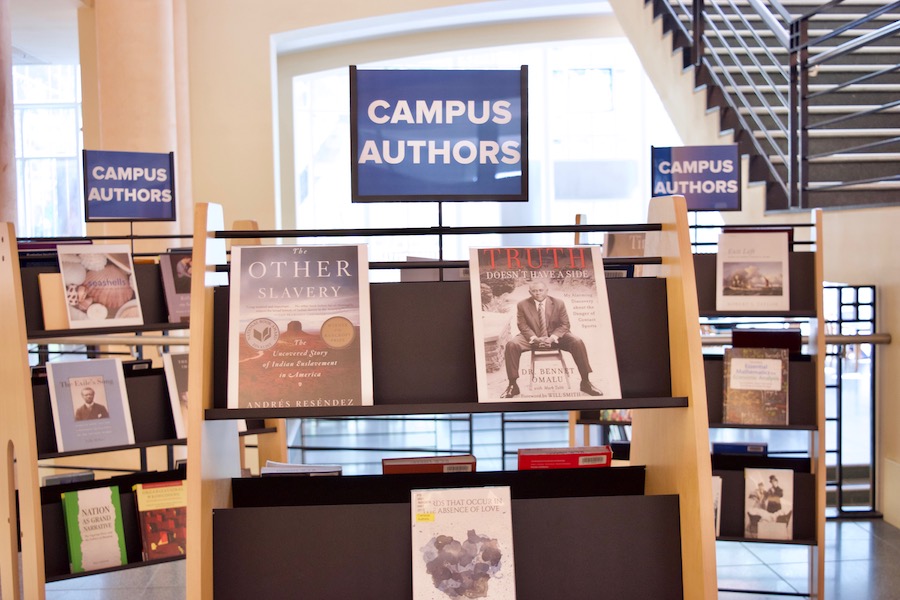
UC Davis faculty publications on display

ALEXA FONTANILLA / AGGIE

Showcasing prestigious academia

On the first floor of Shields Library, there is a small display of books written by UC Davis faculty. Hailing from disparate disciplines, many campus educators publish books in addition to their journal articles, research and teaching. Professors Julia Simon of the French and Italian Department, Andres Resendez of the History Department and Donald Palmer of the Graduate School of Management have each published more than one book thus far in their careers. They can each speak of the connections and transitions between publications, the challenge and satisfaction that is publishing, not to mention the work at hand.

Professor Simon narrows her research to the 18th century while broadening its scope through interdisciplinary work. One of Simon’s primary lenses is music, to which she has personal ties, having gigged in a jazz band for many years. Simon published a book entitled “Time in the Blues” and is currently working on her fifth book, “Debt and Redemption.”

“I got interested in the idea of teaching blues since I play it all the time,” Simon said. “First, I did a first-year seminar, freshman seminar, and that went really well. Then I developed a big humanities course on it, so I do kind of a cultural history of the blues. I gave a talk at an American Musicological Society conference and it went really well and I was like, ‘I could publish an article on this.’ So I wrote an article, and I published it and then I thought, I have an idea for a book, and I’m just going to do it.”

That creative spark became “Time in the Blues,” a book about the historical realities that gave particular form to the blues music of the era, the way that these realities impacted individuals experiences of time and how that time is expressed and felt in blues music. Simon makes these realities tangible.

“A lot of the argument in time in the blues is about how things like sharecropping, or long prison sentences and even convict lease […] how that might change your perception of time,” Simon said. “How you might not be connected to your past, how you might not be able to project into the future because things are foreclosed and why the music that you play might be so focused on the present.”

Furthermore, Simon considers how and where music is born in the first place, connected inextricably to the resonance it may have with present and future listeners.

“It really makes you think about how music comes to reflect the world around you,” Simon said. “I think about how blues came about in the 1890s when race relations were really at their worst in the United States. It’s when lynchings were at their peak, when Jim Crow laws were being put in place. I think one of the things that the book does do is make you think about those things, when you listen to a song, what exactly happened.”

While Simon’s familiarity with playing as well as studying music elevates the book as theory, she believes it can be relevant to the UC Davis community that appreciates music. “Time in the Blues” serves as fertile grounds upon which one can interrogate the kind of music with which they resonate.

“Maybe students would be interested to think more about what they like and why they like it and what gave rise to it,” Simon said. “At the end of the book, I talk about how you can go listen to people play blues and it can kind of sound, we call it phoned-in […] but those ones that really get you, I say in there, I think it’s because people really understand where it came from.”

Professor Andres Resendez is not new to publishing, much like Simon, and similarly finds that the research from one book project propels him into the next. His book displayed, “The Other Slavery,” informs readers of the history of Native American enslavement both by one another and by colonizing forces.

“Indian slavery, unlike African slavery, was forbidden early on,” Resendez said. “The Spanish crown prohibited the enslavement of Indians under all circumstances as early as 1542, so very early. But by that point European colonists essentially depended on coerced Indian labor for everything.”

Distinguishable from the enslavement of African Americans in the United States by its illegality, Resendez finds a number of differences that obscure the realities of Native American slavery over the course of history. He believes these factors are at least partially responsible for the ignorance of many to this story.

“I think one of the reasons why we have a hard time coming to terms with this other slavery, as I call it is because A) it goes by very different names, B) it was supposedly was not supposed to exist and there are other reasons. For example, African slavery involved the wholesale transfer of millions of people across the ocean, and therefore we have a lot of these port records. Indian slaves in contrast were both procured and consumed in locally or regionally and so […] it’s very hard to come to terms with hard evidence by way of numbers, for example.”

In addition to formulating an estimate of the number of Native Americans impacted by a period of slavery between Columbus and the 1900s, Resendez also wants to step away from an ideology of victims and victimizers, with the hopes of inspiring debate and scholarship among researchers.

“One of the things that I tried to do in my book […] is to point out that this is not a history about victims and victimizers,” Resendez said. “Everybody who was in a position to do it, did it. There are a few groups that, because of their particular conditions, did not benefit from the enslavement of other Native Americans, but everybody who was in a position to benefit from this did it. This is not a history about pointing fingers at some people or others but it’s more about human nature.”

By human nature, according to Professor Palmer of the Graduate School of Management, we also live within organizations. This is the focus of Palmer’s research: abuse and alternative value systems generated by organizational cultures. Palmer wrote “Normal Organizational Wrongdoing,” which inspired the Royal Commission of Australia to seek him out to conduct a report on abuse within the country’s institutions.

“My book is called ‘Normal Organizational Wrongdoing’ and the most basic argument in the book is that misconduct is common,” Palmer said. “The other thing about my book is that the reason it’s prevalent is that every structure that makes organizations what they are […] can both make them efficient and effective but can also, if they’re misaligned, lead to misconduct. Insofar, as we all spend lots of time in organizations in our lives, it’s good to understand […] how organizations can cause people to engage in misconduct, even if they are ethical, law abiding rule following order obeying people. We’re all at risk of that. The consequences can be really severe.”

Palmer explained how ‘normal’ people become party to misconduct as part of organizations that require or teach alternative knowledges of them.

“Organizations are many things,” Palmer said. “They are administrative systems, they have rules and protocols, they are power structures […] but one of the things they are, in addition to those things, is cultures. They have a set of assumptions about the nature of the world, and values and beliefs, about what’s good and what’s bad and norms about what to do. In some cases those cultures have a lot in common with the, what you might call a societal culture […] and in other cases they’re really very different. Some of it has to do with the kinds of people who are recruited, some of it has to do with how people are socialized once they enter the organization. There are multiple things going on.”

Palmer applies his research expertise to the case of abuse in Olympic gymnastics.

“In the Olympic sports domain, the assumption is that the children are just small humans,” Palmer said. “One way that’s manifested is they’re referred to as athletes. Once you have a universe where these twelve-year-olds are just considered smaller versions of adults, you can understand why coaches would end up in inappropriate relationships with these kids, because they don’t see them as children.”

Given the commonality of misconduct, Palmer felt that more writing needed to be published on the phenomenon within organizations. As a teacher of management courses, the absence of materials was palpable.

“The book was something like an itch that I wanted to scratch,” Palmer said. “I had taught a course, ethics, social responsibility and misconduct at UC Davis for the graduate school of management, and I just couldn’t find anything which seemed to accord with what I was reading in the Wall Street Journal or the Washington Post. I kept on thinking, there’s a really obvious way to approach the subject, but I haven’t seen anybody who’s done that. So I did write a journal article, and I would give talks, and I kept on expecting somebody somewhere to say, ‘you know somebody’s already done this.’”

According to Palmer, that ‘somebody’ never arrived, and he took up the project. Since “Normal Organizational Wrongdoing” he has also published “Organizational Wrongdoing: Key Perspectives and New Directions” and “Comprehending the Incomprehensible: Child Sexual Abuse in Organizations, An Organization Theory Perspective” alongside Valerie Feldman.

Palmer, Resendez and Simon each seem to relish the experience of crafting a book as a necessary output of their research interests. However, the privilege of spending three or four years with one project may not be accessible to junior, or adjunct, faculty.

Simon noted that the publishing process requires the writer to essentially finish the book without a commitment from the publisher that they will accept it, leading to a prolonged period of crafting and revision.

“Publishing books is a tough thing, it’s a really tough business. You essentially have to finish the book before you even go out and find out if there’s a publisher. Books get rejected and then you start all over again, it’s just crazy. It’s a slow and difficult process, but obviously we love it or else we wouldn’t be doing it.”


Written by: Stella Sappington — features@theaggie.org

Former UC Davis professor filmed individuals showering without their consent, stored footage on university-owned hard drives

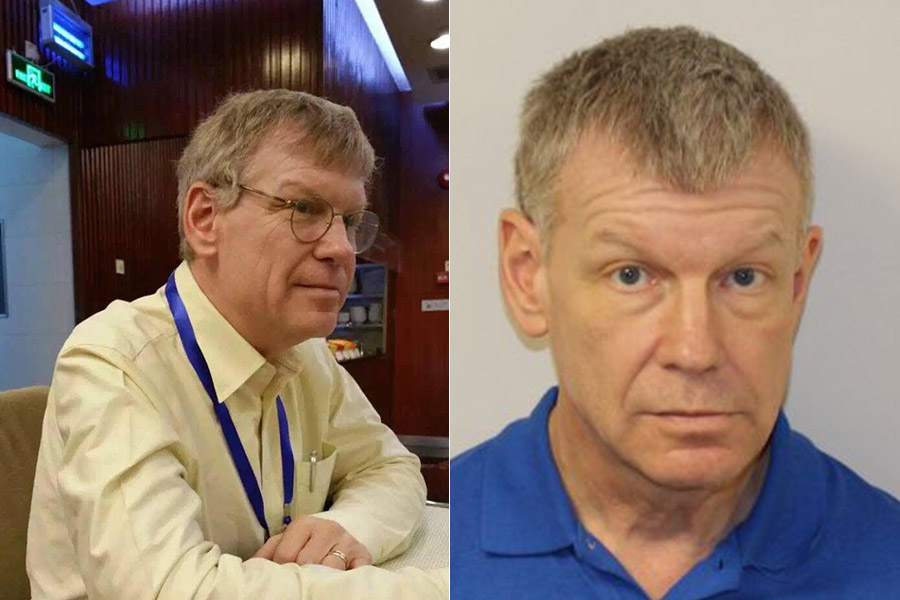
KARL KJER / COURTESY (left), MIDDLESEX COUNTY PROSECUTORS OFFICE / COURTESY (right)

Accidental finding led to conviction of former UC Davis professor for filming of 19-year old

Before taking time off for Winter Break in 2015, Karl Kjer, an entomologist and tenured professor at UC Davis, left the keys to his office with one of the junior specialists working in his lab so they could feed his fish while he was gone. A few weeks prior to Winter Break, Kjer had asked the junior specialist to order two 1-terabyte Western Digital external hard drives, purchased through the university, for the purpose of storing photographs and images for research-related purposes.

The junior specialist, who recently recounted the incident to The California Aggie and who wishes to remain anonymous, said they had seen Kjer take the hard drives into his office — which had a separate door that locks independently. The plan was to transfer photos from an iMac to a computer hooked up to an imaging system. A volunteer working at the lab had asked the junior specialist to retrieve the hard drives from Kjer’s office so they could begin transferring files.

“I went to find the hard drives […] in Karl’s office and just picked up one and gave it to the volunteer and we plugged it into the iMac,” the junior specialist said. “And the hard drive’s window […] automatically pops up. We saw all of these different little file names pop up, and we were like, ‘What’s this?’ Because we weren’t expecting them to be full already.”

What they found on the hard drives was not the research data they expected, but internet pornography as well as videos Kjer had recorded himself in 2012 by setting up a camera inside the bathroom of his home in New Jersey to record individuals without their knowledge. The discovery of these materials on hard drives purchased by UC Davis later led to criminal charges.

Kjer recently spoke to The California Aggie over email about his time at UC Davis and his ultimate resignation from the university for health reasons.

“Working at UC Davis was the greatest honor of my life,” Kjer said. “My colleagues in my department were so kind to me, and were unaware that for a short period prior to moving to California, I was consumed by an ugly, compulsive and addictive behavior that I was unable to control. I commend those who shined a light on it, and in particular, one in NJ whose strength and bravery is beyond measure.  I never meant to harm anyone, and am sorry. I know I cannot undo the harm I caused. I deeply regret the impact of my actions on all those affected. I have been in therapy since, and am focusing on sobriety.”

________________


In July of 2015, Karl Kjer accepted the Schlinger Chair of Systematic Entomology position in the UC Davis Department of Entomology and Nematology. Kjer left Rutgers University, in New Jersey, after 18 years at the university, for the tenured position at UC Davis.

Kjer is a co-founder of the 1,000 Insect Transcription Evolution Project. According to the Davis Enterprise, the project’s team had “developed state-of-the-art methods to analyze genetic data from the DNA of modern insects and calibrate DNA ‘clocks’ with fossil records” which were then used “to estimate the patterns and timing of insect evolution.”

Morgan Jackson, a Ph.D. candidate at the University of Guelph in Ontario, Canada, said via email interview that Kjer “was highly regarded for his work deciphering the higher relationships of insects using DNA data, which he was an early proponent of.” Jackson had cited “a number of papers” that Kjer had either published or contributed to.

In November of 2015, Kjer hired a junior specialist who worked with him in a full-time position in his lab at UC Davis.


“When I first started working with Kjer, we were going to set up a really nice imaging system for publications or just high-def microphotography [of] specimens we were going to use for his research,” the junior specialist said. “Since we did not get our imaging system first, we decided to kind of prepare for it, and so he [Kjer] asked me to order two hard drives.”

After opening files on just one of the two university-purchased hard drives stored in Kjer’s office over Winter Break, the junior specialist and volunteer found a lot of “terrible images that he recorded of quite a lot of women without them knowing.”

“There was a lot of folders of internet pornography that he downloaded, and we kind of closed the window and looked at each other like, ‘What did we just find?’” the junior specialist said. “At a later point, after we looked through it and made notes [of] when they were taken, when did he last access them — they were spanning at least all the way back from 2010, up to 2012, 2013. A lot of them said that he was still accessing them up to 2015, when I was working.”

In addition to the internet pornography stored on the hard drives, the junior specialist estimates that there were more than 10 videos Kjer had recorded himself, including a video of him installing the camera in the bathroom in his home in New Jersey. It appeared the camera was pointed at the shower and some individuals being filmed were partially clothed while others were nude — “all of them definitely did not know they were being filmed or imaged at the time.”

“We kind of freaked out a little bit and we weren’t sure what to do,” the junior specialist said. “Both of us were kind of scared the university wouldn’t take us seriously or wouldn’t take serious action against Karl. We were scared about that and we didn’t know if we would get retaliated against.”
The junior specialist continued working with Kjer until his resignation from the university, although they took a medical leave because they were “stressed and not coping too well with the entire situation.”

“I decided to talk to one of the professors at UC Davis who I really trusted,” the junior specialist said. ”She, through obligation, told me beforehand that she would have to tell the appropriate authorities at UC Davis if I was going to tell her. She reported it to the UC Davis police and they got involved and ended up confiscating the computers at Kjer’s lab, including the hard drives. The volunteer and I […] also took backups of the evidence that were on the hard drives on our own little USBs and we turned those in too. Only through the professor I talked to initially who I reported this to did I learn that he was encouraged to leave and that he himself decided to leave the university a week after this meeting.”

The university initially denied record requests from The California Aggie related to the incident, citing an exemption for disclosure in relation to personnel matters. However, the university did finally release a Summary of Incident Report.

“June 10, 2016: UC Davis Police Department was contacted by College of Agricultural and Environmental Sciences (CAES) when student employees alleged that a tenured faculty professor had secretly videotaped possible students in a bathroom,” the report states. “June 13, 2016: UC Davis Detective met with student employees and two CAES administrators. Student employee discovered pornographic thumbnail images on hard drive. Student employees looked through some of the files and saw Kjer placing and removing a video camera in a bathroom after a female got out of the shower. Student employees copied and saved images and videos on a thumb drive but did not alert authorities until now. Detective reviewed videos and confirmed content.”

According to Sgt. Paul Henoch from the UC Davis Police Department, two concurrent investigations were occuring at this time — the university’s investigation and the criminal investigation, which he was involved with. The report states that the modification/creation dates on the videos are 8/21/2012 and 8/22/2012, before Kjer came to UC Davis.

Henoch was responsible for determining whether any criminal violations took place in California. One of Kjer’s hard drives was seized, which Henoch said contained videos of surreptitious recordings of “women [and] possible students in [the] bathroom, taking a shower, getting out of the shower [and] undressing.”

According to the report, “Detective, with assistance of CAES administrators, was able to confirm probable identity of one of the females in the video.” Henoch said detectives confirmed the identity of one of the individuals using a still image of a posterboard of a project the student had been working on. The individual was not a UC Davis student.

Ultimately, detectives “could not determine that any crime occurred in California.”  

On June 16, a letter was delivered to Kjer which placed him on administrative leave and UCDPD sent information to New Jersey.

“Once my investigation was completed, [the] university was very concerned about the safety of the students here, that’s why I went through all of the megabytes of imagery, videos and stuff like that,” Henoch said. “I was able to determine that none of it was our students or videotaped at UC Davis and it happened back in 2012-2014 over at possibly Rutgers University. I sent my incident report to Rutgers and they sent it to wherever they needed to send it.”

The California Aggie received a copy of The State of New Jersey vs. Karl M. Kjer, dated to 2017.

“Within the jurisdiction of this court, knowing he is not licensed or privileged to do so, he photographs, films, videotapes, records or otherwise reproduces in an [sic] manner, the image of another person whose intimate parts are exposed or who is engaged in an act of sexual penetration or sexual contact without that person’s consent and under circumstances in which a reasonable person would not expect to be observed, specifically by video taping (victim #1) while showering at his residence […in NJ] without her knowledge or consent, in violation  N.J.S. 2C: 14-9B (a third degree crime).”

Kjer was charged on Feb. 17, 2017 “with one count of invasion of privacy” for filming a 19-year old woman showering in his bathroom in June of 2015 without her knowledge, according to the website for Middlesex County, New Jersey. One article from a local New Jersey publication states that he has avoided jail time and was sentenced to three years probation.

“He would invited people over to his house for parties because sometimes that’s what lab professors do […] so they can connect and get along with each other,” the junior specialist said. “But he was just using it for a really malicious purpose.”

In email communication with The California Aggie, Kjer said both he and UC Davis administrators “came to an agreement of confidentiality” over his resignation in June of 2016 which “was health related.”

After news broke in 2017 that Kjer had been charged in New Jersey, however, some students and staff in the Department of Entomology and Nematology were upset the university had not told them about the investigation. Some UC Davis students found out about the charges through tweets. One tweet from entomologist Fran Keller, who works at the UC Davis Bohart Museum, states: “Now we know why he left an entomology endowed systematics chair at UCD. He… secretly recording woman in shower.”

Other students found out about the charges from Jackson, the aforementioned Ph.D. candidate in Canada, who also tweeted about the news.

“I’m sorry that the Davis entomology community learned about Kjer’s deeds via my Twitter rather than from their institution and “leadership,”” Jackson wrote via email interview. “For what it’s worth, I originally learned of the story from a Davis alum who shared the first news report from New Jersey and noted that this would explain why Kjer seemingly disappeared in the dead of night from a high profile research chair position.”

On March 2, 2017, Steve Nadler, the chair of the Department of Entomology & Nematology, sent an email to graduate students addressing the arrest of Kjer in New Jersey.

I understand that this has been disturbing news to those of you who have become aware of this thing through social media,” Nadler wrote in the email. “Several of you have expressed concerns to me about what may have taken place while Karl was employed at UC Davis. Please be assured that I share your concerns about Dr. Kjer. it is my understanding that the University learned of this matter in June, 2016. The University acted immediately to launch a criminal investigation and placed Dr. Kjer on involuntary leave.”

Nadler also offered to organize “a joint student-faculty committee to address any remaining concerns you may have regarding student safety or graduate student-faculty interactions.” On March 9, Nadler sent another email.

“I realize that one of the disturbing things about […] the Karl Kjer incident is that there is concern among those of you who visited Karl’s home that your privacy could have been violated,” Nadler wrote. “I also understand that this concern may persist despite that the UC Davis police found no evidence of criminal activity taking place in Davis based on university computers and backup drives seized from Dr. Kjer (and examined by the UCD police). I had a conversation about this with members of the Dean’s office today, and they recommend that if you have any reason to believe that you could have been a victim of Dr. Kjer, please contact the UC Davis police to discuss the matter with them.”

After Kjer’s departure from the university, his former junior specialist was able to work in Nadler’s lab for some time. The junior specialist said that while they did feel the university addressed the situation, they also felt “they were trying to sweep it under the rug.”

Entomologist Gwen Pearson, who is also Purdue University’s Department of Entomology Education and Outreach coordinator, is the founder and head of Ento-Allies, which serves as “victim advocates.” Pearson spoke to The California Aggie not as part of her official capacity as an official at Purdue.

“Entomology itself is an interesting discipline,” Pearson said. “For many, many years, women were quite scarce. At this point, we have almost equal male/female student numbers, but in terms of tenured members in entomology or people who are in the industry, there’s still a pretty significant skew towards men. We’re there for the people who have had bad things happen. Especially when you have power situations, like a faculty member and a student, not everybody wants to file a complaint but they do need support and advice and somebody to say, ‘It’s totally not your fault that you were picked on, it’s totally not your fault that someone touched you inappropriately, and we will stay with you and here’s some options for you.’”

Pearson discussed what she says is a pattern in the scientific community where a male professional will engage in inappropriate behavior, resign and quickly find another job.

“Right about the time they’re called on it, and proceedings begin, if they resign, it’s over because they’re no longer an employee and the university no longer has any sway over that,” Pearson said. “Very often what happens is […] someone will get in trouble and resign, start over at a new institution and their bad behavior doesn’t necessarily follow them from institution to institution.”

An example of this pattern, which Pearson discussed, is that of the accusations of sexual misconduct as well as research misconduct aimed at University of Kentucky Professor of Entomology James Harwood, who subsequently resigned from his position. The university decided not to pursue an investigation after Harwood’s resignation.

“I’ve seen it happen a couple of times where someone resigns and back channel talk is all — they get caught doing something they shouldn’t have done — and they get a new job,” Pearson said. “It really baffles me why, when there’s such a huge pool of talented scientists, why do we keep rehiring people who we know behave badly?”

Jackson discussed his frustration when, after the news broke of Kjer’s criminal charges, colleagues “shrugged it off,” chastised him “for speaking out and condemning him before he was found guilty” or “who continued to publish with him.”

“If academics are too afraid or too weak to call out someone who has been criminally convicted for exploiting multiple victims, how can we trust them to do the right thing when a case isn’t as black and white?” Jackson said. “How can we trust them to stand up for their students, their employees, or the general public interacting with their institution if they can’t bring it upon themselves to publicly comment and condemn someone like Kjer? I’m equally concerned about scientists who may choose to overlook these charges and still consider Kjer a scientist worth collaborating with, as if his ideas and influence excuse his exploitation of other humans.”


For Pearson, in a circumstance such as this, it is important to make sure people are informed — “there’s things that we can do personally, which is what I’m focused on, by being as supportive as I can to victims.”


“This is not someone you should collaborate with,” Pearson said. “The larger part is, the consensus we are moving towards, is that harassment, assault — that’s a type of misconduct that is scientific misconduct. If you can’t be a good human, then you can’t be a good scientist.”


Written by: Hannah Holzer — campus@theaggie.org

UC maintains contract with Aramark despite UC divestment from private prison corporations

HANNAH HOLZER / AGGIE

UC Office of the President’s systemwide strategic sourcing initiative includes Aramark laundry contract

Over the course of the last two years, the UC system has actively divested from corporations involved with the private prison industry. In January, The California Aggie reported that the mobile ordering app Tapingo had ties to Aramark, a corporate food service giant that has clients in education and healthcare as well as contracts with privatized correctional institutions. However, the UC has, as of last year, entered into a contract with Aramark itself for systemwide laundry services.

According to an article written in The California Aggie, in December 2015, the Afrikan Black Coalition (ABC) created a petition sent to UCOP “calling for the University of California to divest $425 million worth of stock from Wells Fargo due to the banking and financial company’s financial support in private prison companies.”

According to the petition, “private prisons profit from incarceration (an average of $122 per person per day) and use their political influence to lobby for harsher penalties and anti-immigrant legislation.” In response to the petition created by the ABC, ASUCD passed Senate Resolution #14 in February of 2016.

“[This resolution urges] both the Board of Regents of the University of California (UC Regents) and the Associated Students of University of California, Davis to undertake practices of corporate social responsibility by divesting in corporations which are directly and indirectly involved in the private prison industry, an industry built on profiting off of incarceration and the school to prison pipeline,” the resolution states. “We as a student body and as a University system cannot, in good conscience, seek out a diversity of students when we are investing in incarceration and policing in communities of color.”

In response to these demands for action, the UC divested around $25 million from two private prison corporations. The Annual UC Investment Office Sustainability Report, Fiscal Year 2015-2016 Achievements stated: The UC investment office participated in a productive dialogue with the Black Afrikan Coalition on issues of joint concern and supported efforts to engage Wells Fargo Bank regarding its responsible banking policies and practices surrounding private prison finance.”

According to its website, Aramark is “in the customer service business across food, facilities and uniforms.” Additionally, according to an article from Medium, Aramark “works in over 600 correctional institutions across the United States and Canada […and] serves more than 1,000,000 meals to prisoners each day.”  

Aramark has gained media attention on multiple occasions regarding backlash for poor food quality, protests, strikes and lawsuits. According to PBS, the corporation “has been the subject of complaints about maggots and rocks, sexual harassment, drug trafficking and other employee misconduct.”

A 2017 article from The Atlantic states that a $145 million contract with Aramark was terminated early by the state of Michigan after issues “from maggot-ridden potatoes to employee drug smuggling” arose. Aramark has denied these allegations and any wrongdoing.

Aramark has also faced student backlash both nationally and internationally, in Washington D.C., Florida and Newfoundland, Canada regarding working conditions and food quality.

In early January, members of the UC Davis student body and the ASUCD Senate became aware of ties between Tapingo, a mobile ordering app introduced on campus, and Aramark. Director of Dining Services Darin Schluep stated that there was no correlation between providing services through Tapingo and the private prison industry since Tapingo did not directly work within the industry.

But according to Emily Galindo, the executive director of student housing and dining services and the associate vice chancellor of student affairs, Aramark now holds a contract with UC, spanning all ten campuses, as a laundry service provider.

Aramark won the UC Office of the President’s bid last year to be the systemwide laundry service vendor,” Galindo said via email. “Davis is one of many UCs which is using this contract for our laundry needs. You may be aware that Aramark has a number of different divisions that sit under their company umbrella. Laundry is a different division from food service.”

In a separate email to The California Aggie, Galindo expanded upon the terms of the contract.

“Aramark laundry contract is a UC systemwide agreement that falls under the Office of the President’s strategic sourcing initiative,” Galindo said.

At UC Davis, the Department of Finance, Operations and Administrations is responsible for, among other things, coordinating and managing the campus budget, analyzing strategy development, managing human resources, accounting for campus finances and maintaining campus facilities.

“We align business requirements and represent UC Davis on system-wide activities, incorporating our requirements to ensure that contracts that come out of Office of the President will yield tangible value [and] add to the Davis community,” said Mike Morgan, the strategic sourcing manager in the Finance, Operations and Administrations Division. “On the other side of that, [the] Office of the President is looking at larger spend engagements.”

Chief Procurement Officer in the Finance, Operations and Administrations Division Tim Maguire is responsible for overseeing numerous departments, including purchasing and contracts management, strategic sourcing, distribution services and facilities maintenance.

“My ultimate role is to coordinate all these groups to ensure that we’re achieving the best value for the University and the commercial engagement of the University with outside resources,” Maguire said.

Maguire discussed how financial costs and requirements of the UC impact the decisions regarding which companies to contract with.

“The spend across the UC system is about $13 billion [and] the spend at UC Davis is a little more than $685 million,” Maguire said. “We have a large spend, we have a large population […and] there’s not a lot of companies that can support our needs. We try to leverage companies across all ten campuses and all five medical centers to be able to drive best pricing for the university. You couple that with the other aspect of this: since we’re a public institution, we’re held responsible to the Public Contract Code.’

The Public Contract Code is a compilation of all public contract laws in one code that applies to virtually all public entities in California. The California State Legislature created this code with various goals in mind which include: “protecting the public from misuse of public funds,” “stimulating competition in a manner conducive to sound fiscal practices,” “To eliminate favoritism, fraud, and corruption in the awarding of public contracts,” “To encourage competition for public contracts and to aid public officials in the efficient administration of public contracting, to the maximum extent possible.”

Maguire explained the logistical process of creating this contract with Aramark, and the requirements that were considered by UCOP.

“The Aramark agreement was done through a system-wide initiative that was based out of UCOP and we put our business requirements into the pool,” Maguire said. “We all have lab coats that need to be laundered, we all have uniforms that are needed for the facilities. We pooled all these requirements that we had from a uniform standpoint and we give that information to UCOP. They come back with proposals and in the proposal review UC Davis played a role in the review of the proposals and then at the end of the proposal review, […] UCOP would then identify who the awardees are.”

The Aramark agreement was created by UCOP in September of 2016 after various difficulties with the UC’s prior laundry servicing company, Mission Linen.

“We’ve had trouble in particular in the laundry area,” Maguire said. “Prior to our relationship with Aramark, we had a relationship with Mission Linen and Mission Linen, if you don’t watch this area very closely, they’ll take advantage of you very quickly. Mission took advantage of us in certain areas that made them difficult to work with. We’re working with Aramark to transfer the business to them, underneath the UCOP award, and we’ve been working with Mission to pull them out as best as we can.”

Maguire explained that UC Davis, specifically, has only been working with Aramark for the last several months due to the challenges with campus size, garment quota and the challenge of being able to “identify a company that has the ability to service an institution of our size and an institution that has as much variety as we do.”

Maguire responded to student concern in regards to Aramark’s ties to private prisons.

I don’t know what Aramark’s business engagement with the prison industry is,” Maguire said. “I know they service almost any industry and I’m sure there’s a ton of suppliers that service the prison industry as well. As far as I know, Aramark’s not in the prison business, but […] you’re going to be hard pressed to find a company […] that’s a large company that supports us that wouldn’t support a state prison, and a lot of our contracts that we have our state contracts.”

When asked if he knew whether or not UCOP had considered the ties between Aramark and the privatized prison industry, Maguire replied that he did not know.

“As far as I know, I don’t believe [UCOP] knew the other customers of Aramark when they went into the RFP [Request for Proposal],” Maguire said.

Jeremy Meadows, associate director of Facilities and Maintenance and Strategic Sourcing Centers of Excellence within UCOP, ran the Request for Proposal. He did not respond to a request for comment on this issue.

Maguire discussed the potential difficulties caused by a discussion of the extent to which ties to the private prison industry should play when UCOP considers whether to form contractual agreements with companies.

“There’s a lot of suppliers to any industry — if it’s a prison industry, to higher education, to high-tech, banking,” Maguire said. “It could be any industry that had these similar types of needs, and most anybody we engage with could be involved with those customers as well. Are we supposed to disqualify these suppliers because they service the prison industry?”
Maguire expanded upon his points later via email.

“There are many suppliers involved with supporting the Prison Industry, are you suggesting that we discriminate against them as a UC because they supply goods and services to the Prison Industry?” Maguire said via email.It’s our departments mission to ensure that we maximize the value of each dollar spent by UC Davis. If we were to remove competitors from the marketplace based on who they do business with, we may find it difficult to acquire the goods and services the University needs.  Additionally, the cost of running the University could potentially increase if we were not able to maintain a free market structure.”

Maguire did not have specific knowledge of the UC’s divestment from companies with ties to the private prison industry and found little to no issue in contracting with companies indirectly involved in the private prison industry.

UCOP has yet to provide a statement regarding the state of knowledge over Aramark’s ties to the private prison industry.


Written by: Priyanka Shreedar — campus@theaggie.org

Letter from the Editor

CAITLYN SAMPLEY / AGGIE

From the outgoing editor-in-chief

I have cherished every moment of the last four years I have spent at The California Aggie. This is likely the last time I will write for this publication. Before I say goodbye, I want to share why this newspaper is so important to me.
So much of my time as editor-in-chief has been a learning process. I have learned from my staff and from community members every single day, growing as an individual and as a leader as a result. It’s been an experience like no other.

I joined this paper when it was at its lowest point and I saw its presence rebuilt step by step by a dedicated staff and a supportive community. The Aggie shows no signs of slowing down, and its now-150-person staff is a testament to that.

We’ve grown. We’ve expanded our operation, our reach and responsibilities with it. We breathed life back into our on-campus presence by collaborating with other units to redesign and upgrade each of our distribution points. We continued working on the newspaper digitization project. The community has engaged with our content, which has affected positive, tangible change.

Journalists choose to hold others accountable. We try to shed light on important issues and make an impact. During a time when most everything has to be questioned, responsible news sources must build a foundation of trust to serve those who seek reliable information. That foundation starts with student journalism. The Aggie has always strived toward this ideal.

This newspaper is fueled by the passion of the students who work here. We have always done what we can to bring reliable, timely and engaging news to our readers, and I can say with confidence that we’ve been able to do that. We do it for the community. In our case, without the students we serve, we wouldn’t be here. But we also do it for ourselves, because it’s undoubtedly something we love to do.

It’s emotional for me to leave because this paper has been one of the few constants during my time at UC Davis. Some of my proudest memories at this university involve being a member of the staff that brought the student newspaper back from virtual extinction. And beyond that, the people who work here have been my close friends. The stories have become part of my experience. I wouldn’t trade a single moment of my time here for anything. Next year’s staff members — many of which have a year or more of experience under their belts — are a capable bunch, and I have no doubt they will take good care of this newspaper.

It’s been an honor to be the 2017-18 editor-in-chief of The California Aggie. Each year I spent here has been different, but it has always been fun and never boring. Thank you to all those who made this experience so worth it. To the people whom I respect, laugh with and love, thank you.


Bryan Sykes

Editor-in-Chief


Gary May reflects upon first year as chancellor

TREVOR GOODMAN / AGGIE

Chancellor answers questions about student activism, union negotiations,accessibility of on-campus mental health care

The California Aggie sat down with Chancellor Gary S. May on Tuesday, June 5, to speak about the successes and shortcomings of his first year as chancellor. He also addressed student concerns over the funding of centers such as the Cross Cultural Center, access to on-campus mental health care and ongoing bargaining negotiations with the UC. The following interview has been lightly edited for length and clarity.


The California Aggie: How has your first year been as chancellor?


Gary May: It’s been exciting, informative, I’ve learned a lot, met a lot of really interesting people [from] all aspects of the campus — students, faculty, staff, alumni, leaders, administrators. It’s been really fulfilling and I still feel like it’s a great opportunity for me [to be] in a place that has so much potential. It’s already very good, some would say even great, but I think it has more potential.


TCA: I’ve noticed that you and LeShelle [May] have managed to stay very busy. How do you engage with the large and diverse Davis community and student population?


GM: I think it’s important for people in leadership roles to be visible and accessible and approachable. I’ve tried to do that since the beginning, and LeShelle has been a great partner for me. She’s also gotten involved in things in the community — not just on campus where she’s gotten involved in sexual violence stuff and women in STEM kind of stuff — but she’s also on the Girl Scouts Board and KVIE board. We’re both very energetic and enthusiastic about being visible. I’ve tried to extend that to the rest of the campus leadership with the shadowing program. One of the things I noticed very early is that there was a lack of knowledge among the students in particular, but even the faculty too, about what we do as administrative leaders and whether we add value or not. And from the student side, more trust kind of issues that there’s a bit of a deficit in that had been built up over the years for various reasons. I’m trying to rebuild that [and] I think being visible is an important part of that.


TCA: Can you give me an update on your task forces on housing, food security and mental health care?


GM: I wish I could. Reports are all due June 30 and I haven’t really been getting status updates. I did go to one of the housing task force meetings because they wanted to meet with me and talk more directly because there’s so much going on there. My sense is they’re all in various stages of data gathering and preparing recommendations. I’m hoping they’ll give us something we can act on in the next budget cycle because we’re holding some resource places for each of those groups. Obviously, scope is important because we’re not going to build a new dorm in the next budget cycle — we’re already working on three projects. I’m hoping the housing folks will come up with something that’s a little more immediate that we can do, whether it be just information about where housing is or something we can do about the affordability issue. The other two, I expect mental health will probably have some pretty actionable and direct recommendations. […] And I think we’ll be able to respond to those pretty quickly. Same thing for food security, we’ve already put the Aggie Compass in place and we’ve been working on helping The Pantry out with some philanthropy and I won’t say too much about it publicly, but we have some significant donors in our sights.


TCA: To what extent did The Aggie’s coverage on mental health care and resources influence your decision to create a task force?


GM: I certainly read all of your articles and was very interested in the topic and had heard from other students about it, some of the student activists are on my Facebook feed. […] And it’s an important issue for me as well. From a personal standpoint, my daughter had gone through counseling. I know this is an important issue nationwide and not just at UC Davis. And quite frankly, I was concerned [about] our accountability and stewardship of the resources. I’m not sure we did everything we were supposed to do the right way. I think we’ve got that rectified now, but I think we need to own that some things were mishandled. We did make some personnel changes and re-righted the ship if you will — I think. We’re going to be doing some hiring, appropriate number of counselors, not just the number but also the availability and scheduling aspect of students being able to get counseling. I think we’re on the right track now.


TCA: With the additional funds for hiring new counselors and expanding mental health resources, students are still faced with long wait times for psychiatry and psychology appointments. Is achieving accessibility of care a matter, from your perspective, of examining how the funds are being used or increasing the investment in student mental health?


GM: It’s probably a little bit of both. […] The audit results that we got said our counselors weren’t seeing enough students [and] number of appointments per day was low and that was because they were doing more programmatic stuff, that I’m not saying was bad stuff, but was leaving the clinical part of their jobs undone or not done as effectively as it should have been. The reason why it’s a little bit of both is I think as we add more people, there’s more people available to do programmatic and clinical. I think the wait time issue is not just a matter of human resources but a matter of the systems we use to schedule.


TCA: I know the university has announced its support for the Nishi Housing project. What are your thoughts on the project?


GM: We have to be careful, because as a 501(c)(3) organization, we’re prohibited for campaigning for individuals or for campaigning for ballot measures, however we think this would be a useful thing for our students to have more housing. I think everyone can agree on that. We did enter into an MOU with the developer to put a roadway between downtown and the development, should the ballot measure pass. We are supportive and we hope it works out. […] We’ve heard the concerns from some of the community about the air quality. […] We’re not overly concerned about it. I think it’s a valid thing to investigate, but we think that question has been answered. We just hope that the Davis city community will be more accepting of the fact that students are in this predicament and will be sympathetic to that.


TCA: I wanted to talk a bit about student activism and advocacy on campus. I know you said, at the beginning of the year, that student activism was minimal at Georgia Tech. What has your reaction been to the amount of activism that goes on on campus?


GM: It’s still a lot more here than I’m used to. Whenever the end of my chancellorship is, if I can say that I’ve improved the level of trust and reduced the adversarial us vs. them between student activists and administrative leadership — it’s probably never going to be zero — but if I can reduce that to a manageable amount, I would have had some success. I’m still working on that. I know there have been some recent issues. I think it’s better, I don’t think it’s perfect yet. What I’d like to do is to get our student activists vectored into a more constructive mode. I don’t want this to sound patronizing or like I’m putting them down, but sometimes it comes off as making noise and having tantrums [rather] than, ‘What can we do, constructively, to change this situation?’ For example, when the tuition hike was first proposed, we had some activists here in Mrak [Hall]. I met with them afterwards and I invited them to help us be a part of the advocacy efforts in Sacramento to get the legislature to buy out the proposed tuition increase. And I was hoping they’d taken advantage of that. I was really disappointed that they didn’t. Some ASUCD and other student leaders did go with me to meet some members and I think we did have some really positive effects. But the students who’d been protesting were not really a part of that, unfortunately. I’m going to keep trying, I don’t want to be the enemy. I don’t want the administration to be the enemy. Although some of those students do say and do some things to demonize me and others. But that’s really not the case. I think we all sort of want the same things and I’m proud of the fact that we were able to get the tuition buyout through the legislature. […] I’m looking forward to the day when student activists view the administration as a collaborative partner. We’re not going to always agree, there’s going to be things we’re going to disagree or butt heads on, but I hope we’re not automatically viewed as the enemy.


TCA: Recently, you shared a link on Facebook to an LA Times article about funding boosts to the UC from the state and you thanked student advocacy. Do you include the student protesters who sat-in at Mrak Hall in that thanks?


GM: I include any student who took whatever action to influence the legislature — if they wrote, letters, if they went to the Capitol, to Sacramento either with me or on their own, in their own organizations, or anyone who raised awareness about the issue. To the extent that they did help raise awareness about the issue, sure. But as I said, I think it could be more constructive.


TCA: Do you feel it was justified that these students were placed on disciplinary probation?


GM: Those students were disciplined not because they protested, they were disciplined because they spent the night in Mrak Hall which is a violation of policy. I think that policy is a good one, and I’ll give you a couple of reasons why — when that happens, we have to bring an officer to stay with the students and kind of supervise. That particular officer could be doing more helpful things out on the campus instead of spending the night with the students. One of the clerical staff here shared with me that she felt unsafe because of the folks spending the night and some of the signage, the wording in the sign, was provocative and she herself felt like this wasn’t the safest environment. I understand the students need to be heard, want to be heard, but there are ways to do that. Ultimately, all they wanted to do was meet with me which, as any student knows, if you ask for an appointment you can get one generally with me when I can get to it. That was not the right way to go about it in my opinion.


TCA: My colleagues and I still don’t have a solid grasp on the Aggie Square project. Would you be able to provide additional, clarifying details?


GM: Aggie Square is, first and foremost, an economic development project designed to help us take our research from the laboratories to the market place more efficiently, that’s really the primary goal. Along with that, there will be many components — there will be an academic component, we’ll be teaching classes and perhaps even delivering degrees there as well as doing professional education there like through the extension. There will be research centers of various types there, there’ll be incubators and start-up facilities for new companies there. There will be landing places for big company partners that want to collaborate with us on research and hire our students and collaborate with each other as well. Peripherally, there will be housing, retail, venues for perhaps art and music and perhaps restaurants. It will be a whole sort of ecosystem devoted to, first and foremost, this economic development motivation. We’ll cooperate with the community and engage that community. There was an article in The Bee right after we announced it in April, maybe a couple of weeks after, […] warning the community not to gentrify. Nothing could be further from our intent. [….] We’re working pretty closely with the community precisely to avoid those kinds of issues and we’ve got people on campus who are experts [in] community development. We’ve also tapped into their expertise.


TCA: In on-going bargaining negotiations between the UC and AFSCME as well as between the UC and UPTE, individuals have accused the UC of bad faith bargaining. Do you share any concerns over the current state of bargaining with the UC, especially in light of the recent strike?


GM: My biggest concern is that we haven’t resolved it. Students should know that the way the UC does the bargaining, there is a bargaining team in Oakland at the Office of the President that works directly with the officers and the chancellors are not involved. And that’s a source of frustration, some frustration for me, but the fact that the people that work here at Davis are in this negotiation and I can’t take place in it is kind of a source of frustration. I think there’s a lot of misconceptions about that and people think that me as chancellor or a UC Davis person has some role, but we don’t. I would like the students to know that I’m a supporter of collective bargaining, I’m the son of two union members. My mother was the teacher’s union, my dad was the postal workers union. I walked picket lines with my mother as a kid and held her sign when she was taking a break. I do believe in that method of bargaining. The biggest thing I want to come across is I’m hopeful that a resolution can be reached as quickly as possible and we can get back to the business of the university.


TCA: Many students voiced frustration over the $77,000 cut to the Cross Cultural Center’s budget this year. Do you think the university should increase its funding into student resources on campus moving forward?


GM: We’re actually in the midst of budget hearings now, each of the units on campus [that] report to me are presenting to me and that includes Student Affairs. […] I think it was unfortunate that cut was made. I think that decision came as a result of an overall set of cuts the university had to enact to fill a $30 million budget hole from last year. We cut people here, from the office of the chancellor. I think everyone did, but that was a more student-facing organization, so students saw that and didn’t see all of the other stuff that was [cut]. I don’t know if we can restore that specific cut, but I’m hoping we can strengthen certainly those centers, all of the centers, not just the Cross Cultural Center but centers that serve various demographics in our student body and make sure that they’re on sustainable footing going forward. We’re still listening to the presentations and kind of deciding how to allocate our limited funds the best way we can.


TCA: A lot of students advocates have brought up concerns with lack of transparency from UCOP. From your perspective, is there more the UC Office of the President or the UC Regents can be doing to maintain transparency with students?


GM: I need to know more about what they think is missing, like Regents meeting minutes are published, they’re broadcasted so you can watch it. I don’t know what more students are looking for in terms of transparency. I do think there’s a certain expectation that a lot of things are going on behind the scenes and sometimes there really isn’t. I would invite students who have questions to ask me or whoever to see if we can get the information to them.


TCA: What lasting impact do you think you’ve already had on the university?


GM: I think I have a long way to go, certainly, but I hope that one thing we’ve done is to make this office more visible and student-friendly and approachable. The lasting impact will be determined. I think Aggie Square, when it’s realized, will be a transformative thing. The strategic plan which, the draft will out Friday, will have sort of a framework will have at least 10 years worth of impact. I think in some sense just my selection as chancellor has meant something to a select group of students as the first African American chancellor and they’ve kind of told me that directly. I think it’s opened some doors for the future.


TCA: What do you think have been your greatest successes and shortcomings this year?


GM: I’m very excited for the traction Aggie Square has received from all four corners. No one has said it’s a bad idea, no one has tried to stop any of it. I think we’re had some real success in fundraising, we’ll probably end up at around $230 million this year […] which is pretty good for a first year considering I came two months into the year. All of the various rankings have, by and large, moved in the right direction. I think the general campus climate is better, still not perfect. I’m anxious to see what the task forces come up with so we can continue to address these basic needs students have and I think students can see we’re paying attention to those things maybe more than perhaps was visible to them in the past.


TCA: What are your plans for next school year and beyond?


GM: Next school year, we’ll start executing the strategic plan. That will be very important. For example, when we next do the budget this time next year, we’ll be asking all of the budget owners to tell me how this aligns with the strategic plan, how they’re moving us in the direction we said we all wanted to go. We’ll continue to emphasize the fundraising that we need to do. The culture of a public university has changed significantly and particularly a UC where we used to think the state would provide everything and it doesn’t, and now we need to depend on private sources and other sources to build buildings and to do various programs and to fund scholarships and fellowships and do the things we want to do. […] I think we’ve got our leadership team in place with a couple of exceptions.


TCA: Additional thoughts?


GM: Thank you for giving me this platform to share my thoughts with the students and I hope we’re moving in the right direction in terms of the relationship we have with the students, not just The Aggie, but the students at large. I hope people will share with me when there are gaps or things we can do better, because we can always do better. But do so in a respectful and constructive way.


Written by: Hannah Holzer — campus@theaggie.org