57 F
Davis

Davis, California

Monday, December 22, 2025
Home Blog Page 638

Traditions of UC Davis

UC DAVIS

Evolving, expanding, evoking Aggie pride

Last spring, Kimberly Miller strode across the graduation stage, squeezing her daughter’s hand with glee as their medals gleaned in the sun. Miller, now an animal biology graduate student, and her daughter, Evie, were each wearing a special medallion in recognition of their completion of all 50 Aggie Traditions.

“Most folks don’t get to wear a medal unless you’re the university medalist, which is only going to one person,” said Jennifer Thayer, the assistant director of programs for the Cal Aggie Alumni Association and UC Davis alumna. “So having a nice medal that’s just showing you have Aggie pride and Aggie spirit and just showing that you were really committed to being fully engaged on campus during your time here is pretty exciting.”

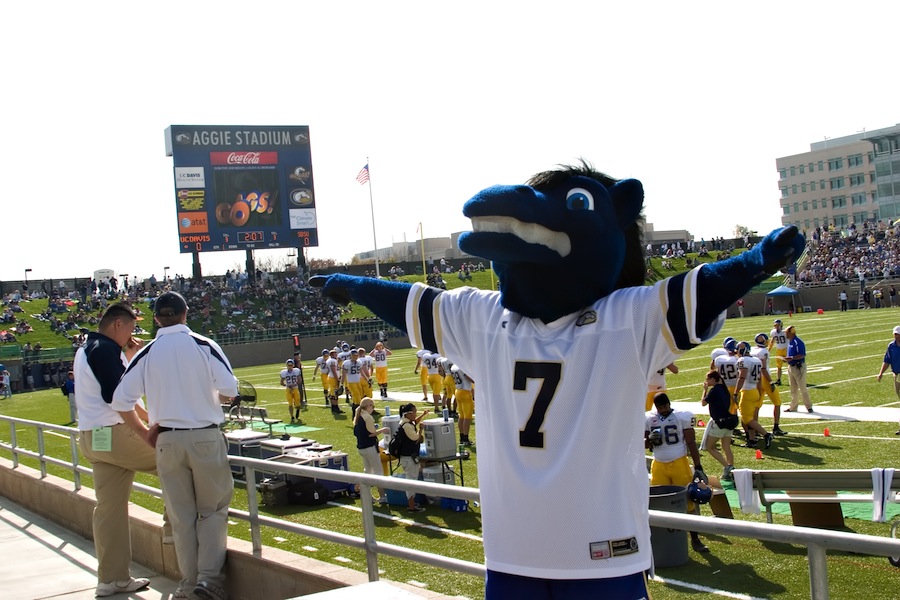
Back in 2008, the Cal Aggie Alumni Association collaborated with ASUCD to create a list of the most quintessentially UC Davis activities, which can be conveniently found online or on the mobile app, “Aggie Traditions.” Once all 50 traditions are completed — including visiting the Davis Farmers Market, reading a copy of The California Aggie and meeting Gunrock — students are given a medal at commencement to showcase their dedication to the authentic Aggie experience.

“I think so many times we focus on getting the grade, getting the internship, getting through school, paying their way, the kind of stuff where we forget we should be doing great, fun things,” said Carrie Wright, the associate executive director and chief programs officer for the Cal Aggie Alumni Association and a UCD alumna.

One of the most iconic events at UC Davis that makes the list is Picnic Day, the oldest and most popular tradition a student has the opportunity to experience. Not only do students partake in this annual event, but family, alumni and community members have enjoyed this event since 1909.

“Picnic Day is over 100 years old and was basically an open house where families would come and see where their students were going to school,” Wright said. “It’s the largest student-run event on a campus, so that’s clearly one of the most unique and long-lasting of the traditions we have.”

Miller considers Picnic Day the most classic from the list of Aggie Traditions. She attests that spending the day on campus visiting all of the open house exhibits and exploring areas outside of one’s own department is special and connects people to each other in a special way. To Miller, attending Picnic Day is a great representation of Davis culture; attending Picnic Day, in other words, is a rite of passage.

I feel like a tradition is something that has some kind of special connection to it,” Miller said. “Something that after you’ve completed it, you’re now a part of something. Even if it’s as simple as eating lunch in the CoHo or studying at Shields, now you can share that experience with other Aggies who have done the same.”

Indeed, traditions surround UC Davis students. When Thayer was a student, she spent a lot of time in the CoHo, unaware that she was living an Aggie tradition every day of her college experience. As a freshman, visiting the cows by her dorm in Tercero was another effortless check on her own list of accomplished traditions.

“I think some of these are not what we necessarily consider traditions, but it’s something that the students or even a staff member or a faculty member are doing every day that they don’t even know is creating their whole UC Davis experience, whether it be visiting the cows or going to the Rec Pool for a swim or reading the book of the campus book project,” Thayer said. “All of these things that we do everyday […] are actually really cool fun things to do and [are] making your time here at Davis that much more memorable.”

The Aggie Traditions list also includes other signature Davis events like Pajamarino, which has its roots back in 1912, as well as rituals like rubbing or kissing the egghead in front of Shields Library during finals week — which was around when Thayer and Wright were students here in the 1990s and persists today. They can be as big as attending the Whole Earth Festival or as simple as riding Unitrans to campus. No matter the magnitude, all of these activities and customs are considered traditions for important reasons.

“To make something special enough to be considered a tradition, I think it needs to be something relatively unique to UC Davis (like the Pajamarino), something any student can reasonably accomplish, and something that will make the student experience more memorable overall,” Miller said.

Traditions have the capacity to evolve. Pajamarino started as a small gathering of students in their pajamas at the train station in order to greet returning alumni on the eve of Homecoming. Today, though, the event is a full-fledged celebration, complete with student performances and a parade through downtown.

Not only do traditions evolve, but they expand as time moves forward. Thayer and Wright both mentioned the possibility of adding eating Woodstock’s pizza to the list of Aggie Traditions, and Miller believes riding the draft horse wagon around campus would be another great addition. Both of these activities fit Miller’s definition of what makes a good tradition in that they are accessible to students and community members as well as offer a taste of true Davis culture — something that can’t be experienced just anywhere.

        “How [traditions] add to the UC Davis experience is that [they] make a student really appreciate their time on campus,” Thayer said. “If you’re here for four years and studying for four years, […] you want […] to be able to enjoy your time without having to feel like you’re rushing through your four years. I think some of the traditions allow students to be able to do that, […] to have a good, well-rounded experience while you’re on campus and so when you leave campus it gives you that warm and fuzzy good memories of your time here.”

Written by: Marlys Jeane — features@theaggie.org

On the road to a debt-free college experience

HANNAH LEE / AGGIE

California Democrats attempt to lower need for student loans

Democrats in the California State Assembly proposed the “Degrees Not Debt” Scholarship (DNDS) on March 13 during a news conference in Sacramento in response to growing concerns about the increasing number of college students who are graduating with debt.

The proposed scholarship will confront the increased need for college students to take out student loans by “filling the gap” between financial aid the individual is granted and the amount the student and their family is able to contribute.

Additionally, the program appears to not only focus on rising tuition rates, but on the costs of living as well, which include housing, books and transportation.

“When you think about the cost of college, we focus many times, rightfully so, on tuition, but we know it’s much more than tuition,” said assemblymember Kevin McCarty, one of the legislators heading the project, at the press conference in Sacramento. “It’s about the costs of living […] so we’re really going to zero in on that issue in this debt-free program.”

The DNDS will assist both low-income and middle class students by working in tandem with existing financial aid and grant programs (such as Cal Grants and Pell Grants), as well as saving the Middle Class Scholarship, which Governor Jerry Brown proposed to phase out of the budget earlier this year.

Parker Spadaro, a first-year political science major who recently participated in a protest against the upcoming tuition hike, criticized the development of more scholarships, rather than a decrease of tuition itself.

“It distracts us from how education should be an intrinsic right,” Spadaro said via email. “I appreciate scholarships and benefit from them myself, but they make us students compete against other students who may be equally deserving of scholarship money […] There won’t ever be enough money purely through scholarships. That’s especially true if we’re talking about private scholarships because trickle down economics like that don’t work.”

In the first year of its implementation, the estimated cost of DNDS is about $1.6 billion, with the annual cost of the program estimated to be $1.2 billion after it is completely integrated. The high price tag raises red flags for those, like Republican Assemblyman Rocky Chavez, who worry about the strain it puts on the state’s budget.

“I think it’s well intentioned,” said Chavez to the California Political Review and Fox News. “But I don’t think it recognizes the economic reality or really addresses the challenges we have to address […] the real problem is that it takes 5.7 years to get a college degree. The change should be to ensure that students graduate in four years.”

However, some students who are affected by the recently approved tuition increase support the potential scholarship program at it will increase the number of individuals who attend and graduate college, which will be economically beneficial.

“I am for Degrees Not Debt because making college more affordable is a motivator for people who don’t go to college simply because they believe they cannot afford it,” said Ashley Lord, a first-year undeclared physical sciences major, via email. “Having more skilled and educated citizens will eventually benefit the economy so it would be a plan worth investing in.”
Written by: Emily Shintani — campus@theaggie.org

Spring Quad Playlist

ANH-TRAM BUI / AGGIE

After storms, clouds and finals, we’re walking on sunshine and listening to this burning playlist

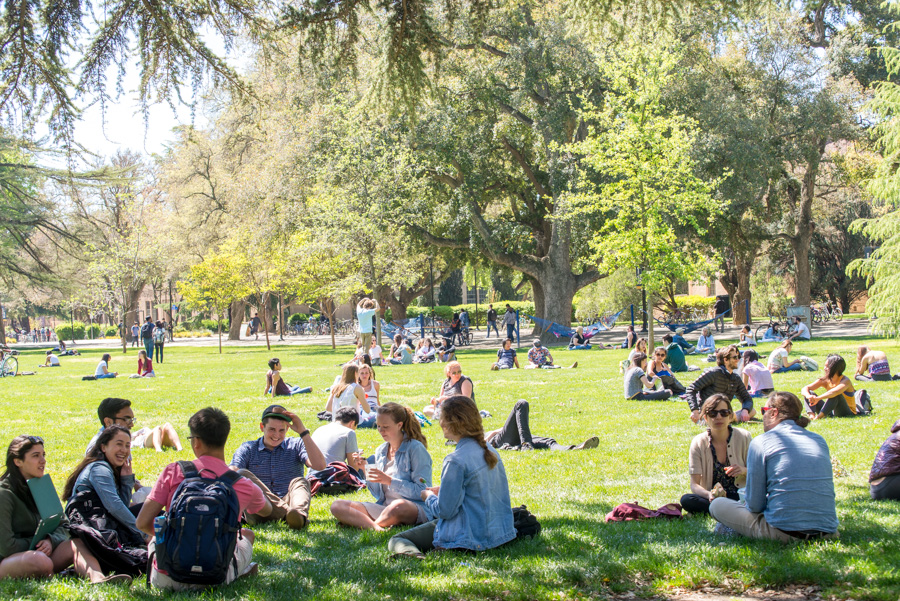
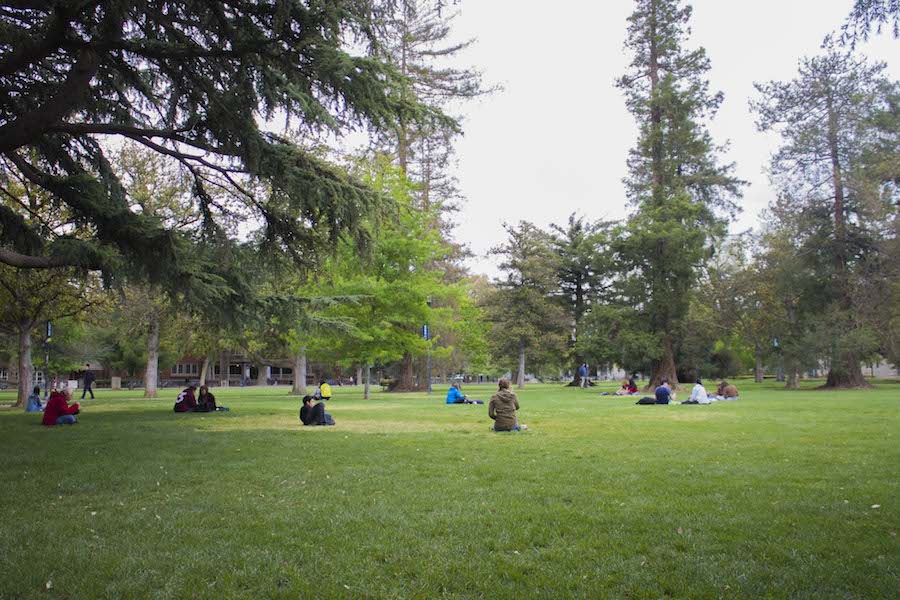
As the wise Katy Perry once said, “after a hurricane, there’s a rainbow.” What better way to celebrate the rainbow that is Spring Quarter than by soaking in the sun on the Quad with a hot playlist?


  • “Paradise Waiting” — Vacationer


The last few weeks of Winter Quarter chaos bring daydreams of the beauty that is Spring Quarter hangout seshes on the quad. Times when all of us can “unwind/don’t worry [our] mind[s].” But no need to worry now because “paradise is waiting for us.”


  • “Hit the Quan” — iLoveMemphis


Now it’s finally here — the sun is out after a quarter of hibernation. It’s time to “hit the [quad].” The bustle of conversation is muted by the serenity of the scene and the calm expressions on everyone’s faces. What better way to complement it than with a trendy dance, song and a sweet pun?


  • “Past Lives” — BØRNS


With the transitional stage of Fall Quarter and the insanity of Winter Quarter, you almost forget the sweet taste of Spring Quarter — your past life of sunshine, happiness and naps under a canopy of trees, squirrels and iconic duck couples. Our almost-forgotten love for the quad during the spring “is deeper than the oceans of waters.”


  •  “Salad Days” — Mac Demarco


There’s something special and nostalgic about the ease of sitting on the grass, bliss and nothingness that make you remember the beauty of youth. Moments of simplicity on the grass are your salad days, moments to remember when older and “just to tell ‘em ‘so long.’” Introspection aside, salads from the neighboring CoHo are scientifically proven to taste better while sitting outside on grass.


  • “Open Your Eyes” — STRFKR


The warmth of the sun seems to have a hypnotic hold on those enjoying the quad. It’s true, it seems harder to get anything done when beautiful weather and friends await you outside. It’s easy to give in, to “let it take me.” It also seems to have a physical hold; sunburns suck.


  • “Ultralight Beam ” —  Kanye West


Feelings about the Quad can only be summarized as such: “an ultralight beam,” “a god dream,” “Hallelujah.” Word.


  • “The Only Place” — Best Coast


It’s clear at this point: springtime on the quad is one of the best things about Davis — it’s “the only place for me.”
Written by: Caroline Rutten — arts@theaggie.org

Tea 4 U: the newest addition to the Davis boba scene

JAY GELVEZON / AGGIE

Popular boba tea chain brings newest store to downtown Davis

In a town like Davis, there can never be too many boba places. For many Aggies, bubble tea is a staple drink. The craze for boba stems not only from its deliciousness, but also from the social atmosphere that comes along with the boba-going experience. In a small town, sometimes all there is to do is go out with friends to get some milk tea. For this reason, I believe that Tea 4 U (T4), Davis’ newest addition to the boba scene, will fit in perfectly among its fellow tea houses.   

“I was so happy when I found out a T4 was opening up in Davis,” said Annika Sabaratnam, a first-year global disease biology major. “There’s one in my hometown, and I love it.”

JAY GELVEZON / AGGIE

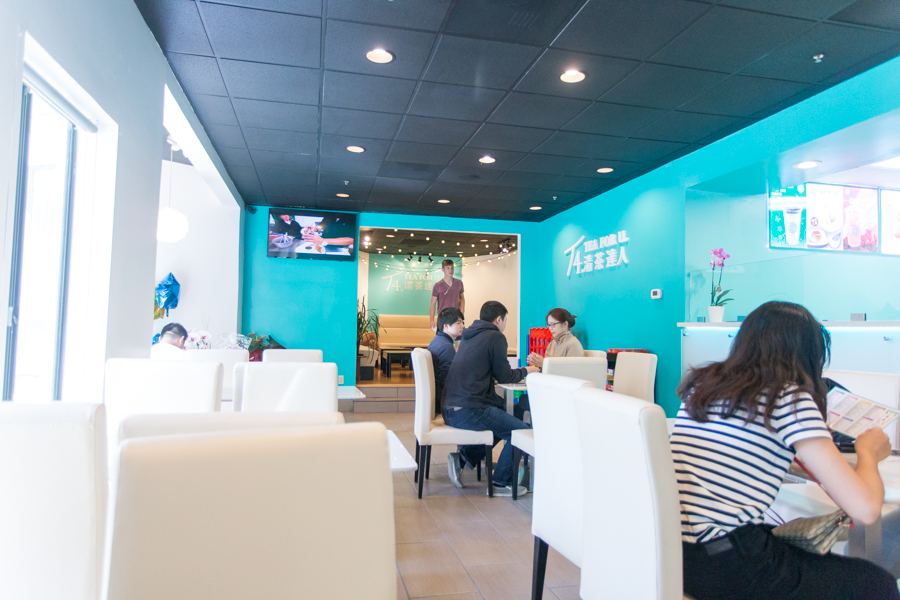
With its official grand opening on April 2, T4 has already been slammed with business throughout their soft opening in the last weeks of March. I visited on a Friday afternoon, and to my surprise, there was a line nearly out the door. However, service was quick and efficient, and I didn’t find myself waiting very long to order. At first glance, I noticed that the place was extremely spacious with plenty of available seating, despite the large crowd that was forming in the store. Customers sat in the comfortable lounging areas surrounded by bright turquoise walls, sipping on their bubble tea and playing the variety of board games provided by T4.

By the time it was my turn to order, workers and customers alike were bustling about. On the wall, there was a poster listing all the popular drink recommendations, and with these in mind, I elected to try the Mango Royal Tea with lychee coconut jelly. As a self-proclaimed boba connoisseur, I have to say that the drink was pretty tasty. The tea was the perfect amount of sweetness, and the ratio of tea to toppings within the cup was just the right amount. At T4, they allow you to adjust the level of sweetness in your drink to your own tastes, which was extremely helpful. They also offer an assortment of different snacks and finger foods, in addition to their drink menu. In comparison to other boba joints in Davis, I’ll definitely be adding T4 to my list. With its high-quality tea and convenient location right in downtown Davis, it’s no surprise that Tea 4 U is already booming with business.

T4 is located at 132 E St. and is open from noon to 10 p.m.


Written by: Sydney Odman — arts@theaggie.org

Spring break adventures in pictures

Take a look into what The California Aggie’s Photo Desk was up to this spring break


An original British telephone booth from the set of Sherlock Holmes, found at Universal Studios Hollywood. (CIERA PASTUREL)
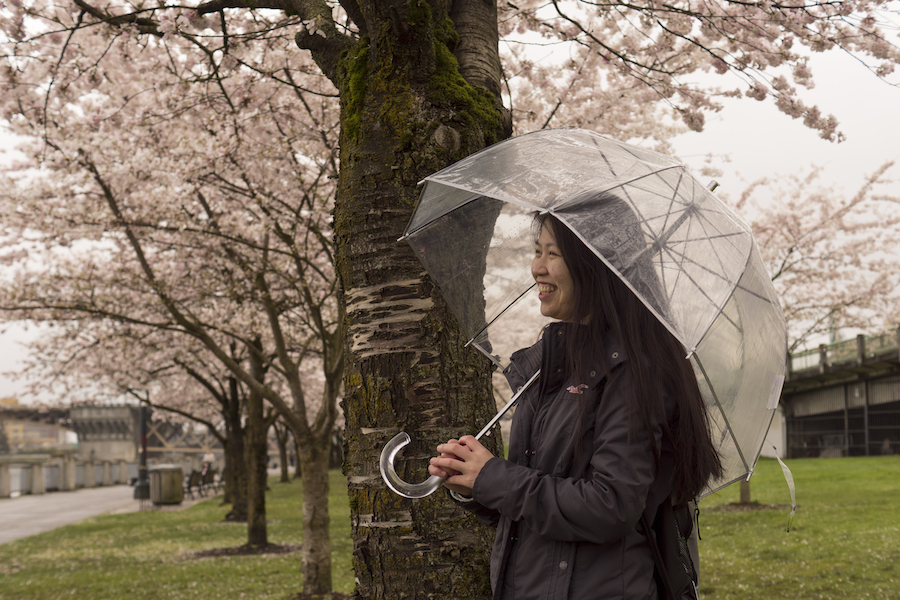
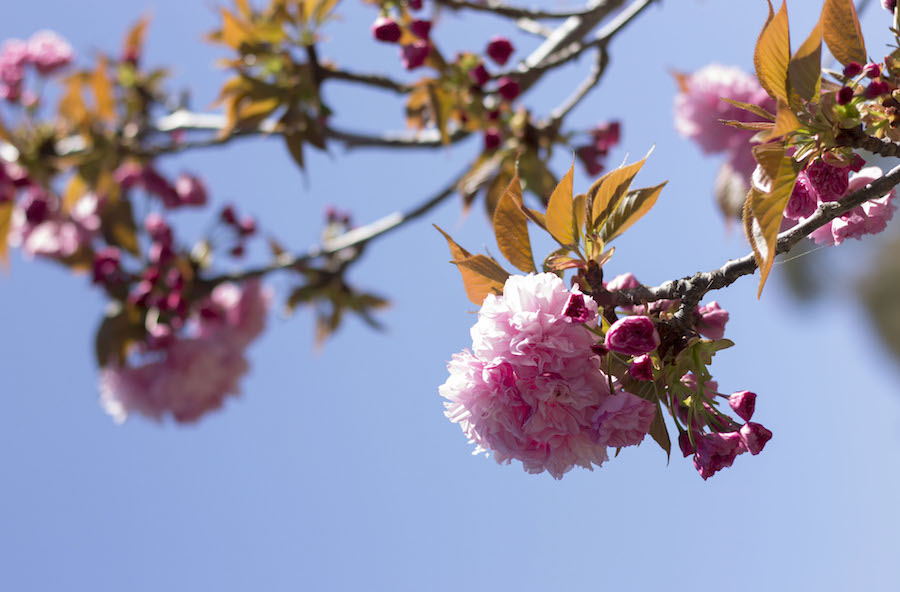
I spent the majority of Spring Break road-tripping from L.A. to Seattle with my friend. This was taken beneath the Cherry Blossom trees at the Lan Su Chinese Garden in Portland, OR. (BRIANA NGO)
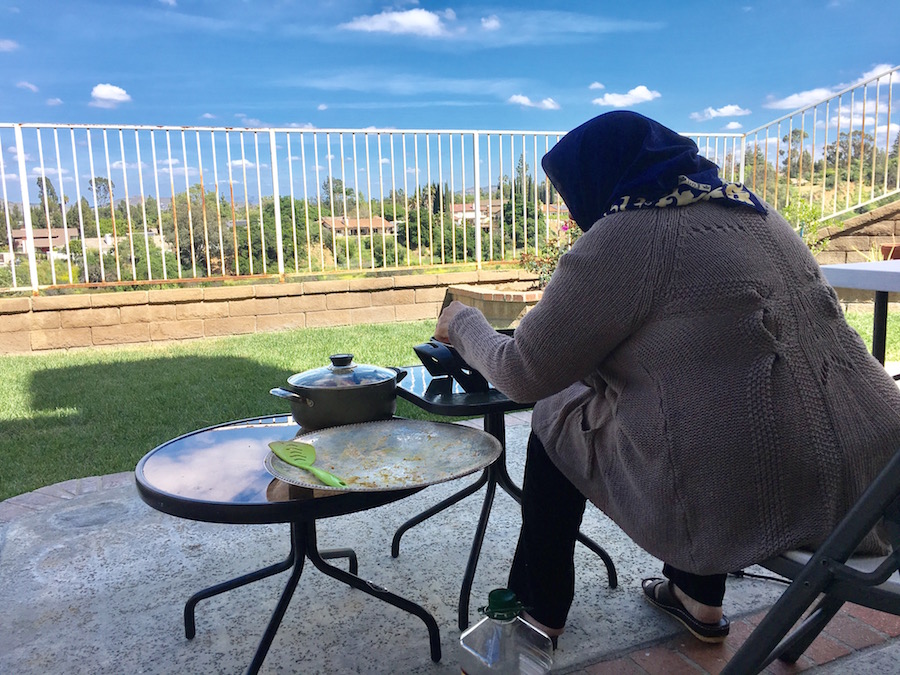
Spring break fell on the week of the Persian New Year, so I was able to enjoy spending time with my family and eating my grandmother’s delicious food, which included a traditional dish of rice and fish. (VENOOS MOSHAYEDI)
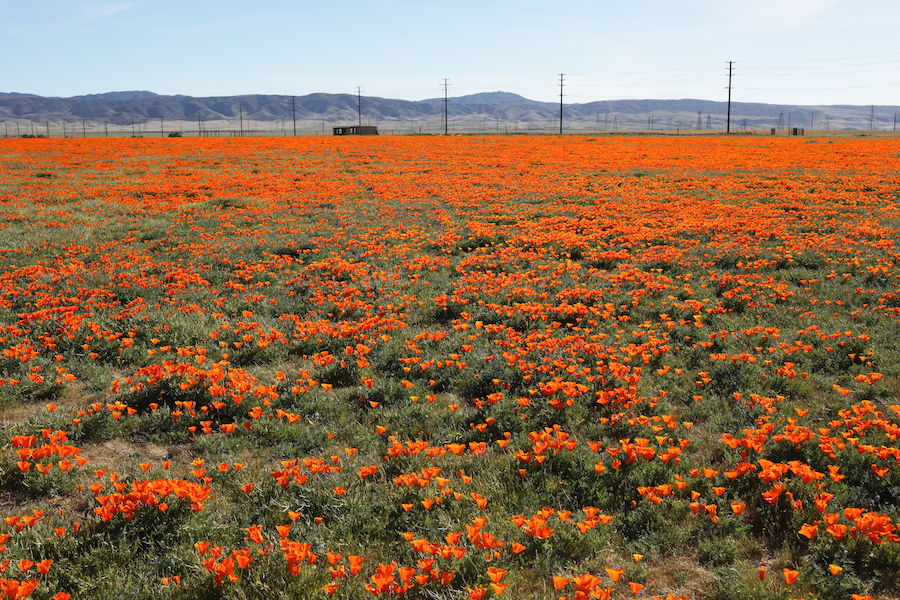
I finally got the chance to see the Poppy Fields in the Antelope Valley in person. (ZOË REINHARDT)
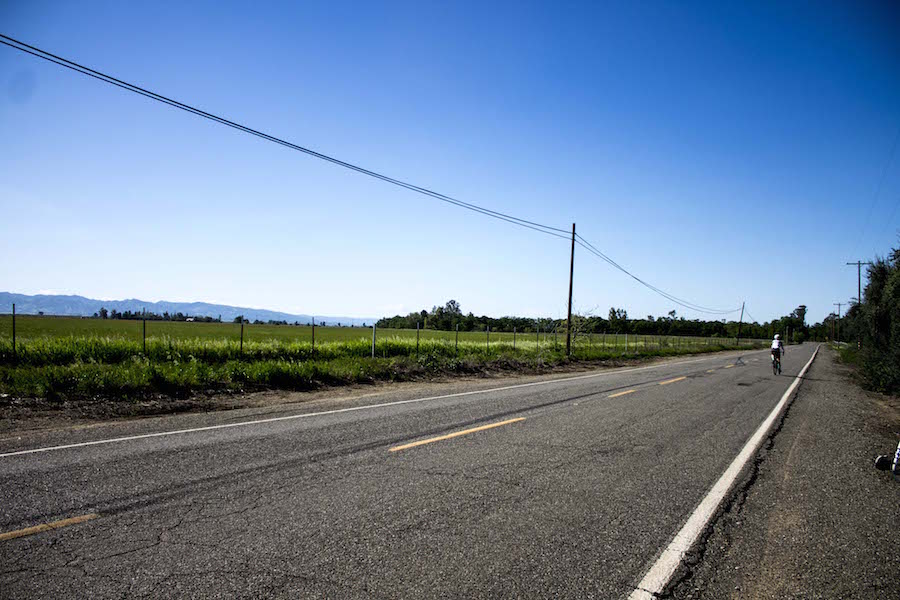
Spent break exploring the parts of my hometown I’d long forgotten. I’m thankful that this past rainy season brought so much life and color back into the world. (REBECCA RIDGE)
I got to experience OUE Skyspace with my family in Los Angeles. This is the memorable view from the 70th floor of the U.S. Bank Tower. (SAHAR FOROUZANFAR)
Spent a lot of time outdoors thanks to my dog and the perfect weather we’ve been having. (MEENA RUGH)
Celebrated my anniversary with dinner, gifts and a trip to the drive-in theater. (ANH-TRAM BUI)
Light show on Highway 113. (NICHOLAS CHAN)
My goal this break was to spend as much time outside as possible to counteract how much time I spend inside studying during the quarter. It went well. (LUCY KNOWLES)
Had a blast with my little cousin and family at the beach, despite my broken ankle. (LAURA LONG)
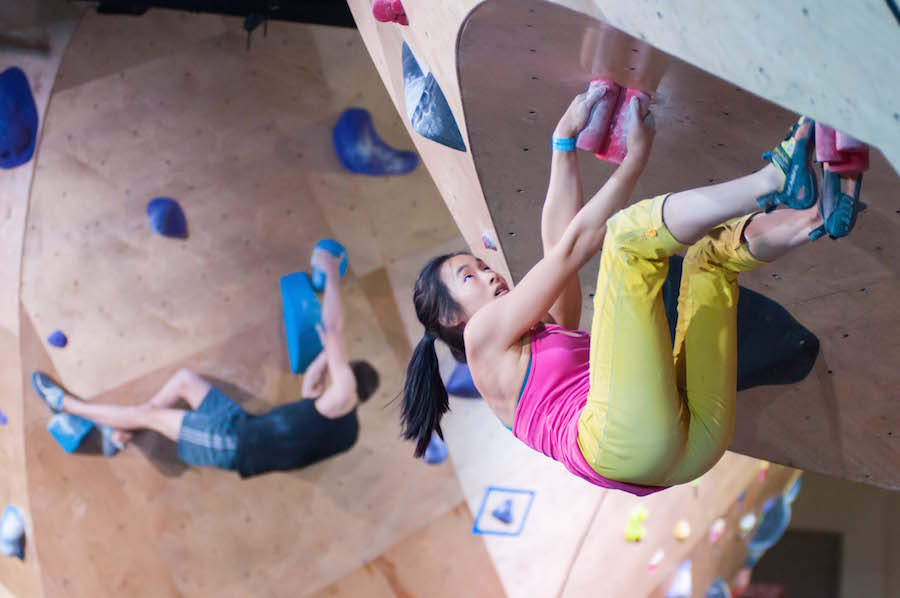
Final round competitors hang onto quality for the U.S. Collegiate Climbing Series National Championship. (IAN JONES)
When you walk around L.A., you’ll find that it’s a host to an abundance of stunning artwork. (DIANA LI)
Sunrise at home in the Foothills. (NICOLE WASHINGTON)
A leisurely drive down the California coast brought peace, pastrami and pictures. Here is Point Lobos. (CAT TAYLOR)
I missed the beaches of SoCal. (BRIAN LANDRY)
Tri-State trip to Iowa, Wisconsin and finishing with the Mall of America in Minnesota. (FARAH FARJOOD)
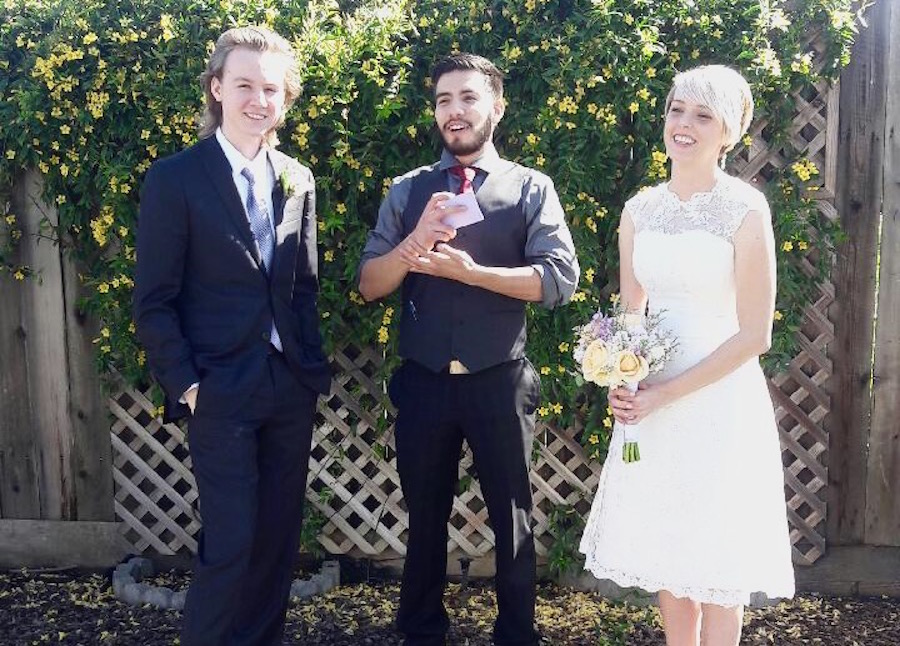
I got married on March 28! (TAYLOR RUNNELLS)
For this spring break, my friend recently launched his own t-shirt design. My friends and I had a photoshoot to promote his shirts! (ALEXA FONTANILLA)
Midwest cows. (CHELBERT DAI)

Compiled by: The California Aggie Photo Desk — photo@theaggie.org

Guest: A movement to dissolve a language barrier

Students with family members who speak different languages understand the difficulty of surmounting the language barrier and mastering a second or even third language. As a second generation Vietnamese American, I understand the tragedy of failing to properly articulate a second language spoken by most of my family and community. My negligence in practicing my native language has taken its toll, cutting me off from communication with a huge Vietnamese population in California, and it’s unlikely that I will be able to pass on the language to my children — creating yet another barrier between generations. These issues emphasize the importance of language courses that not only provide communication, but also a deeper understanding of  another culture’s history.

Like other schools in California, UC Davis provides useful resources, including plentiful language courses. Despite the fact that Asian Americans comprise 36.9 percent of the school population — with Vietnamese being the second-largest denomination in that group — UC Davis still does not offer Vietnamese language courses. Though UC Davis is a research institution with international affiliates, we lag behind other California universities and colleges such as UC Berkeley, UC Irvine, Stanford, De Anza College and Evergreen Valley College, which already offer Vietnamese language courses.

UC Davis has a department in Asian American studies and language courses in Arabic, Hebrew, Persian and Chinese (to name a few). It is appalling that Vietnamese is not on the list. Aside from being able to understand Vietnamese culture and history on a deeper level, learning the Vietnamese language has many practical uses, such as preparing students for the international professional workforce and providing opportunities to expand community development or interdisciplinary experiences.

Vietnam, with a population of 94 million, is the fastest-growing economy in Southeast Asia. As of early January 2017, Vietnam holds an economic growth rate of above 6 percent while the rest of Asia’s economy is slowing down. California, with one of the top 10 largest economies in the world, is also the state with the largest Vietnamese population outside of Vietnam.

As of 2014, 40 percent of Vietnamese immigrants reside in California. California is dotted with thriving “Little Saigon” enclaves that operate bilingually and host businesses still owned by first-generation Vietnamese immigrants. There are also dozens of study abroad programs based in Vietnam, such as Project Vietnam (a medical mission) and other various internships. As a result, educating our students in the Vietnamese language is a skill that can benefit them in their careers locally, nationally and internationally.

There have already been dozens of efforts by various students and faculty to establish Vietnamese language courses at UC Davis. Today, the student-led Vietnamese Language Movement (VLM) at UC Davis, supported by Professor Kieu Linh Valverde, is working towards this goal and is determined to finally reach it. As the movement reaches out to students, many professors from other colleges and universities have voiced their willingness to pledge their support. There is currently a Change.org petition in which you can pledge your support to this movement. In the future, the letters of support and petition signatures will be used to propose to our administrative leaders that Vietnamese courses are needed at UC Davis and will benefit not only our students, but the quality of our school.

As students of an esteemed university, we deserve to push the university to provide us with resources and opportunities we would like them to offer. As students with families from different places, it’s important for us to remember where we came from. Though we might not all have interest in speaking the Vietnamese language, it is without a doubt that the language is important in its own right and should be preserved for future generations.

For more information about the student-led Vietnamese Language Movement at UC Davis, please visit the Facebook page.

Written by: Michelle Nguyen

Disclaimer: The views and opinions expressed by individual columnists belong to the columnists alone and do not necessarily indicate the views and opinions held by The California Aggie.

Humor: How to make ambitious plans for your quarter and then throw them in the fire

LUCY KNOWLES / AGGIE

Making the most out of your self-destructive habits

Look, we all want to be the best version of ourselves and make our greatest ambitions a reality. But let’s face it: We’re all hot garbage and we probably won’t. However, there’s a way to trick yourself into thinking that you’re going to absolutely kill Spring Quarter, at least in the beginning, so that you can sleep easily despite your lack of effort.

First and foremost, you’ve got to start off the quarter by being involved and active — two words that no one has ever used to describe you. What you ought to do is just buy a stamp with your name, school email and phone number, and just run around during the Club Fair, signing up for quite literally everything in sight. Pre-med club? You’re down. Rowing club? You’re down. Medieval underwater basket weaving with inner-city kids club? You’re the next treasurer of it. Wait until your email is filled to the absolute brim with invites to first meetings, sign-ups for events and all that jazz. Next, star the ones that interest you, so you can weed out the duds. Finally, take your entire Gmail account and throw it into the flames. You’re not doing any of those clubs, you damn liar.

Even though you’re clearly not doing any clubs, you’ll still need to stay organized when it comes to class, studying, work, exercise and basic hygiene, so you’ll need a planner. Ideally, you’ll go to Target and pick out the most expensive one. This is important because you’ll want to feel even guiltier (both morally and financially) when you stop using it after the first three weeks of class. In fact, you’ll also want to splurge on colorful gel pens so you can “color code” your schedule. This is Latin for “an adorable attempt to pretend that this will make you actually work out after class, you lazy sack of lard.” Eventually, you’ll lose these pens in the bottom of your backpack, alongside your dignity and will to live.

Another great habit to start: Study at least two weeks before any major test in your classes. This will be extremely helpful because it will give you time to go to office hours and ask questions on course material you find confusing. But wait: The test is two weeks away —- you can totally go out with your friends instead, just this once. I mean, what’s really going to happen? You still have thirteen days left. Whoops! It’s the day before the test and guess what? You haven’t even unwrapped your textbook from that shameful plastic packing. Way to go, champ!

Lastly, you’ll want to really pick out which friends you want to spend time with this quarter. This is really important because you’ll want someone super special to be there to find you dead, underneath a stack of notes. This is fine because you already dug your own grave with your choices throughout the quarter. Good luck!


Written by: Olivia Luchini — ocluchini@ucdavis.edu

(This article is humor and/or satire, and its content is purely fictional. The story and the names of “sources” are fictionalized.)

Humor: CoHo pastry has vivid dream of life on the other side of glass

Life can get lonely as a pastry at the CoHo, especially if you’re not a cinnamon roll or chocolate-filled croissant. Pastries can’t help but imagine a better life — one in which they aren’t trapped behind a pane of glass, but living out their wildest fantasies.

“In my dreams, I’m either an astronaut or a scuba diver. Or both,” said a CoHo scone, who once appeared in a television ad for an erectile dysfunction medication that took place in a small-town bakery. “But instead I’m stuck back here. Nobody wants an unfrosted scone unless it’s the last option. Frosting is all the rage these days.”

As it turns out, scones aren’t the only ones that feel like they are not reaching their full potential as CoHo pastries.

“I see the way people look at the cinnamon rolls,” said an ecstasy bar, whatever that is. “Nobody ever looks at me like that. Is it because I don’t have curves like a cinnamon roll? Or is it because people just don’t know what I actually am? Because sometimes I’m not even sure who I really am. So if they could let me know when they find out that would be great. I have so much time while I’m waiting to be bought to just stare at myself in the glass. But it’s like, the more that I stare, the less I recognize the pastry staring back at me. Spooky.”

The pastry continued its disturbing ramblings by talking about what it desires in the future.

“I’d love to see the world,” the bar continued. “There’s so much out there. I’d love to see ‘UC Davis Memes for Edgey Teens,’ whatever that is. All I really know is that it makes people really happy. I’m constantly hearing students in line talk about it. It must be beautiful. I’d also love to get a chance to finally go to Whole Foods.”


Written by: Brian Landry — bjlandry@ucdavis.edu

(This article is humor and/or satire, and its content is purely fictional. The story and the names of “sources” are fictionalized.)

Sudwerk Brewery, Bakuhatsu Taiko Dan host Cherry Blossom Festival

ASHLEY LUGO / AGGIE

Celebrate the arrival of spring with activities, food, beer

When UC Davis’ Anthropology Museum coworkers Greg Wada and Kathleen Brandl grabbed a beer to bounce event ideas off each other, they knew that they’d struck gold with their brainchild — bringing the traditional Japanese Cherry Blossom Festival to Davis and hosting it at Sudwerk Brewery. Brandl is the dock store manager at Sudwerk Brewing Co., and Wada is a first-year anthropology graduate student who has been involved in the Japanese percussion art form of taiko for five years, which made this partnership a match made in heaven.

“We got together and thought that it would an awesome idea if we did this, because we’re both passionate about the work we do,” Wada said. “But the greater impact of this — at least for me as an artist and a person of color — is the diversity of the American experience and highlighting that through a festival where you get to experience different cultures just coming together and enjoying each other’s company.”

Sudwerk held the first Davis cherry blossom festival last year.

“We are trying to make it even bigger and better this year,” Brandl noted.

This year’s festival will feature a variety of performances, exhibits, game booths and food vendors. There will be exciting Taiko performances by UC Davis’ own Bakuhatsu Taiko Dan group, UC Berkeley’s Cal Raijin Taiko, Stanford Taiko and Jiten Taiko as well as a mini taiko lesson for the community. Local percussive finger style guitarist katgrüvs will be providing background instrumentation for Ikebana International, which will be demonstrating the Japanese art of flower arrangement, and the Anthropology museum will host an exhibit of Japanese artifacts.

There are many more activities and performances throughout the day as well as a variety of food options. Sacramento’s Roaming Spoon will have vegan eats, Koizora will offer a more traditional Japanese sushi experience and Puros Churros will be offering some sweet desserts. And of course — who could forget the beer?

Those who are 21 and older have Sudwerk’s two specialty beers to get excited about. Last year, Brendl helped brew a seasonal Sakura beer — which sold out in less than two hours — and she will be brewing this beer again, along with a special plum beer. With both cherries and plums being symbolic in the celebration of spring in Japan, these beers will help tie the whole festival together.

The Cherry Blossom Festival is a wonderful opportunity for the community to experience multicultural activities and to celebrate diversity in the Davis community. Janice Yamaoka Luszczak, who is a member of the Japanese American Citizens League, a civil rights and cultural organization, will be tabling at the festival and ready to answer any questions in hopes of fostering an open dialogue. She is concerned with the recent string of events concerning minorities and immigration, referencing the inhumane internment of Japanese Americans during World War II.

“We’ve been trying to get more and more involved in terms of some of the things going on with the national issues that have been coming up recently and doing what we can to support other organizations and communities that might be threatened,” Luszczak said. “Our organization has been more of a cultural rather than a political organization, but I think the time is right to be changing that as much as we can because the more people that speak out for people who are being targeted, the better.”

Wada expressed a similar opinion.

“Genuine human interaction is an important part of the process to overcome social prejudice, and the broader impact of it is this: can we get people together to have fun and witness parts of different cultures that they haven’t experienced before,” Wada said.

So for those who’d like to start the new quarter by celebrating the arrival of spring in the traditional Japanese spirit and appreciating the diversity of the Davis community, stop by Sudwerk’s free Cherry Blossom Festival event on Saturday, April 8  from 2 to 8 p.m. to enjoy various activities, performances, food and beer! For more information, check out the event page.


Written by: Pari Sagafi — arts@theaggie.org

Assisting students in need

NICKI PADAR / AGGIE FILE30

Different resources help struggling Aggies stay in school

Deborah Agee, the director of the UC Davis Financial Aid Office, took out loans in order to earn her undergraduate degree. Since then, Agee has spent her career paying forward the help she received.

“I certainly think it’s incredibly important for a land-grant institution such as ours to invest in the larger community,” Agee said. “It makes the world better for all of us.”

Students who take out loans, like Agee, may find themselves in a position in which they run out of funds at the end of each quarter. At UC Davis, a number of resources and organizations, including the Financial Aid Office, exist specifically for the purpose of providing assistance to students who are food-insecure or in need of financial support.

“The first thing we’re going to do with a student who comes in and tells us that they are struggling is […] to look at their whole package and see […] what the issues that they’re facing are,” Agee said. “If we can understand that more specifically, then we might be able to identify resources or other aid that the student may not have considered previously.”

75 percent of students at UC Davis receive some form of financial aid and 43 percent of students at UC Davis receive money from Pell Grants. Although the Financial Aid Office does not provide resources specifically for homeless students or students without primary incomes, Agee urges that such students seek university jobs and not hesitate to take loans. She also advises all students to fill out their Free Application for Federal Student Aid (FAFSA).

“I have heard, anecdotally, that there are students who don’t take their loans and instead struggle,” Agee said. “The student loans are an investment in yourself. The small amount of student loans that you would have to take to get yourself through your undergraduate education [compared to] what you get out of a UC Davis degree is just tremendous. Go ahead and take the student loans.”

One organization on campus which provides financial assistance to students in need is We Are Aggie Pride (WAAP). According to Karla Timbang, a fourth-year psychology and communication major and the WAAP program director, the organization has been a student-run and largely student-funded resource for undergraduate students since 2012.

“Since it’s started, we were able to help over 80 students stay in school and finish college,” Timbang said. “We don’t have a budget [or] limit. If we awarded five students this quarter, it doesn’t mean we have to cut it off if a student comes and they need help.”

Students who receive help from WAAP must be fully-registered UC Davis students, must have exhausted all financial resources — including any possible loans — and must have a FAFSA on file. Though WAAP’s slogan is ‘Students Helping Students,’ the organization also receives donations from faculty and alumni including the UC Davis Foundation. Bruce Bell, a 1985 economics graduate and chairman of the foundation, said the board of the foundation decided to partner with WAAP. Together, the two groups raised $110,000.

“When you talk about funds for people in critical need, that is exactly what […WAAP provides],” Bell said. “We [helped] establish a $110,000 fund for We Are Aggie Pride that they’re wanting to use as […] the start of an endowment so it becomes a reusable [source] as opposed to a fundraiser.”

The UC Davis Foundation has in the past few years raised $1 million — which was then matched by an outside source — to create a fund for student scholarships.

“We’re looking, as a board, to find ways to involve ourselves directly with the students as opposed to just […] fundraising for some big project,” Bell said. “We find that involving ourselves in these types of projects is more fulfilling for us because you know that you’re helping someone stay in school and continue their education — which is obviously something that’s important to them and important to us.”

The UC Davis Food Pantry is visited by approximately 100 students every day who may identify as food-insecure, according to Rosa Maria Martinez, the organization’s director of external affairs. Martinez, a third-year human development major, said her parents struggled with food insecurity after arriving in the United States, so providing assistance to those who are in need of food is an issue of personal importance to her.

I want to ensure a student’s pursuit of higher education is not hindered by their financial burden,” Martinez said. “A student should not be consumed by thoughts of where they sleep tonight, where their next meal comes from and making a choice between rent, tuition and basic needs. Basic needs are not the second choice.”

The Pantry has instituted a point system to divide and distribute the resources amongst students. Students who use the Pantry may do so with confidentiality and anonymity.

“The Pantry provides a service free of judgment — everyone is welcomed with open arms,” Martinez said. “We also provide fresh produce every weekday in the early afternoons and have a Calfresh — […] food stamp — representative that helps students fill out the application [which] can [help students] receive up to $194 a month to pay for groceries. On a monthly basis, we provide students with ten points worth of food through our Emergency Food Assistance Program.”

About 3,300 students utilize the Pantry in an academic year and, in the two years Timbang has worked at WAAP, 12 students have met the criteria and received financial support. However, Agee said the Financial Aid Office only encounters one to two students a year who are in need of immediate assistance.

“We’re here to counsel students,” Agee said. “I just want to say: we’re not scary, we do care about you and we will help you. You shouldn’t be afraid to come to us if you’re really in trouble because we can help.”

Because college is not free and will likely remain costly, at least for the foreseeable future, students like Timbang see the continued need for additional assistance.

“In a perfect world, We Are Aggie Pride shouldn’t exist,” Timbang said. “The university should be able to […] help out. I think it’s important that the university help these students because education is really important. It shouldn’t be about […] money, it should be about educating future leaders.”

Written by: Hannah Holzer – features@theaggie.org

Board of Regents holds March meeting

AUDREY McNAMARA / THE DAILY CALIFORNIAN / COURTESY

Regents approve new UC Berkeley chancellor, discuss nonresident enrollment cap, divest from fossil fuels

The University of California (UC) Regents held a board meeting on March 16, during which they appointed Carol Christ as UC Berkeley’s new chancellor and discussed a 20 percent enrollment cap on non-California residents and foreign exchange students.

Christ will oversee UC Berkeley’s 27,000 undergraduates and 10,000 graduate students. During the remarks leading up to the vote, Napolitano spoke of why she had selected Christ.

“I strongly believe that Carol Christ will make an excellent chancellor for UC Berkeley,” Napolitano said. “She has a compelling vision for Berkeley’s future, a demonstrated record of accomplishment and the trust of students, faculty, staff, alumni and the other members of Berkeley’s community. I urge you to support her appointment.”

Christ’s annual salary will be $531,939, set by the Regents as a continuation of the current chancellor Nicholas Dirks’ salary.

Christ was unanimously voted as Berkeley’s new chancellor.

“I am deeply honored that the president and the regents have chosen me to lead Berkeley at this critical moment in its history,” Christ said. “I’m even more honored to serve the campus that I love. I’ve been asking myself what Berkeley has meant and continues to mean to me. I arrived to Berkeley in 1970.”

Napolitano spoke about Christ’s established history at UC Berkeley, complementing her leadership and administrative skills.

“In January of 2015, Dr. Christ returned to campus as director for center of studies for higher education,” Napolitano said. “May of last year, she agreed to take up her former role as executive vice chancellor and provost on an interim basis. In every position she held at Berkeley, she left the entity better off.”

In 1970, Christ became a faculty member of UC Berkeley and also served as the chair of the English Department from 1985 to 1988. She became dean of humanities, mathematic and natural sciences in 1986 and was appointed provost and dean of the College of Letters and Sciences. The highest-ranking female administrator member at UC Berkeley, Christ served as vice chancellor, assistant manager and continuing provost at UC Berkeley until this latest position.

Napolitano said that Christ has been an integral part of Berkeley’s success and will help the school continue to grow.

“Dr. Christ has a way with making things better,” Napolitano said. “She builds strong relationships, and trust, with diverse groups and diverse individuals, and then forms consensus and finds solutions. In challenges, she uncovers opportunities and improves upon them. I believe she is the right person to lead what is widely regarded as the best public research university in the world. It also helps that she loves the place, and the faculty, students, staff, alumni and community who make Berkeley what it is: rightly famous.”

In addition to the appointment of Berkeley’s new chancellor, Regent Sherry Lansing said that she is interested in the “assembly of a debt-free college education which would include more than just tuition,” and that the Regents should support this step.

“We want to be very strong advocates of this legislation once it’s finally proposed,” Lansing said.

On March 15, the Regents held an Investment Subcommittee meeting to announce a further $150 million fossil fuel divestment.  

Companies being divested from include the Sunoco and Energy Transfer Partners, businesses involved in building the Dakota Access Pipeline. UC has also divested from companies earlier this year, including $450 million from Wells Fargo and $200 million from coal and tar sands resources.

Laretta Johnson, a first-year student at UC Santa Cruz, demanded that the UC fully divest from fossil fuel businesses.

“The UC refuses to take a firm stand, in essence backing the status quo, and acting as though we are not in a time of deep political and climate crisis,” Johnson said in an interview with Fossil Free UC. “This situation demands action, and real leadership requires they make the decision to fully divest from fossil fuels and truly stand with us.”

The board also discussed a possible 20 percent cap on non-California residents, which would affect out-of-state and foreign exchange students. Some regents mentioned how tuition and housing payment from out-of-state students help fund the UC system, while others were concerned about resources.

Some students have mixed feelings about the results from recent Regents board meetings. Dinar Kurji, a second-year religious studies major at UC Davis, questioned the potential cap on non-California residents, as it could encroach on foreign exchange students.

“I’m glad UC Berkeley has a new chancellor,” Kurj said. “Regarding the non-resident cap, it’s bad to restrict foreign exchange students.”


Written by: Aaron Liss — campus@theaggie.org


Support sexual assault survivors

HANNAH LEE / AGGIE

How to get the most out of Sexual Assault Awareness Month

As part of April’s Sexual Assault Awareness Month, UC Davis organizations are hosting various on-campus events to raise awareness of sexual assault and harassment, provide survivors with safe spaces where they can learn about available resources and give students the opportunity to show their support for survivors of sexual assault.

Sexual assault is incredibly prevalent within the University of California (UC) system. Just last month, The Daily Californian reported that at least 124 UC employees have been accused of sexual harassment and violence since 2013. UC Regent Norman Pattiz was accused last year of sexual harassment.

However, the UC system has recently taken strides toward preventing sexual violence and harassment. As a result of Pattiz’s sexual harassment, the UC Board of Regents implemented a policy that requires regents to undergo sexual harassment prevention training. The UC also hired its first-ever Title IX coordinator, whose role is to work against sexual harassment and violence among the 10 UC campuses.

UC Davis students are also working toward ending sexual violence and harassment. Several ASUCD senate candidates ran on sexual assault prevention and awareness platforms this year. For example, ASUCD Senator Anastasia Ruttkay, who was elected during Fall Quarter, is working to create a sexual assault prevention chairperson in UC Davis Greek chapter houses.

The Editorial Board applauds these efforts but recognizes that more work regarding sexual assault prevention and awareness must be done.

The Editorial Board also encourages students to publicly support survivors of sexual assault or sexual harassment. Interested students can participate in a number of activities, such as the Dear Survivor Photo Project, in which individuals can write letters to survivors they personally know or survivors of the campus community as a whole. The Center for Advocacy Resources and Education (CARE) is hosting numerous events this month as well, such as Take Back the Night, which, according to the Facebook event page, is “an annual event that aims to support survivors of sexual violence, raise awareness and promote action within our community to end sexual and gender-based violence.” Showing support for sexual violence or harassment survivors can even be as easy as wearing jeans on Denim Day or attending the Sexual Assault Awareness & Advocacy Committee’s screening of The Hunting Ground, a documentary about rape culture on college campuses, on April 13 in the Sciences Lecture Hall at 7:30 p.m.

The Editorial Board urges students who need support to utilize on-campus resources, such as the Sexual Violence Prevention and Response website, CARE, the Harassment and Discrimination Assistance and Prevention Program, the Office of Student Support and Judicial Affairs and the UC Davis Police Department.

Remember, this month was designed to give a voice to those who have been silenced. If you or someone you know is a survivor of sexual violence or harassment, you deserve to be heard.

Spring Quarter’s no vacation for track and field

LUCY KNOWLES / AGGIE FILE

April looks busy for UC Davis track and field team

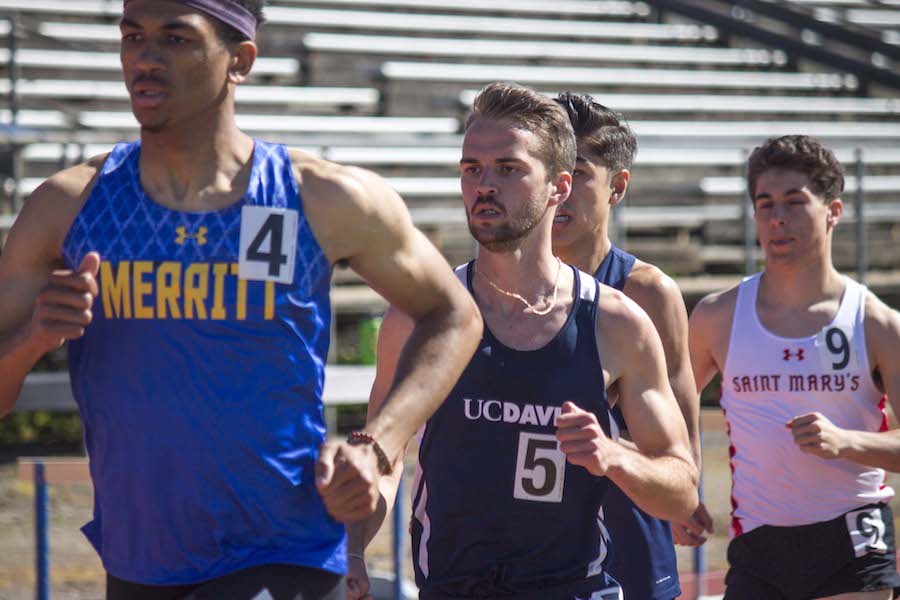
Spring has finally arrived, and at UC Davis the turning of the season brings with it the most competitive meets of the Aggies’ track and field schedule. With several meets already under their belt this season, the Aggies look to utilize this early competition experience to fuel success in coming matches.

The Aggie Open — UC Davis’ first home meet, which took place back on March 11 — was a definitive success for the team. Both the UC Davis men’s and women’s teams won their respective competitions, defeating the likes of Sacramento State, Saint Mary’s and Nevada. Standout performances came from all over the event schedule. Three Aggies earned top-four finishes in the women’s 100 meter, led by sophomore sprinter Natsumi McGee, who finished first. The women also saw success in the field events, as UC Davis athletes finished first in pole vault, triple jump, hammer throw and discus throw. For the men, junior sprinter Brian Thomas carried the day, with first-place finishes in both the 200 meter and 400 meter runs.

Experience is something that the team does not lack — 27 of the team’s 86 athletes are seniors, and plenty of them are stars. The senior sister tandem of Rianna and Olivia Goins have been successful in their distance events so far this season: Rianna was named Big West Conference Women’s Track Athlete of the Week on March 14 and Olivia placed first in her section of the 3,000 meter steeplechase at San Francisco State on Friday, March 31. For the men, seniors Jordan Rushing and Nick Ratto have been especially impressive. Both Rushing and Ratto placed in the top 10 of their respected long-distance events at the first day of the Stanford Invitational this past Friday, and Rushing finished first in the 2,000 meter steeplechase at the Aggie Open last month.

Make no mistake: the Aggies possess a wealth of young talent as well. A contingent of UC Davis athletes competed at Las Vegas on March 18, when freshman star sprinter Kierra Davis showed off her athleticism in the 200 meter and 100 meter runs, in which she currently ranks third and fifth in the conference, respectively. Junior sprinter Emma Redick also had an impressive showing in Las Vegas, where her time in the 400 meter hurdles placed her at the top of the conference in that event.

The season’s pace has continued to accelerate. Last weekend, the Aggies faced grueling competition from athletes all over the country in three separate events located in the Bay Area and in Sacramento. A fairly quick turnaround will have the Aggies travel out to the desert to compete in the Mesa Classic and the Sun Angel Classic at Arizona State, beginning Friday. From here, the Aggies will have several other key meets in the month of April, including the Woody Wilson Classic on April 14 and 15 in Davis. The Aggies will also participate in meets in Long Beach, Azusa and Berkeley, to name a few, before they begin competing for the Big West Championships in May.

April looks to be a grueling month for the UC Davis track and field team, but the depth and talent that the team seems to possess early on in this season might be enough to carry these athletes to springtime glory come May.
Written by: Dominic Faria — sports@theaggie.org

Meet the Spring Quarter columnists

Millennial relationships and agricultural advocacy among diverse array of topics
It’s Spring Quarter! Finally. There’s no better time to open up a copy of The Aggie on the Quad, flip a few pages to the opinion section and cheerily read about what people are complaining about.

This quarter we have a decidedly diverse set of topics, ranging from how Millennials interact with each other to the prevalence of mental health issues in our society. Readers will both learn about the need for agricultural advocacy and how science fiction has provided the perfect medium for understanding some of today’s most pressing problems, like climate change.

It’s a thrilling time to be in journalism, and this quarter’s writers and their passions show why.

But columnists can only contribute so much to the discourse on a college campus. As always, The Aggie welcomes and encourages guest submissions from the Davis community. Are you seeing something that bothers you? Write about it. Do you take contention with an article we ran? We want to publish your reaction. A healthy paper depends on the active participation of its readers.

Email opinion@theaggie.org to submit an op-ed for consideration. Make your voice heard.

Here are the Spring Quarter columnists and their topics:


Marisol Beas


Third-year sociology major Marisol Beas understands that mental health permeates and influences all aspects of a person’s life, from sleep to school and everything in between. Her column will focus in part of self-care for individuals who might be experiencing varying levels of mental illness or stress. With more and more students seeking mental health services, Beas’ column promises to shine light on an issue and problems that are increasingly hard to ignore.


Camille Chargois


For first-year communication major Camille Chargois, agricultural advocacy has long been a personal passion. With a special focus on the Davis, Sacramento and Woodland areas, Chargois will illustrate how agriculture is intimately tied to issues like food security and sustainable living. In doing so, she hopes to impart to readers the importance of the intersection between agriculture and community service — often overlooked and underappreciated, even at a school known for its environmentally-conscious student body.


Brody Fernandez


How do Millennials connect? It might not be through an abundance of sex, according to third-year communication major Brody Fernandez. And if we are connecting, Facebook and Twitter and text messaging make it clear that we’re not connecting intimately. Fernandez will be looking at how members of Generation Y interact with each other. With an eye for how culture evolves over long periods of time, Fernandez hopes paint a picture of Millennial interpersonal relationships .


Noah Pflueger-Peters


If there’s a genre of art or film that can best help contextualize our political environment, fourth-year English major Noah Pflueger-Peters would argue it’s science fiction. Dystopian governments, rising seas and oppressed mutants all in some way reflect the anxieties shared by Americans in this critical moment in history. Pflueger-Peters wants to show how it’s not a coincidence that science fiction has become one of the world’s most popular genres in a time that might best be described as surreal.
Written by: Eli Flesch — ekflesch@ucdavis.edu

Tar Heels crowned 2017 NCAA Champions

FIVETHIRTYEIGHT / SCREENSHOT

University of North Carolina conquers Gonzaga to capture sixth title in school history

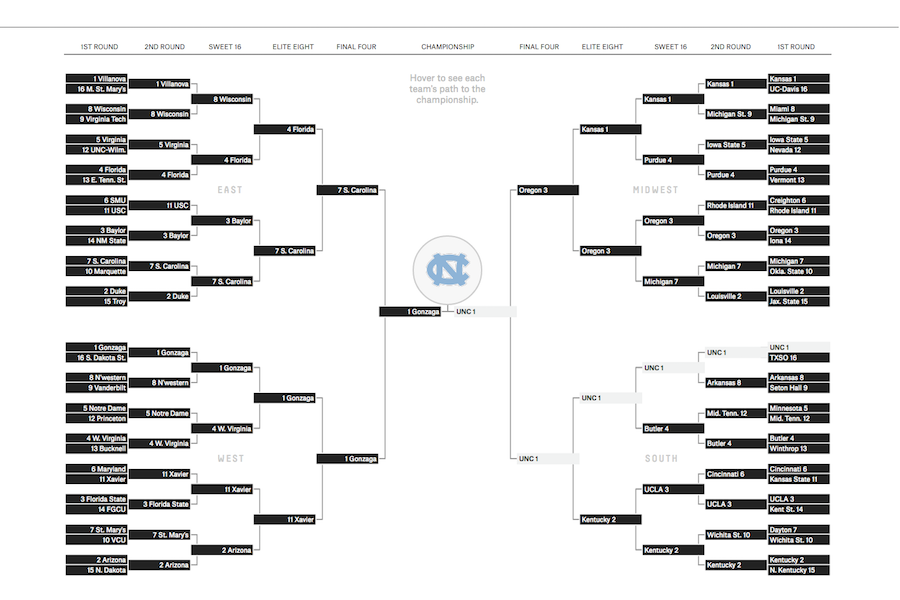
March Madness tipped off three weeks ago. UC Davis, among 67 other national teams, began a quest for the ultimate goal: a National Championship. In the end it came down to a battle between a Final Four newcomer in the form of the Gonzaga Bulldogs and a perennial college basketball powerhouse, the North Carolina Tar Heels. The Bulldogs hung tough for the entire game but ultimately came away empty-handed as the Tar Heels seized another championship with a 71-65 victory.

The NCAA men’s basketball tournament began on March 14 with the first four teams participating in a series of play-in games to decide who moved into the tournament’s round of 64. This aspect is part of a recent change to the tournament to a 68-team field from the previous 64. These play-in games allow four more teams to make the tournament while preserving the famed sweet sixteen, elite eight, final four breakdown. Fresh off of their Big West Championship, the UC Davis Aggies won an automatic bid to take part in the play-in games.

The Aggies played their first ever NCAA tournament game against North Carolina Central University. Playing for a chance to move into the round of 64, UC Davis came out and played its hard-nosed defense, leading to the program’s first ever NCAA tournament win, 67-63.

On March 16, the round of 64 took place and the true tournament began. While there weren’t as many of the shocking upsets fans have come to expect from March Madness, there were a few games that stuck out. The Cinderella story of the seventh-seed Michigan Wolverines continued as they dispatched their opponent, tenth-seeded Oklahoma State. The Wolverines had been a long shot to make the tournament before catching fire and cruising to Big Ten Championship win. Additionally, twelfth-seed Middle Tennessee State upset fifth-seed Minnesota. While this shocked many fans, just one year prior the Blue Raiders upset the second-seed Michigan State Spartans in a similar scenario.

UC Davis, a sixteen seed, squared up against the top-seeded Kansas Jayhawks. With Kansas being one of the top four teams in the tournament, the Jayhawks were heavily favored. Regardless, the campus and city of Davis tuned in to cheer on the Aggies. The Aggies played well at the beginning of the game, but halfway through the first half the Jayhawks raced to a massive lead, resulting in a 100-62 win for Kansas.

The round of 32 was marked by the matchup between the eight-seed Wisconsin Badgers and the one-seed Villanova Wildcats. The Wildcats defeated the North Carolina Tar Heels in last year’s championship game on a stunning buzzer-beater. With that in mind, Villanova looked to become the first team to repeat as champions since the 2007 Florida Gators. Wisconsin had something to say about that. The Badgers rode the timely shooting of senior forward Nigel Hayes and came out with the 65-62 win and a trip to the Sweet Sixteen.

The Sweet Sixteen featured a matchup of arguably the two most successful college basketball programs ever, UCLA and the University of Kentucky. A three and a two-seed respectively, the matchup highlighted several superstar freshman. The Bruins led with their duo of freshman, guard Lonzo Ball and forward T.J. Leaf, who were matched up against the Wildcats freshman, guards Malik Monk and De’Aaron Fox and forward Bam Adebayo. Ball had a rare off night and the rest of the Bruins could not pick up the slack as Kentucky triumphed with a 86-75 win.

In the Elite Eight, the upstart seven-seed South Carolina Gamecocks beat a talented four-seed Florida team 77-73. With the victory, the Gamecocks reached their first Final Four in school history. The Gamecocks were lead by two in-state stars, senior guard Sindarius Thornwell and sophomore guard P.J. Dozier.

The Final Four came down to the University of North Carolina versus the University of Oregon and Gonzaga University versus the University of South Carolina. North Carolina versus Oregon proved to be the game of the night, as the game was decided in the final seconds. With the Tar Heels up by one point and five seconds remaining in the contest, the Tar Heels missed four straight free throws, but on each of the free throw sets the Tar Heels managed to corral the offensive rebounds and hold out for the 77-76 win. In a bizarre ending, North Carolina won via their ability to rebound rather than to score.

With Gonzaga winning its semifinal against the Gamecocks of South Carolina, the stage was set for the national title between Gonzaga and North Carolina. North Carolina’s path to the championship was driven by a hunger for redemption. The Tar Heels were beaten by Villanova in the 2016 Championship on a buzzer-beating three-pointer. For Gonzaga, the west coast squad was compelled by its need to prove the doubters wrong. Despite several successful seasons under head coach Mark Few, the team has often been viewed as soft, due to playing in the weaker WAC conference. With the Gonzaga Bulldogs’ first Final Four under their belt, they had more than proven their ability to fight with the big-time schools.

The Bulldogs controlled the majority of the first half behind the smart play of junior guard Nigel Williams-Goss and the poor shooting of North Carolina. At the half, Gonzaga led the Tar Heels 35-32. In the second half, the Tar Heels came out firing. With its defensive intensity cranked up, North Carolina forced a series of turnovers and swung the momentum in its favor. The rest of the second half was marred by bad shooting from both teams and poor judgement by the referees. The teams combined for an absurd 52 free throws. The final minute, however, was decided by the players rather than the referees. With the Tar Heels leading 68-65, Williams-Goss brought the ball up the floor and raced into the lane, putting up a shot that was emphatically blocked by North Carolina senior forward Kennedy Meeks. Meeks’ block led to a two-handed slam by senior forward Justin Jackson. Down by five, the Bulldogs panicked and threw a wild pass up the court which was intercepted by the Tar Heels. In a matter of seconds, the one-possession ball game was blown open by North Carolina and Gonzaga could do nothing but watch as the Tar Heels put the finishing touches on their redemption, a 71-65 victory.

Congratulations to North Carolina Tar Heels, the 2017 NCAA Men’s Basketball National Champions!


Written by: Rowan O’Connell-Gates — sports@theaggie.org