58.7 F
Davis

Davis, California

Monday, December 22, 2025
Home Blog Page 744

How to become a CoHo pro

0
VENOOS MOSHAYEDI / AGGIE

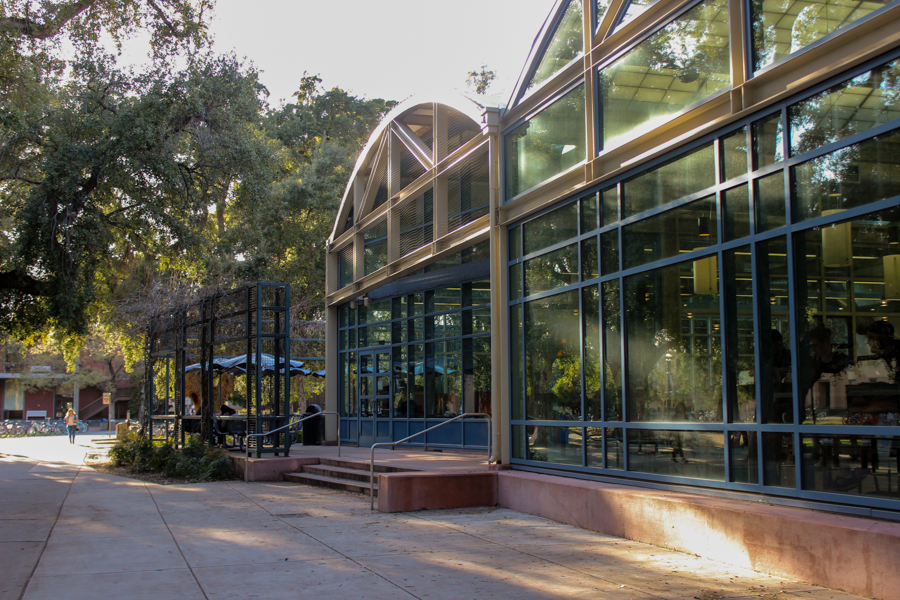
The UC Davis Coffee House: it’s at the helm of our campus’ holy trinity — the CoHo, the Quad and the holy MU. But much like a lost theologian, I’ve always struggled to understand the CoHo’s purpose. Are you supposed to eat there? Are you supposed to study there? Are you supposed to socialize there? There’s no way to do all three at once. This article captures this familiar conundrum pretty well. But I’ll just be focusing on the food.

At first glance, eating at the Coho is like eating at a mediocre version of the most successful restaurants in Davis. Crouton’s is a mediocre Pluto’s, Fickle Pickle is a mediocre (and much more fickle) Mr. Pickles, the bagel place is a mediocre Posh bagel, Chopstixx is a mediocre Pho King 4 (which is also mediocre; where are Pho Kings 1-3?), TxMx is a mediocre Chipotle and Cooks is a mediocre everything else in Davis (Or is it? Have you been there more than thrice?) If you’re paying standard prices for the standard Coho menu items, your experience will range somewhere between “ethnic food in the Midwest” at worst and “a hospital cafeteria” at best. But the CoHo doesn’t have to taste like “White Guy Pad Thai.” You just need to know what you’re doing. So I sat down with the experts, CoHo supervisors, socialites and enthusiasts alike to find out all the most coveted CoHo secrets and bring them to you. This article will change the way you eat at the CoHo — guaranteed. Let’s break it down by CoHo station.


Fickle Pickle Deli/Bagel Place:

  • First of all, a lot of people don’t know that these two places are actually the same venue. That means if the line is really long for the sandwiches, you can actually order a sandwich from the bagel register and vice versa. Nine times out of 10 they’ll do it for you.
  • Second, here’s how you can save buku bucks on your bagel:

Get a side of fowl salad, tuna salad or egg salad for $1.50 (I recommend the bird). Tomatoes, cucumbers and onions are the only regular toppings they charge for, so load up on all the others for free. Next, buy a day-old (but literally just as good) bagel from Coho ToGo for 50¢ and assemble the bagel yourself. Your total will be between $2-3 and you’ll get the same amount of food as the regular-priced bagel.


Croutons:

  • Salad hack: The CoHo allows you to make a salad out of just toppings, 55¢ each. Ask for a topping salad, then ask for the first topping to be spinach, lettuce or your leaf of choice. If you’re lucky, you’ll get one of those groggy, borderline comatose CoHo employees who’ll put the normal amount of leaves in your bowl instead of just a handful. If they only put a handful in, ask for a couple more “toppings” of leaf until you’re satisfied. Then add whatever other toppings you like. Last week I had a topping salad with three spinaches, onion, kalamata olive and balsamic dressing for $2.75 — a very dank snack indeed.
  • Baked Potato: Baked potatoes are underrated at the CoHo. Without meat, one potato costs $4.50 and you can add seven toppings. Be sure to choose a leaf, and make one of your toppings cheese. You can ask them to put the cheese on first so that it melts onto your potato.


TxMx

  • If you get the taco salad without the tortilla it’s 50¢ less. You can follow it while it’s being made, and ask for extra lettuce, beans, etc. You can also ask for rice, beans, cilantro, onions, jalapenos and all three of the salsas for no extra charge.
  • Don’t get the tacos, you idiot.
  • The especial quesadilla is so cheesy it will make you cry — only a die-hard cheese-lover should ever order this.
  • I’d steer clear of the guacamole as well; rumor has it, their avocados aren’t that fresh. 


Chopstixx: Avoid.


Ciao: Their pizza is 6.5/10. (I’ve never gotten their sandwiches; that is my bad.)


Cooks:

Now to the main event. Cook’s is the best part of the Coho and by far the most underappreciated — there’s so much to explore. Everyday the Cooks menu features five things: deli salads, pastas, mixed entrees, soups and chili, and casseroles. All of these options change daily and are on a 4-week rotation. You can see what options will be available at cooks here.

Deli Salads:

Cooks’ salads are healthy, filling and will blow Croutons and CoHo-To-Go salads out of the water. The small is $3.50 and actually a pretty decent size. If you can’t decide which one you want to get, you can try three salads with their deli salad sampler for a dollar more than their normal salad price. Here are the top 5 Cooks salads you should try:


  • Sundried Tomato and Spinach
  • Southwest Sweet Potato Salad
  • Kale and Feta
  • Chilled Zucchini and Corn
  • Basil Chicken Parmesan


Pasta:

Every day there are new pasta sauces to choose from. You can ask for white or brown rice instead of pasta for the same price. The top five sauces to try are:


  • Creamy Tomato Feta
  • Chicken Alfredo
  • Spicy Artichoke
  • Italian Sausage Marinara
  • Mushroom Dill

Don’t get a large pasta, get a small pasta with a breadstick. It’s basically the same amount of pasta and $2 cheaper, plus a breadstick. Word up.

Mixed Entrees. The top five, son:

  • Thai Peanut Chicken
  • Broccoli Beef
  • Walnut Tofu
  • Hungarian Beef Goulash
  • Meat Lasagna

You can add rice to anything at Cooks FOR FREE. Be sure to add rice to some of these.

Soups and Chili:

  • Not a bad idea to add rice to these either.
  • You can take a plastic CoHo spoon and turn it inside out to make it into a ladle. I got real bored one time and discovered this.

Here are the top five Cooks soups:


  • Cauliflower Cheese Chowder (TRY THIS)
  • Jamaican Black Bean Soup
  • Sopa Azteca (like a chicken tortilla soup)
  • Split Pea Soup
  • Clam Chowder (served every Friday)

Casserole:

  • Disclaimer: These can be super unhealthy. That being said, Cooks casseroles are some of the finest items available at CoHo. So skip breakfast and ball out:


  • The Pesto Chicken Casserole (Best thing at the Coho)
  • Chicken Tet  (served every Friday; I’d definitely recommend)
  • Baked Potato Casserole
  • Mac and Cheese (made from scratch)
  • Laura’s South of the Border Casserole


Swirlz/Out Front

  • Try the Passion Fruit Italian Soda. You can just ask for “The Willis” and they’ll know that’s what you mean (they probably won’t, but still try).


Now you’ve got a friend in the dinin’ business!
JONAH VERSMAN is a semi-pro garage-sailor and avid sorbet enthusiast. You can reach him at jiversman@ucdavis.edu.


(CORRECTION: A previous version of this article incorrectly stated that the CoHo uses “powdered guacamole.” The CoHo makes its guacamole with real avocados.)
Davis duo competes in Olympic Marathon Trials

0
ANH-TRAM BUI / AGGIE

Brother, sister continue family running tradition  

This year, the Olympic Marathon Trials included Davis brother and sister duo Kaitlin Gregg Goodman and Brendan Gregg. They were among the hundreds of runners competing in the Olympic trials for marathon running on Feb 13.

It’s an extremely rare event for a brother and sister to run in the Olympic Trials together rarer than one might think. Even married couples and twins compete together more often than brothers and sisters. In fact, a brother and sister have not competed together since the 1984 Olympic Trials, the year women were first allowed to run the marathon.

“It was emotional standing on the starting line as it was the realization of a dream I’ve had, to compete at the Olympic Trials, for the past eight years,” Kaitlin said.

Brendan runs with the Hanson-Brooks team and is a Stanford University graduate. Due to injuries that accumulated a few months before the trials, he went into the race knowing he would not finish.

“It was kind of fun to just take a step back, really just enjoy the environment, soak it up, see the crowds and not really have any stress as to how the result was going to end up,” Brendan said.

Instead of racing competitively, Brendan helped pace two of his Hanson-Brooks teammates for the first part of the race. He was also able watch his sister compete.

“The core of our relationship when it comes to running is definitely supportive,” Brendan said. “I’m always supportive of her and she’s always supportive of me.”

Although the brother-sister dynamic induces some areas of competitiveness, Kaitlin agreed that running together is more encouraging than anything.

Sure, we joke and jockey for the top national ranking, which makes for good dinner table bragging rights, but mostly we support each other’s goals and root each other on,”  Kaitlin said.

Growing up in Davis, the siblings played a variety of sports. They both attended Davis High School, where their father, Bill Gregg, is the cross-country coach. Bill explained that coaching his children wasn’t as hard as he expected.

“It was surprisingly easy, probably because at some point in time they became passionate about the sport,” Bill said.

Bill, who led the Davis High cross-country team to win second place in Nationals this year, couldn’t believe that his kids had made the trials. Watching his children start the race, Bill thought the entire ordeal to be surreal.

“A few years ago, the thought of both kids being in the Olympic Trials was like, no that’s kind of impossible,” Bill said.

Even more incredible, Kaitlin has ran very few marathons, her usual race of choice being the 10,000-meter. Although her brother was unable to finish the race, Kaitlin came in 56th place amongst the women. Sadly, this was not enough to push her through to the Olympics.

“Well, in Kaitlin’s case you look at what happened in the field — 199 women started, only 149 finished, so 25 percent of the field dropped out. It was really hot, so for her to finish I think was a really great accomplishment,” Bill said.

Although the marathon trials are over, the running season is still underway. Brendan plans to continue racing in the upcoming track.       

Written By: Samantha Solomon – city@theaggie.org

Super seniors in our midst

TIFFANY CHOI / AGGIE

A fifth-year student’s academic reality

We’ve always been told that college will be the best four years of our lives. But what if those four years turned into five, or even six?

Fifth-year students, also known as “super seniors,” seem to be increasing in number every year. Students across UC Davis are choosing to extend their time as undergraduates depending on their academic goals, their extracurriculars and their future endeavors. Sara Sweeney, academic counselor for the College of Letters and Sciences (L&S), advises these students on a path that fits best for them.

“A lot of times I see [L&S] students […] looking for additional experiences like a second major, an additional minor, study abroad –– where that path is going to go [is student-led],” Sweeney said. “[Students] are used to high school where you were [there for] fours years and then you’re done. But at UC Davis […] you tell us when you’re done.”

Sweeney, a UC Davis alumna and former super senior herself, understands that academic, familial or financial pressures may make students feel pressured to complete their undergraduate education in four years. However, she emphasizes that a lot of students are open to the idea of staying longer.

“I encourage students to do what works for them –– no student’s path even in the same major is going to look the same […] just because there is so much variety and choice,” Sweeney said. “Of course, we want students to know about requirements, [but] figuring out that you can graduate every quarter, that you aren’t in a class of students moving all through the same thing, makes [it so that] they can kind of do [their] own thing, whatever that turns out to be.”

Fifth-year English and evolutionary anthropology double major Alyssa Hurst transferred to Davis after many years of community college and working full time.

“A lot of transfer students you may talk to say that Davis is [overwhelming and] that [they] want to get out as soon as possible –– and I sort of had the opposite reaction,” Hurst said. “Once I got used to it, I thought [that] there was so much good here. I wanted to do it all.”

Hurst decided to extend her education by two quarters in order to incorporate her many extracurriculars, including study abroad in Japan, anthropological field school, English critical honors program and applying to graduate school. She’ll be graduating from L&S this winter with no regrets.

“The decision to take a fifth year […] is really subjective –– basically, those really cool experiences I would have had to sacrifice to take classes,” Hurst said. “It makes sense for some people, and doesn’t make sense for others.”

As L&S caps students at 225 units for their entire undergraduate career, graduation is relatively straightforward, whether that be in three, four or five years.

“In L&S, [we try to] make sure that every student can graduate in the time that they want, but sometimes the time that they want is not four years,” Sweeney said. “If you start off [as] a physics major, there’s a plan; you’re going to get the classes and move through, [but] if you find out that you want to be a physics major in your third year, that might be a challenge. That’s what I kind of see, for L&S –– we experience that more than any other college.”

The College of Engineering makes it available for their students to graduate within four years plus a quarter and between 190 and 230 units on average, since there is no unit cap. Pam Kisting, academic program coordinator for mechanical and aerospace engineering, meets with fifth-year students for degree checks more often than an L&S advisor would.

“Maybe 30 to 40 percent of students continue on [to a fifth year],” Kisting said. “The majority of our students do probably get out in four, […] but we definitely have students that stay.”

Kisting explained that staying an extra year depends on whether the student wants to focus on real-world experiences like internships and “co-ops” (extended internships), or the 19 units of classes that a particular quarter holds.

“The reality is that what internship you have […] is going to be the most important factor to what job you get when you graduate, […] but that means that [a student is] going to strategically weigh staying longer,” Kisting said. “[And] here if you want to pick up a minor or double major, you’re basically guaranteeing yourself staying longer than four years –– if you’re okay with that, fine, but it you aren’t then you need to be very strategic with your planning.”

With a heavy workload, engineering students are advised to delegate their time efficiently in order to support a healthy GPA. Rosa Morales, a fourth-year mechanical and aerospace engineering double major, looks forward to her fifth year of focused work and leadership opportunities.

“I didn’t want to rush my double major [because] it could get pretty intense,” Morales said. “Now my fifth year will be pretty relaxed, and next year […] I can focus on my personal statements [and] getting good letters of recommendations –– it’ll open up my schedule so I can focus on getting into grad school.”

As a first generation college student and the current vice president of the Chicano and Latino Engineer and Scientists Society (CALESS), Morales credits the time she was able to focus on the club as a motivator for her future goals.

“There’s a lot of things that I’m learning being an officer that I wouldn’t have learned otherwise,” Morales said. “If I had been trying to get out of here in four years I probably wouldn’t have had the time to get so involved.”

With regard to her students’ success, Kisting wants to motivate engineers like Morales to go at their own pace, no matter what their academic plan may dictate.

“I want students […] where they can be academically successful,” Kisting said. “[But] there’s this bureaucratic side of higher education saying that you need to turn these kids out in four years. [But because of] the different accreditation process that we have to adhere to […] you have to have a solid curriculum that will prepare students for employment in the industry.”

Despite the pressures, Kisting hopes that it’s a student’s own personal choice that determines whether they stay for longer than the traditional four years.

“You gotta listen to your gut,” Kisting said. “If you’re okay with [it], we’re okay with it.”

Written by: Emilie DeFazio – features@theaggie.org

Free & not-so-For Sale

Students offer their services for free on the Facebook Free & For Sale Group. (ASHLEY LUGO / AGGIE)

Students offer free services in the UC Davis Free & For Sale group on Facebook

Relaxing with Sensui

If ever in need of a massage after a stressful week of midterms, Sensui Tao is the man to visit. From a young age, one of Tao’s older sisters deemed him the family masseuse. Being the sixth youngest child, Tao massaged the rest of his siblings in various ways, such as stepping on their backs and using his elbows.

Tao took a break from massaging in high school, however, when his father passed away from liver cancer four years ago. Later on, he got back into the practice to take better care of his mom.

“[My dad] didn’t take a practical approach to his health,” Tao said. “You know, in terms of exercise, eating right, all the essentials that sustain a healthy body. He wasn’t doing that and that really hit me.”

A former undeclared major in the College of Biological Sciences at UC Davis, Tao withdrew from school and worked full-time for two years in the fields of pest control sciences and furniture. It was during those two years that he became immersed in massaging.

“I didn’t want the same thing to happen to my mom,” Tao said. “I did everything I could to upkeep her health like massaging her joints.”

In 2014, Tao returned to UC Davis as a philosophy and English double major hoping to go into law. At the same time, he started posting in the Free & For Sale group on Facebook to advertise his massage service. However, after seeing his sister come home after being negatively affected by her work as a lawyer, Tao decided that law wasn’t for him and recently withdrew from UC Davis once again.

“After a lot of thinking, a lot of practice and talking to family, clients, and a lot of friends, I decided to pursue Chinese medicine,” Tao said. “I’m trying to have this as a platform for something greater hopefully.”

Several weeks ago, Tao started taking classes at the Massage Institute in Downtown Davis and offers free massages to anyone who is interested. Sessions are typically an hour long and Tao goes to each client’s house for the massages.

“I’m really trying to get better,” Tao said. “Every body is different, every person has a different issue, like a different kind of pressure, tension, modality, different leverage that they need. I’m just getting a ton of experience this way.”

Tao also accepts donations which will help with gas and other minor expenses; by doing this, he said that people don’t expect to get a certain level of service. He also receives and utilizes  feedback from his clients.

“I look at it as a community building thing on the Free & For Sale page where I get to meet people and people get to meet me,” Tao said. “We try to figure out your issue together and then you tell me what’s not working and so that way I get to research something later to see if I could find a better method for next massage [session].”

Currently, Tao plans to graduate within the next three months from the Massage Institute and then move onto Chinese medicine school after working full time for a couple years. To graduate, Tao needs 500 hours of the curriculum as well as electives.  

“I’m trying to get into acupressure, more like the Eastern energy modalities whereas there’s also European, cranial sacral, sound healing, emotional healing — there’s a lot of things,” Tao said. “So I’m trying to specialize in something that’s already heading toward my field.”

What Tao enjoys most about his experience through offering free massages on the Free & For Sale page is the networking.

“You get to meet a lot of interesting people,” Tao said. “The fact that they are vulnerable enough to let you touch them and to gain that trust, it’s like we’re good friends after a couple sessions. Through that, I’ve been having people help me with word-of-mouth advertising.”

Tao said he has met people who hope to help him with future developments, such as a website or app for services.

“I’ve met a lot of good people,” Tao said. “They’re good at what they do and it’s like sharing that same drive towards something bigger than us.”

Jamming with Corbin

If you walked through the parking lot behind the Primero Grove Apartments last year, there’s a good chance you heard recent UC Davis graduate Corbin Gomez jamming with his guitar.

From age 4 to 11, Gomez played the piano, but he didn’t like it. Then at age 13, he switched to the guitar because of its portability. His father taught him how to play.

Gomez commuted to and from Davis starting Winter Quarter 2015. In order to avoid traffic, he would leave home early, arriving on campus around 7 a.m., and leave campus at 9 p.m. With his L permit, Gomez parked in Lot 22 behind the Primero Grove Apartments and would have two hours of free time. He started bringing his acoustic guitar with him to play before and in between classes. According to Gomez, a lot people passed through the parking lot and would hear him playing.

“I met so many people there,” Gomez said. “You play and all of a sudden there are people coming to you who are like, ‘Hey, can I try?’ and then they teach you things. I’ve learned so much from so many musicians here that I felt like maybe I should give back […] because I’ve learned so much. If I could teach one person at least one thing, then I’d be a very happy boy.”

It was 9 a.m. on a Wednesday morning in the library during the second week of Fall Quarter 2015 when he posted on the Facebook Free & For Sale group offering free guitar lessons.

“It was such an intense thing because it had a lot of support and interest,” Gomez said. “It kind of blew up. That’s why I remember the time because at 9 a.m. I posted it and by 9:05 a.m., I was pulling my hair out. I was so nervous because how was I going to organize everything?”

Gomez said that he only expected three or four people to be interested, but the number of people who reached out on Facebook was actually around 60 or 70. At first, he thought he would simply schedule with people through Facebook messaging, but when the messages overwhelmed him, he switched to Google Calendar.

“People could see what the open slots were,” Gomez said. “So pretty much from 7 a.m. to 9 p.m. every single day, if there wasn’t a time where I was in class, that spot was open and people could sign up for it.”

Since Gomez commuted daily, he went to people’s apartments for lessons and would meet them anywhere.

“I also asked them what kind of stuff [they’re] interested in and what can I teach [them] that [they’d] actually be interested in,” Gomez said. “And also [about] the logistics like do they have a guitar and stuff like that.”

Instead of holding straightforward guitar lessons, Gomez wanted his lessons to be more community-oriented to spread music. To do so, those he tutored would have to pass on their favorite album in the form of a CD to the next student.

“The idea was that I would give the [person in] the first lesson that I had my favorite album, whatever album that was,” Gomez said. “I would give it to them on disc and they would give me an album that I would give to the next person.”

Although the CDs didn’t work as well as he originally imagined, the general idea still stuck and notes were passed on instead.

“I had them write a little cute message like ‘Keep on rocking!’ or whatever and then [without reading it], they would suggest songs and I’d give it to the next person,” Gomez said.

In total there were approximately 37 people that received lessons from Gomez, meaning 37 hours at 37 different apartments or houses that Gomez had to visit to complete his mission.

“[My mission was to make it] where they would be confident and able enough to go up to some random person they’ve never met before on the sidewalk and be able to hold their own,” Gomez said.

In addition, Gomez wanted to help people enjoy themselves while playing guitar, no matter their skill level.

“If I could just have them hold the guitar and just have them laugh at something they’re doing,” Gomez said. “I love music and if I could share that and make somebody happy with it, I’m very happy myself.”

Pictures with Ed

Recently, a few posts about free photo shoots on the Facebook Free & For Sale group have gained immense popularity. With over 1,000 combined likes on his posts, fourth-year managerial economics major Ed Ju has taken dozens of student’s photos over the past couple of weeks.

Ju became interested in photography after stumbling across The Stranger Project on Flickr, which inspired him to start his own project.

“It was a challenge for people all around the world to approach a stranger and ask them about their story and then photograph them,” Ju said. “I started that four years ago. At that time, I was terrified of people. I would be scared to order water from a waitress. I wanted to break out and be more sociable. My mom did photography so I was like, ‘Okay, I’ll use her camera.’”

Ju still remembers the first photograph for his own “Stranger Project.” Ju described the man he photographed at BART as a “guy with a great big orange beard.” Normally, he would never have approach a person like him, but his father encouraged him to do so.

“After that it was like, ‘Oh my gosh, I can’t believe I did that!’” Ju said. “I looked down at my camera and was like, ‘Wow, I did it. This is so awesome.’ And I felt so proud of myself. And since then, I’ve just been doing it.”

Ju said that while he was afraid of strangers, he “fell in love” with people all around him.

“I fell in love with how everyone has their own stories and their own personalities,” Ju said. “Photographing them became a way where I could express myself in capturing someone.”

Ju originally wanted to hold photo shoots to fundraise for a mission trip to Mexico during spring break, but instead decided to use the photo shoots as an opportunity to enhance his photography skills.

“Students don’t really get many opportunities to capture moments, like the people that they love here, their roommates, their housemates, just like they’re best friends, you know?” Ju said. “Later down in life when they don’t have any good pictures, it’ll just be a memory. So I thought, ‘You know what? I’m just going to do this.’ Not because I’m trying to raise money, but just because give my fellow students a frozen moment in time that they could remember later on.”

However, Ju is still accepting donations since there’s a difference between shooting for free versus shooting for clients.

“[Students] are grateful that I’m doing this for them whereas [clients] expect like, ‘Oh yeah, I’m paying you for your time; you better do this right,’ which I’ve experienced before,” Ju said.

Though Ju wasn’t expecting many people to sign up for his photo shoots, with only two weeks having passed already, he already photographed approximately 80 to 100 students. With six-hour shifts and breaks in between, each person or group gets 15 minutes to take photos.

To check out Ed’s work, follow him on Instagram @iamedju or check out his Facebook.

“I love being a photographer because I feel like I get to be a part of [people’s] special relationships,” Ju said. “I get to capture this sliver of moment where they’re laughing and where they’re loving each other. And it’s like this frozen moment in time in our constantly busy world where they get to remember that [moment].”

Written by: Jacqueline Chufeatures@theaggie.org

Dutch bicycling expert visits Davis

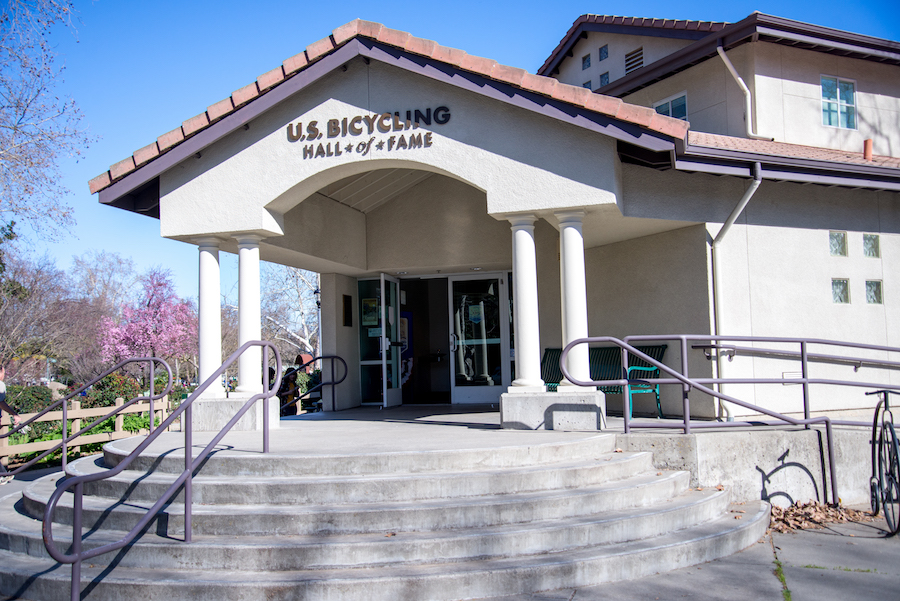
Located in Downtown Davis, the U.S. Bicycling Hall of Fame is one of the city's hallmark attractions. (ANH-TRAM BUI / AGGIE)
Located in Downtown Davis, the U.S. Bicycling Hall of Fame is one of the city’s hallmark attractions. (ANH-TRAM BUI / AGGIE)

Herbert Tiemes speaks at U.S. Bicycling Hall of Fame

On Feb. 9, Dutch bicycling expert and famed former traffic planner Herbert Tiemens spoke at the U.S. Bicycling Hall of Fame, where he discussed Davis’ progressive biking culture and how it compares to hallmark biking cities in Europe such as Utrecht, Netherlands.  

“I’m not surprised Davis attracts someone like Tiemens. I know the Netherlands has a strong bike presence in general, and it’s very interesting to think of Davis as a comparison,” Davis resident Heather Bryant said.  

Working closely with the Dutch Cycling Embassy, Tiemens is frequently dispatched to cities across the globe to discuss bicycling culture and its benefits for both citizens and the environment.  

Bob Bowen, the president of the U.S. Bicycling Hall of Fame, explained that the Hall is continuously trying to encourage bicycling, so having Tiemens there as a speaker did just that.

“The U.S. Bicycling Hall of Fame is striving to assist in advocating for bicycle infrastructure, and incorporating cycling into the fabric of many other communities, just like what we have done in Davis,” Bowen said.

Bowen hopes that Davis will exemplify the importance and benefits of pro-biking societies for the rest of the U.S.

Just last year, Davis unveiled America’s first protected bicycle intersection, modeled after intersections in the Netherlands, at the Covell Boulevard and J Street crossroad.

Steve Tracy, vice president of Davis Bicycles, a nonprofit group with the mission of encouraging bicycling in Davis, was the primary organizer of Tiemen’s talk.

“Davis is the premiere bicycling town in America, and Herbert wanted to come see how high the bar was set,” Tracy said. “It’s a great honor for the city, and an even better encouragement for the future.”

Tiemens has always had a passion for cycling. On his website, he explains that since learning to ride at the age of six, bicycling has always been a part of his life. After a long career of city planning in the Dutch city of Houten, where he implemented safer roadways for bicyclists, he now works for the city of Utrecht as a senior policymaker and bicycle program manager.  

According to his website, his interests include “integrated spatial plan development as well as complete street design,” which is essentially the combination of roomy road infrastructure coupled with alternative roadway options like bike paths.

Tiemens’ visit only proves that Davis’ efforts to create a pro-bicycling culture have paid off and that the city’s small town vibe can grasp attention across the globe.

Written By: Tristen Thalhuber city@theaggie.org

UC Davis study finds that the bad boy doesn’t always win

NICKI PADAR / AGGIE
NICKI PADAR / AGGIE

Human development professor’s study with adolescents shows that empathy is more attractive in romantic partners

In a recent UC Davis study of early adolescent relationships, youth subjects showed through self-reported surveys that they tend to pursue relationships with members of the opposite sex who are approved of by their peers. In a collaboration with two other professors outside of UC Davis, Adrienne Nishina, an associate professor of Human Development and Family Studies, also found that empathy plays a large role in early adolescent attraction.

This study is part of a larger multi-state study in collaboration with Professor Melissa Witkow at Willamette University and Professor Amy Bellmore at the University of Wisconsin, Madison,” Nishina said in an email.  “We recruited over 1,000 sixth graders from seven different middle schools across the three states [Oregon, California and Wisconsin]. The main goals were to examine middle school peer relationships and how they are associated with student adjustment and academic outcomes.”

Andrew Bower, a former graduate student of Nishina’s who posed the main questions for this study, was particularly interested in pop culture’s perception of adolescent relationships.

“You see a lot in anecdotal popular media that the bad boy wins or the bad girl wins when pursuing relationships,” Bower said. “As a social status researcher, I wanted to understand why some [adolescents] get a disproportionate amount of attention from their peers. How do these naïve individuals formulate ideas of romantic partners?”

Nishina said that the researchers were also interested in how students cope with daily negative experiences like peer victimization and how ethnically diverse relationships might promote coping skills.

“Because we were interested broadly in peer relationships, we also collected data on students’ current ‘crushes,’ which we wanted to know more about since in sixth grade, most students are at the beginning phases of romantic relationship development and aren’t actively dating yet,” Nishina said. “To get at students’ crushes, we use a methodology called ‘peer nominations.’ This is where we ask students to name students in their grade who fit different descriptions, such as friends, popular students and in the case of this study, who they have a crush on.”

According to a press release, Nishina and her colleagues found that empathy the ability to understand another person’s emotional state was one of the most desirable traits in early adolescents.

“Also, for these adolescents in their early middle school years, aggressive behavior actually negated the romantic desirability of being popular,” Nishina said in the press release. “This appears to be in contrast to later in adolescence, when aggression and popularity are more strongly intertwined.”

Qianhui Loo, a first-year biological sciences major, said that her romantic experiences in early adolescence were with people who could understand her through their similar ethnic backgrounds and family dynamics.

“Both of our parents were divorced,” Loo said. “If I had talked about the same problems with my friends, they wouldn’t understand because they never went through it. When I talked about my family to him, he would understand, and that’s how we really connected.”

Written by: Julian Leus – campus@theaggie.org

This week in sports

0
TIFFANY CHOI / AGGIE

UC Davis athletics from Feb.15 to 21

Women’s Water Polo (10-5)

UC Davis vs. CSU Bakersfield (W, 13-7)

UC Davis vs. Brown (W, 12-3)

UC Davis vs. Stanford (L, 14-5)

Junior utility Bryn Lutz scored four goals in the home opener against CSU Bakersfield. Senior center Allyson Hansen and junior center Carla Tocchini each added two goals in the win. Junior goalkeeper Olivia Husted added nine saves to the game to help the Aggies gain the victory.

UC Davis scored five unanswered goals in the match against Brown. Junior utility Hannah Harvey and Tocchini both scored three goals. Senior goalkeeper Haley Cameron made eight of the nine saves to keep the Bears off the board. Check out a recap from sports reporter Aaron Sellers here.

The Aggies fell short in an attempt to upset the Stanford Cardinal, losing 14-5. Veronica Vargo covered the game, and her recap can be found here.

The women’s water polo team next plays in Irvine at the UC Irvine Invitational on Feb. 27 and 28.


Women’s Tennis (4-6)

UC Davis vs. CSU Fullerton (L, 4-3)

UC Davis vs. Sacramento State (L ,4 -3)

UC Davis fought to make a comeback against CSU Fullerton but the Titans squeaked past the Aggies with a 4-3 win. UC Davis tied the score at 2-2 after sophomores Jessie Lee and Lani-Rae Green won their sets, but weren’t able to gain much more traction.

Sacramento State rallied past UC Davis with a win despite Lee winning both her matches. Freshman Isabella von Ebbe won her match and improved her undefeated record to 5-0.  For the full story by Julia Wu, click here.

UC Davis travels to San Jose State on Saturday, Feb. 27, for an 11 a.m. match.


Swimming and Diving

Mountain Pacific Sports Federation Championship (1st place)

Freshman Solie Laughlin earned two Mountain Pacific Sports Federation titles in the 100-yard Backstroke and the 400-yard Individual Medley. The Aggies won their fourth MPSF Championship in six years with 735 points beating out Hawai’i, who had 673. The UC Davis diving team competes next on March 7 in Colorado at the NCAA Zone E Diving Championships. For a full recap of the Championship meet, check out Iman Farahani’s story here.


Softball (3-6)

DeMarni Desert Classic

UC Davis vs. Nevada (L, 8-7)

UC Davis vs. UNLV (L, 3-2)

UC Davis vs. Oregon State (L,11-2)

UC Davis vs. Utah (L, 11-0)

The Aggies fought hard against Nevada but fell despite a three run home run by freshman infielder Meghan Bradbury that tied the game in the third inning, followed by a one run hit to give the Aggies the lead in the fifth. The Wolf Pack then tied the game before taking the lead and game in the 8th inning.

UC Davis was able to score first against UN Las Vegas and kept the lead throughout the third inning. UNLV scored on a double along with an error to tie the game 1-1. In the sixth inning, the Rebels scored twice on three singles taking the lead and game from the Aggies.

The Aggies played Utah and were defeated 11-0 in five innings. Utah scored four runs in the first inning, followed by another three and then four more in the fourth inning causing the game to end early.

UC Davis played Oregon State and, despite starting a comeback, lost the game 11-2. The Aggies tried to continue their momentum but Oregon State hit another three runs to bring the score to its final margin.

The softball team will kick off the Aggie Invitational on Thursday, Feb. 25, against Iowa State at 2:30 p.m.


Lacrosse (1-1)

UC Davis at Bryant (W 12-7)

UC Davis at Temple (L, 17-4)

The Aggies opened their season with a win over Bryant. Senior midfielder Courtney Neff and senior attacker Ellie Delich recorded hat tricks in the win. UC Davis outshot Bryant 23-19 and had 19 of those shots on the goal.

UC Davis fell to the Owls 17-4. Delich led the Aggies offensively with a goal and an assist, but Temple outshot UC Davis 31-9 and had less turnovers, 12 to UC Davis’ 17.

UC Davis plays Furman at Fresno State on March 6.


Gymnastics

Southern Utah with Michigan (third place finish, 194.025)

UC Davis came in third place with a score of 194.025. Senior Stephanie Stamates scored a 9.900 on her floor routine and junior Katy Nogaki scored a 9.875 to win part of the individual beam title.

UC Davis returns home at 1 p.m. on Sunday, Feb. 28 to face Alaska Anchorage in their Alumnae game.


Women’s Basketball (15-11)

UC Davis at Hawai’i (L, 70-50)

UC Davis vs. UC Riverside (L, 90-76)

UC Davis fell to Hawai’i 70-50 breaking the three game winning streak the Aggies were on. Redshirt freshman guard Morgan Bertsch scored a team high 22 points and had her seventh 20-point game of the season. UC Davis shot 40 percent from the field.

Bertsch had her second straight 20 plus point game with 21 against UC Riverside. UC Riverside made a comeback to win the game and cause the Aggies to fall to 15-12 for the season.

Read a recap by George McConnell here.

The Aggies will face CSUN at home on Saturday, Feb. 27 at 3 p.m.


Men’s Basketball (10-16)

UC Davis at Cal Poly (L, 58-53)

UC Davis at UC Santa Barbara ( L, 62-55)

Junior guard Brynton Lemar earned his first double double in the loss against UC Santa Barbara with 17 points and 11 points. UC Davis shot 38 percent from the field and held the Gauchos to 33 percent shooting but were unable to keep the turnovers down, leading to Santa Barbara scoring 24 points on them. The Gauchos won, though the Aggies defense kept the scoring to a minimum.

UC Davis hosts UC Irvine on Feb. 27 at 9 p.m. in a televised game on ESPN.


Baseball (1-3)

UC Davis vs. Portland (L, 12-0, L, 9-6, L, 7-4, W, 4-3)

The UC Davis baseball team faced Portland for four straight home games, avoiding the sweep by defeating them in a close final Sunday game. Throughout the weekend, the Aggies improved against the Pilots, losing their first game 12-0, but closing the distance in scoring over the following games. Their determination paid off in the end with a 4-3 win to finish off of the weekend.


Written by Lindsay Yim – sports@theaggie.org

Women’s water polo loses to Cardinal in Davis Shootout

0
BRIAN LANDRY / AGGIE

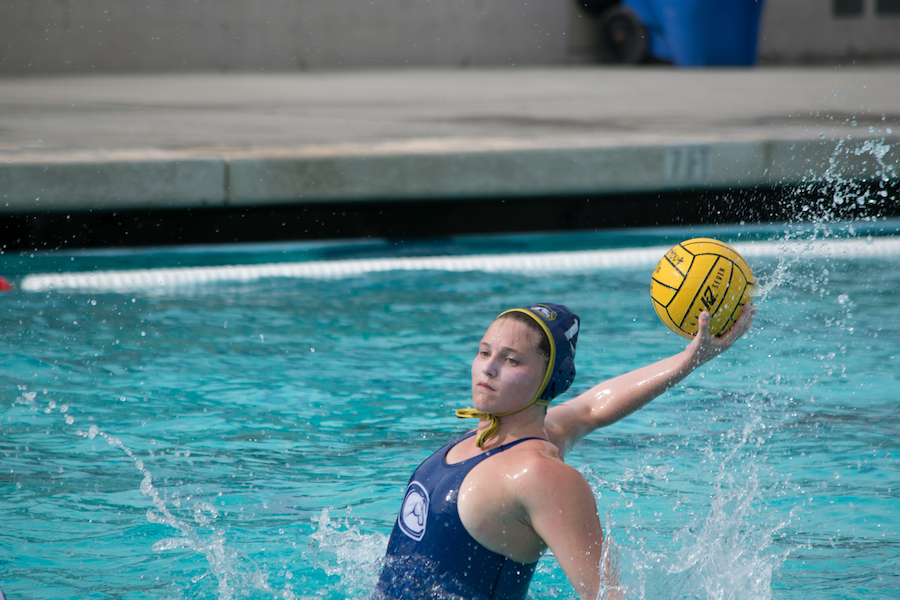
14-5 loss to Stanford concludes home tournament for UC Davis

An early lead by Stanford left the Aggies off to a rough start as the score was 3-1, and by the end of the first half the Aggies were trailing the Cardinal 7-1.

Sophomore center Greta Kohlmoos led the Aggies through the first half, picking up one point in the second half and playing predominantly defense to put up an equally challenging match for the No. 4 nationally ranked Stanford. Along with senior center Allyson Hansen and sophomore attacker Heather Johnson, who played against her sister senior guard for The Cardinal, Rachel Johnson, the game was filled with a certain amount of intensity that would lead a spectator to question the story told by the scoreboard.

The tally by Kohlmoos was made by an intense ball recovery, as she turned to the goal for an undeniable Aggie point during the final seconds of the third period, a successful shot on goal that head coach Jamey Wright feels the Aggies needed to improve on.

“I think the biggest problem for us today was that we got very tentative shooting the ball and then when we did shoot, we weren’t putting it on goal,” Wright said. “They are a really good team, but you have got to still take shots and water polo is such a transition counter attack sport, you miss a shot and they’re going. It’s very hard to catch up if you give somebody a two stroke lead or a three stroke lead because they are a fast team.”

The Aggies managed to force some fouls that led to several exclusions, which aided them in picking up more points in the second half, one of which was scored on a six versus four matchup, with the Aggies in the majority.

“We drew some exclusions,” Wright said. “They’re long and they’re quick and they get off their hips well, but having an extra player doesn’t always guarantee you getting a goal […] I don’t know what our [shooting] percentage was, but it has to be better if you want to upset Stanford.”

Hansen alone drew four exclusions and put up two goals, one in the first and the second in the last, to bring the final score to 14-5. She leads the Aggies with 28 goals this season.

With egg beating legs and twisted arms, the teams battled to stay afloat, but the Aggies were drowned offensively and made a splash in the water for the Cardinal defensively.

“I thought we played front court defense pretty well, we didn’t give up a lot out of that, at least not with our first group,” Wright said. “We’re all trying to be aggressive and press our person, but you have to look behind you and help out where you can.”

As they end the Davis shootout weekend with a 10-5 record and Stanford progresses to 8-1, the UC Davis women’s water polo team looks to take more shots from the outside when attending the UC Irvine invitational on Feb. 27.
Written by Veronica Vargo – sports@theaggie.org

Women’s basketball gives up win to UC Riverside

0
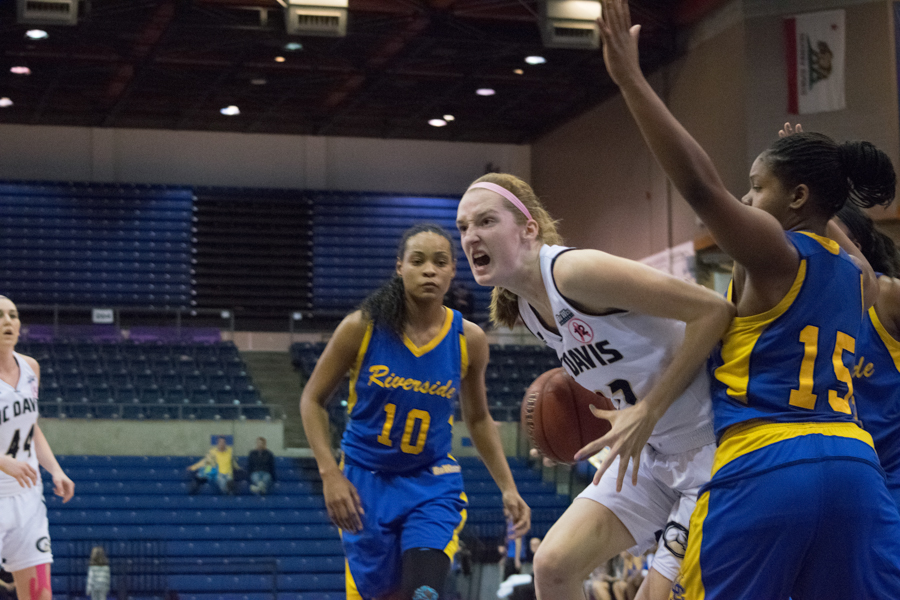
Redshirt freshman Morgan Bertsch drives to the basket en route to a 21 point night. (BRIAN LANDRY / AGGIE)

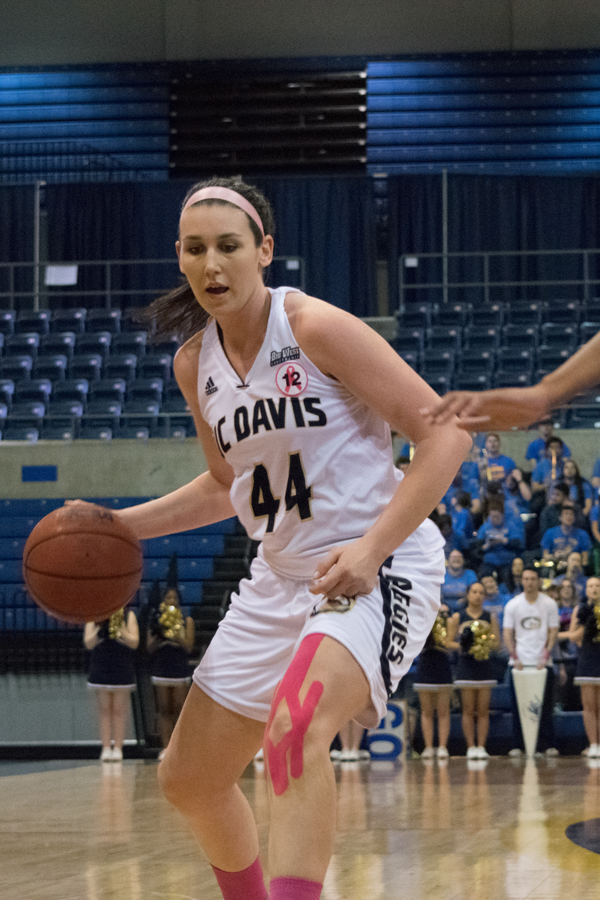
In a 90-76 loss to the Highlanders, the Aggies still maintain positive conference record, 8-5

Following Wednesday night’s disappointing loss in Hawai’i, the jet-lagged Aggies dropped another one to the unbeaten UC Riverside Highlanders, losing 90-76 Saturday evening.

Despite another spectacular performance from redshirt freshman forward Morgan Bertsch, UC Davis had no answer for the reigning Big West Conference Player of the Year, Brittany Crain. Crain, who is averaging a league best 21.7 points per game, scored 33 points in the contest, with 18 coming in the fourth quarter.

wbballucr_sp_Landry2Throughout the first quarter the lead seesawed back and forth and senior forward Alyson Doherty hit a jumper to tie the game at 19 a piece. The reenergized Ags maintained the momentum of the late first quarter push and six minutes into the second quarter, sophomore forward Pele Gianotti converted a three point play, giving the Aggies a 27-21 lead.

But from there Crain and the Highlanders took over, going on a 22-4 run to finish the half, entering the intermission with a 43-31 lead .

The Aggies refused to go down without a fight, thanks in large part to four second-half three-pointers from freshman guard Kourtney Eaton. Three minutes into the fourth quarter, the Aggies held a 65-62 lead, but once again, Crain and the Highlanders took control.

Bertsch, who finished the game with 21 points on 7-of-10 shooting, secured her eighth 20-point game of the season following another 20-point night in Hawaii earlier this week. Doherty claimed 15 points with five boards as well.

There is a reason UC Riverside has an undefeated 12-0 conference record. The Highlanders are an incredibly talented basketball team, with a wbballucr_sp_Landry3multitude of offensive threats. Three of five of the top Big West scorers call UC Riverside home, and the Highlanders average more than ten points a game more than any other team in the conference combined with the most efficient shooting per contest.

But the beauty of the Big West is that regular season statistics mean nothing unless the team wins the conference tournament in March. And at 8-5, UC Davis is putting together an impressive Big West campaign and demonstrated Saturday night they can hang with the big dogs. With the high quality play of Bertsch, Doherty, Gianotti, senior forward Celia Marfone and sophomore guard Dani Nafekh, combined with a deep bench, the Aggies have the tools they need for an NCAA tournament berth.

UC Davis looks to bounce back as they host their final home game of the season next Saturday, Feb. 27, against CSUN at 3 p.m. in the ARC Pavilion.

Written by George McConnell – sports@theaggie.org

Department of Theatre and Dance presents ‘Time Is Passing By’

0
UCD THEATRE AND DANCE DEPARTMENT / COURTESY

Department’s poignant winter production features diverse cast

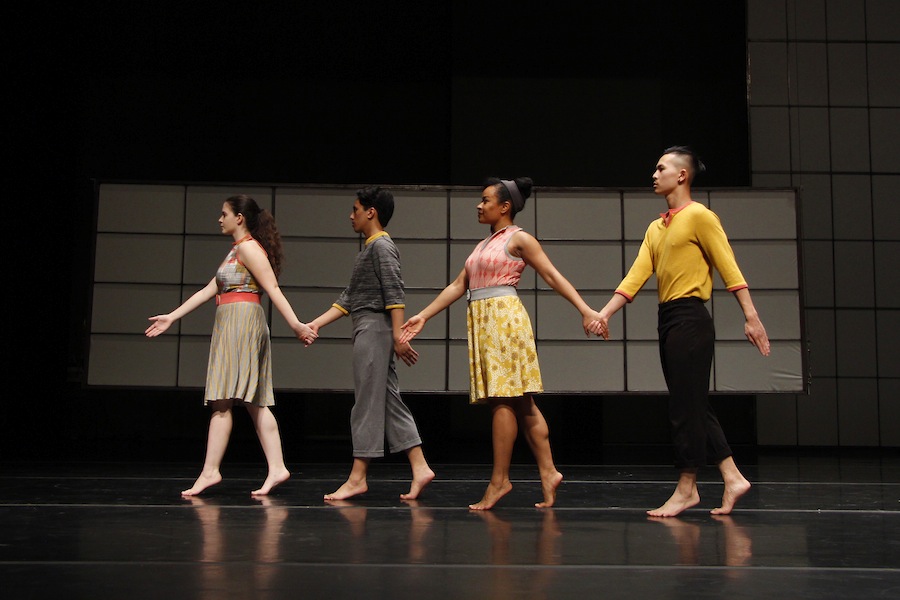
UC Davis’ Department of Theatre and Dance will be putting on a production entitled Time Is Passing By, produced by John Jasperse, a renowned choreographer and UC Davis’ Granada Artist in Residence. The Artist in Residence program brings artists from around the country to campus to produce their work in collaboration with UC Davis students. The production opens Thursday, Feb. 25, and will run until Feb. 28. The second run will be between March 3 and 6.

Jasperse’s Time Is Passing By is a dynamic dance production that ruminates on the passage of time and the links between the past and the present. Jasperse describes the show as one that pulls from Western art history and dance history, but will be understandable and accessible to audience members regardless of their familiarity with these themes. Jasperse encourages audience members to connect to the production by allowing their minds to freely associate with the performance, much like they would when listening to music.

The cast is comprised of 11 people, including undergraduate students, graduate students and community members. Rebecca Dolan, a third-year animal science major, feels that the diversity of the cast is one of the strengths of the production.

“We all come from different backgrounds, different majors, have different ages and different ethnicities, which are all reflected in the piece,” Dolan said. “What is beautiful about the cast is that we, as very different individuals, come together to make a whole moving unit. We all work fairly well with each other and have blended together to form an extremely well-rounded cast.”  

Daniel Ferrer, a third-year dramatic arts major and dancer in the production, is particularly excited about the experience of performing in a dance piece.

“I’ve only ever worked on a production of this scale as an actor, so diving into an art form where the articulation of an idea is done through the body, as opposed to the words that one says, is an exciting experience for me,” Ferrer said. “I hope to engage the audience with the experience that I have personally felt through the production and generate excitement in them.”

Jasperse explained that although the production is centered around the passage of time, he hopes audience members will be able to interpret the piece individually.

“In all of the work I do, I aim to create a space of questions that invites people to think about the issues that the piece explores on their own terms rather than telling people what to think,” Jasperse said. “Perhaps the work makes people reflect about time and the passage of time in their own lives; that is something I hope for.”

Audience members can expect to enjoy a dance piece that is not centered around characters or plot, but experience and emotion. The diversity of the cast and the talent of John Jasperse will surely be reflected in the production, ensuring that the audience will be able to connect with Time Is Passing By in a different way than many other theatre or dance productions.

Time Is Passing By opens on Feb. 25 at Wright Hall Main Stage Theatre. Tickets are $15 for the general public and $10 for students. To purchase tickets or for more information and showtimes, please visit http://arts.ucdavis.edu/seasonal-event/time-passing.


WRITTEN BY: Sara Williams – arts@theaggie.org

KDVS presents indie bands at Third Space

0

kdvs_arPsychedelic sounds put a twist on generic rock
On Feb. 23, Third Space Art Collective will be showcasing an event featuring the bands Ringo Deathstarr, Future Death and Starrsha.

Kasra Mirblouk, a fourth-year computer science major and events coordinator of KDVS, and J.E. Paguyo, a third-year mathematics major and bassist and vocalist of locally-based Davis band Starrsha, worked together in scheduling all three bands to perform at the venue.

“I contact bands that I really enjoy that are semi-local, ones that are potentially [from the] Bay Area or I see are touring California and they have a spot in their tour itinerary,” Mirblouk said.

Starrsha, a Davis-based band formed last year by Paguyo and singer/guitarist Carlos Pineda, started out by playing in the Avalon Apartments and received positive mentions on Yik Yak. After playing many shows here in Davis, they are now focusing their efforts on making an official release and playing outside of Davis.

Mitch Sieren, a third-year chemical engineering major who plays drums for the band, described the group’s unique sound as different from that of generic rock bands.

“We didn’t want to play any bars of anything of the like. We wanted to play to a crowd that actually was there for our type of music, like a DIY kind of venue,” Sieren said.

Sieren described the shoegaze genre of music that Starrsha specializes in.

“In technical terms, the genre can be described as distorted guitars creating a giant wall of noise over a driving drum beat with lush, incoherent vocals,” Sieren said. “It’s named shoegaze because the original performers just sulked on stage in their own minds, literally looking at their own shoes.”

Paguyo expressed the importance of melodies of guitars and vocals that makes shoegaze different from other rock genres.

“It emphasizes the overall atmosphere,” Paguyo said. “It is characterized by fuzzed out/reverb soaked guitars and soft, obscured vocals. Everything just melts together into a wall of sound.”

Starrsha is eager to have Ringo Deathstarr come to Davis, as their band was named after one of Ringo Deathstarr’s songs.

“I’m super excited to have a band that we have looked up to this past year come and represent shoegaze to the Davis community,” Sieren said.

To find out more about KDVS and Third Space Art Collective, visit their website. The show begins on Feb. 23 at 8 p.m. at 946 Olive Drive; admission is $13.

WRITTEN BY: Megan Toy – arts@theaggie.org

UC Davis increases number of admitted international students, decreases resident enrollment in 2015

DANIEL TAK / AGGIE
DANIEL TAK / AGGIE

UC Davis remains the highest California resident enrolling campus within UC system

California resident enrollment has dropped throughout the UC system, with the nine undergraduate campuses enrolling 1,600 fewer in-state students in fall 2015 than the year before, including 1,317 fewer resident freshmen.

Walter Robinson, associate vice chancellor of enrollment management at UC Davis, explained that this decline is due to the university working toward becoming an increasingly globally diverse community, though he defends that UC Davis enrolls the most California students out of all of the UCs.

“At Davis, we have more Californians enrolled than any other UC, [and] that is often not part of the conversation,” Robinson said. “The conversation tends to focus more on who’s getting admitted and who’s not.”

The university’s 2020 initiative seeks to increase enrollment at the university, along with increasing the amount of international students admitted. Robinson further explained how the initiative will break down the types of students that will be admitted into UC Davis.

“The majority of those students would be non-resident and a smaller number of those would be California residents,” Robinson said. “The logic behind that was to have global diversity for the campus and also to have the benefit of the revenue that is generated by non-resident fee payers to offset the budget downturn and the declining allocation from the state of California.”

Although an increase in international students is part of the university’s plans, Robinson emphasized that the university will retain its commitment to admitting top-notch students, especially with increased applicant competition.

“I will maintain that every student that we admit we stand behind and we believe that that student should be here,” Robinson said. “More people who are going to be told no, look just as strong as people who we used to say yes to and the people we’re saying yes to today.”

Sydney Kaye, a third-year communication major, believes that international students competing for spots with California residents is fair for California residents.

“I do not believe that it is unfair for international students to be admitted to UC Davis in competition with California students,” Kaye said. “I think with the amount of California students admitted every year, there is room for students from other states and countries.”

With such immense growth planned in the 2020 initiative, Madelyn Smith, a third-year psychology major, has a hard time seeing how the university will be able to adjust to the influx of students in such a short amount of time.

“I immediately think about impacted classes and how much worse the issue will be with an additional 5,000 [students],” Smith said.

Robinson ensures that the university is accounting for the changes that will be needed. For example, the 2020 initiative includes a plan to support up to 300 new faculty positions.

“It isn’t purely about an enrollment plan as much as it is an economic plan,” Robinson said. “We as a campus have been in pursuit of growing and building our own streams of revenue.”

As competition increases throughout the entire UC system, UC Davis is building a platform to reward both domestic and international students who are deserving of admission.

“It’s hard to say that the best students got in,” Robinson said. “Our definition of merit is definitely beyond test scores and definitely beyond grade average.”

The planned increase of enrollment at UC Davis may create various obstacles for the university, but Robinson believes that the university is ready to face whatever comes its way.

“It is extremely challenging, while at the same time rewarding, to wrestle with whatever the challenge of the day might be,” Robinson said. “At this point in time, the challenge is how we can make the University of California accessible to more Californians while at the same time carrying out our responsibility to provide a high quality education experience to all students that come here.”

Written by: Nick Griffen – campus@theaggie.org

The talk on Zika

BRIAN LANDRY / AGGIE

UC Davis experts discuss Zika virus and it’s recent outbreaks

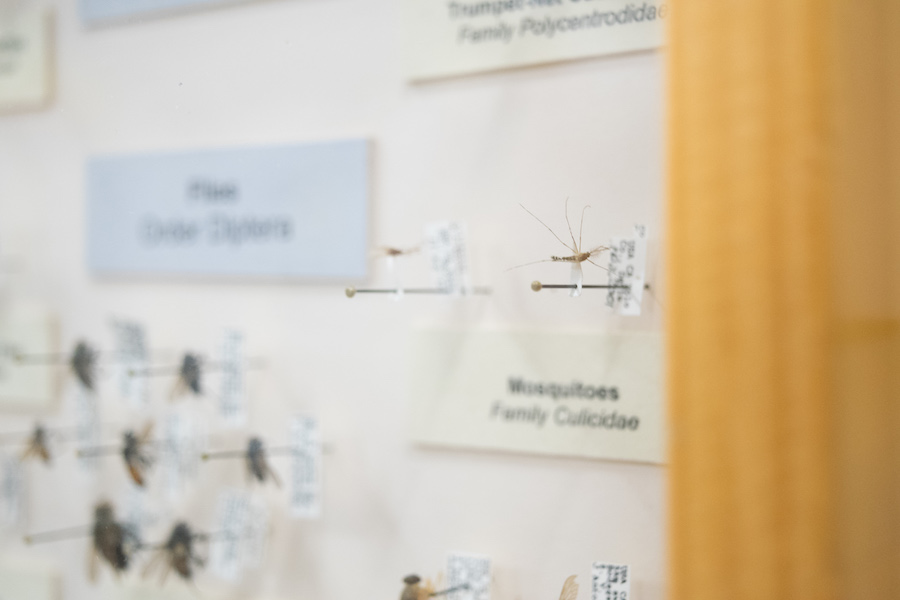
On Feb. 1, The World Health Organization declared Zika virus a “public health emergency of international concern.” Zika virus is transmitted by the infected Aedes species mosquito, with recent outbreaks throughout the world having caused health officials to become alarmed. On Feb. 10, it was confirmed that a Yolo County resident tested positive for Zika virus.

The virus was first isolated in 1947, when the virus was found in the blood of a macaque monkey in Uganda. Since then, periodic outbreaks in humans has caused scientists to presume that the virus was transmitted between forest mosquitos and non human primates.

UC Davis experts spoke out about the virus to address the growing fear amongst Yolo county residents.

“The mosquito bridges between the monkey and the person,” said virologist in the UC Davis School of Veterinary Medicine’s Department of Pathology, Microbiology and Immunology Lark Coffey.  “The virus replicated in a monkey and when it does that it makes high levels of virus in the blood so then when another feeding mosquito came they picked up the virus and [fed on a person].”

About 80 percent of people infected with the virus show no symptoms that would prompt them to visit the doctor.

“The remaining 20 percent would typically have something along the lines of a flu — illnesses like a fever or potentially a rash. Those are common symptoms of viral illness in general,” said Chris Barker, a researcher in the UC Davis School of Veterinary Medicine’s Department of Pathology, Microbiology and Immunology.

According to The Washington Post, more than 4,000 cases of microcephaly in babies have been reported in Brazil since last fall. Microcephaly is a condition which results in physically smaller heads due to underdeveloped brains. Some attribute this to the outbreak of Zika virus.

“That’s what made so much news interest about Zika. The fact that it’s spreading into new places is really terrible,” Coffey said. “What has everyone so concerned is that when Zika got into Brazil at the very end of last year in the time between November 2015 and now, obstetricians started noting there was a higher incidence of microcephaly.”

According to Coffey, people made the association that Zika causes microcephaly. However, that assumption is not definitive.

“Just because it’s an association, doesn’t for sure mean its causal,” Coffey said. “There are a lot more studies that need to be done to actually prove that infection of the mother during pregnancy causes [the] small head in the baby.”

Zika virus may also be linked to Guillain-Barré syndrome, a neurological disease that can lead to the paralyzation of one’s body.

“It’s possible that Zika […] has always been causing this neurologic disease in adults and microcephaly in babies but we’ve just never seen it yet,” Coffey said. “Maybe what it took — really sadly — is that the virus had to get into enough people that we could see these effects that could happen, because the more people it infects the more of those minority cases you see.”

At the time being, there is no vaccine or treatment for Zika virus. According to former UC Davis professor in the Department of Entomology Thomas Scott, controlling mosquito populations and preventing human contact could be the current most feasible solution, including using insecticides to kill the mosquito.

“Some of the things you could do [to prevent getting the virus] would be to wear long pants and long sleeves — so a physical barrier,” Scott said. “How close you are to someone socially actually increases your risk of infection. The mosquitoes don’t fly very far they usually stay in the house where they emerged as an adult. It’s primarily people that are moving the virus around.”

There have been over 50 reported cases of Zika virus in the U.S., all of them as a result of international travel.

“Travelers are bringing Zika into the United States but that happens with all mosquito-borne viruses. People are great spreaders,” Coffey said. “What we’re worried about here is that [when] people [who have] a high level of [Zika] virus go outside and get fed on by the right mosquito vector, which can transmit to another host, they start a focal transmission cycle, and that’s what can lead to human outbreaks.”


Written by: Fatima Siddiqui – features@theaggie.org

UC Davis’ spookiest urban legends

0
DEVIN McHUGH / AGGIE

Students, faculty discuss campus legends passed down for generations

Amidst chilling rumors of radioactive beagles and cows on the roof of school buildings, UC Davis is certainly no stranger to a long history of urban legends.

“It’s amazing to us how these stories have passed [down] year after year, when we only house first-year students,” said Richard Ronquillo, assistant director of the Student Housing Communications and Student Housing Outreach Program.

For years, legends of eerie occurrences around campus have left a mark on generations of students. According to first-year Spanish major Kenton Goldsby, the old Tercero buildings were home to many mysteries that remain unsolved.

“[Before] we replaced a lot of our housing buildings, the students were able to get up on the roofs of a lot of our buildings, over the Cuarto area and in the high rise[s],” said Emily Galindo, executive director of Student Housing and associate vice chancellor of Student Affairs.

The  rooftops of the student housing buildings served as the central location for a majority of urban legends that took place in residence areas on campus.

“A lot of our doors go to the roof,” Ronquillo said. “There used to be this belief that if you ever knocked on that door [to the roof], people would knock back. People would always be scared to knock on that door at night.”

According to Ronquillo, many of the legends at Davis took place in a building called Casa, which was an old Tercero building that housed the Chicano-Latino program. The Casa building was known for its walls, which were decorated from top to bottom with peculiar murals of nameless people.

“For a long time, that was the home for most of the legends in student housing,” Ronquillo said. “There was one [mural] with a little girl in a white dress and the residents believed [that] at night, [she] would come alive and [roam] around the building. She would have black hair in a ponytail and students [swore] that they would see this little girl running around the building at night playing and laughing.”

The Casa murals haunted students in Tercero residence halls for years.

“There [were] murals where people [painted] black silhouettes of all the residents and put them up on the walls,” Ronquillo said. “Students would do laundry, and they would get scared [because] they’d turn around and the silhouettes would move.”

According to many students, Casa was not only known for moving silhouettes and a laughing little girl in a white dress, but also for a reappearing painting.

“The old buildings used to have overhangs on the windows, and there was a photo that someone had drawn a woman’s picture on the overhang,” Ronquillo said. “The urban legend was that Housing always painted over it, over and over again, and the mural would leak itself through.”

Some of the legends also include peculiar rumors of deaths in the residence halls.

“About 10 [or] 15 years ago, there was a kid who was attending UC Davis and was in a fraternity,” Goldsby said. “[People] hadn’t heard from him for a couple days and they didn’t know where he was, until they finally checked his bedroom at the frat, and they found him there dead. He’d been stabbed in the back 20 times.”

Although the Davis Police Department insisted the death was a suicide after finding a suicide note left in what appeared to be the student’s handwriting, most students believe there’s more to the story than just that.

“How do you stab yourself in the back that many times?” Goldsby said. “How do you commit suicide by stabbing yourself in the back? It doesn’t make sense. There quite possibly could be a murderer that was in Davis that [was] never caught.”

Old buildings, such as the Segundo high rises built in the 1970s, are avoided by students due to their “darker atmosphere.”

“In Gilmore, Ryerson, Bixby and Malcom, there [are] no students that live on the first floors,” Galindo said. “We used to call the lounge spaces down below ‘the morgues.’”

According to Goldsby, there was also an eerie note left in one of the Segundo elevators, a room haunted by twins and legends of secret tunnels underneath multiple student housing areas.

Although the Davis campus has its fair share of urban legends, not all UC Davis histories are quite so macabre.

“It’s been a tradition in Davis for a really long time that during finals week, if you rub some of the egg heads around campus you’ll get good luck, and you’ll pass your finals,” said second-year communications major Noelle Haycraft.

Despite their dark nature, these legendary tales serve as part of the campus’ long trail of histories that make UC Davis a place that students can call home.

“These stories create a shared experience for students,” Ronquillo said. “They believe that these things are happening and they’re all a part of it.”
Written by Allyson Tsuji – features@theaggie.org

City council considers ordinance for bars and nightclubs in effort to decrease downtown violence

0
HEE-AH YOO / AGGIE
HEE-AH YOO / AGGIE

In an effort to address the city’s concerns about Downtown Davis nightlife, Davis Police Chief Darren Pytel addressed the City Council at a meeting on Feb. 16. He recommended the implementation of an ordinance that would require entertainment establishments to obtain operating permits.

Pytel explained that while there haven’t been many violence arrests, since September, there have been 75 DUI arrests and 75 drunk in public arrests originating in the downtown area.

Following an approach that has been effective in decreasing the number of violent incidents in Sacramento’s entertainment districts, he suggested that Davis introduce similar safety measures. The measures implemented in Sacramento include increasing policing in target areas, establishing entertainment operating permits and requiring businesses to hire armed private security or to form contracts with city police departments for additional law enforcement.

Rather than closing bars and nightclubs at midnight, like many people have suggested, Pytel said applying a “soft-closure” on nightclubs and bars can reduce public safety issues.

Soft closure would reduce or eliminate entry or reentry into establishments and would not allow people to form new lines after a certain time. This way, businesses would be allowed to remain open until 2 a.m., but would prevent people who are too drunk or who have been kicked out of one place to gain entry into a new one. Servers would also be able to monitor alcohol consumption more effectively because people would visit fewer bars on a given night, which could lead to a reduction of alcohol-related incidents.

At the meeting, Kevin Huang, a Davis resident and owner of Sophia’s Thai Kitchen, expressed his support for an ordinance that requires operating permits.

“This is the most equitable solution to ensure overall public safety without compromising the autonomy of individual businesses. Additionally, having to renew these permits on a regular basis incentivises responsible business practices and encourages continued dialogue between business owners and Davis police,” Huang said to the council. “A thriving and vibrant downtown nightlife is something to be nurtured, not merely tolerated or punished.”

Some of the concerns associated with a hard closure time are a potential increase in the number of house parties or more drunk driving incidents, as students and young adults travel out of town in search of other places to drink.

“If we shut down earlier, then folks can go to 7-11 and go buy an 18-pack. Some of the kids that were at the bar are going to go home and fall asleep, but some are going to keep partying and they’re going to be going to a worse place,” said William Arnold, a Davis resident, at the city council meeting.

Arnold indicated that the safest place for people, especially young college students, to drink is a bar. At public establishments people’s legal drinking age is verified, their alcohol consumption is monitored, and security is there in case a fight breaks out, unlike at a house party.

“A hard closure is a just bad idea from a public safety standpoint,” Arnold said.

Mariah Kala Watson, UC Davis’ ASUCD President, addressed the council and discussed a student survey that reveals some of students’ downtown safety concerns.

45 percent of students who answered the survey said they go to downtown specifically for the bars. 10 percent of the students actually responded to the survey.

“When we talk about entertainment and nightlife, this is the place that we go to, this is within driving distance, this is where we have tipsy taxi and safe ride in order to ensure safe partying,” Watson said at the meeting.

Watson said students fear early closing times for bars because that would mean they would need to travel to places like Sacramento and Fairfield to party.

“When you talk about closing the bars at midnight, from a student perspective that’s unrealistic a lot of our discussions on Thursday nights don’t get out until 8 or 9 p.m. and that would cause us to potentially pre-game even harder, so that’s drinking even more before you get to the bar,” Watson said.

This is also a concern for students because it would increase drunk driving accidents as students try to make their way back home from out of town or perhaps into other parts of Davis after the bars close to continue drinking.

After listening to the public’s comments, councilmembers agreed that a soft closure and adoption of operating permits is the appropriate way to address the issues downtown.

“Increased screening at the door, a higher level of security qualification requirements for the bouncers on site and increased police presence are important,” said Councilmember Brett Lee at the meeting.

Lee expressed his desire to differentiate businesses’ regulations depending on their hours of operation.

He also said he would like to incorporate looser restrictions for establishments that provide good security and serve as good models.

Councilmember Rochelle Swanson voiced her support for a permit ordinance and added that she would also like to prioritize better lighting in downtown as a safety measure for everyone.

She also discussed the possibility of extending some businesses’ closing hours in order to prevent people from roaming downtown after they leave a closed establishment.

Pytel agreed to return to the City Council in April with an ordinance to be approved by the council, taking the feedback given at the meeting into account.

Written By: CARLA ARANGOcity@theaggie.org